Traction Alopecia vs Scarring Loss: The Clinical Differences
9 min read ·
Understand Traction Alopecia vs Scarring Loss: explore the critical differences in causes, symptoms, reversibility, and treatments for healthy hair preservation.

Quick answer: The core distinction in Traction Alopecia vs Scarring Loss is reversibility and causation. Traction alopecia stems from prolonged mechanical tension pulling on hair follicles, often presenting with intact follicle openings that can regrow if tension ceases early. Primary scarring loss (cicatricial alopecia) involves autoimmune or inflammatory destruction of follicular stem cells, replacing openings with permanent fibrotic tissue. The main limitation is that prolonged, untreated traction alopecia eventually causes secondary cicatricial scarring, making early clinical differentiation vital to prevent permanent loss.
Key takeaways
- Mechanical vs inflammatory: Traction alopecia begins as mechanical strain from tight hairstyles, whereas primary scarring alopecia arises from inflammatory or autoimmune attacks on the follicle bulge.
- Follicular ostia status: Early traction alopecia retains visible follicular openings (ostia), while scarring alopecia displays smooth, shiny patches where openings are completely lost.
- The "fringe sign": Traction alopecia along the hairline often preserves fine, shorter vellus hairs directly at the margin, a feature rarely seen in frontal fibrosing alopecia.
- Progression risk: Untreated, chronic traction alopecia transitions from reversible shedding into permanent secondary scarring alopecia over months or years.
- Biopsy confirmation: A scalp biopsy remains the definitive clinical tool when physical examination and dermoscopy cannot distinguish late-stage traction from primary scarring alopecias.
Traction Alopecia vs Scarring Loss: what the evidence shows
Understanding Traction Alopecia vs Scarring Loss requires looking closely at how dermatologists evaluate follicular architecture. Research published in the British Journal of Dermatology and the Journal of the American Academy of Dermatology confirms that while both conditions can lead to permanent patches of baldness, their pathways, clinical signs, and management strategies diverge significantly.
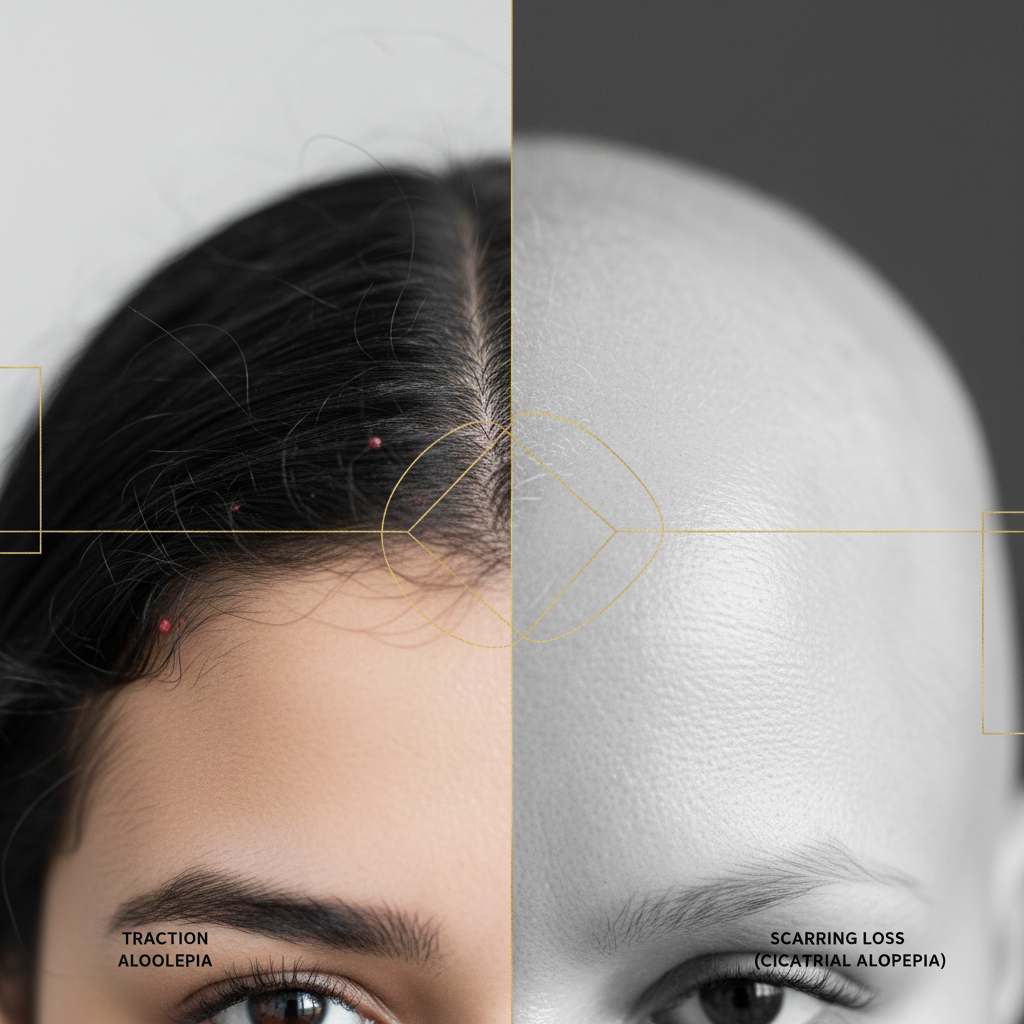
Traction alopecia is primarily an external, physical process. It develops when sustained pulling forces, such as tight braids, weaves, heavy dreadlocks, extensions, or rigid ponytails, generate continuous strain on the hair follicle. In its early stages, traction alopecia is fully reversible. The follicle experiences micro-trauma, causing perivascular inflammation and premature transition into the catagen (regression) and telogen (resting) phases. If the mechanical tension is removed promptly, follicles recover and produce healthy terminal fibres again.
Primary scarring loss, known clinically as cicatricial alopecia, encompasses a distinct group of disorders such as lichen planopilaris (LPP), frontal fibrosing alopecia (FFA), and central centrifugal cicatricial alopecia (CCCA). In primary scarring alopecia, the primary target of destruction is the follicular stem cell reservoir located in the bulge region of the hair follicle. Cellular infiltration, predominantly lymphocytic or neutrophilic, destroys these stem cells. Once the stem cells are obliterated, the follicle cannot regenerate, and collagen-dense scar tissue replaces the entire structure.
The clinical overlap emerges over time. If mechanical pulling persists for years, chronic traction alopecia induces deep peri-follicular fibrosis. At this late stage, traction alopecia essentially becomes a secondary scarring alopecia, resulting in permanent follicle death.
| Diagnostic Feature | Early to Mid Traction Alopecia | Primary Scarring Loss (Cicatricial Alopecia) | Late-Stage Traction Alopecia |
|---|---|---|---|
| Primary Trigger | Sustained mechanical tension | Autoimmune or inflammatory destruction | Long-term chronic tension causing fibrosis |
| Follicular Openings (Ostia) | Present and visible under dermoscopy | Completely absent; skin appears smooth/atrophic | Largely absent; replaced by fibrotic tracks |
| Typical Location | Frontal, temporal, and occipital margins | Crown, vertex, or receding frontal hairline band | Frontal and temporal margins |
| Fringe Sign | Frequently present (fine hairs spared) | Generally absent (clean loss across zone) | May persist in partial forms |
| Scalp Symptoms | Mild tenderness, tightness, occasional folliculitis pustules | Burning, itching, severe erythema, perifollicular scale | Typically asymptomatic; inactive smooth skin |
| Reversibility | Highly reversible with tension relief | Irreversible (treatment focuses on arresting progression) | Irreversible |
Biological mechanisms of follicular damage
The mechanical mechanism of traction alopecia relies on sustained tensile stress. This pull damages the outer root sheath and separates the hair fibre from the dermal papilla. As the follicle struggles against continuous tension, it develops perifollicular erythema, follicular keratosis, and small pustules or casts along the hair shaft. Over time, persistent micro-inflammation triggers fibroblasts to deposit dense extracellular matrix, ultimately replacing the dermal papilla with a fibrous tract.
In contrast, primary scarring alopecias involve immune privilege collapse. In conditions like lichen planopilaris and frontal fibrosing alopecia, cytotoxic T-lymphocytes target follicular antigens around the infundibulum and bulge. The body treats its own hair-producing factories as foreign tissue. Perifollicular inflammation chokes off the vascular supply, leading to apoptosis of epithelial stem cells. In neutrophilic scarring alopecias, like dissecting cellulitis or folliculitis decalvans, intense bacterial involvement and neutrophil infiltration trigger rapid, purulent tissue breakdown followed by dense hypertrophic or atrophic scarring.
Clinical signs: distinguishing traction from scarring
To differentiate between these conditions, trichologists and dermatologists rely on dermoscopy (trichoscopy) and clinical patterns:
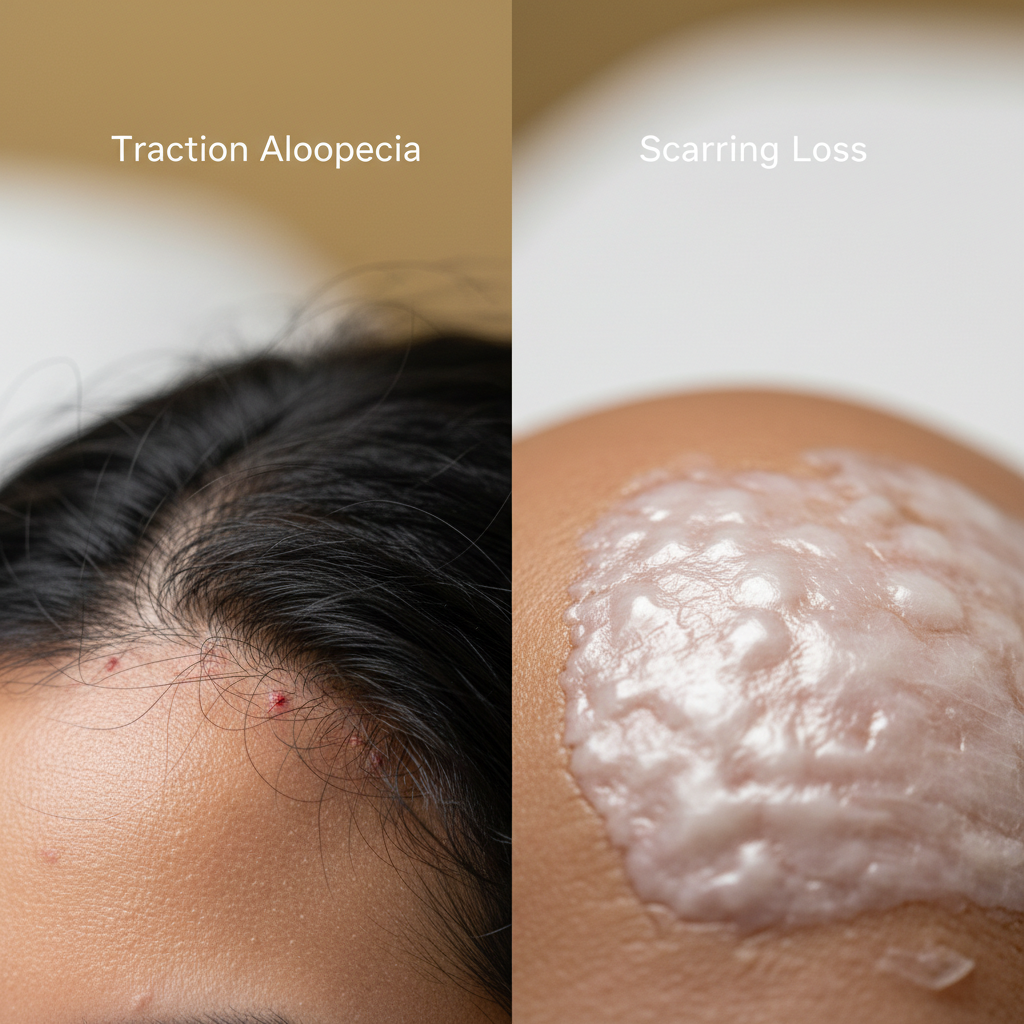
- The "Fringe Sign": In traction alopecia of the frontal or temporal hairline, patients typically retain a narrow band of miniaturised, weaker vellus hairs right along the extreme outer edge. In frontal fibrosing alopecia (a common scarring loss), this fringe is absent; the skin margin looks pale, uniform, and completely bare, often described as an ivory band.
- Follicular Casts vs Perifollicular Erythema: Active traction often displays mobile white or yellow cylindrical casts that slide along the hair shaft, reflecting physical tension. Active scarring alopecias display violaceous erythema (purplish-red discoloration) and distinct tubular scaling tightly anchored to the base of the follicle.
- Distribution Patterns: Traction aligns directly with styling habits. For instance, cornrows pulled backward cause marginal or coronal loss, while tight buns create loss at the nape or temporal peaks. Scarring alopecias frequently begin on the crown or vertex (such as CCCA) or spread across the entire fronto-parietal line without relation to hair tension.
What the evidence does not show
Controlled research does not show that primary scarring loss can be initiated solely by everyday grooming habits or cosmetic washing. While older theories suggested that hot combs or chemical relaxers directly triggered CCCA, large-scale studies have shown these products are not the sole causative agents, pointing instead towards genetic predispositions (such as mutations in the PADI3 gene) alongside chronic low-grade inflammation.
Similarly, there is no clinical evidence that non-scarring traction alopecia damages internal health or reflects nutritional deficiencies. Traction is an external physical injury to the follicle. Applying systemic treatments like vitamins or DHT blockers will not prevent or reverse traction alopecia if the underlying mechanical tension remains.
When the cause may be something else
Thinning around the hairline or crown is not limited to traction or scarring. Several other conditions can mimic these presentations:
- Alopecia Areata: Autoimmune attack that usually creates smooth, round patches rather than marginal bands. Yellow dots and exclamation mark hairs under dermoscopy indicate alopecia areata.
- Female or Male Pattern Hair Loss (Androgenetic Alopecia): Driven by genetic sensitivity to dihydrotestosterone (DHT), producing gradual follicular miniaturisation rather than abrupt destruction. Follicular openings remain open and functional, with varying hair shaft diameters across the scalp.
- Telogen Effluvium: Sudden, diffuse shedding triggered by physiological stress, illness, or hormonal shifts. It affects the entire scalp uniformly, showing no localized scarring or margin loss.
What you can do and when to seek professional advice
If you suspect traction alopecia, immediate intervention is essential:
- Eliminate tension immediately: Cease tight braids, tight buns, extensions, and weaves. Switch to loose styles where hair hangs naturally.
- Rotate styling habits: Avoid wearing the same protective style continuously. Allow the scalp several weeks of complete rest between styled installations.
- Monitor the scalp surface: If you feel persistent soreness, throbbing, or notice small pimples along the hairline after styling, your hair is under too much mechanical strain.
You should consult a dermatologist or qualified trichologist immediately if you notice:
- Loss of visible follicular pores, leaving the skin shiny and flat.
- Persistent burning, tingling, or itching sensations.
- Redness, violet rings, or scaling clinging to the base of the hair shafts.
- Patchy hair loss that continues to expand despite removing all physical tension.
Dermatologists will perform a physical assessment and, if necessary, take a 4 mm punch biopsy for horizontal and vertical histological sectioning to confirm or rule out primary scarring alopecia.
Supportive care for a healthy scalp environment
While cosmetic hair products cannot alter the course of primary scarring loss or reverse end-stage fibrotic scarring, maintaining optimal scalp hygiene supports recovery in early, reversible traction.
Watermans provides scalp-focused formulas, such as the Grow Me Shampoo and Condition Me Conditioner, designed to cleanse buildup and maintain a revitalised environment for remaining follicles. Formulated with ingredients such as biotin, rosemary extract, niacinamide, and caffeine, these products support hair fibre vitality, reduce breakage along fragile edges, and keep the scalp refreshed. They serve as valuable everyday hygiene companions while you eliminate mechanical tension, helping existing hair look fuller and healthier.
Frequently asked questions about Traction Alopecia vs Scarring Loss
Can traction alopecia turn into permanent scarring loss?
Yes. If mechanical tension is sustained over many years, the chronic micro-trauma and perifollicular inflammation cause the follicle to be replaced by fibrous scar tissue. Once this happens, the condition transitions into secondary scarring alopecia, and hair regrowth from those specific follicles is no longer possible.
How can a specialist tell the difference between Traction Alopecia vs Scarring Loss?
A specialist uses a dermatoscope to examine follicular openings. In early traction alopecia, openings remain visible alongside follicular casts and a preserved fringe of fine hairs. In primary scarring loss, the openings are absent, the scalp appears smooth and ivory-like, and active follicular redness or peripilar casts are tightly bound to emerging hairs. A punch biopsy provides definitive confirmation.
Will hair regrow once traction is removed?
Hair usually regrows within 3 to 9 months if traction alopecia is caught in its early, non-scarring stage and the mechanical strain is completely discontinued. However, if the follicles have undergone permanent fibrotic change due to years of tension, regrowth will not occur naturally.
Can shampoos or topical oils cure scarring alopecia?
No. Primary scarring alopecia is a medical dermatological condition driven by internal inflammatory or autoimmune processes. Shampoos and cosmetic oils cannot halt the destruction of the follicle bulge stem cells. Primary scarring conditions require medical management by a dermatologist, using prescription anti-inflammatory or immunosuppressive treatments.
Conclusion
Understanding Traction Alopecia vs Scarring Loss is crucial for preserving your hairline and scalp health. While early traction alopecia represents a reversible mechanical injury that responds rapidly to style changes, primary scarring conditions involve internal inflammation that permanently destroys follicular stem cells. Because untreated mechanical pull can gradually advance into permanent secondary scarring, recognising the earliest warning signs, easing tension, and seeking expert dermatological evaluation will ensure the best possible outcome for your hair.
Sources and references
- British Association of Dermatologists. Clinical Guidelines for the Management of Lichen Planopilaris and Frontal Fibrosing Alopecia.
- Journal of the American Academy of Dermatology. Traction Alopecia: The Root of the Problem.
- American Academy of Dermatology. Cicatricial Alopecia: Diagnosis and Treatment.
- NHS. Hair loss causes and types.
Find these ingredients in Watermans products
- Niacinamide: you will find this ingredient in our Hair Mask.