Thyroid Hair Loss Mechanics: Cellular Causes and Solutions
8 min read ·
Understand thyroid hair loss mechanics: explore how T3 and T4 hormones disrupt the follicular cycle, cause diffuse shedding, and what steps lead to healthy hair regrowth.

Quick answer: Understanding Thyroid Hair Loss Mechanics requires examining how thyroxine (T4) and triiodothyronine (T3) regulate cellular division inside the hair follicle matrix. Both deficient and excessive thyroid hormones stall mitochondrial metabolism, forcing actively growing anagen follicles into premature catagen and widespread telogen shedding across the scalp. The main limitation to keep in mind is that topical hair therapies cannot resolve this shedding alone; follicular activity only normalises once serum hormone concentrations are physiologically balanced through appropriate medical care.
Key takeaways
- Thyroid hormones T3 and T4 directly modulate hair matrix keratinocyte proliferation and prolong the active anagen growth phase.
- Both hypothyroidism (underactive thyroid) and hyperthyroidism (overactive thyroid) induce diffuse telogen effluvium, rather than focal bald patches.
- Severe or prolonged thyroid disruption alters hair fibre synthesis, leading to dry, brittle strands that snap easily under mechanical tension.
- Co-occurring autoimmune conditions, such as Hashimoto's thyroiditis and alopecia areata, can cause distinct patch-like shedding that requires separate clinical diagnosis.
- Regrowth is typically slow, often taking 3 to 6 months after serum thyroid-stimulating hormone (TSH) levels stabilise within target ranges.
Thyroid Hair Loss Mechanics: what the evidence shows
Research published in endocrinology and dermatology journals confirms that human hair follicles are direct targets of thyroid hormones. The dermal papilla and outer root sheath express specific nuclear thyroid hormone receptors (TRalpha1 and TRbeta1). When circulating concentrations of free T3 and free T4 bind to these receptors, they stimulate keratinocyte proliferation and govern the synthesis of hair keratins.
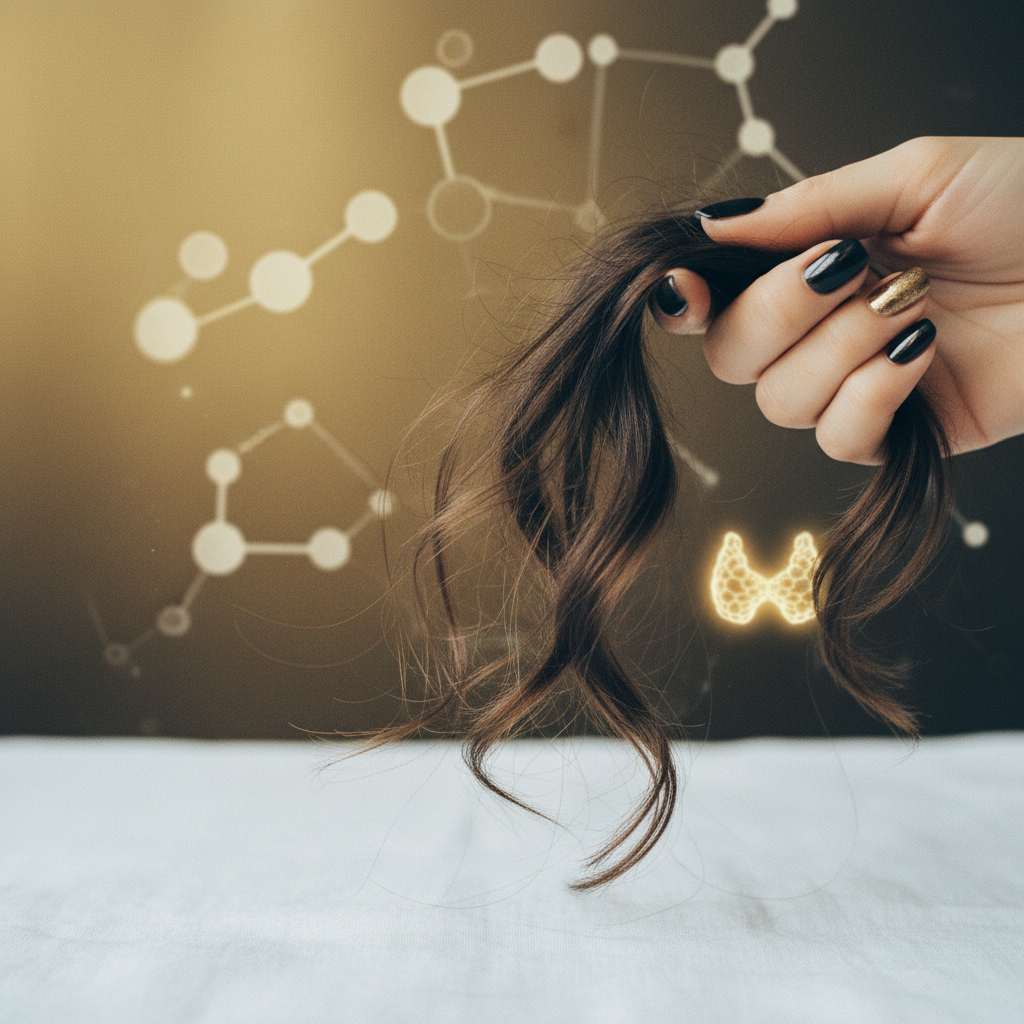
In clinical terms, Thyroid Hair Loss Mechanics reflect an energy crisis at the base of the follicle. The hair matrix is one of the most metabolically active tissues in the human body. Because thyroid hormones set the basal metabolic rate and regulate mitochondrial oxygen consumption, any drop or spike in hormone levels disrupts the energy balance required to maintain anagen.
In hypothyroidism, low cellular energy downregulates cell division in the matrix. The follicle runs out of metabolic fuel to sustain active elongation, prompting an uncoordinated exit from anagen into the resting phase. In hyperthyroidism, accelerated cellular turnover exhausts metabolic reserves, similarly destabilising the follicular cycle and precipitating premature catagen induction.
How thyroid imbalance alters the follicle: the biological mechanism
To grasp the biological mechanics, one must look at how thyroid hormones interact with cellular pathways in the scalp:
- Cellular energy and ATP production: Free T3 stimulates mitochondrial biogenesis. When T3 levels fall, ATP production in matrix keratinocytes drops, limiting cell division. Without sustained division, the hair fibre ceases to grow outward.
- Transition from anagen to catagen: Physiological levels of thyroid hormones actively suppress apoptosis (programmed cell death) in the hair bulb. Severe imbalances trigger apoptotic signalling, transforming healthy anagen follicles into shrinking catagen structures.
- Telogen synchronisation: Normally, human hair shedding is asynchronous; roughly 85 to 90 percent of follicles reside in anagen, while 10 to 15 percent rest in telogen. Thyroid disruptions synchronise these phases. Large groups of follicles leave anagen simultaneously, entering telogen together. Two to four months later, this results in sudden, profuse shedding across the entire scalp.
- Sebum and barrier disruption: In hypothyroidism, reduced sebum production impairs the scalp's lipid barrier. This leads to perifollicular xerosis (extreme dryness), making newly emerging fibres brittle, dull, and vulnerable to breakage alongside shedding.
Hypothyroidism vs hyperthyroidism: comparison of scalp and fibre changes
While both conditions present with diffuse shedding, their wider systemic effects cause noticeable differences in fibre texture and scalp ecology.
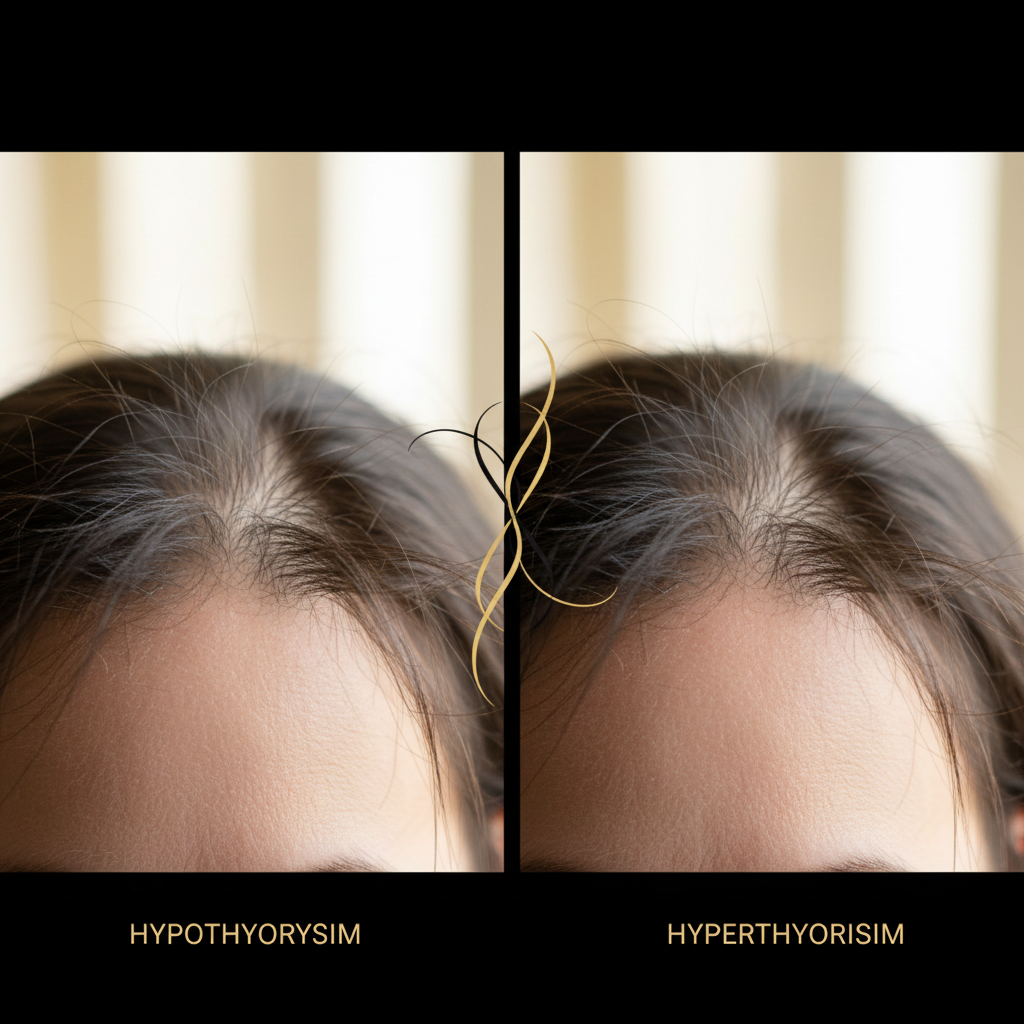
| Characteristic | Hypothyroidism (Underactive) | Hyperthyroidism (Overactive) |
|---|---|---|
| Primary shedding mechanism | Diffuse telogen effluvium via low cellular metabolism | Diffuse telogen effluvium via accelerated follicular turnover |
| Fibre texture | Coarse, dry, brittle, prone to mid-shaft breakage | Thin, remarkably soft, silky, limp |
| Scalp condition | Xerosis (severe dryness), scaling, reduced sebum | Warm scalp, hyperhidrosis (excessive sweating), oily residue |
| Eyebrow involvement | Thinning of the outer third (sign of Hertoghe) | Infrequent; diffuse thinning across face may rarely occur |
| Associated nail signs | Thickened, brittle, slow-growing nails with ridges | Onycholysis (Plummer's nails: lifting from nail bed) |
| Reversibility | High, once TSH and free T4 stabilise | High, once euthyroid state is achieved |
What the evidence does not show
Popular discussions around thyroid disorders often foster misconceptions regarding how hair reacts to hormonal shifts:
- Thyroid imbalance does not permanently destroy hair follicles: Thyroid-driven shedding is fundamentally a cycling disorder (telogen effluvium), not a scarring alopecia (cicatricial alopecia). The follicular stem cell reservoir in the bulge remains intact.
- Topical caffeine, oils, or vitamins cannot cure thyroid shedding: While nourishing topicals can support scalp condition and improve fibre strength, they cannot compensate for systemic cellular starvation caused by aberrant serum hormone levels.
- Hair does not regrow immediately upon taking medication: Initiating levothyroxine or antithyroid medications does not halt shedding overnight. In fact, a transient spike in shedding often occurs in the first 4 to 8 weeks of treatment as newly awakened anagen hairs push out dormant telogen shafts.
Signs to look for: follicular shedding versus hair breakage
Stylists and clients must differentiate between hair coming out at the root and hair snapping along the length.
Follicular shedding from thyroid disease produces intact hairs with a small, white, bulbous keratinised end (club hairs). You will see these across pillowcases, shower drains, and hairbrushes in numbers exceeding the standard 50 to 100 hairs per day.
By contrast, hair breakage produces shorter fragments without a bulb. In hypothyroid patients, the hair shaft suffers from altered keratin synthesis and reduced surface lipids. This structural weakness means routine detangling, blow-drying, or colour processing causes severe breakage, compounding the cosmetic loss caused by true shedding.
What you can do to support hair during recovery
Rehabilitating hair during thyroid treatment requires a dual approach: internal medical stability combined with external cosmetic preservation.
- Confirm blood markers: Work alongside a GP or endocrinologist to monitor TSH, free T4, free T3, and thyroid peroxidase (TPO) antibodies. Full recovery requires sustained, stable levels within physiological targets over several months.
- Check co-factors: Thyroid issues frequently coincide with low serum ferritin (iron stores), vitamin D3, and vitamin B12 deficiencies. Maintaining ferritin levels above 50 ug/L is widely considered beneficial for optimal anagen recovery.
- Minimise mechanical traction: Avoid tight ponytails, extensions, or vigorous brushing. Weakened hypothyroid fibres break under minimal tension.
- Gentle cosmetic care: Use mild, sulphate-free shampoos and rich emollient conditioners to coat the depleted cuticle layer. Watermans offers revitalising, nutrient-dense scalp formulations designed to maintain a clean, balanced micro-environment, supporting optimal cosmetic fullness and fibre resilience while your body restores internal equilibrium.
When the cause may be something else
If hair shedding persists despite normal blood panels, investigate alternative or co-morbid triggers:
- Alopecia Areata: Autoimmune thyroid conditions (Hashimoto's or Graves') double the risk of developing secondary autoimmune disorders. If hair falls in distinct, smooth, circular patches rather than uniformly across the scalp, suspect alopecia areata.
- Androgenetic Alopecia: Thyroid dysfunction can unmask or accelerate pattern hair loss. If thinning concentrates primarily along the crown or central parting while the back of the head remains dense, miniaturisation from dihydrotestosterone (DHT) is likely playing a role.
- Nutritional Telogen Effluvium: Rapid weight loss or crash dieting, sometimes attempted to combat hypothyroid weight gain, can trigger a separate bout of nutritional shedding.
When to seek professional medical advice
You should consult a GP or registered trichologist if:
- You experience sudden, excessive hair shedding accompanied by profound fatigue, unexplained weight changes, heart palpitations, or cold intolerance.
- You notice distinct patchy bald spots on your scalp, beard, or body.
- Shedding continues at high volumes more than six months after your thyroid blood levels have normalised.
- The scalp exhibits intense itching, burning, erythema (redness), or visible scaling, which may indicate seborrhoeic dermatitis or an autoimmune scalp dermatosis.
Frequently asked questions about Thyroid Hair Loss Mechanics
Why does levothyroxine sometimes cause shedding initially?
When starting levothyroxine, the sudden restoration of metabolic signalling wakes dormant follicles simultaneously. The newly stimulated anagen hairs quickly push out old, resting telogen fibres that were trapped in the scalp. This shedding usually subsides within 6 to 8 weeks as the follicular cycle resynchronises.
How long does it take for hair to grow back after thyroid levels stabilise?
Hair follicles require time to complete their transition through resting and emerging phases. Most individuals begin to observe fine regrowth along the hairline and part line approximately 3 to 6 months after reaching a stable euthyroid state, with cosmetic density returning over 12 to 18 months.
Can Thyroid Hair Loss Mechanics cause permanent baldness?
No. The underlying mechanism of thyroid hair loss is non-scarring. The follicular stem cells in the bulge remain viable. Unless accompanied by a scarring condition like frontal fibrosing alopecia, the follicles retain full biological capability to produce healthy terminal fibres once systemic hormonal balance is restored.
Does thyroid disease cause hair loss on the body and eyebrows?
Yes. Thyroid hormones influence hair growth across the entire body. Hypothyroidism frequently leads to madarosis, specifically the thinning or complete absence of the outer third of the eyebrows (known as the Queen Anne's sign or sign of Hertoghe), as well as sparse underarm and leg hair.
Can over-the-counter hair supplements correct thyroid shedding?
No. Dietary supplements cannot regulate thyroid hormone synthesis or replace medical therapy. While addressing nutritional deficiencies like iron or vitamin D aids follicular health, excessive intake of supplements like biotin can actually interfere with thyroid laboratory test results, masking true hormone values.
Restoring balance to your hair cycle
Understanding the biological mechanics behind thyroid-related thinning demystifies a distressing condition. When thyroid hormone concentrations deviate from physiological norms, matrix energy collapses and follicles slip prematurely into dormancy. While external cosmetic routines help preserve brittle strands and promote a healthy scalp environment, the fundamental driver remains internal. By combining disciplined endocrine care, nutritional optimisation, and gentle haircare practices, the complex cycle of Thyroid Hair Loss Mechanics can be arrested, paving the way for durable, healthy regrowth.
Sources and references
- British Thyroid Foundation. Thyroid and Hair Loss: Patient Information Guide, 2021.
- Journal of Clinical Endocrinology & Metabolism. Thyroid Hormones Directly Alter Human Hair Follicle Functions: Anagen Prolongation and Keratinocyte Proliferation, 2008.
- National Institute for Health and Care Excellence (NICE). Thyroid disease: assessment and management (NICE Guideline NG145), 2019.
- Dermatology and Therapy. Diffuse Hair Loss in Thyroid Dysfunction: Mechanisms and Clinical Approaches, 2020.
- Endocrine Reviews. Hormonal Control of the Hair Follicle: Thyroid and Glucocorticoid Axis Interactions, 2017.
Find these ingredients in Watermans products
- Biotin: you will find this ingredient in our Hair Growth Shampoo.