Thermal Heat Damage and Hair Protein Denaturation
8 min read ·
Thermal Heat Damage and Hair Protein Denaturation causes irreversible structural breakdown in keratin. Learn the science, temperatures, and prevention strategies.
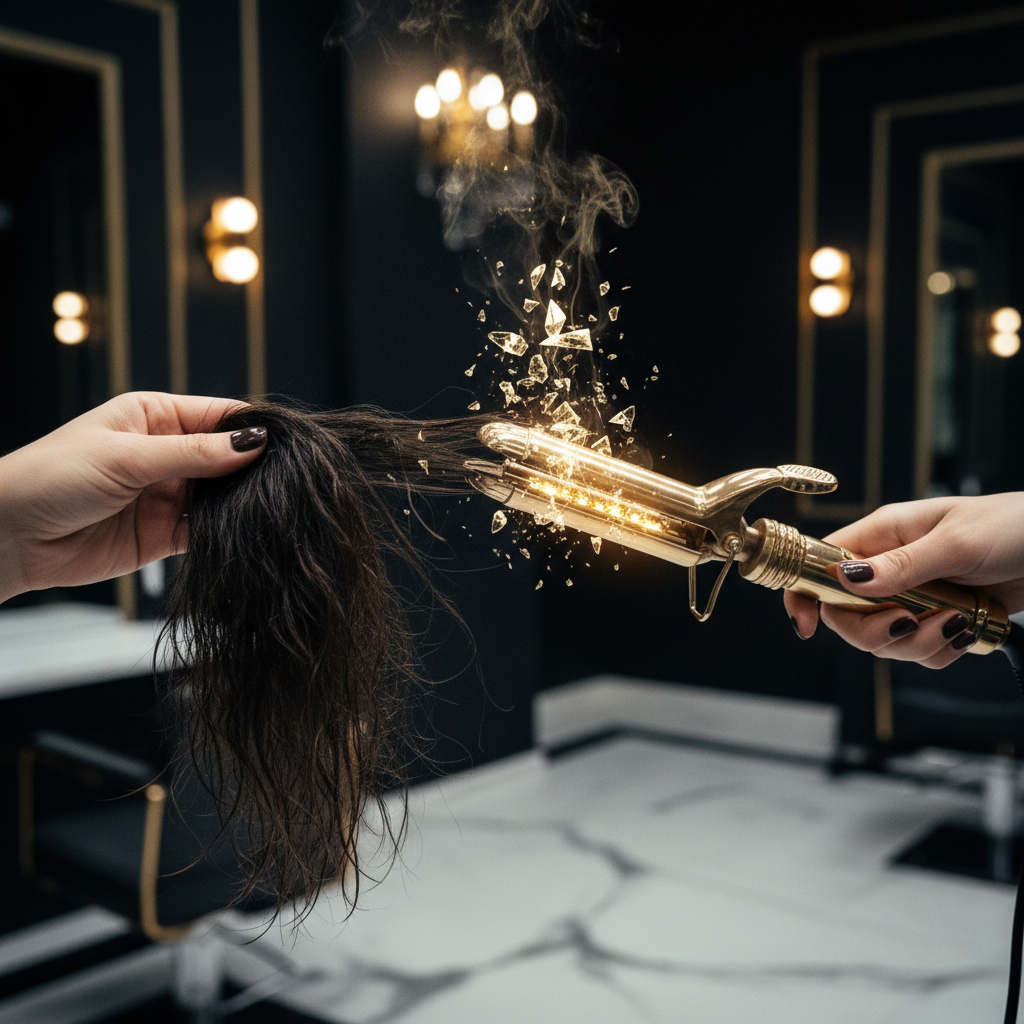
Quick answer: Thermal Heat Damage and Hair Protein Denaturation describes the irreversible structural breakdown of hair keratin caused by high temperatures from styling tools. When temperatures exceed 140°C, the alpha-helical protein coils unwind into disordered beta-sheet structures, while temperatures above 200°C degrade critical cystine disulfide bonds and lipid layers. The main limitation is that denatured keratin cannot be biologically repaired or restored; once thermal degradation occurs, topical cosmetic interventions can only temporarily coat, lubricate, and mask the fibre damage until new hair grows.
Key takeaways
- Hair is composed of roughly 65% to 90% keratin protein, arranged in tightly coiled alpha-helices stabilised by disulfide bonds and hydrogen cross-links.
- Thermal Heat Damage and Hair Protein Denaturation begins around 140°C with moisture loss and alpha-to-beta keratin transitions, escalating to cystine degradation past 200°C.
- Applying heat to damp or wet hair causes rapid steam expansion inside the cortex, creating microscopic voids known as "bubble hair" that leads to severe fibre breakage.
- Protein denaturation causes permanent structural loss: decreased tensile strength, increased porosity, surface roughness, and split ends.
- Heat protectants cannot prevent 100% of thermal transfer, but film-forming polymers reduce the rate of heat conduction and prevent surface lipid strip.
Thermal Heat Damage and Hair Protein Denaturation: what the evidence shows
Scientific evaluation of human hair fibres using differential scanning calorimetry (DSC) demonstrates that hair keratin undergoes profound, measurable transitions when exposed to elevated temperatures. Dry hair typically exhibits a denaturation melting peak between 215°C and 235°C, while chemically treated or water-swollen hair denatures at significantly lower thresholds, often starting near 140°C to 155°C.
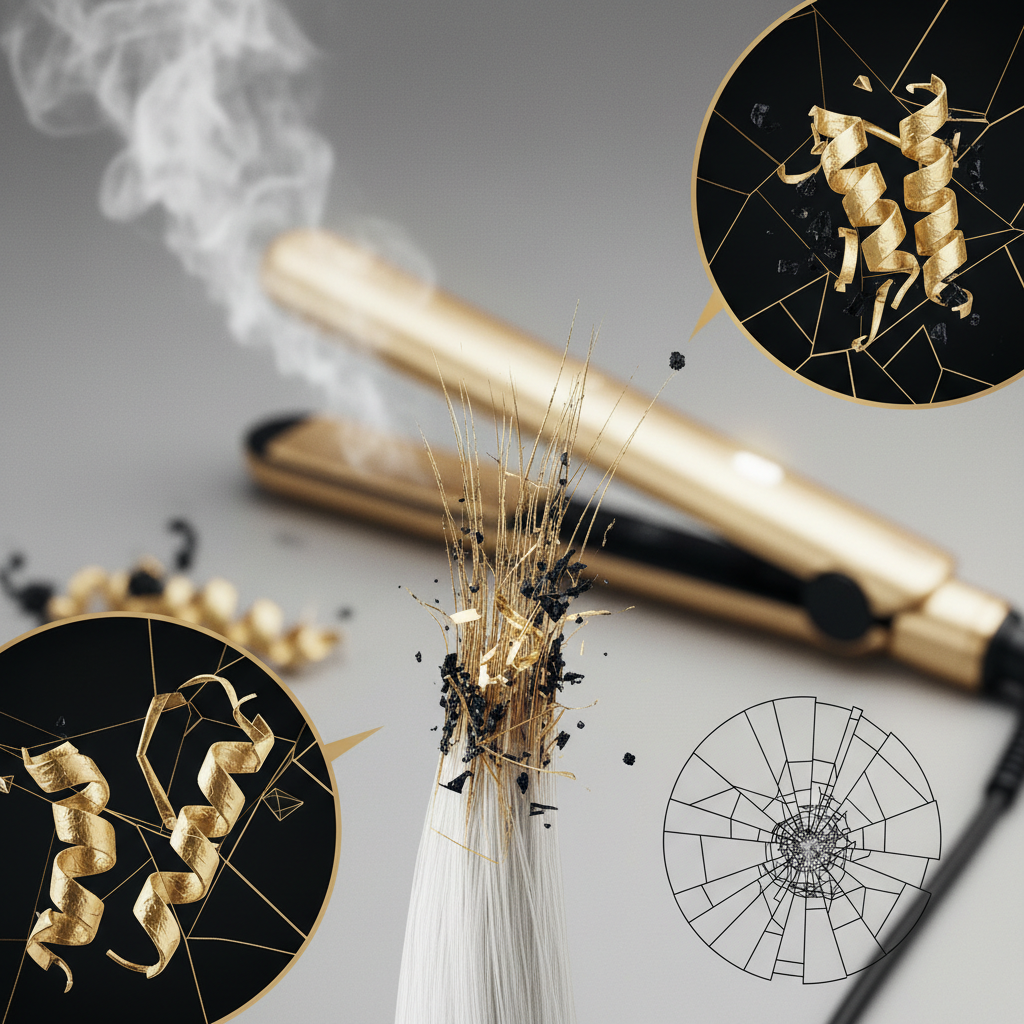
During Thermal Heat Damage and Hair Protein Denaturation, heat weakens the secondary and tertiary architecture of keratin. Thermal styling tools such as flat irons (often reaching 180°C to 230°C) and curling wands transfer intense contact heat in seconds. Research shows this energy causes the natural alpha-helical keratin microfibrils to unfold into disorganized, non-crystalline beta-sheet structures. This transition robs the hair fibre of its natural elasticity, leaving it brittle and prone to snapping under minimal mechanical tension.
Cosmetic science literature confirms that temperatures above 180°C also strip the hair surface of 18-methyleicosanoic acid (18-MEA), the primary covalently bound fatty acid layer that provides natural hydrophobicity. As a result, the fibre becomes hydrophilic, absorbing ambient moisture uncontrollably, swelling unevenly, and suffering progressive cuticle lifting.
The molecular mechanism of thermal denaturation
To understand why thermal damage is permanent, you have to look inside the hair cortex. Hair keratin relies on a precise hierarchy of chemical bonds:
- Hydrogen and salt bonds: These weak physical bonds are easily broken by water and mild heat (such as a blow-dryer). When the hair cools and dries, they reform in a new temporary shape.
- Disulfide bonds: Covalent links between cystine amino acid residues provide the structural backbone and tensile strength of the fibre.
- The alpha-helix structure: Rigid coils of polypeptide chains that allow hair to stretch and bounce back.
When excessive heat is applied, thermal energy exceeds the dissociation energy of these bonds:
- 100°C to 140°C: Free and bound water evaporates rapidly. If hair contains free moisture when hot plates clamp down, the water flashes to steam, expanding violently inside the cortex and blowing microscopic gas bubbles through the fibre wall (bubble hair deformity).
- 140°C to 180°C: The alpha-helical keratin coils begin to unfold into random coils and beta-sheets. Surface cuticle scales warp, blister, and crack along their edges.
- 190°C to 230°C: Disulfide bonds undergo irreversible thermal cleavage. Cystine breaks down into cysteic acid and other oxidation byproducts. Melanin granules degrade, producing yellowing in grey or blonde hair and fading in darker hair.
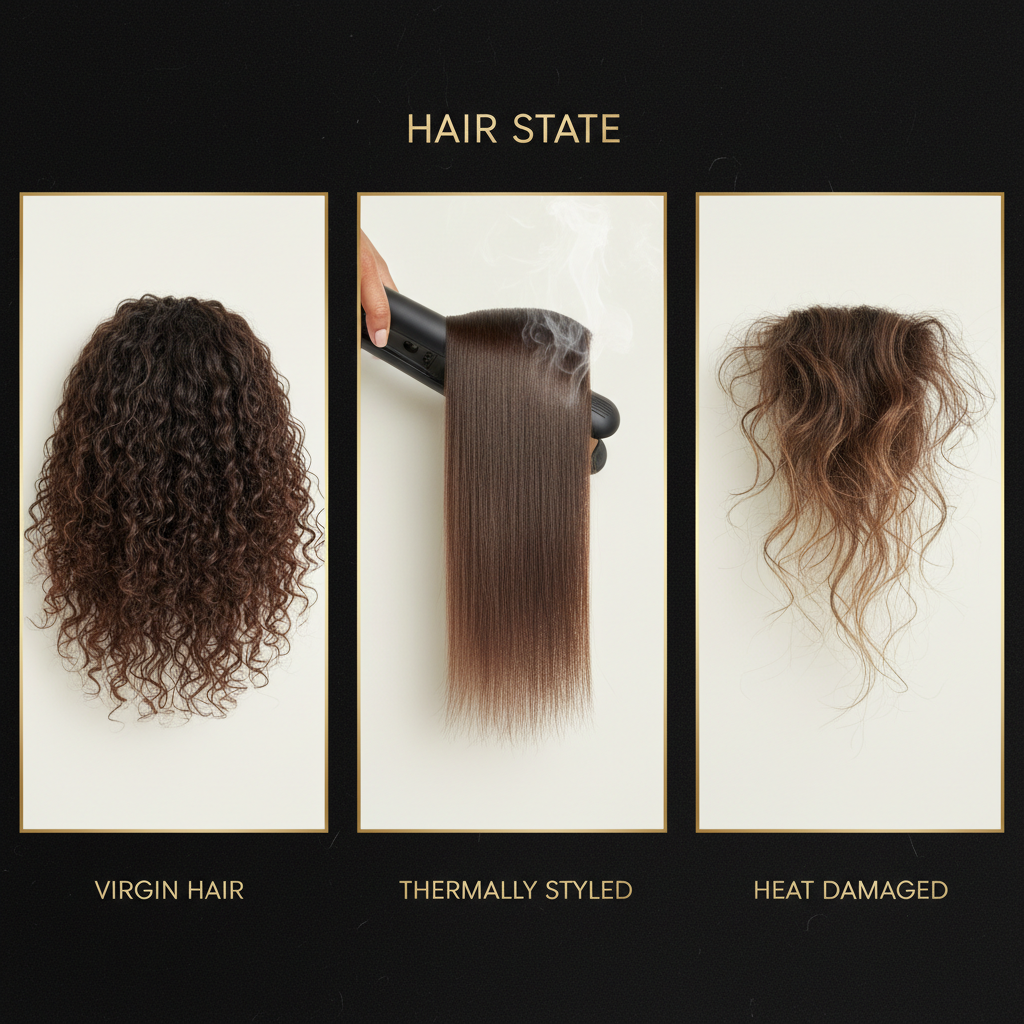
Thermal impact across different hair states
The physical outcome of heat exposure depends on temperature, contact time, and whether the hair is wet or dry:
| Temperature Range | Condition of Fibre | Structural & Molecular Effect | Visible Result |
|---|---|---|---|
| Below 100°C | Wet or dry | Hydrogen bond temporary reforming; gentle water evaporation | Smooth finish, no internal structural loss |
| 120°C to 140°C | Wet | Steam generation within cortex; localized mechanical blistering | Bubble hair deformity, acute breakage |
| 140°C to 180°C | Dry | Alpha-to-beta protein transition; loss of 18-MEA lipid layer | Rough texture, static, increased porosity, frizz |
| 180°C to 210°C | Dry | Cleavage of cystine disulfide bonds; initial protein denaturation | Reduced tensile strength, split ends, loss of bounce |
| 210°C to 240°C | Dry | Complete keratin melting; cortical breakdown; melanin degradation | Scorched hair, spontaneous snapping, severe colour shift |
What the evidence does not show
There is no scientific evidence that hair protein can be biologically "rebuilt" or "resynthesised" once denatured. Dead cellular tissue cannot regenerate. While cosmetic treatments containing hydrolysed proteins, amino acids, or bond-multiplying polymers can patch damaged sites or form synthetic cross-links to improve tensile strength temporarily, they do not reverse the underlying protein denaturation.
Furthermore, evidence does not show that thermal tools cause follicular hair loss. Heat-induced breakage occurs along the dead shaft, not at the dermal papilla. Unless a burning-hot tool physically touches and scars the scalp skin, thermal styling cannot trigger follicle miniaturisation, androgenetic alopecia, or telogen effluvium.
Visible signs of protein denaturation
You can assess thermal denaturation through physical and tactile markers:
- Loss of elasticity: Healthy wet hair can stretch up to 30% of its resting length and return without snapping. Thermally denatured hair has minimal stretch and breaks immediately under slight tension.
- Extreme porosity and water absorption: Damaged hair absorbs water instantly like a sponge, taking far longer to dry naturally because the protective lipid barrier is absent.
- Dullness and rough cuticle texture: Blistered and stripped cuticle tiles scatter light rather than reflecting it, leading to a matte, lifeless appearance.
- Persistent split ends and mid-shaft fractures: Cuticle loss leaves the cortical fibrils exposed, causing them to fray into trichoptilosis (split ends) or trichorrhexis nodosa (node-like fracture points along the shaft).
Preventing denaturation: evidence-based strategies
Because protein denaturation is irreversible, prevention is the only definitive defence.
Manage tool temperature
Never exceed the thermal threshold necessary to style your hair texture. Fine, chemically treated, or bleached hair should never encounter styling tools hotter than 150°C to 170°C. Coarse or resistant hair should remain below 190°C. No domestic styling should ever require 220°C or 230°C.
Always dry hair completely before flat-ironing
Never use clamping hot tools on damp hair. Ensure the hair is 100% dry to prevent flash-boiling of water within the cortex and subsequent bubble hair deformities.
Use verified heat protectants
Heat protectants work via two mechanisms: reducing thermal conduction rate and providing sacrificial barriers. Ingredients such as silicones, polyquaterniums, and hydrolysed wheat or pea proteins slow heat transfer to the cortex, distribute heat more evenly across the shaft, and lower friction during styling passes.
Support fibre integrity in your daily routine
While cosmetic care cannot heal denatured keratin, gentle haircare preserves the remaining cuticle integrity. Watermans approaches hair maintenance from a holistic perspective: using pH-balanced, sulphate-free cleansers and nutrient-dense formulations to keep the scalp environment balanced while conditioning agents smooth the surface cuticle to limit mechanical friction and further snapping.
When the cause may be something else
If your hair is snapping or thinning, thermal damage may not be the primary culprit:
- Chemical over-processing: Bleaching, high-lift dyes, perms, and chemical relaxers cleave disulfide bonds chemically, producing identical brittleness without heat.
- Telogen effluvium: If you notice sudden, diffuse shedding with white bulbs attached to the root, the issue is follicular shedding triggered by systemic stress, illness, or hormonal shifts, not heat breakage.
- Nutritional deficiencies: Inadequate protein intake or severe iron deficiency (ferritin) can cause the hair follicle to produce a structurally weaker hair shaft that fails under ordinary mechanical handling.
When to get professional advice
Consult a qualified trichologist or dermatologist if you experience scalp burns, pain, persistent redness, or patches of sudden baldness following heat tool usage. If hair shedding exceeds 100 to 150 hairs daily from the root, a medical professional can run blood panels to investigate underlying systemic causes. For shaft breakage, a skilled professional stylist can shear off denatured sections and establish a safe thermal protocol.
Frequently asked questions about Thermal Heat Damage and Hair Protein Denaturation
Can you reverse Thermal Heat Damage and Hair Protein Denaturation?
No, Thermal Heat Damage and Hair Protein Denaturation is chemically and structurally permanent. Keratin is non-living biological tissue. Once alpha-helices unfold and cystine disulfide bonds cleave under excessive temperatures, the fibre cannot regenerate them. Bond-building cosmetics and conditioning treatments can temporarily coat and support the fibre, but the only permanent cure is trimming off the denatured hair.
At what temperature does hair keratin start to denature?
Dry, untreated hair begins subtle protein alterations around 140°C, with full thermal denaturation occurring between 215°C and 235°C. However, bleached, chemically relaxed, or damp hair has a substantially lower heat tolerance, often experiencing structural protein breakdown at temperatures as low as 140°C to 160°C.
What is bubble hair, and is it related to denaturation?
Bubble hair is a specific thermal deformity that occurs when wet or damp hair is styled with hot tools above 100°C. Internal moisture flashes to steam, expanding violently and creating microscopic cavities or "bubbles" within the cortex. This severely compromises cortical integrity, leading to immediate fracture and localised hair breakage.
Do heat protectant sprays completely stop protein denaturation?
No heat protectant spray offers 100% protection against high temperatures. Quality thermal protectants typically reduce heat transfer by 20% to 50% by insulating the fibre and reducing friction. They raise the damage threshold and prevent cuticle ablation, but prolonged direct exposure to 200°C will still cause protein denaturation over time.
Summary
Understanding Thermal Heat Damage and Hair Protein Denaturation clarifies why prevention remains paramount in professional and home haircare routines. High heat permanently changes hair chemistry, transforming flexible alpha-keratin into brittle beta-sheets and stripping away the vital lipid barrier that maintains fibre hydration and slip. By respecting thermal limits, ensuring hair is completely dry before iron styling, using quality protective products, and maintaining a healthy haircare routine, you can preserve the natural structural integrity of your hair for years to come.
Sources and references
- Journal of Cosmetic Science, "Thermal analysis of hair: thermal degradation of hair keratin", 2004.
- International Journal of Cosmetic Science, "Hair protein removal by thermal styling tools", 2011.
- Journal of the Society of Cosmetic Chemists, "The effects of heat on hair", 1998.
- British Journal of Dermatology, "Bubble hair: a physical abnormality of the hair shaft produced by thermal styling", 1994.
- Differential Scanning Calorimetry (DSC) Studies in Keratin Fibres, PubMed, 2008.