Telogen Effluvium vs Hair Breakage: Signs, Causes, and Solutions
11 min read ·
Confused by falling strands? Learn how to distinguish Telogen Effluvium vs Hair Breakage by examining fibre length, bulb presence, and root causes for the right care.
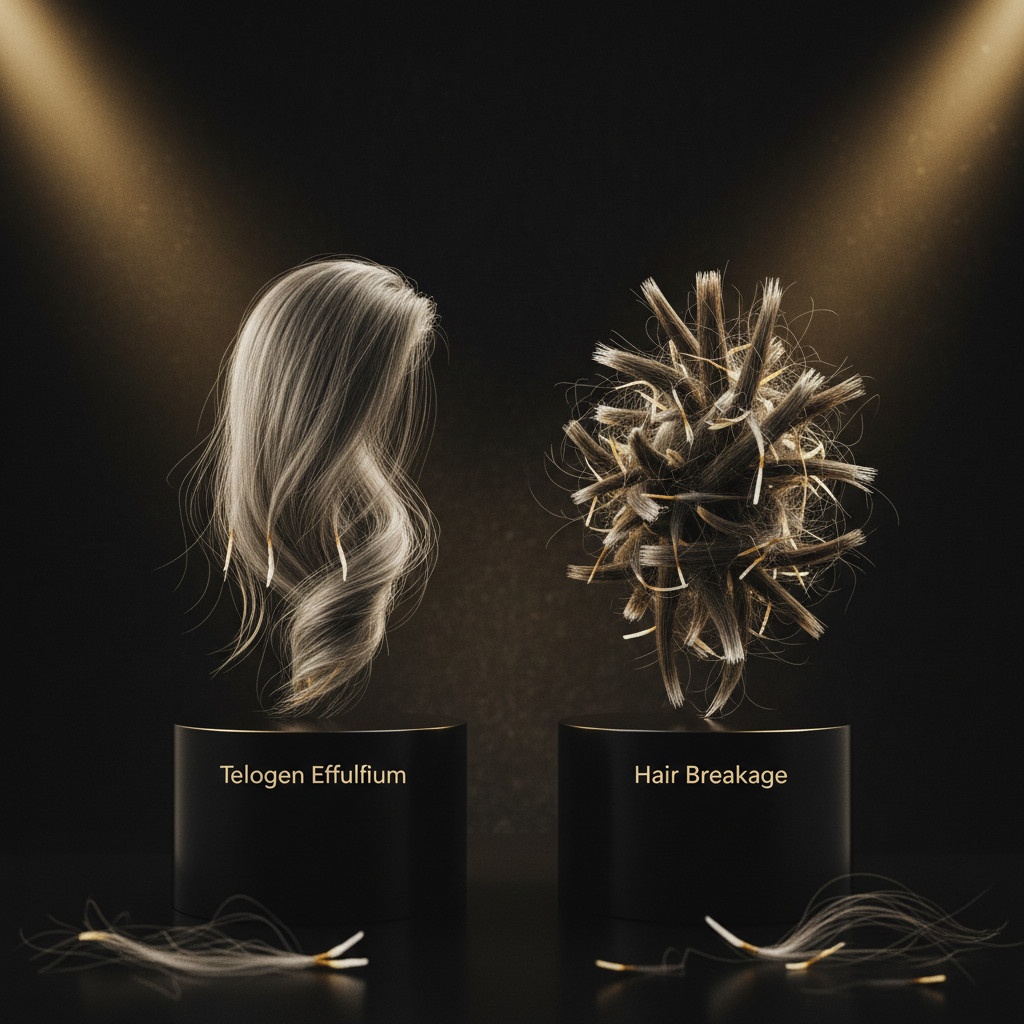
Quick answer: When evaluating Telogen Effluvium vs Hair Breakage, the difference comes down to the root versus the shaft. Telogen effluvium is a temporary physiological shedding event where full-length fibres with a tiny white keratin bulb at the base detach from the follicle due to systemic stress or illness. Hair breakage is mechanical or chemical fracture occurring along the hair shaft without follicle detachment. The main limitation in self-diagnosis is that severe breakage and acute shedding often co-occur, requiring careful physical examination to treat correctly.
Key takeaways
- The root tells the story: Shed hair from telogen effluvium shows a small, white keratin bulb at one end; broken hair has blunt, split, or frayed ends without a bulb.
- Follicle versus fibre: Telogen effluvium is an internal biological shift in the follicular growth cycle, whereas breakage is structural damage to the external hair fibre.
- Fibre length varies: Telogen effluvium sheds hairs of full length from across the entire scalp, whereas broken hairs are noticeably shorter than your typical length.
- Recovery timelines differ: Acute telogen effluvium usually resolves on its own within 3 to 6 months once the systemic trigger is removed, while breakage stops only when styling, heat, or chemical practices change.
- Topical cosmetics do not stop shedding: Cosmetic treatments and strengthening shampoos can dramatically reduce breakage by improving fibre elasticity, but they cannot alter internal follicular cycling caused by physiological shock.
Telogen Effluvium vs Hair Breakage: what the evidence shows
Understanding Telogen Effluvium vs Hair Breakage begins with dermatological classification. Telogen effluvium is a diffuse, non-scarring form of hair shedding first described clinically by Dr Albert Kligman in 1961. Under normal conditions, roughly 85 to 90 percent of scalp follicles sit in the active growth phase (anagen), while 10 to 15 percent rest in the resting phase (telogen). In telogen effluvium, an acute physiological shock precipitates up to 30 to 50 percent of growing follicles prematurely into telogen. Around 2 to 4 months after the triggering event, these hairs shed simultaneously. Daily shedding can leap from a baseline of 50 to 100 hairs up to 300 or more per day.
Hair breakage, by contrast, is not shedding at all. It is the structural failure of the hair shaft under mechanical or chemical tension. A virgin human hair fibre can typically stretch up to 30 percent of its dry length before snapping. However, exposure to high-lift bleaching, chemical relaxers, excessive thermal styling above 185°C, or aggressive mechanical friction strips the protective lipid layer (18-methyleicosanoic acid) and degrades the structural keratin proteins within the cortex. When the tensile strength drops below the force applied during brushing or detangling, the shaft fractures.
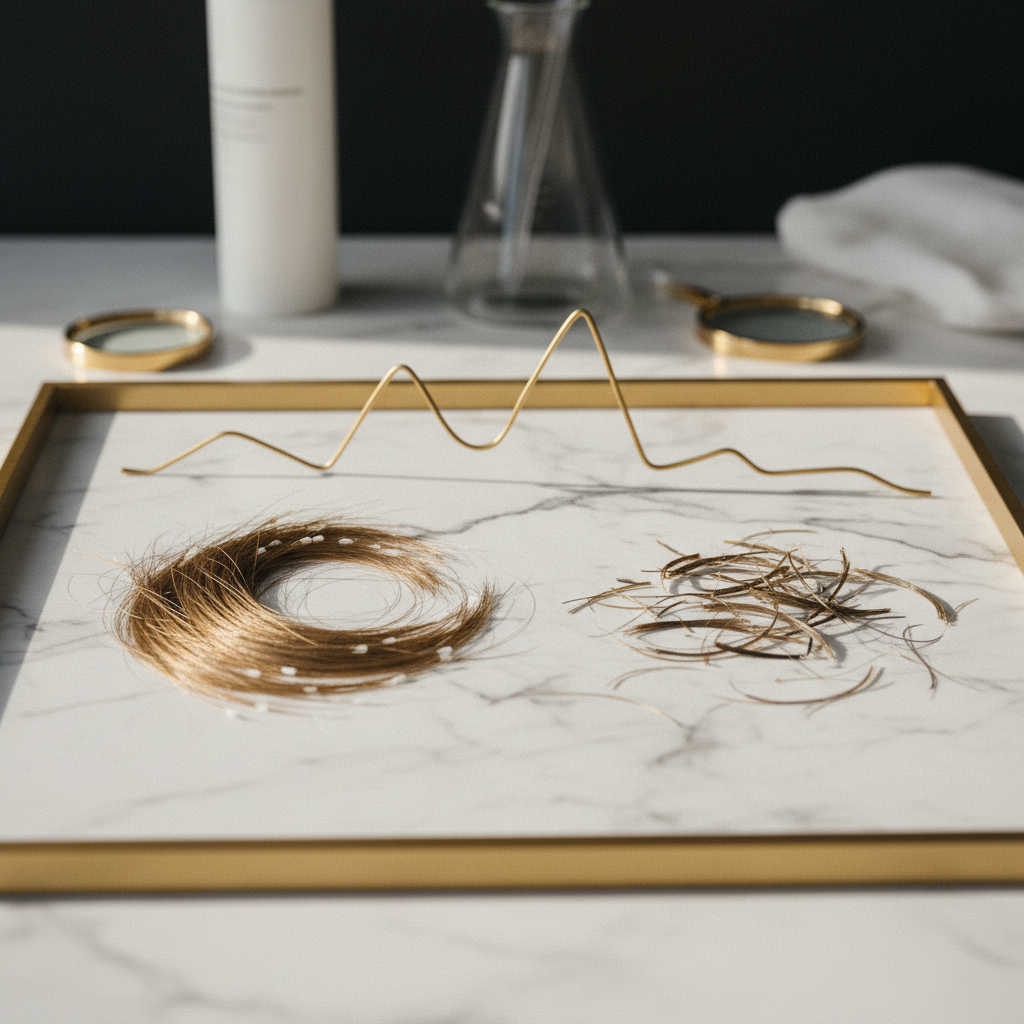
Dermatologists and trichologists rely on close physical inspection to separate the two. A simple test involves gathering the fallen hairs on a dark, flat surface or under a low-power magnifying loupe. If the fibre exhibits a tiny, firm, club-like white bulb at the base, it detached cleanly from the follicle. If the strand has irregular, ragged ends, white dots along the shaft (trichorrhexis nodosa), or splits without any bulb, you are seeing structural breakage.
| Diagnostic Marker | Telogen Effluvium | Hair Breakage |
|---|---|---|
| Origin of loss | Follicular detachment (scalp level) | Fibre fracture along the hair shaft |
| End of the fibre | Intact white keratin club bulb present | Frayed, blunt, or split end; no bulb |
| Length of fallen strands | Uniform, full-length scalp hairs | Uneven, short, fragmented pieces |
| Scalp distribution | Diffuse thinning across the entire scalp | Localised to crown, hairline, ends, or nape |
| Primary root cause | Systemic stress, illness, fever, hormonal shifts | Bleach, heat, friction, mechanical traction |
| Tug / pull test result | 6 or more full-length hairs release easily | Hairs snap mid-shaft under slight tension |
| Resolution path | Systemic balance and time (3 to 6 months) | Altering hair handling, bond repair, hydration |
What the evidence does not show
There is no clinical evidence showing that hair breakage leads to telogen effluvium, nor does shedding cause the hair fibre itself to become brittle. They operate through entirely separate biological pathways.
Furthermore, published dermatology research does not support the common belief that cosmetic shampoos, conditioners, or scalp oils can reverse or shorten acute telogen effluvium. Because the biological trigger occurred inside the body months earlier, topical cosmetic products cannot force resting telogen follicles back into active anagen. Similarly, taking high-dose biotin or multivitamin supplements has not been proven to treat hair shedding unless an underlying clinical deficiency has been diagnosed by blood testing. For hair breakage, treatments cannot permanently fuse split or shattered fibres back into pristine virgin keratin; they can only coat, reinforce, and temporarily seal weakened bonds until healthy hair grows out.
The biological mechanisms behind each condition
The biological mechanisms governing the two conditions happen in distinct anatomical zones: the living follicle beneath the skin surface, and the non-living keratinised fibre protruding above it.
The follicular shift in telogen effluvium
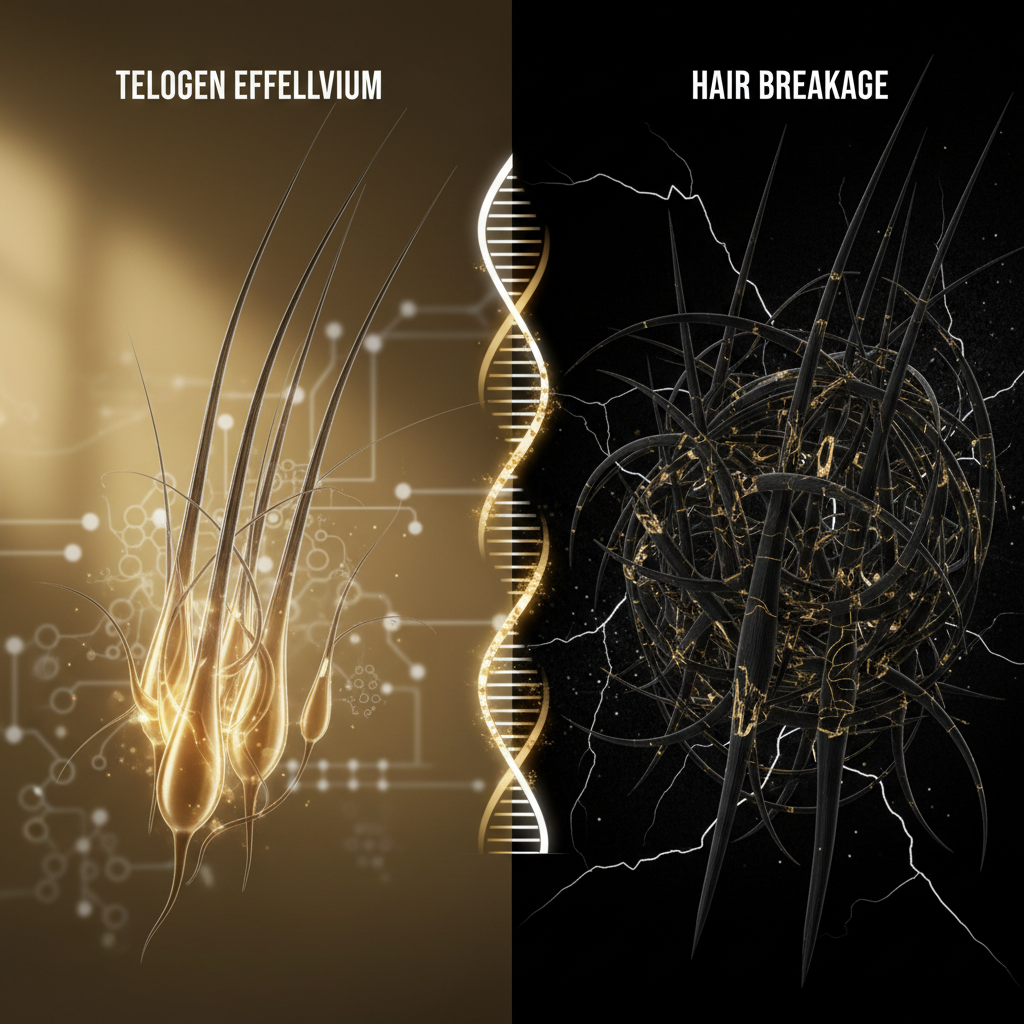
The follicular cycle moves through anagen (growth), catagen (regression), telogen (resting), and exogen (shedding). In telogen effluvium, an acute stressor causes a sudden release of pro-inflammatory cytokines, neuroendocrine hormones like cortisol, or substance P around the hair follicle. This biochemical disruption prematurely aborts the active anagen phase. The follicle moves through catagen and enters telogen. Because the telogen phase naturally lasts approximately 100 days, the patient experiences no immediate change at the moment of the stressor. Only when the new hair begins to grow beneath the resting club hair does the old strand get pushed out, causing sudden, alarming, widespread shedding.
The structural breakdown in hair breakage
Hair breakage is a biophysical failure. The hair fibre consists of an outer protective cuticle, a structural cortex rich in disulphide bonds, and an innermost medulla. When chemical processes such as bleaching or permanent waving alter the internal pH (raising it into high alkaline territory of pH 9.0 to 11.0), the cuticle scales swell and lift. This allows oxidative agents to break down the disulphide bonds within the cortex. Subsequent heat styling above 185°C degrades alpha-keratin into beta-keratin, stripping moisture and inducing micro-fractures known as trichorrhexis nodosa. When a comb encounters these weakened zones, the fibre fractures abruptly.
How to assess which one you have
To determine whether you are dealing with shedding, breakage, or both, inspect your fallen hair and review your recent history:
- Collect and measure: Pick up 10 to 15 fallen strands from your brush, shower drain, or pillowcase. Compare their lengths against your current hair length. If the majority match your full length, diffuse shedding is the primary culprit. If you find short, irregular pieces, breakage is taking place.
- Inspect the tip: Use good lighting against a dark sheet of paper. Look for a miniature translucent or pearly white bulb at the end. That bulb confirms the entire hair was shed from the follicular pocket.
- Assess the timeline: Think back 6 to 16 weeks. Did you have a high fever, severe psychological trauma, rapid weight loss, major surgery, discontinuation of birth control, or childbirth? If yes, the timing aligns neatly with telogen effluvium.
- Evaluate routine damage: Have you had chemical lightening, thermal straightening, tight braided styles, or daily heat tools without thermal protection over the past few weeks? If your ends feel like straw and snap easily when gently tugged between two fingers, you have active breakage.
Practical steps to manage each issue
Because the mechanisms are completely different, your recovery strategy must target the correct problem.
Supporting recovery from telogen effluvium
- Wait out the biological cycle: Acute telogen effluvium is self-limiting. In most cases, shedding peaks around 6 to 8 weeks after it starts and subsides over 3 to 6 months once the systemic trigger has passed.
- Support systemic health: Ensure adequate dietary protein (roughly 1.2 to 1.5 grams per kilogram of body weight) and screen for low ferritin (stored iron), vitamin D, and thyroid anomalies via your GP.
- Maintain gentle scalp care: Do not avoid washing your hair out of fear. Hairs in the exogen phase are already detached from the dermal papilla; delaying washing simply allows loose hairs to accumulate, making subsequent washes look artificially catastrophic.
Stopping active hair breakage
- Lower thermal stress: Keep hot tools below 185°C, always apply a protective thermal barrier, and let hair air-dry halfway before blow-drying.
- Adjust wet hair handling: Hair is at its most vulnerable when wet, absorbing water up to 30 percent of its weight and dropping its elastic modulus. Never aggressively towel-dry or yank a fine-tooth comb through damp hair. Use a wide-tooth comb or flexible detangling brush, working upwards from the ends to the roots.
- Book a corrective trim: Severely damaged, split ends cannot be mended by conditioners alone. Trimming away split ends prevents fractures from travelling further up the hair shaft.
Daily haircare with Watermans
When managing hair through recovery, maintaining a calm scalp and resilient hair shafts makes daily styling easier. Watermans Grow Me Shampoo and Conditioner are formulated to cleanse gently without stripping natural protective lipids. While no cosmetic formula can alter internal follicular shedding cycles, the nutrient-rich blend of biotin, rosemary, caffeine, and hydrolysed lupin protein helps condition the scalp and improves fibre lubricity. This reduces mechanical friction during washing and brushing, which prevents hair breakage from compounding existing shedding.
When the cause may be something else
If your symptoms do not neatly fit acute telogen effluvium or mechanical breakage, other conditions must be considered:
- Female or male pattern hair loss (Androgenetic Alopecia): Unlike the sudden, generalised shedding of telogen effluvium, pattern hair loss involves gradual miniaturisation of follicles, typically widening the central parting or thinning the temples over several years.
- Alopecia Areata: An autoimmune reaction where lymphocytes target anagen hair bulbs, producing distinct, well-circumscribed, round or oval patches of sudden, complete hair loss.
- Traction Alopecia: Mechanical tension caused by tight ponytails, extensions, or braids that inflames the follicle. This is often confused with breakage because it occurs around the hairline, but it is actual follicular damage that can lead to permanent scarring if left unaddressed.
- Trichorrhexis Invaginata: A rare structural defect (often known as bamboo hair) where the hair shaft folds in on itself, causing extreme fragility and breakage even without heat or chemical exposure.
When to seek medical advice
Consult a GP or board-certified dermatologist specialising in trichology if you notice any of the following:
- Shedding continues at an intense rate for more than 6 months (indicating chronic telogen effluvium).
- You develop patchy bald spots, distinct circular areas of bare skin, or redness and burning on the scalp.
- You observe scaling, pustules, scarring, or loss of follicular openings on the scalp.
- Diffuse shedding is accompanied by unexpected weight changes, persistent fatigue, heat or cold intolerance, or irregular menstrual cycles.
Frequently asked questions about Telogen Effluvium vs Hair Breakage
Can you experience telogen effluvium and hair breakage at the same time?
Yes, it is common to experience both simultaneously. A person may undergo a physiological shock, such as childbirth or severe illness, that triggers telogen effluvium, while also using chemical bleaches or hot irons that weaken the hair shaft. Inspecting the fallen strands will reveal a mixture of full-length hairs with white bulbs alongside short, broken fragments.
Does brushing make telogen effluvium worse?
No. Brushing removes hairs that have already entered the exogen phase and detached from the follicle base. While it can feel alarming to see loose hairs collected on your brush, brushing does not cause telogen effluvium. However, using excessive force or a rigid brush can cause secondary hair breakage on fragile shafts.
How can you tell Telogen Effluvium vs Hair Breakage when washing hair?
Examine the strands left in your hands or shower drain. In Telogen Effluvium vs Hair Breakage, shedding produces long, full-length fibres with a tiny white bulb on one tip. Breakage leaves short, uneven pieces of varying lengths with frayed or blunt ends, accompanied by snapping sounds when detangling.
Will broken hair grow back as fast as shed hair?
Hair grows from the follicle at an average rate of 1 to 1.25 centimetres per month. A broken hair never stopped growing at the root; it simply lost length along the shaft, so it will continue advancing from where it fractured. A hair shed via telogen effluvium leaves the follicle temporarily empty for around 2 to 4 months before a new anagen fibre emerges.
Can a hair mask cure hair breakage?
A conditioning mask cannot permanently repair broken bonds, but deep conditioners containing proteins, fatty alcohols, and lipids can coat the cuticle and boost moisture retention. This increases shaft flexibility and lowers friction, preventing future breakage while previously damaged sections are gradually trimmed away.
Conclusion
Understanding the difference between Telogen Effluvium vs Hair Breakage is the first step toward choosing the right recovery strategy. Telogen effluvium is an internal, self-limiting biological response that requires time, nutritional support, and patience while your follicles reset their natural cycle. Hair breakage is an external, physical problem that demands immediate changes to chemical processing, heat styling, and daily mechanical handling. By checking for the presence of a white bulb, noting the length of fallen fibres, and identifying recent triggers, you can care for your scalp and protect your hair shaft with confidence.
Sources and references
- British Association of Dermatologists. Telogen Effluvium: Patient Information Leaflet. 2021.
- Kligman, A. M. Pathologic Dynamics of Human Hair Loss: I. Telogen Effluvium. Archives of Dermatology, 1961.
- Robbins, C. R. Chemical and Physical Behavior of Human Hair. 5th ed., Springer, 2012.
- Malkud, S. Telogen Effluvium: A Review. Journal of Clinical and Diagnostic Research, 2015.
- Sinclair, R. Diffuse hair loss: An approach to diagnosis and management. Australian Family Physician, 2005.
- National Institute for Health and Care Excellence (NICE). Alopecia - diffuse hair loss clinical knowledge summary. 2022.