Split Ends Prevention: The Science of Hair Fibre Care
8 min read ·
Explore evidence-based split ends prevention. Learn the mechanics of hair breakage, bust cosmetic repair myths, and discover proven ways to protect your hair.
Quick answer: Effective Split Ends Prevention relies on protecting the protective outer cuticle before structural damage reaches the cortex. True split ends (trichoptilosis) represent irreversible physical fibre breakage, meaning no cosmetic formulation can permanently repair a strand once it has split. Successful prevention demands reducing mechanical friction, limiting thermal breakdown from heat tools above 185°C, managing chemical processing, and maintaining adequate fibre lubrication with lipid-rich conditioners and oils to preserve tensile strength.
Key takeaways
- Split ends (trichoptilosis) are permanent structural fractures of the hair shaft; they cannot be glued or permanently repaired back together.
- The cuticle layer functions as a protective shield. Once worn away, the inner cortex splits apart under daily mechanical tension.
- Heat styling above 185°C rapidly degrades hair keratin and evaporates bound internal moisture, drastically accelerating shaft splitting.
- Routine mechanical habits, such as aggressive wet brushing and rough towel drying, cause micro-fissures that develop into longitudinal splits.
- Regular dusting trims every 8 to 12 weeks physically remove weakened tips before fractures travel upward along the fibre.
Split Ends Prevention: what the evidence shows
Scientific research into split ends prevention demonstrates that hair fibre integrity depends on preserving the 18-methyleicosanoic acid (18-MEA) lipid layer and outer cuticle scales. The hair fibre is not living tissue. Because it lacks cellular regeneration, any damage accumulated along the length remains until cut away.
Studies in cosmetic dermatology show that split ends occur when the outer cuticle scales (which overlap like roof tiles in 6 to 10 layers) erode away. Friction, heat, and chemical treatments strip the hydrophobic 18-MEA layer, leaving the inner cortical fibres exposed. Without cuticle support, normal tensile forces cause cortical cell bundles to unravel longitudinally. Evidence confirms that prevention protocols focused on friction reduction, moisture retention, and surface lubrication delay this structural failure significantly longer than untreated controls.
What the evidence does not show: the repair myth
Cosmetic products frequently promise to seal or cure split ends overnight. Peer-reviewed hair science does not support these claims. Polymers, silicones, and hydrolysed proteins can temporarily fuse split fibres together via film-forming adhesion, creating a smoother appearance. However, microscopic analysis reveals these temporary bonds wash away with surfactants or break down under mechanical brushing. No topical ingredient can regenerate the broken peptide bonds of an already separated cortex. Trimming remains the only permanent remedy for existing splits, making proactive prevention the only valid scientific approach.
The biological and physical mechanism of hair splitting
Understanding how split ends develop explains why gentle maintenance is so vital. Each hair strand consists of three distinct layers:
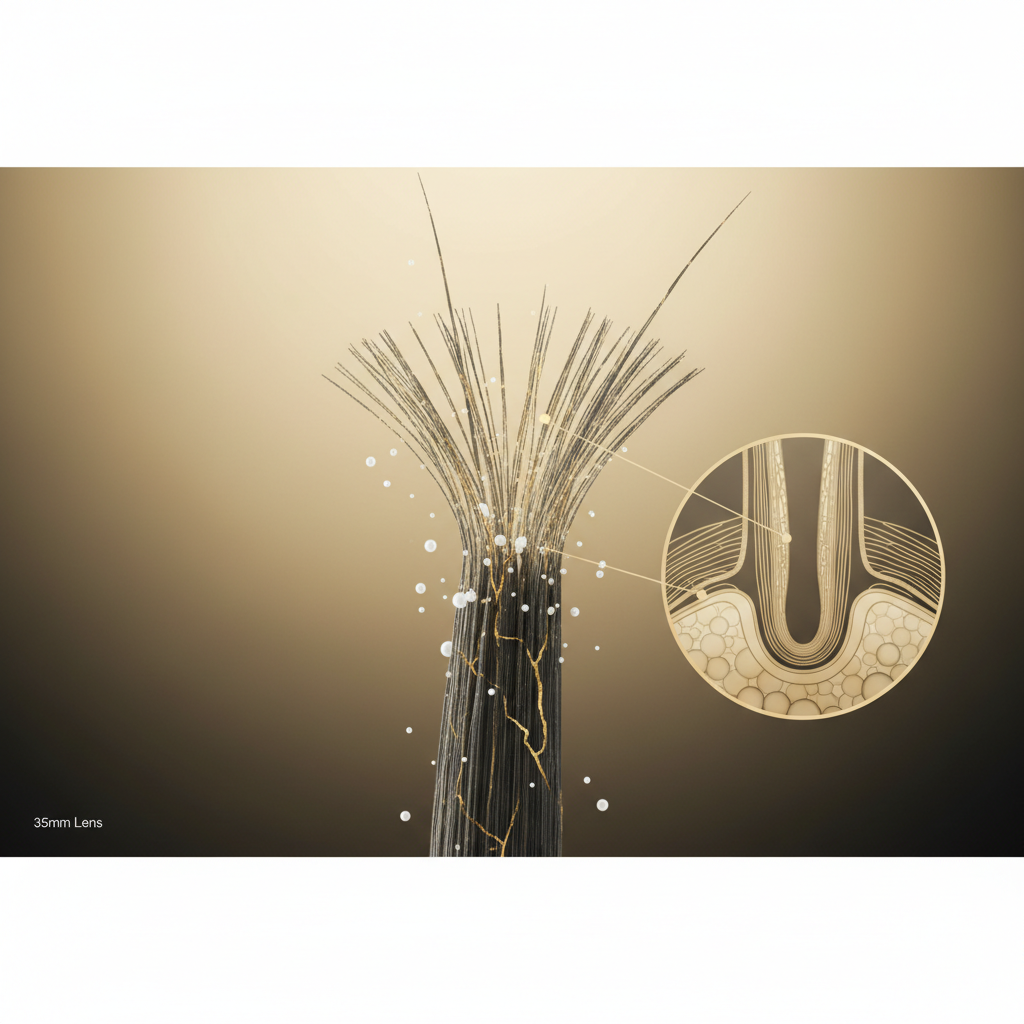
- The Cuticle: The outermost protective barrier composed of flattened, overlapping keratin scales coated in fatty acids (18-MEA).
- The Cortex: The structural core making up roughly 80 to 85 percent of the fibre, containing melanin granules and parallel keratin filament bundles bonded by disulphide, salt, and hydrogen linkages.
- The Medulla: The innermost porous canal present primarily in coarse or thick hair types.
When mechanical friction or chemical processing strips the cuticle, the cortex loses its protective sleeve. Tensile stress from combing forces the parallel macrofibrils within the cortex to separate. This separation typically begins as a classic Y-shaped split (trichoptilosis), but can also manifest as incomplete splits, tree-like fractures, or transverse fractures (trichorrhexis nodosa) where the hair snaps cleanly across the shaft.
Intact Hair Fibre:
[ Cuticle (6-10 overlapping layers) ] -> Protects Cortex & Keratin Bundles

Damaged Fibre:
[ Cuticle Stripped by Heat/Friction ] -> Cortex Exposed -> Mechanical Pulling -> Longitudinal Split
Common forms of fibre damage compared
Understanding the nature of fibre degradation helps in choosing the right preventive regimen:
| Damage Type | Primary Cause | Observable Micro-Symptom | Prevention Focus |
|---|---|---|---|
| Trichoptilosis | Mechanical friction, aging ends | Longitudinal splitting of ends into two or more strands | Lubrication, regular micro-trims |
| Trichorrhexis Nodosa | Chemical over-processing, heat | Node-like swelling where the fibre snaps cleanly | Restoring protein-lipid balance, reducing bleach |
| Bubble Hair | Wet heat styling over 170°C | Vapour bubbles forming inside cortex cavities | Air-drying hair partially before heat, thermal sprays |
| Weathering | UV exposure, environmental washing | Generalised cuticle thinning along outer shaft layers | UV protectants, leave-in antioxidants, hats |
Practical steps for successful Split Ends Prevention
Implementing evidence-based hair practices preserves the structural cuticle layers and minimises stress on the older portions of the hair shaft.
1. Control thermal styling exposure
Excess heat denatures the alpha-keratin structure of the cortex into beta-keratin, weakening fibre elasticity. Keep styling appliances below 185°C. Always apply a film-forming heat protectant containing ingredients such as polyquaterniums or silicones, which slow down heat transfer and buffer internal water loss. Never use flat irons on damp or wet hair, as rapidly boiling internal moisture creates permanent cortical fractures.
2. Minimise mechanical tension
Hair is in its weakest, most elastic state when wet because water temporarily breaks weak hydrogen bonds within the cortex.
- Never violently brush wet hair; use a wide-tooth comb or flexible detangling brush, working upwards from ends to roots.
- Replace rough cotton bath towels with smooth microfibre wraps or cotton t-shirts to eliminate friction.
- Sleep on a silk or satin pillowcase to reduce nightly friction on delicate ends.
3. Fortify the lipid barrier
Because ends are the oldest section of the fibre, they have lost most of their natural sebum and 18-MEA coating. Apply leave-in conditioners and lightweight plant oils (such as argan, jojoba, or coconut oil) to mid-lengths and ends. Coconut oil, in particular, possesses a low molecular weight and linear chain that allows it to penetrate the hair shaft, reducing protein loss during washing.
4. Schedule preventative micro-trims
Waiting until split ends are clearly visible guarantees that you will need to cut off significant length. Getting a dusting or micro-trim of 3 to 6 millimetres every 8 to 12 weeks eliminates microscopic fissures before they travel inches upward into healthy shaft sections.
When breakage indicates an underlying issue
While most split ends stem from external weathering, sudden widespread fragility or breakage along the entire shaft can indicate systemic disruptions. Nutritional deficiencies in zinc, iron (ferritin), or essential fatty acids can lead to compromised keratin matrix production during the anagen (growth) phase. Similarly, thyroid dysfunction (such as hypothyroidism) causes coarse, brittle fibres that fracture under minimal tension. If hair snaps close to the scalp despite minimal heat or chemical exposure, consult a GP or trichologist for blood evaluation.
Supporting hair condition with Watermans
Maintaining high tensile strength requires supporting both the fibre surface and the scalp environment where growth begins. While genetic factors dictate baseline hair diameter, external care preserves fibre life. Watermans GrowMe Shampoo and ConditionMe Conditioner deliver nutrient-dense, cosmetically balancing support designed to strengthen hair feel and reduce breakage caused by daily grooming.
By incorporating hydrolysed lupin protein, niacinamide, caffeine, and argan oil, Watermans formulations help condition the cuticle layer and lock in hydration. Using ConditionMe as a replenishing rinse restores vital slip to damp hair, dramatically reducing detangling friction and reinforcing the shaft against mechanical splits.
Frequently asked questions about Split Ends Prevention
Can split ends be repaired without cutting?
No. Split ends cannot be permanently repaired without cutting. Cosmetic serums, leave-in treatments, and split-end menders contain polymers that temporarily glue the separated cortical strands together, masking the appearance until your next wash. However, the internal structural integrity is gone, and the split will continue to travel up the hair shaft until it is trimmed away.
How often should I trim my hair for Split Ends Prevention?
For optimal Split Ends Prevention, schedule a micro-trim or dusting every 8 to 12 weeks. If you frequently use bleach, permanent hair dye, or daily heat tools, you may need a trim every 6 to 8 weeks. Trimming just 3 to 6 millimetres removes weakened cuticle margins before they separate into full longitudinal fractures.
Does cold water prevent split ends?
Rinsing with cold water does not physically close hair cuticles, as cuticle scales do not contain muscles to open or close. However, very hot water can excessively swell the hair shaft and wash away protective surface lipids. Using lukewarm water preserves natural protective fatty acids, while applying a pH-balanced conditioner (pH 4.5 to 5.5) flattens cuticle scales and preserves fibre strength.
Does brushing wet hair cause split ends?
Yes. When hair is saturated with water, internal hydrogen bonds temporarily break, increasing the fibre elasticity while reducing its tensile resistance. Dragging a standard brush through wet strands stretches the cortex beyond its recovery limit, fracturing cuticle edges and initiating split ends. Always apply a detangler and use a wide-tooth comb from ends to roots.
A sustained approach to fibre preservation
Long-term Split Ends Prevention is not about buying emergency rescue products; it is about respecting the biological limits of non-living keratin fibres. Every strand on your head reflects months or years of environmental, thermal, and mechanical exposure. By keeping styling temperatures low, minimising friction, coating fragile ends in protective conditioning lipids, and scheduling regular maintenance trims, you preserve your hair cuticle and keep fibres strong, resilient, and intact.
Sources and references
- British Association of Dermatologists. Hair Breakage and Hair Shaft Disorders. Bad.org.uk
- Robbins, C. R. Chemical and Physical Behavior of Human Hair (5th ed.). Springer, 2012.
- Gavazzoni Dias, M. F. Hair Cosmetics: An Overview. International Journal of Trichology, 2015. DOI: 10.4103/0974-7753.153450
- Ruetsch, S. B., et al. Secondary Ion Mass Spectrometry (SIMS) of the 18-MEA Layer on Human Hair. Journal of Cosmetic Science, 2003.
- National Health Service (NHS). Hair loss and hair damage assessment guidelines. Nhs.uk
Find these ingredients in Watermans products
- Zinc: you will find this ingredient in our Hair Vitamins.
- Niacinamide: you will find this ingredient in our Hair Mask.