Split End Prevention: Science-Backed Strategies for Longer, Healthier Hair
8 min read ·
Discover the science of Split End Prevention. Learn why hair splits, how to preserve the cuticle, and practical routines to stop damage before it starts.

Quick answer: Effective Split End Prevention relies on shielding the hair fibre from mechanical, thermal, and chemical stress before structural damage becomes irreversible. Hair is non-living tissue, meaning once the protective outer cuticle wears away and the inner cortex splits (trichoptilosis), the fibre cannot biologically regenerate or mend itself. Real-world Split End Prevention therefore centres on proactive lubrication, gentle handling, heat moderation, and routine micro-trims to stop existing micro-fissures from migrating up the hair shaft.
Key takeaways
- Permanent damage: Once hair splits, no cosmetic formulation can permanently rejoin the separated cortical fibres; only cutting removes them.
- The role of cuticles: The hair cuticle consists of 6 to 10 overlapping cellular layers. When these layers strip away through friction or heat, the cortex unravels.
- Surface lubrication: Conditioners, leave-in serums, and natural oils reduce inter-fibre friction by up to 50 percent, making them the first line of defence.
- Heat management: Temperatures exceeding 150°C denature keratin and cause internal moisture to boil, creating bubble hair and rapid longitudinal fractures.
- Mechanical care: Wet hair stretches easily and snaps under lower tensile loads; detangling must begin at the ends with wide-toothed tools.
Split End Prevention: what the evidence shows
Scientific research confirms that Split End Prevention is entirely a matter of physical and chemical preservation. Unlike living skin, which constantly turns over cells and repairs lacerations, the extruded hair shaft is composed of non-vital, cross-linked keratin proteins.
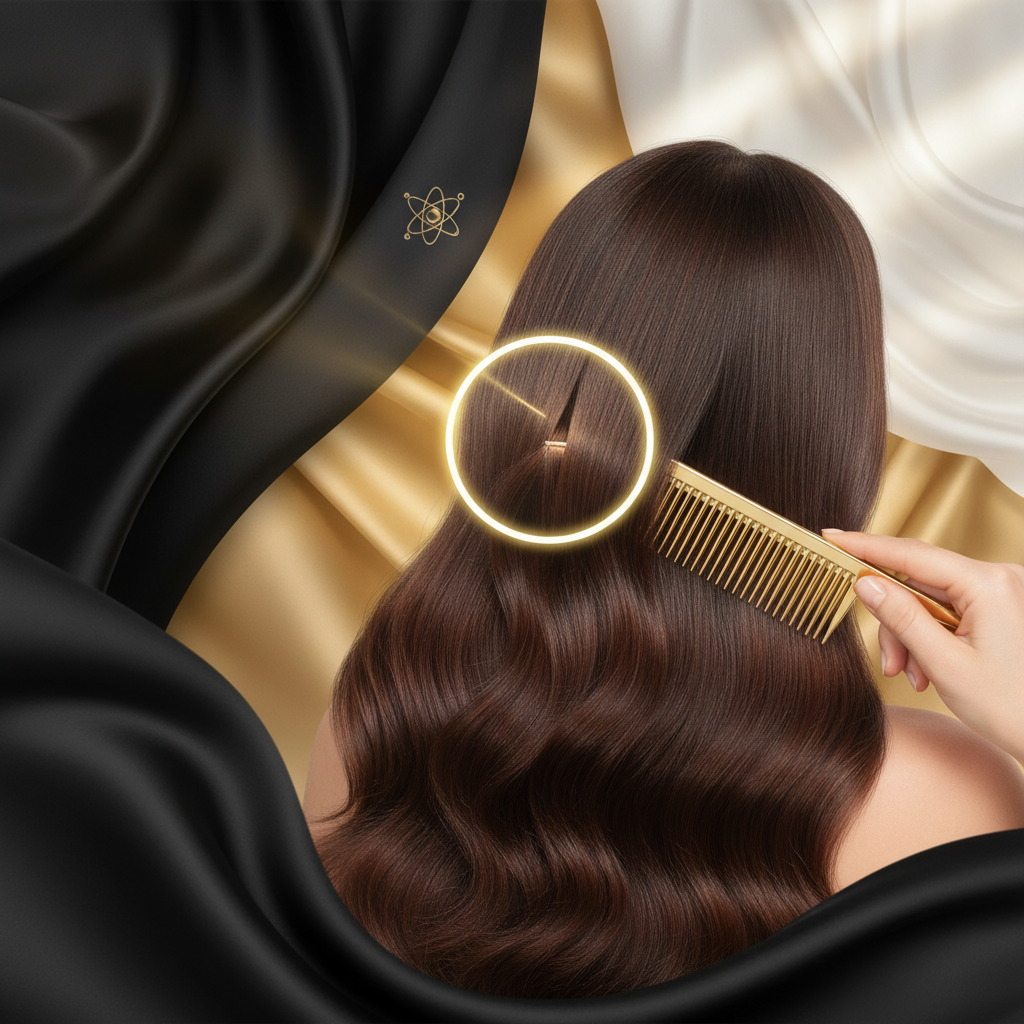
Peer-reviewed studies published in the Journal of Cosmetic Science show that the distal ends of longer hair have endured years of environmental exposure, UV radiation, washing cycles, and styling. Over time, the outer lipid layer (specifically 18-methyleicosanoic acid or 18-MEA) wears away. Without this natural hydrophobic barrier, the underlying cuticle scales lift, crack, and break off. Once the cortex is exposed, normal day-to-day grooming creates sufficient shear stress to peel the parallel macrofibrils apart.
Clinical assessments indicate that cosmetic treatments containing hydrolysed proteins, silicones, and polyquaterniums temporarily cement these split fragments together through physical adhesion and ionic bonding. However, these bonds wash away with surfactants, showing that prevention prior to cuticle loss is the only true long-term solution.
What the evidence does not show
Marketing campaigns often claim that specialised serums, bond builders, or creams can permanently "weld" or "heal" split ends. Cosmetic science does not support these claims. While conditioning agents smooth the cuticle and temporarily glue split filaments together, cross-sectional electron microscopy demonstrates that the underlying structural integrity remains compromised.
Furthermore, there is no evidence that dietary supplements, biotin, or internal vitamins can repair hair that has already emerged from the scalp. Nutrition impacts the hair bulb during the anagen (growth) phase, determining initial tensile strength, but it cannot deliver nutrients to dead keratin fibres down the shaft.
Biological and physical mechanisms of trichoptilosis
Trichoptilosis is the technical medical term for split ends. Understanding how it develops helps you build an effective routine.
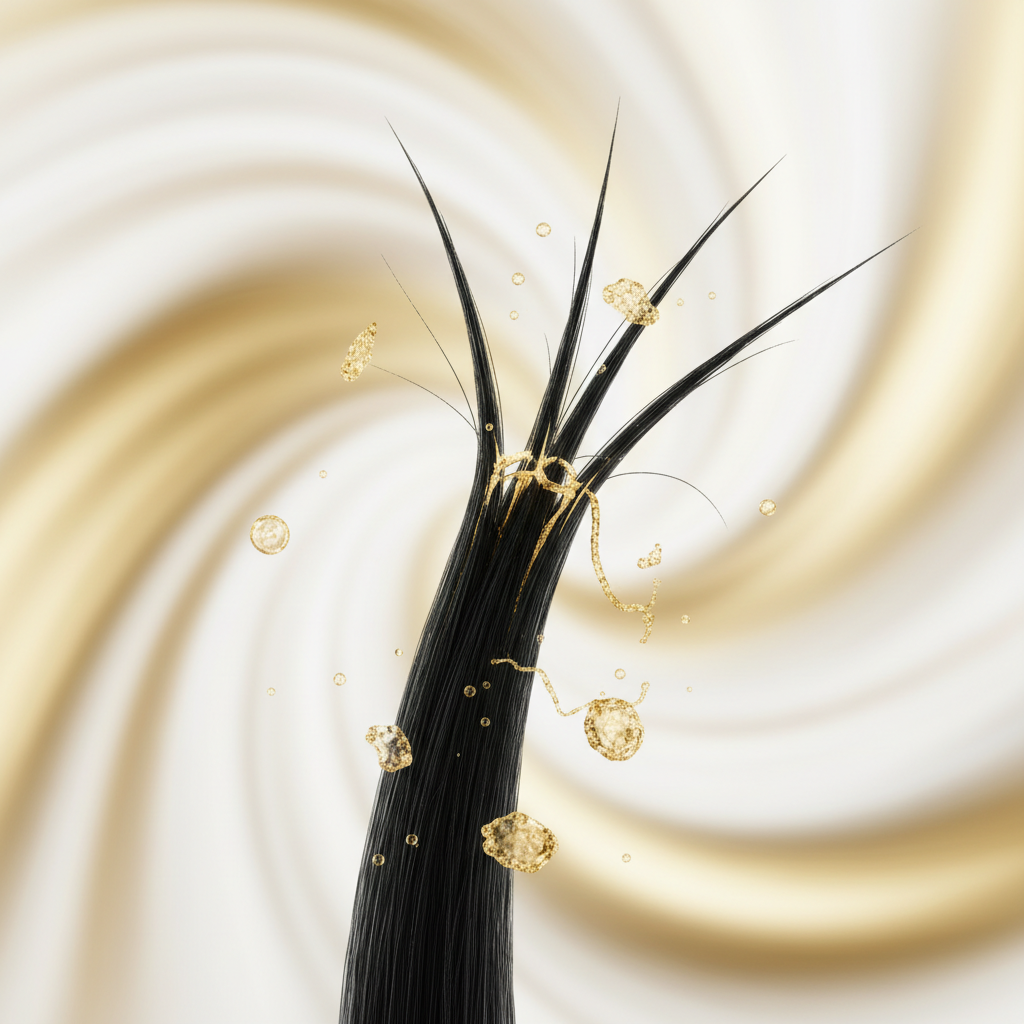
- Cuticle stripping: Mechanical friction (rough brushing, vigorous towel-drying) and chemical treatments (bleaching, perm solutions at pH 9.0 to 10.5) dissolve the cell membrane complex between cuticle scales.
- Cortex exposure: Without cuticles, the inner cortical cells (bundles of intermediate filaments embedded in a high-sulfur protein matrix) are exposed directly to the air.
- Tensile failure: Brushing exerts longitudinal tension. Because the cortex lacks its protective sheath, the parallel bundles shear apart down natural structural cleavage planes.
- Upward migration: As the hair moves and flexes, the initial tear acts as a stress concentrator, propagating the split centimetres upward toward the scalp.
| Prevention Method | Mechanism | Primary Benefit | Limitation |
|---|---|---|---|
| Film-Forming Conditioners | Deposits silicones, quats, or fatty alcohols | Cuts combing friction by 40 to 60 percent | Washes out; requires reapplication |
| Micro-Trimming | Physically shears the distal tip above the fracture | Stops splits from running up the shaft | Sacrifices a few millimetres of length |
| Heat Protectors | Dissipates thermal energy; seals moisture | Slows down keratin denaturing up to 230°C | Cannot eliminate 100 percent of heat damage |
| Silk or Satin Linens | Minimises surface roughness against the hair | Lowers night-time friction and knotting | Cosmetic/preventative; does not treat existing damage |
| pH-Balanced Cleansers | Keeps cuticles tight around pH 4.5 to 5.5 | Keeps outer scales flat and tightly sealed | Does not replace lost moisture alone |
Signs that hair is nearing structural collapse
Catching damage before full splits form makes preservation far easier. Watch for these diagnostic indicators:
- White specks near tips: Small white dots on the shaft indicate complete cuticle loss and localised cortical crushing (trichorrhexis nodosa). The hair will snap here under slight tension.
- Inability to detangle: Ends that continually knot around each other signal lifted, jagged cuticle scales interlocking like Velcro.
- Loss of elasticity: When wet hair snaps immediately upon gentle stretching rather than returning to its initial length, internal disulfide bonds are heavily depleted.
- Dull, matte finish: Intact cuticles reflect light evenly. Distal ends that appear cloudy or rough have lost their lipid layer.
Practical steps for daily defence
A comprehensive approach to avoiding shaft breakdown involves controlling daily handling habits:
- Wash with lukewarm water: Excessive heat swells the hair shaft unnecessarily. Use cleansers formulated near the scalp's natural pH of 4.5 to 5.5 to prevent cuticle flare.
- Gentle drying techniques: Ditch heavy cotton bath towels. Squeeze water out gently with an old cotton t-shirt or a smooth microfibre wrap; never rub roughly back and forth.
- Systematic detangling: Always work from the ends upward toward the scalp using a wide-toothed comb or flexible detangling brush. Never force a knot downwards, as this packs fibres tightly and causes tensile fracture.
- Thermal discipline: Keep styling irons under 180°C. Never apply heated plates to damp or wet hair, which creates steam inside the cortex that explodes the cuticle.
- Pre-shampoo lubrication: Applying protective oils to the lower lengths before washing limits water ingress and prevents excessive swelling-shrinkage fatigue (hygral fatigue).
The Watermans approach to hair resilience
Healthy hair lengths rely on robust foundational growth from the scalp combined with fibre protection. Watermans focuses on non-invasive, nutrient-rich scalp support that creates an ideal environment for new strands emerging from the follicle.
Using gentle, balancing cleansers such as Watermans GrowMe Shampoo helps support scalp vitality without harshly stripping the essential natural oils that coat the upper shaft. Pairing this with a deeply nourishing rinse-out treatment like Watermans ConditionMe Conditioner infuses the hair lengths with hydrolysed proteins, cholesterol, and natural oils. This smooths raised cuticles, restores surface slip, and dramatically lowers the combing friction that triggers longitudinal splits.
When fibre breakage indicates an internal issue
Sometimes what appears to be basic mechanical splitting is exacerbated by underlying health factors. Extreme brittleness, where hair splits or breaks only a few centimetres from the root, can stem from:
- Thyroid disorders: Hypothyroidism often leads to dry, brittle hair that fractures under low mechanical tension.
- Severe micronutrient deficiencies: Inadequate ferritin (stored iron), zinc, or essential amino acids can compromise the matrix during initial keratinisation.
- Chemical over-processing: Repeated high-lift bleaching or overlapping relaxers will chemically dissolve the fibre, presenting as widespread snapping rather than isolated end splits.
If you notice sudden, diffuse breakage across the crown or mid-lengths alongside increased shedding at the root, consult a trichologist or dermatologist for a full clinical workup.
Frequently asked questions about Split End Prevention
Can you repair split ends without cutting them?
No. Split ends cannot be permanently repaired. Hair is biologically dead tissue without cellular regeneration mechanisms. Conditioners, serums, and bonding products can temporarily glue split ends together using film-forming polymers, but this is an aesthetic fix that washes away. The only definitive solution is trimming the damaged tip above the split.
How often should I trim my hair for Split End Prevention?
For optimal Split End Prevention, schedule a micro-trim (removing 3 to 6 millimetres) every 8 to 12 weeks. If you routinely use heated styling tools or colour your hair, trimming every 6 to 8 weeks prevents small, invisible micro-fissures from migrating further up the shaft.
Does brushing wet hair cause split ends?
Yes. Hair is at its most vulnerable when wet because water temporarily breaks weak hydrogen bonds, allowing the shaft to stretch up to 30 percent beyond its normal length. If you brush wet hair aggressively, it quickly reaches its breaking point, stripping cuticles and initiating splits. Always detangle wet hair gently with a wide-tooth comb and ample conditioner.
What ingredients should I look for to stop split ends?
Focus on smoothing and film-forming ingredients that lower friction. Look for hydrolysed vegetable or keratin proteins, behentrimonium chloride, cetyl alcohol, dimethicone, and natural oils like argan, jojoba, or coconut. These agents seal the cuticle layer, improve elasticity, and reduce the physical drag caused by styling tools.
Conclusion
Mastering Split End Prevention is an ongoing practice of friction reduction, temperature discipline, and structural preservation. Because the hair fibre cannot self-heal once torn, protecting the external cuticle layer is the only reliable way to maintain smooth, resilient lengths. By handling wet hair with care, using protective leave-in treatments, and scheduling modest micro-trims before damage climbs, you can successfully protect your hair from the physical wear of daily life.
Sources and references
- International Journal of Cosmetic Science, "Hair breakage: A review of the biological and physical mechanisms", 2017.
- Journal of the Society of Cosmetic Chemists, "The physical and chemical properties of hair and their relation to grooming", 1998.
- British Journal of Dermatology, "Chemical and physical behaviour of human hair", 2012.
- Dermatology Practical & Conceptual, "Hair Cosmetics: An Overview", 2015.