Signs of Hair Breakage vs Hair Shedding: The Complete Diagnostic Guide
9 min read ·
Learn the clear signs of hair breakage vs hair shedding. Discover how to inspect the root, identify mechanical damage, and protect your hair density.
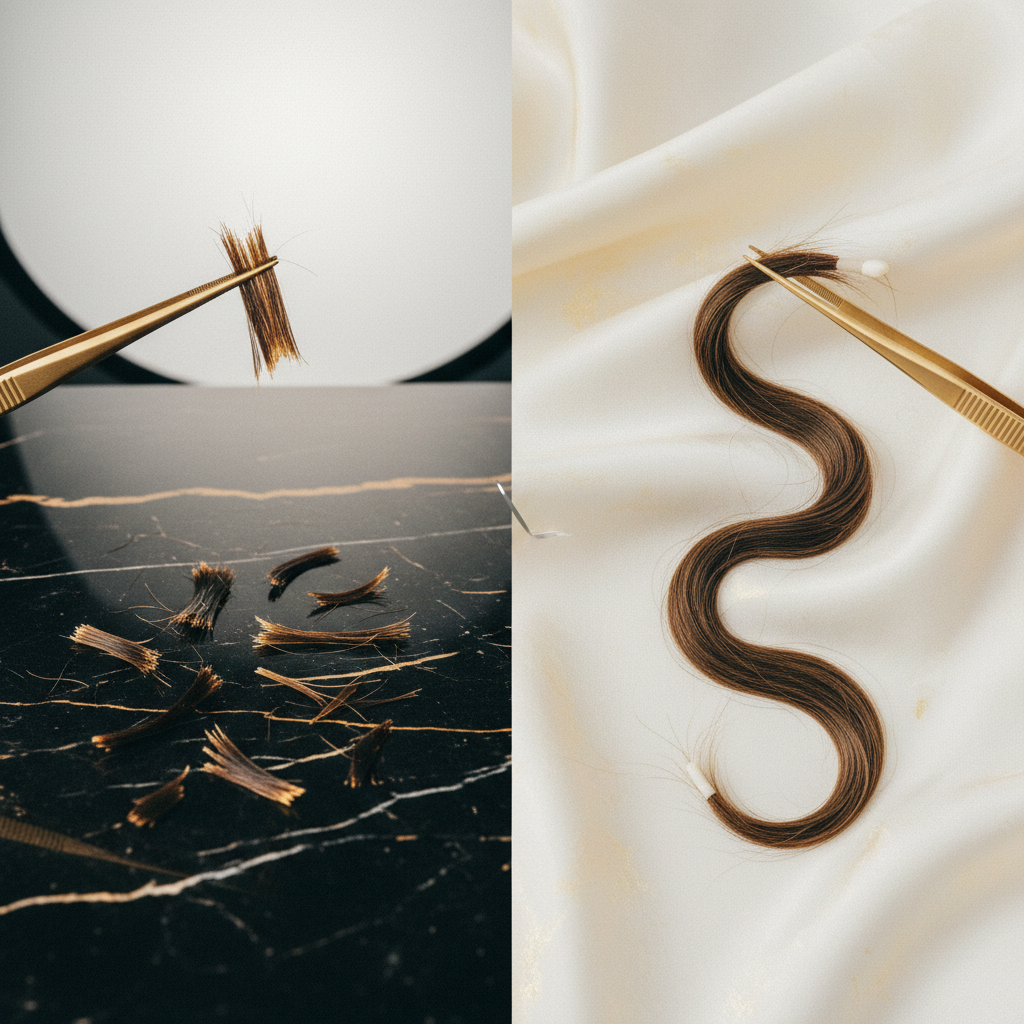
Quick answer: Identifying the signs of hair breakage vs hair shedding comes down to inspecting the strand itself. Shedding involves full-length hairs released from the follicle, almost always featuring a tiny, white bulb (the telogen root) at one end. Breakage occurs when the hair shaft snaps along its length, producing shorter, uneven fragments with frayed ends and no bulb. While daily shedding of 50 to 100 hairs is biologically normal, breakage indicates physical, chemical, or mechanical structural damage to the fibre rather than follicular hair loss.
Key takeaways
- Shed hair originates at the root and features a small, white keratin bulb, whereas broken hair snaps along the shaft without a bulb.
- Shedding is driven by the natural follicular cycle (telogen phase), while breakage is caused by mechanical stress, thermal tools, or chemical processing.
- A healthy adult naturally sheds roughly 50 to 100 hairs per day without causing loss of overall density.
- Broken fibres are noticeably shorter than your natural hair length, often with split ends, white dots (trichorrhexis nodosa), or ragged tips.
- Hair breakage can be reduced through conditioning, gentler handling, and protein-moisture balance, whereas true systemic shedding (telogen effluvium) requires addressing internal physiological triggers.
Signs of Hair Breakage vs Hair Shedding: what the evidence shows
Distinguishing between the signs of hair breakage vs hair shedding is vital for determining the correct corrective routine. The primary difference lies in the anatomical site of separation.
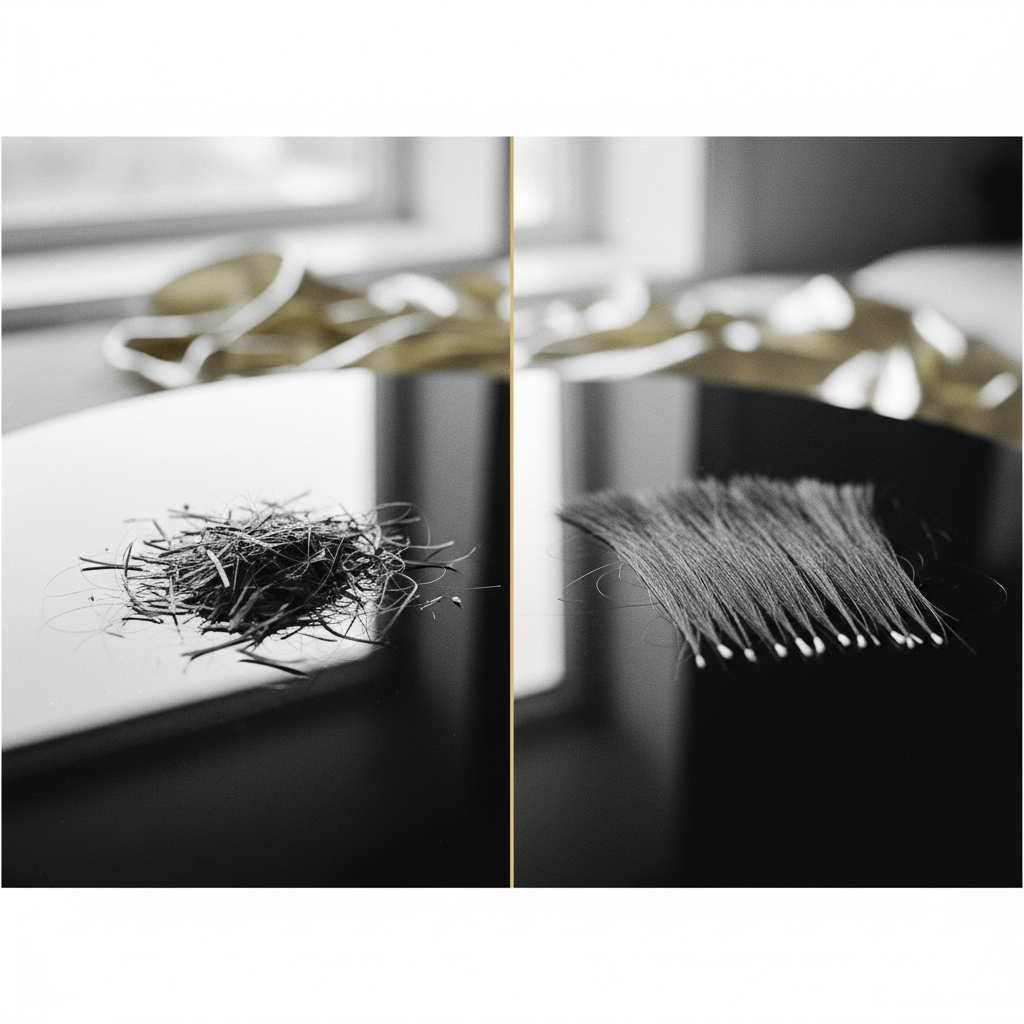
When hair sheds, the entire hair fibre detaches from the dermal papilla within the hair follicle. This is an intrinsic biological process known as the exogen phase of the hair growth cycle. Research in trichology and dermatology confirms that human scalps support roughly 100,000 hair follicles, of which roughly 85 to 90 percent reside in the active growing (anagen) phase, while 9 to 14 percent sit in the resting (telogen) phase. The telogen hair eventually detaches, leaving behind a firm, bulbous keratinised root visible to the naked eye.
In contrast, hair breakage is an extrinsic structural failure. The hair shaft, primarily composed of a protective outer cuticle and an inner structural cortex made of alpha-keratin bundles, fractures under mechanical, chemical, or environmental strain. The fracture site shows no bulb. Instead, microscopy reveals ripped cuticle scales, frayed cortical fibres, or localized transverse splits.
Shed Hair: [White Bulb]==============================[Tapered/Natural Tip]
Broken Hair: [Fractured End]==================[Frayed/Split End] (No Bulb)
Understanding this mechanical difference prevents the common error of treating structural fibre breakage with systemic supplements, or treating follicle-level shedding with leave-in surface conditioners.
The physical mechanisms: root vs shaft
Hair fibre strength relies heavily on disulphide bonds within the cortex and intact, overlapping lipid-coated cuticle scales on the exterior. When hair is exposed to repeated chemical bleaching, high heat above 185°C, or aggressive dry brushing, the protective 18-methyleicosanoic acid (18-MEA) lipid layer strips away.
Once the cuticle degrades, the cortex absorbs moisture unevenly, swells, and loses tensile strength. When applied tension exceeds the fibre's remaining elastic limit, the hair snaps. This physical fracture is known clinically as trichorrhexis nodosa or trichoclasia.
Follicular shedding operates via entirely different biological signalling. Hormonal shifts, acute illness, high fever, rapid nutritional deficits (such as severe ferritin or zinc depletion), or significant emotional stress trigger follicular cells to shift prematurely from anagen into telogen. Two to four months after the triggering event, these follicles shed their hairs in unison. This condition, telogen effluvium, leaves the physical fibre structurally healthy, but temporarily depletes visible scalp density.
| Feature | Hair Shedding | Hair Breakage |
|---|---|---|
| Origin point | Scalp follicle (root) | Hair shaft (mid-lengths or ends) |
| Visible bulb | Yes, tiny white or translucent bulb present | No bulb present |
| Strand length | Full length of current hair growth | Short, irregular, uneven pieces |
| Fibre texture | Uniform thickness along strand | Frayed, brittle, or split ends |
| Primary cause | Natural biological cycle, stress, hormones | Heat styling, bleach, friction, mechanical pull |
| Normal threshold | 50 to 100 strands daily | Minimal to none with healthy hair practices |
| Effective solution | Internal balance, nutrition, scalp care | Conditioning agents, bond repair, low heat |
What the signs look like in daily life
Examining your brush, pillowcase, and shower drain provides direct clues regarding what is happening to your hair.
Signs of true hair shedding
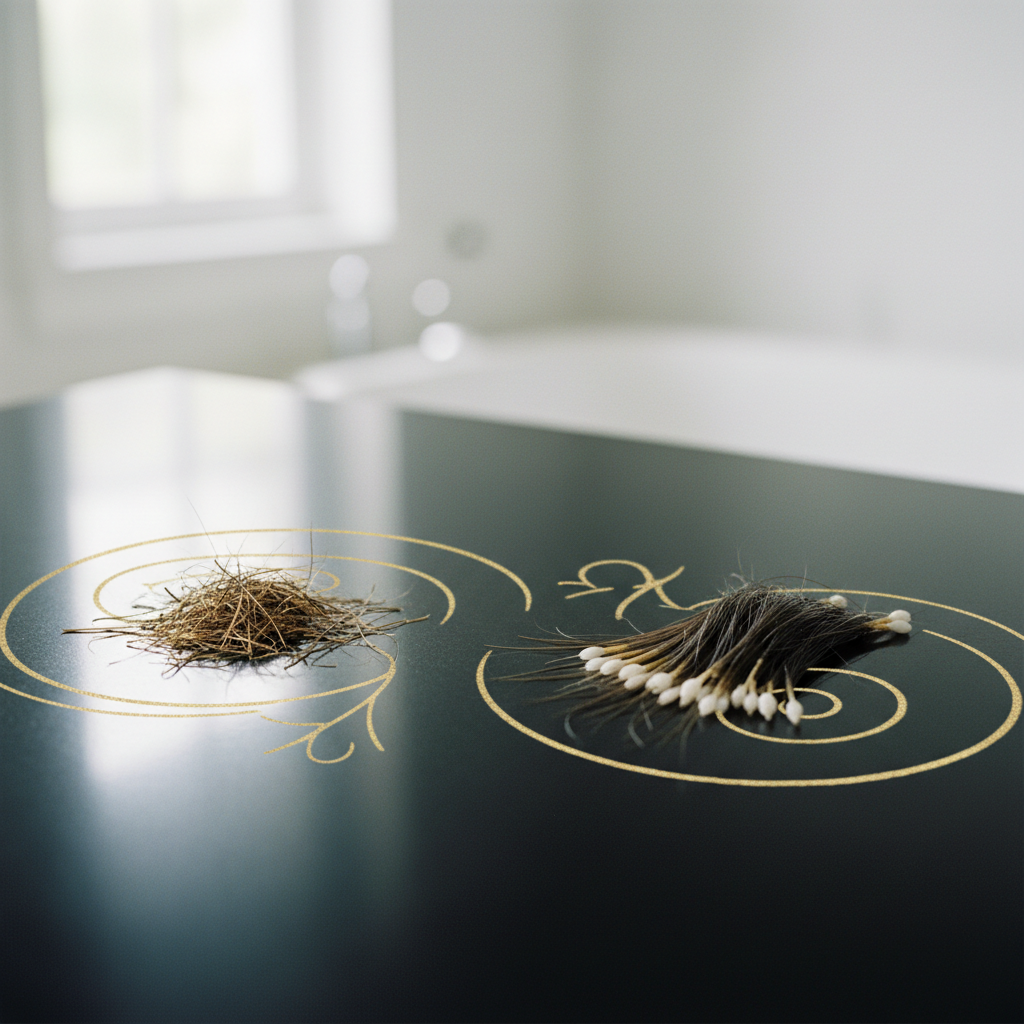
- Presence of the telogen bulb: Look closely at the thicker end of the fallen strand. A solid white or cream-coloured node confirms the hair separated cleanly from inside the follicle.
- Consistent full length: The strand matches the length of your longest hair layers.
- Root-down fall: Shed strands slide out effortlessly during washing or gentle finger-combing, requiring no pulling force to dislodge.
- Scalp-wide distribution: Increased shedding typically reduces overall ponytail circumference evenly rather than creating localised thin patches (unless patterned alopecia is present).
Signs of hair breakage
- Variable, short pieces: You notice tiny specks or jagged lengths of hair littering your sink, shoulders, or bathroom counter after styling.
- Blunt or frayed edges: The ends of the fallen fragments look jagged, white-tipped without a bulb (nodules), or divided into split ends.
- Rough tactile sensation: Running your fingers down individual strands reveals roughness, bumps, or sudden thinning along the shaft.
- Localised thinning: Breakage frequently concentrates around high-friction zones, such as the crown from tight ponytails, the nape from coat collars, or the hairline from hot tools.
- Tangled knots and snapping sounds: Brushing meets resistance, accompanied by faint popping sounds as brittle strands snap under tension.
What you can do to address each condition
Because hair shedding and hair breakage stem from different root causes, each demands a dedicated management strategy.
Addressing hair breakage
To reinforce the hair shaft and stop physical snapping:
- Reduce thermal stress: Keep heated tools below 185°C, and always apply a thermal protectant that coats the cuticle with protective conditioning polymers.
- Restore lubrication and slip: Incorporate washday products containing fatty alcohols (such as cetyl or stearyl alcohol), natural oils, and hydrolysed proteins that temporarily patch cortical defects and lower dry-brushing friction.
- Optimise wet handling: Hair is weakest when wet because water breaks down temporary hydrogen bonds, increasing fibre elasticity while lowering tensile breaking strength. Detangle wet hair slowly with a wide-tooth comb, starting from the ends and moving upward.
- Minimise chemical overlap: Avoid overlapping permanent colour or bleach onto previously lightened lengths, which strips the cortex and leads directly to progressive structural failure.
Addressing excessive shedding
If you are seeing full-length strands with intact roots exceeding 100 hairs daily:
- Track the timeline: Hair shedding typically lags behind its trigger by 8 to 12 weeks. Look back three months for events like viral illness, medication adjustments, or dramatic dietary shifts.
- Review basic nutrition: Check intake of dietary protein, iron, vitamin D, and essential fatty acids. The hair follicle matrix is among the most metabolically active cell groups in the human body.
- Prioritise scalp hygiene: Wash regularly to prevent sebum oxidation and excess yeast colonisation (such as Malassezia), which can drive perifollicular inflammation and worsen shedding.
Watermans: focused scalp and follicle support
When building a targeted regimen to address hair health, Watermans offers evidence-led formulations designed for both follicle support and strand resilience. Watermans GrowMe Shampoo delivers key scalp-nourishing ingredients, including biotin, rosemary extract, niacinamide, and caffeine, alongside lupin protein to support a clean, healthy scalp environment for natural growth cycles.
Pairing it with Watermans ConditionMe Conditioner provides the surface slip, hydration, and structural conditioning necessary to reduce daily mechanical breakage. While cosmetic formulations cannot cure systemic telogen effluvium or alter internal hormonal factors, maintaining an invigorated scalp and well-lubricated hair shaft helps preserve natural density and minimise unnecessary fibre snapping.
When the cause may be something else
Not all shedding fits the standard picture of telogen effluvium, and not all structural loss is simple grooming damage.
If shedding presents as distinct, circular bald patches with smooth skin, it points toward alopecia areata, an autoimmune condition where T-lymphocytes target the anagen hair bulb. If shedding involves gradual, progressive thinning focused specifically on the crown or widening of the central parting, androgenetic alopecia (pattern hair loss) is the primary suspect.
Similarly, severe breakage very close to the scalp surface accompanied by redness, scaling, or pustules requires formal clinical evaluation, as it may indicate tinea capitis (a fungal infection) or scarring alopecias.
When to seek medical advice
Consult a GP, dermatologist, or registered trichologist if you notice:
- Sudden, profuse shedding that persists for more than six months without slowing down.
- Visible patchiness, burning, itching, or pain across the scalp.
- Shed hairs that possess dark, irregular sheaths or strange deformities rather than a clear telogen bulb.
- Breakage so severe that broad sections of hair fail to grow beyond a few centimetres despite no use of heat or chemicals.
A medical professional can run targeted blood tests (ferritin, full blood count, thyroid panel, vitamin D) or perform a clinical dermoscopy (trichoscopy) to accurately diagnose the root cause.
Frequently asked questions about Signs of Hair Breakage vs Hair Shedding
How can I quickly test if a fallen hair is broken or shed?
Place the fallen strand against a dark background or on a sheet of white paper depending on your hair colour. Look closely at both ends. If one end has a tiny, distinct white or semi-translucent dot, it has shed from the follicle. If neither end has a bulb, or if the strand is significantly shorter than your current hair length with blunt or frayed tips, it is broken.
What are the main signs of hair breakage vs hair shedding when brushing?
When evaluating the signs of hair breakage vs hair shedding during brushing, pay attention to the size and sound of the hairs. Shed hairs will be long strands that weave into the bristles smoothly and display root bulbs. Broken hairs will appear as tiny, splintered pieces resting on your clothes or vanity, often accompanied by audible snapping or popping sounds as the brush encounters snags.
Can severe breakage look like hair loss?
Yes. When breakage is widespread and occurs high up the hair shaft, it creates uneven thinning, sparse ends, and shorter layers that mimic the density loss seen in follicular hair loss. However, dermoscopy can easily distinguish between the two: with breakage, active follicular openings still contain healthy growing fibres, but their visible lengths are mechanically fractured.
Is it normal to experience both breakage and shedding at the same time?
It is very common. Every person sheds between 50 and 100 hairs daily as part of the natural hair cycle. If you also use heat tools, lighten your hair, or brush aggressively, a portion of your remaining hair will break. Distinguishing the ratio of long shed hairs to short broken fragments helps identify whether you need to address internal scalp health or external fibre care.
Clarifying your hair care routine
Correctly identifying the signs of hair breakage vs hair shedding saves time, money, and unnecessary worry. By inspecting the physical structure of your fallen strands, you can quickly separate normal biological turnover from mechanical damage. Match your response to the true root cause: fortify brittle lengths with protective conditioners and gentler handling, while giving your scalp and follicles the balanced nutrition and clean foundation they need to thrive.
Sources and references
- British Association of Dermatologists. Telogen Effluvium Guidelines and Patient Information. 2021.
- American Academy of Dermatology. How to Stop Hair Breakage and Damage. 2022.
- Robbins, C. R. Chemical and Physical Behavior of Human Hair. 5th ed., Springer-Verlag, 2012.
- Sinclair, R. "Healthy hair: what is it?" Journal of Investigative Dermatology Symposium Proceedings, 2007.
- Dawber, R. "Hair: Its Structure and Response to Cosmetic Preparations." Clinics in Dermatology, 1996.
Find these ingredients in Watermans products
- Niacinamide: you will find this ingredient in our Hair Mask.