Scalp Acid Mantle and pH: The Science of Barrier Health
9 min read ·
Discover how the Scalp Acid Mantle and pH regulate your skin barrier, prevent microbial irritation, and protect hair cuticles from friction and mechanical breakage.
Quick answer: The Scalp Acid Mantle and pH refer to the delicate, slightly acidic film of sebum, sweat, and amino acids that protects your scalp skin, naturally sitting at a pH between 4.5 and 5.5. This barrier inhibits harmful microbes, regulates moisture, and keeps hair cuticle scales tightly closed. However, maintaining balanced scalp pH cannot cure hormonal hair loss or reverse genetic conditions, though disrupting it often triggers irritation, dryness, flaking, and cuticle friction that mimics thinning through fibre breakage.
Key takeaways
- The healthy human scalp maintains an acidic pH between 4.5 and 5.5, while the hair shaft itself is slightly more acidic at around 3.67.
- An alkaline environment swells the hair cuticle, increases static electricity, and strips the skin barrier of protective lipids.
- Alkaline cleansers allow opportunistic microbes such as Malassezia restricta and Staphylococcus epidermidis to proliferate, leading to itching and dandruff.
- True hair loss (follicular miniaturisation) differs from breakage, but an altered scalp pH can cause inflammation that degrades overall hair quality.
- Most commercially available soap bars have a pH of 9.0 to 10.0, which severely disrupts the acid mantle compared to properly buffered, pH-balanced shampoos.
Scalp Acid Mantle and pH: what the evidence shows
The Scalp Acid Mantle and pH function as the body's first biological defence mechanism across the cranium. Coined in 1928 by German physicians Heinrich Marchionini and Alfred Schade, the concept of the "Säureschutzmantel" (acid mantle) describes the naturally acidic film covering human stratum corneum.
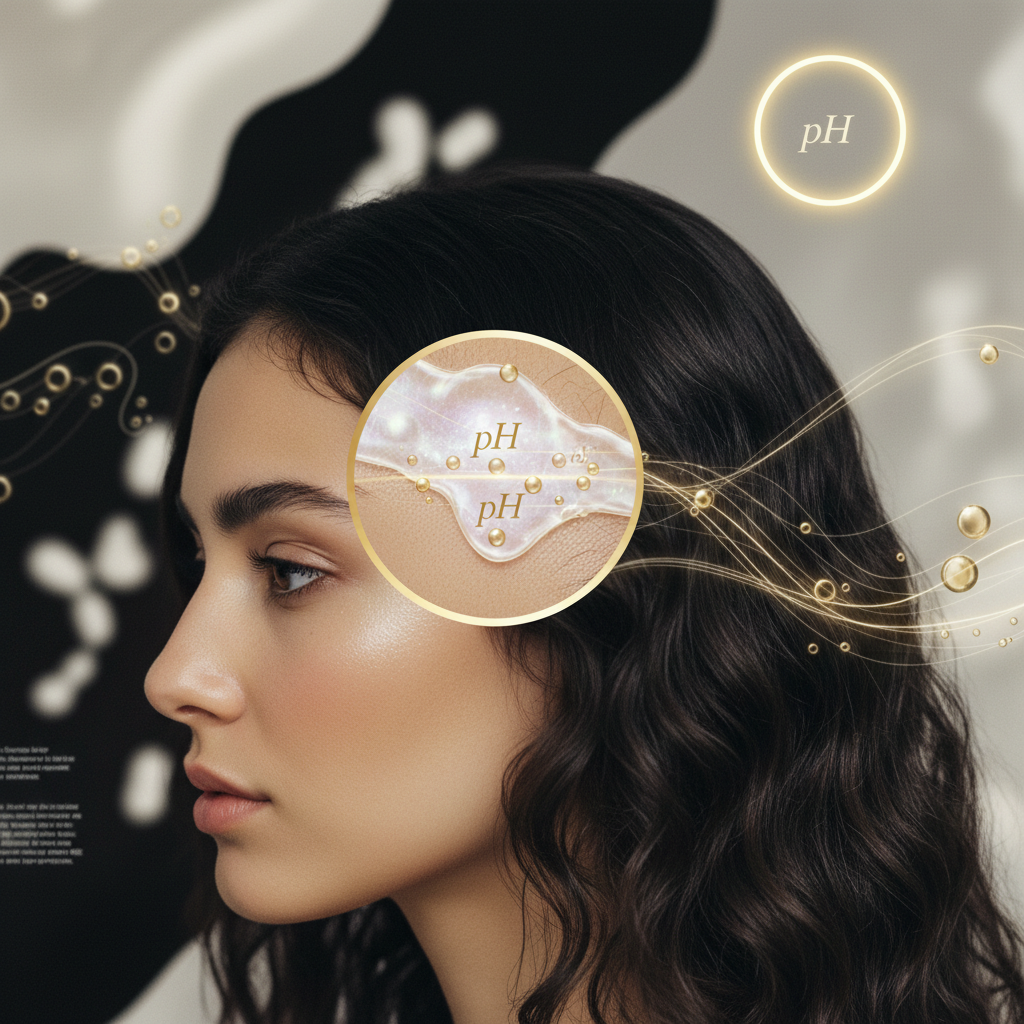
On the scalp, this film is formed by a mixture of lactic acid, amino acids from sweat, free fatty acids from sebum, and the natural breakdown products of keratinocytes. Published dermatological studies confirm that an unwashed, healthy adult scalp consistently measures between pH 4.5 and 5.5.
This mild acidity serves two primary, evidence-backed functions:
- Microbiome regulation: An acidic environment suppresses pathogenic colonisation. Beneficial commensal organisms thrive in a pH 4.5 to 5.5 range, whereas common pathogens such as Staphylococcus aureus prefer neutral to alkaline conditions (pH 7.0 and above).
- Enzyme and barrier maintenance: The synthesis and processing of ceramides, which glue stratum corneum cells together, rely on enzymes like beta-glucocerebrosidase and acid sphingomyelinase. These enzymes function optimally around pH 5.0. If the pH rises, barrier repair slows, trans-epidermal water loss (TEWL) increases, and the scalp becomes parched and reactive.
The physical hair shaft versus the living scalp
While the scalp is living cutaneous tissue, the visible hair fibre consists of dead, highly organised keratin filaments surrounded by an outer cuticle. The isoelectric point of hair keratin (the electrical neutral state where net charge is zero) occurs at roughly pH 3.67.
When you wash your head with products that alter the Scalp Acid Mantle and pH, the hair fibre reacts instantly to the chemical shift. At an alkaline pH (greater than 7.0):
- The negative surface charge of the hair increases.
- Water penetrates the cortex, causing the hair shaft to swell.
- Cuticle scales lift and flare outward like open shingles.
- Inter-fibre friction spikes, making wet combing difficult and dramatically increasing mechanical breakage.
Conversely, washing with a product buffered between pH 4.5 and 5.5 preserves the acid mantle of the skin while keeping the hair cuticle smooth, compact, and resilient against mechanical tension.
| Surface / Product | Typical pH Range | Biological or Mechanical Effect |
|---|---|---|
| Healthy Scalp Skin | 4.5 to 5.5 | Optimum barrier repair, balanced microbiome, low irritation |
| Hair Fibre Isoelectric Point | ~3.67 | Zero net charge, minimal cuticle swelling, smooth surface |
| Tap Water (UK Municipal) | 6.5 to 8.5 | Slightly swells cuticles; transiently elevates scalp pH |
| Traditional Solid Soap Bars | 9.0 to 10.0 | Strips lipids, disrupts acid mantle for 4 to 6 hours, lifts cuticles |
| pH-Balanced Shampoos | 4.5 to 5.5 | Cleanses without stripping lipids; protects skin acid mantle |
| Bleach / Permanent Relaxers | 9.0 to 12.0 | Severe cuticle opening, protein degradation, high scalp irritation risk |
What the evidence does not show
Popular discussions around scalp health often assign powers to pH balance that the scientific literature does not support.
First, correcting your scalp pH will not halt or reverse androgenetic alopecia (pattern hair loss). Pattern hair loss is driven by genetics and sensitivity to dihydrotestosterone (DHT) inside the follicle, not by surface skin acidity.
Second, pH balance alone cannot overcome severe nutritional deficits, telogen effluvium, or autoimmune conditions like alopecia areata. It is crucial to separate hair shedding (follicular detachment) and hair loss from hair breakage. An alkaline scalp wash causes rough, tangled hair that snaps under the brush. That is cuticle breakage, not follicular loss.
Finally, a product being marketed as "natural" does not mean it is pH-appropriate. Traditional saponified natural soaps (made by reacting oils with sodium or potassium hydroxide) inherently sit at an alkaline pH of 9.0 to 10.0. They are among the most disruptive cleansers you can apply to the human acid mantle, despite marketing claims.
Mechanisms: how disruption leads to scalp conditions
When you wash with a high-pH cleanser, your scalp's buffer capacity works to restore acidity. In healthy young skin, this re-acidification process takes between 2 and 6 hours. However, in sensitive, mature, or inflamed scalps, restoring the acid mantle can take over 12 hours.
During this extended window of altered pH, several biological disruptions occur:
Microbial dysbiosis and flaking
The scalp is host to lipid-dependent yeasts, particularly Malassezia globosa and Malassezia restricta. When high pH weakens the stratum corneum, Malassezia lipases penetrate deeper into the skin layers. These lipases break down sebum into irritating oleic acid. The compromised barrier cannot block these free fatty acids, triggering erythema, itching, accelerated skin turnover, and visible dandruff flakes.
Protease activation and barrier breakdown
Endogenous skin enzymes known as kallikreins (serine proteases) are responsible for shedding dead skin cells. These enzymes become hyperactive at neutral to alkaline pH. When activated prematurely, they degrade desmosomal proteins, causing premature shedding of the skin barrier before replacement lipids are fully formed. The result is dry, cracked, and irritated scalp tissue.
Signs your scalp acid mantle is compromised
Recognising an altered acid mantle helps prevent chronic scalp distress. Common indicators include:
- Post-wash tightness and itching: A sensation of tautness or prickling within 30 minutes of washing often indicates alkaline barrier damage.
- Dull, coarse hair texture: If your hair feels grabby, tangles effortlessly, and lacks shine despite conditioning, high pH is likely keeping the cuticle scales raised.
- Sudden flaking with an oily scalp: When the barrier fails, the skin overproduces sebum to compensate for hydration loss, producing greasy, yellow-tinted flakes alongside dry irritation.
- Heightened product sensitivity: Formulations that previously caused no reaction suddenly produce burning, stinging, or redness on application.
How to support and protect your scalp pH
Restoring equilibrium requires minimising environmental and chemical stresses while choosing formulas designed to work with your natural biology.
- Check product formulations: Look for shampoos explicitly formulated at pH 4.5 to 5.5. Quality cleansers use synthetic detergents (syndets) buffered with citric acid or lactic acid to match skin chemistry.
- Limit exposure to hard or alkaline water: Highly alkaline tap water can raise the surface pH of your hair and scalp. While you cannot always change your plumbing, rinsing with lukewarm rather than hot water reduces lipid extraction.
- Avoid raw kitchen remedies: Common home hacks, such as applying baking soda (pH 8.3 to 9.0), cause immediate cuticle damage and strip natural sebum. Similarly, undiluted apple cider vinegar (pH 2.0 to 3.0) is far too acidic and can cause chemical irritation.
- Give the scalp time to recover: Washing multiple times a day prolongs the alkaline state caused by water and surfactants. Stick to a frequency that removes excess sebum without stripping baseline lipids.
Supporting scalp balance with Watermans
When selecting products that support the scalp's natural environment, formulations buffered to physiological acidity are essential. Watermans develops hair and scalp care systems that respect the delicate epidermal barrier while delivering nutrient-dense botanical complexes.
Watermans Grow Me Shampoo is carefully formulated to cleanse effectively without stripping the protective acid mantle, creating an optimal surface environment for thicker-looking, resilient hair. By balancing modern surfactant chemistry with hydrating and conditioning agents, it helps support natural barrier function while minimising the friction and cuticle swelling that lead to premature breakage.
When to seek professional advice
A slightly altered scalp pH usually resolves within a few days of switching to a mildly acidic cleanser. However, persistent symptoms require clinical assessment from a GP, dermatologist, or qualified trichologist. Seek professional evaluation if you notice:
- Thick, adherent silvery scales accompanied by clearly defined red plaques (potential scalp psoriasis).
- Oozing, crusting, or painful yellow pustules (signs of secondary bacterial infection).
- Localised patches of smooth, circular hair shedding (suggestive of alopecia areata).
- Continuous diffuse shedding where more than 100 to 150 hairs detach per day for longer than six to eight weeks.
Frequently asked questions about Scalp Acid Mantle and pH
What is the natural pH of a healthy scalp?
A healthy human scalp maintains a mildly acidic pH between 4.5 and 5.5. This natural acidity keeps the stratum corneum intact, suppresses opportunistic pathogenic bacteria, and supports the skin's moisture retention.
Can water alone disrupt the Scalp Acid Mantle and pH?
Yes. Tap water in the UK and many other regions typically measures between pH 6.5 and 8.5. Even plain water can temporarily raise the surface pH of your scalp and cause mild cuticle swelling, though healthy skin usually re-acidifies within a few hours.
Does an alkaline shampoo cause permanent hair loss?
No, an alkaline shampoo does not cause follicular hair loss or genetic pattern balding. However, alkaline products lift the hair cuticle, increasing friction and fragility. This leads to physical hair breakage, which often makes hair appear noticeably thinner.
Why do solid shampoo bars sometimes irritate the scalp?
Many traditional solid bars are saponified soaps with a high pH of 9.0 to 10.0. Applying such high alkalinity damages the Scalp Acid Mantle and pH, washing away essential barrier lipids and leaving the scalp prone to irritation, dryness, and flaking.
How quickly can a damaged acid mantle repair itself?
If you stop using alkaline or harsh products, a healthy acid mantle begins recovering within hours. However, full repair of the lipid barrier and normalisation of the stratum corneum usually takes between two and four weeks of consistent, pH-balanced care.
Maintaining equilibrium: Scalp Acid Mantle and pH
Understanding the interplay between your Scalp Acid Mantle and pH removes much of the guesswork from haircare. Your scalp is living skin with an active microbiome, while your hair is a delicate, pH-responsive fibre. Maintaining an environment close to the natural baseline of pH 4.5 to 5.5 protects your biological barrier, calms irritation, closes cuticles against friction, and ensures that hair grows from a stable, healthy foundation.
Sources and references
- Ali, S. M., & Yosipovitch, G. (2013). Skin pH: From Basic Science to Basic Skin Care. Acta Dermato-Venereologica, 93(3), 261-267.
- Gavazzoni Dias, M. F., et al. (2014). The Shampoo pH Can Affect the Hair: Myth or Reality? International Journal of Trichology, 6(3), 95-99.
- Proksch, E. (2018). pH in nature, humans and skin. The Journal of Dermatology, 45(9), 1044-1052.
- Tarun, J., et al. (2014). Evaluation of pH of Bathing Soaps and Shampoos for Skin and Hair Care. Indian Journal of Dermatology, 59(5), 442-444.
Find these ingredients in Watermans products
- Oleic Acid: you will find this ingredient in our Camellia & Black Castor Hair & Body Oil.