How to Remove Product Build-Up from Hair: The Definitive Evidence-Based Guide
9 min read ·
Master how to remove product build-up from hair using evidence-based clarifying techniques, surfactant science, and scalp-safe practices to restore bounce and shine.
Quick answer: Learning how to remove product build-up from hair requires using targeted surfactants or clarifying formulations that dissolve stubborn silicones, polymers, waxes, and conditioning quats without stripping natural sebum. Routine mild shampoos often lack the micellar strength to displace occlusive film formers. While a monthly or fortnightly deep cleanse restores volume, curl definition, and moisture absorption, doing it too aggressively or too frequently risks lifting the hair cuticle and causing shaft breakage.
Key takeaways
- Product build-up occurs when non-polar cosmetic ingredients like silicones, heavy waxes, polyquaterniums, and conditioning agents resist removal by standard surfactants.
- Symptoms include a greasy or chalky residue, dullness, limp roots, poor moisture absorption, and sudden flaking on the scalp.
- Standard low-foaming or sulphate-free shampoos often struggle to dislodge dimethicone and microcrystalline waxes; chelating or clarifying surfactant blends are usually necessary.
- Build-up on the hair fibre snaps the strand (breakage) due to increased friction, but cosmetic residue rarely suffocates hair follicles to cause true alopecia.
- Over-cleansing can strip the natural lipid layer (18-MEA) of the cuticle, leading to increased porosity and mechanical tangling.
How to Remove Product Build-Up from Hair: what the evidence shows
Learning how to remove product build-up from hair is a fundamental step in maintaining healthy hair fibre dynamics. Peer-reviewed cosmetic science demonstrates that cationic conditioners, smoothing silicones, and styling polymers stick to the negative electrical charges on damaged keratin fibres through electrostatic attraction and hydrophobic bonding. Over time, these layers fail to wash away under gentle cleansing regimes.
The most effective method to clear this residue involves surfactant chemistry. Anionic surfactants like sodium C14-16 olefin sulfonate or sodium laureth sulfate (SLES) possess a high critical micelle concentration. They effectively bind to hydrophobic oils, silicones, and styling polymers, lifting them off the hair shaft and allowing them to rinse away clean. Mild non-ionic or amphoteric detergents, frequently found in "co-washes" or delicate colour-safe cleansers, rarely create the kinetic pull needed to dislodge heavy mineral oils, beeswax, or amodimethicone.
Cosmetic chemists consistently note that leaving this layer intact alters hair physics. Coated fibres display elevated contact angles, which means water droplets bead up and slide off instead of penetrating the cortex. The result is hair that looks greasy on the surface yet remains paradoxically dry, brittle, and prone to breakage internally.
What the evidence does not show
There is no credible scientific evidence demonstrating that product build-up directly suffocates follicles or triggers genetic hair loss (androgenetic alopecia) or autoimmune conditions (alopecia areata). While heavy pomades or untreated scalp scale can foster an environment for microbial imbalance (such as an overgrowth of Malassezia yeasts), the cosmetic coating along the hair fibre itself does not kill hair roots.
Equally, research does not support the popular internet claim that kitchen remedies like raw baking soda (sodium bicarbonate) or neat lemon juice are safe cleansing agents. Baking soda carries a high alkaline pH of roughly 8.3 to 9.0. Washing human hair with alkaline solutions forces the protective cuticle scales wide open, disrupts the acid mantle of the scalp, degrades keratin bonds, and induces severe fibre breakage.
The mechanism: why product residue clings to the fibre
Understanding the mechanics of build-up helps prevent it from recurring. Hair fibres naturally carry an isoelectric point around pH 3.67. In ordinary shower water (typically pH 6.0 to 8.0), hair carries a net negative electrostatic surface charge.
Styling products and rinse-off conditioners rely on this dynamic:
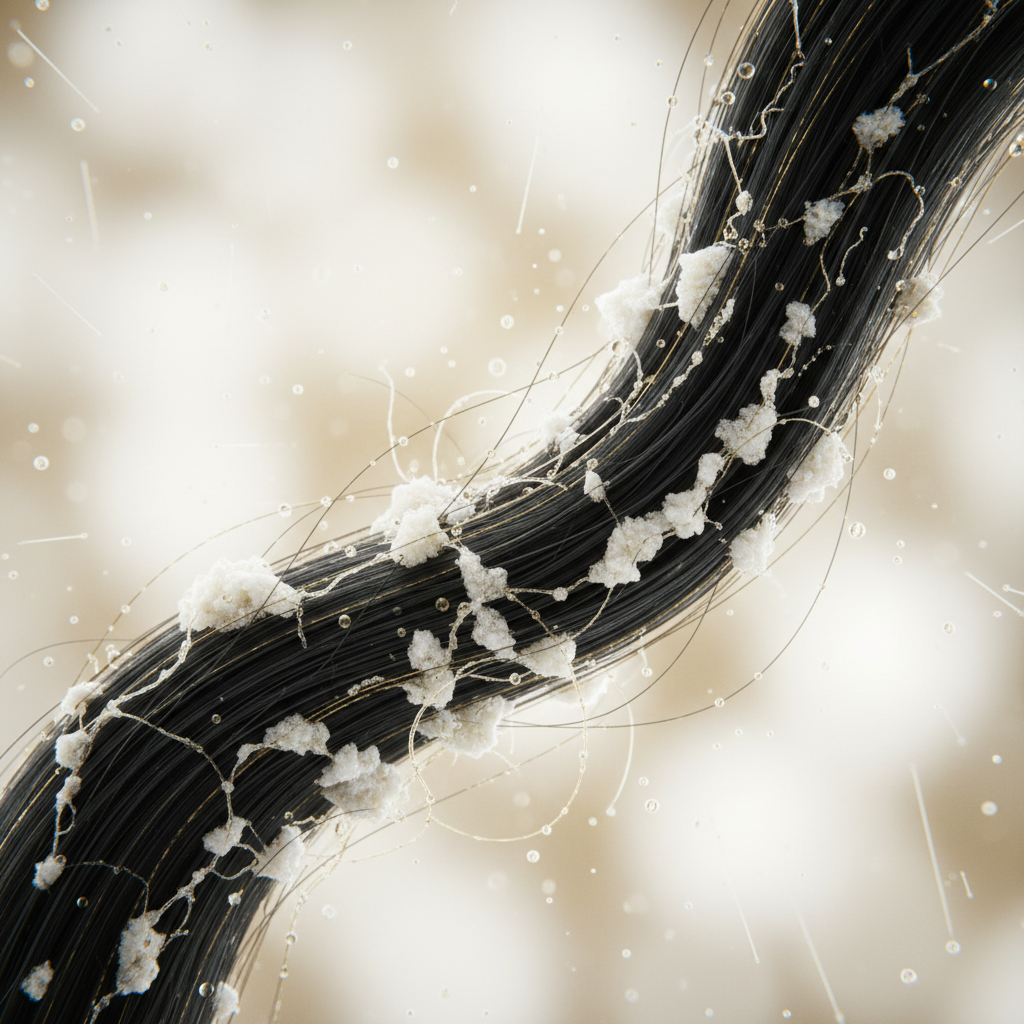
- Electrostatic attraction: Ingredients like behentrimonium chloride, cetrimonium chloride, and polyquaternium polymers carry strong positive (cationic) charges. They snap tightly onto the negatively charged cuticle to smooth frizz and reduce static.
- Hydrophobic deposition: Non-water-soluble silicones (such as dimethicone and trimethicone) and botanical waxes are intensely hydrophobic. They form a micro-film across the outer layer of the cuticle to seal in moisture and reflect light.
- Cumulative layering: When you apply these ingredients daily without an intermittent anionic surfactant to break the bond, the layers accumulate. Each layer traps dead corneocytes, airborne pollutants, and natural scalp sebum beneath it.
Eventually, this dense barrier interferes with chemical treatments, prevents moisture absorption, and causes individual strands to clump, creating drag that leads to comb-induced breakage.
Signs of cosmetic build-up versus alternative scalp issues
Before taking action, you must distinguish between true cosmetic build-up, hard water mineral deposits, and inflammatory dermatological conditions.
| Characteristic | Product Build-Up | Hard Water Mineral Scale | Scalp Dermatitis / Dandruff |
|---|---|---|---|
| Primary location | Hair shaft lengths, coating the root | Entire hair shaft, concentrated at ends | Directly on the scalp skin |
| Physical texture | Greasy, sticky, gummy, or waxy | Stiff, straw-like, rough, dull | Powdery, white flakes or greasy yellow scales |
| Visual clue | Lack of volume, dull film, clumping | Fading colour, brassiness in blonde hair | Redness, inflammation, visible flaking |
| Effective solution | Clarifying surfactant cleanse | Acidic chelating treatment (EDTA, citric) | Antifungal or targeted scalp therapy |
| Root cause | Cationic polymers, waxes, silicones | Calcium and magnesium carbonates | Malassezia overgrowth, rapid cell turnover |
What you can do to clear the hair fibre
Restoring clean hair requires a systematic approach using the right chemistry at the right intervals.
1. Integrate a dedicated clarifying shampoo
Choose a shampoo formulated specifically to clarify. Look for surfactant systems featuring sodium C14-16 olefin sulfonate, sodium lauryl sulfoacetate, or moderate sulphates balanced with amphoteric surfactants (like cocamidopropyl betaine). Use this product once every 7 to 14 days, depending on how many styling aids you apply. Work the lather thoroughly from scalp to ends for 60 to 120 seconds to allow the micelles to dissolve the waxy film.
2. Use a diluted apple cider vinegar rinse with care
If you prefer a mild cosmetic rinse, apple cider vinegar diluted to a safe level (one part vinegar to eight parts water, bringing the pH to roughly 4.0 to 4.5) can help compact the cuticle cells. This acidity helps smooth the fibre surface and clear light residue, but it cannot dissolve heavy water-insoluble silicones or high-melt waxes. Never use undiluted vinegar directly on the scalp.
3. Implement the double-cleanse technique
Professional stylists routinely double-cleanse at the backwash. The first wash breaks down superficial oils, heavy creams, and atmospheric soot; you will notice it produces minimal foam. Rinse thoroughly, then apply a smaller quantity of cleanser for the second wash. With the barrier broken, the second application lathers richly and lifts lingering deposits away cleanly.
4. Rebalance with lightweight hydration
Clarifying strips both cosmetic residue and some naturally occurring superficial lipids. Always follow a deep-cleansing session with a balanced, lightweight hydrating mask or conditioner. Avoid products packed with insoluble silicones or petrolatum immediately after clarifying, otherwise you will re-coat the bare keratin you just freed.
When the cause is something else
If your hair remains stiff, chalky, or dry despite using a high-grade clarifying shampoo, product build-up is unlikely to be the primary culprit.
- Hard water minerals: Homes with high calcium and magnesium carbonate levels (often exceeding 180 mg/L) leave dissolved rock residues that cannot be washed away with normal clarifying cleansers. This requires a dedicated chelating agent such as disodium or tetrasodium EDTA.
- Excess sebum: Seborrhoea produces an oily root within hours of washing, driven by internal androgens rather than exterior hair lotions or styling gels.
- Psoriasis or Seborrhoeic Dermatitis: Thick, silvery plaques or yellowish crusts that itch and bleed when picked are clinical medical conditions. Clarifying shampoos will only dry out the epidermal barrier and worsen inflammation.
When to seek professional advice
Seek guidance from a trichologist or registered dermatologist if you observe:
- Burning, raw patches, or deep red erythema on the scalp surface.
- Hair falling out by the root in wide diffuse volumes (telogen effluvium) or circular bald spots (alopecia areata).
- Scales that cannot be lifted with normal washing and emit an unpleasant odour.
- Severe breakage that continues even after stripping routines have ceased.
A qualified professional can use trichoscopy to examine your scalp skin and follicular openings at high magnification, confirming whether your issue is harmless cosmetic residue or an active dermatological condition.
The Watermans approach to balanced scalp care
Once you clear built-up film from the hair shaft, ongoing maintenance requires formulas that keep the scalp and roots clean without starving the fibre of vitality. Watermans incorporates this balance into its scalp-first hair wellness range. Products like Watermans Grow Me shampoo provide an invigorating cleanse powered by targeted natural extracts, rosemary, biotin, and caffeine. By thoroughly lifting everyday grime and sebum while respecting the scalp microbiome, it supports an optimal environment for fuller-looking, revitalised hair without leaving behind heavy, occlusive residue.
Frequently asked questions about How to Remove Product Build-Up from Hair
How to Remove Product Build-Up from Hair without damaging dyed strands?
To protect dyed hair, use a sulphate-free, colour-safe clarifying shampoo formulated with gentle carboxylate or amphoteric surfactants rather than aggressive sulphates. Keep water temperature lukewarm (around 37°C) to prevent the cuticle from expanding, and always follow with an acidic, cuticle-sealing conditioner (pH 4.0 to 5.0) to preserve artificial colour molecules.
How often should you clarify to remove build-up?
For most people, clarifying once every two to four weeks is ideal. If you use heavy pomades, edge controls, or daily leave-in silicones, a weekly clarifying wash may be necessary. If you rarely use styling products and wash frequently with light cleansers, once a month is sufficient to keep your fibres clear.
Can apple cider vinegar remove heavy silicone build-up?
No. Diluted apple cider vinegar helps flatten the cuticle scale and can clear light mineral dust or thin sebum coatings, but it lacks the lipophilic surfactant micelles needed to encapsulate and rinse away heavy, non-water-soluble silicones like dimethicone. You need a surfactant-based clarifying shampoo for complete removal.
Will clarifying shampoos stop hair shedding?
No. Clarifying shampoos clean the dead keratin of the hair shaft and the skin surface; they do not impact the internal biological mechanisms that govern the follicular hair growth cycle. They may prevent fibre snapping (breakage) by smoothing the strand, but true telogen shedding or alopecia must be addressed clinically.
Balancing clean hair with strand integrity
Knowing how to remove product build-up from hair enables you to restore volume, enhance bounce, and optimise moisture retention across all hair types. Product deposits act like a plastic wrap, dulling colour, distorting curl clumping, and increasing mechanical friction along the hair shaft. By scheduling a targeted clarifying wash, bypassing harsh alkaline DIY mixtures, and rehydrating your strands with lightweight formulations, you can maintain clean, responsive, and resilient hair.
Sources and references
- International Journal of Cosmetic Science: D’Souza, P. Et al., "Shampoos and Conditioners: What a Dermatologist Should Know?" (2015).
- Journal of the Society of Cosmetic Chemists: Robbins, C. R., "Chemical and Physical Behavior of Human Hair", Springer-Verlag (2012).
- British Journal of Dermatology: Trüeb, R. M., "Shampoos: Ingredients, benefits and adverse effects" (2007).
- Dermatologic Therapy: Gavazzoni Dias, M. F., "Hair Cosmetics: An Overview" (2015).