Preventing Bleach Breakage: Causes, Chemistry, and Care
9 min read ·
Learn the science-backed mechanisms behind Preventing Bleach Breakage, from bond chemistry and developer selection to essential post-lightening care.
Quick answer: Preventing Bleach Breakage requires controlling the chemical oxidation process that degrades hair keratin, alongside maintaining post-lightening structural integrity. Bleach permanently alters the hair fibre by stripping protective lipids and breaking disulphide bonds within the cortex. Successfully preventing bleach breakage involves using lower-volume developers, applying bond-protecting additives, avoiding repeated overlapping on previously lightened strands, and restoring mechanical lubrication. The main limitation is that chemical lightening always causes some irreversible structural damage; hair care can minimise or arrest breakage, but cannot restore virgin fibre architecture.
Key takeaways
- Bleach breaks the disulphide bonds that give hair its tensile strength, oxidises cystine into cysteic acid, and strips the protective 18-methyleicosanoic acid (18-MEA) lipid layer.
- Breakage is fibre snapping along the shaft, which is mechanically distinct from follicular hair shedding or systemic hair loss.
- Overlapping fresh bleach onto previously lightened strands is the leading mechanical cause of severe chemical snapping.
- Using a 20-volume (6%) developer for a longer processing time preserves more tensile elasticity than rapidly forcing lift with a 40-volume (12%) developer.
- Restoring surface lubrication through acidic conditioners (pH 3.5 to 5.0) and bond-building treatments significantly reduces friction-induced wet and dry comb snapping.
Preventing Bleach Breakage: what the evidence shows
Preventing Bleach Breakage requires an understanding of how alkaline persulphates interact with human hair keratin. Hair lighteners operate at an alkaline pH, typically between 9.0 and 11.0. This high pH swells the cuticular scales, allowing hydrogen peroxide and persulphate salts to penetrate through the protective outer sheath and into the cortex.
Inside the cortex, bleach oxidises natural melanin granules to lighten pigment. However, this reaction is not selective. The oxidising agents also react with cystine, the sulphur-rich amino acid responsible for cross-linking keratin proteins via disulphide bonds. The process converts cystine into cysteic acid. Cosmetic chemistry research confirms that as cysteic acid levels rise, the wet and dry tensile strength of the hair drops significantly. The fibre loses its natural elasticity, becoming brittle when dry and gummy or overly stretchy when wet.
Preventing bleach breakage relies on controlling the velocity and degree of this oxidation. Studies show that gentler, progressive lifting using lower concentrations of hydrogen peroxide generates fewer free radicals and oxidises fewer structural bonds than high-concentration developers applied to speed up salon appointments.
What the evidence does not show
There is no scientific evidence that any topical treatment, bond multiplier, or deep conditioning mask can completely reverse bleach damage. Once the disulphide bonds are converted into cysteic acid, that sulphur cross-link is permanently lost to oxidation.
Bond-building cosmetics can create ionic or secondary cross-links within the damaged keratin matrix, which improves wet tensile strength and prevents further structural collapse. However, they do not recreate virgin keratin. Furthermore, natural plant oils (such as coconut or argan oil) do not rebuild structural keratin bonds. While penetrating oils reduce protein loss during washing and reduce surface friction, they cannot repair internal cortex fractures. No cosmetic product can rebuild the cuticular 18-MEA lipid layer once bleach strips it away.
The mechanism: why bleached hair breaks
Hair breakage after bleaching occurs through a combination of chemical degradation and mechanical friction:
- Loss of the F-Layer: The epicuticle is coated in 18-MEA, a fatty acid layer that renders virgin hair hydrophobic (water-repellent) and naturally slick. A single bleach application removes most of this lipid shield. Hair becomes hydrophilic, absorbing water rapidly, swelling, and tangling under high friction.
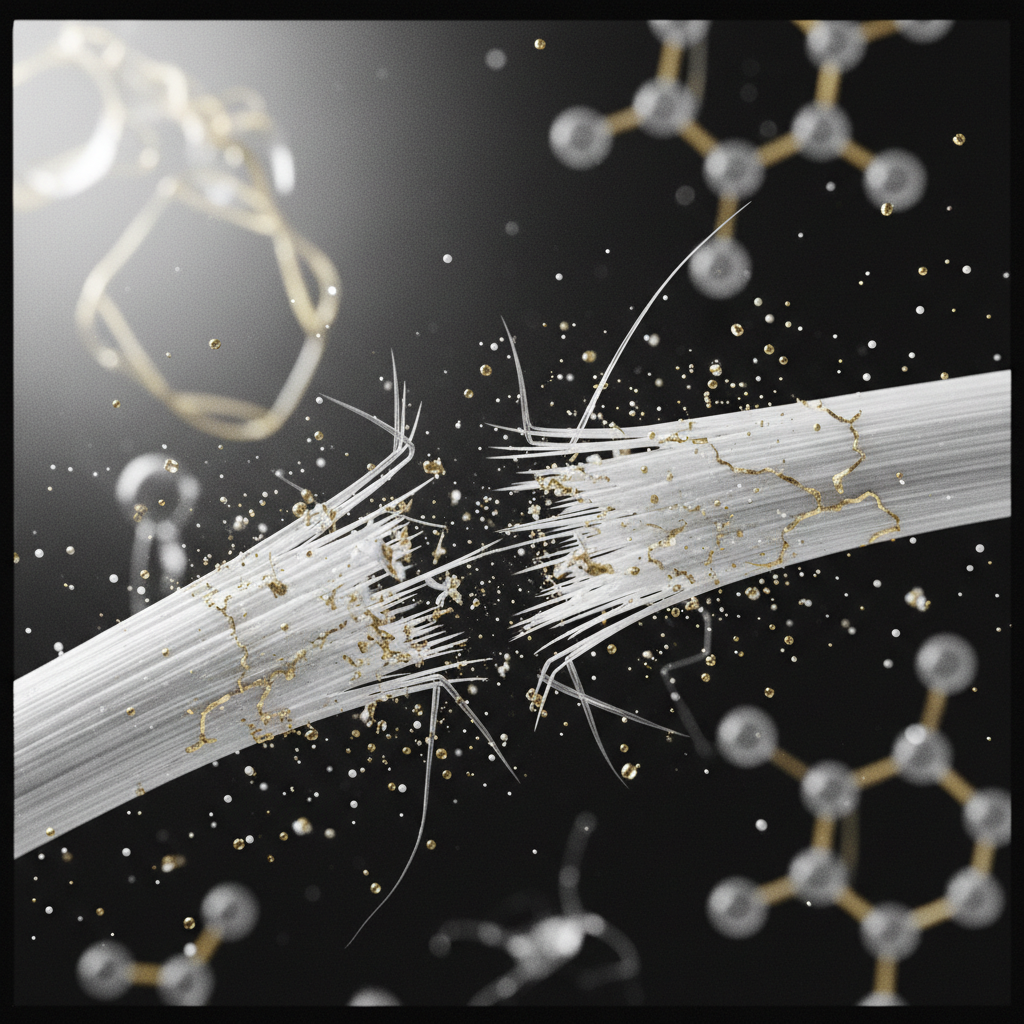
- Cortex voids and porosity: Oxidation creates microscopic fissures and voids within the cortical matrix. Under physical tension (such as combing, brushing, or heat styling), these micro-fractures propagate across the shaft, resulting in transverse fractures (snapping).
- The elasticity tipping point: Healthy hair can stretch up to 30 percent of its dry length before breaking. Severely bleached hair loses this resilience; it either snaps immediately under tension or stretches out elastically without bouncing back, finally snapping at low loads.
| Factor | Virgin Hair | Bleached Hair (Single Process) | Over-Processed Hair (Double Process / Overlap) |
|---|---|---|---|
| Surface Nature | Hydrophobic (lipid-coated) | Moderately hydrophilic | Extremely hydrophilic |
| Cysteic Acid Content | Very low (under 1%) | Moderate (3% to 5%) | High (exceeding 7% to 9%) |
| Wet Tensile Strength | High (elastic bounce-back) | Reduced by 20% to 30% | Critically low (gummy, snaps easily) |
| Cuticle Condition | Flat, intact, smooth | Lifted, chipped edges | Stripped, exposed cortex |
| Breakage Risk | Minimal under normal wear | Moderate if friction is high | Severe (spontaneous snapping) |
Signs of impending bleach breakage
Recognising early signs of structural compromise helps catch hair before it snaps completely:
- The wet stretch test: When wet, healthy hair stretches slightly and returns to its original length. Hair on the verge of snapping stretches excessively, feels mushy or gummy between the fingers, and does not bounce back.
- White bulb-less ends: If short pieces of hair fall onto your shoulders or sink, inspect the ends. A white bulb indicates normal hair shedding from the follicle. A clean, ragged break without a white bulb confirms hair breakage.
- Extreme wet tangling: When the cuticle is damaged, individual hair fibres catch against each other like Velcro. If hair mats instantly upon contact with water, the cuticle is severely degraded.
- Loss of curl pattern: In wavy, curly, or coily hair types, chemical damage disrupts the internal hydrogen and disulphide bonds that maintain the curl coil, leaving the pattern irregular, frizzy, or flat.
Best practices for preventing bleach breakage
Successfully preventing bleach breakage involves rigorous protocols before, during, and after lightening.
Before and during the service
- Avoid overlapping: The single most common cause of catastrophic breakage is applying fresh lightener over previously bleached bands. Lightener should only touch virgin regrowth. Stylists use barrier creams or foils to physically isolate lightened hair.
- Lower the developer strength: Opt for 10-volume (3%) or 20-volume (6%) peroxide rather than 30-volume (9%) or 40-volume (12%). Slower lifting preserves cortical integrity.
- Incorporate bond protectors: Formulations containing dicarboxylic acids or maleic acid derivatives help buffer structural proteins during the chemical process, limiting the reduction in tensile strength.
Post-bleach maintenance and handling
- Acidify the hair shaft: Bleached hair has an elevated, alkaline pH. Use an acidic rinse or conditioner with a pH between 3.5 and 5.0 immediately following lightening. This flattens the cuticular shingles and reduces swelling.
- Eliminate wet friction: Wet bleached hair is at its most fragile. Never roughly rub bleached hair dry with a cotton towel. Press water out gently using a smooth microfibre towel, and always apply a high-slip leave-in detangler before using a wide-tooth comb or flexible detangling brush.
- Reduce thermal styling: Heat appliances accelerate bond destruction in compromised hair. If using a hairdryer, keep the temperature on medium, maintain distance from the hair shaft, and never use flat irons or curling wands above 150 to 180 degrees Celsius on bleached strands.
When breakage is mistaken for other conditions
It is critical to distinguish between hair breakage and follicular shedding. People frequently panic after bleaching, believing their hair is "falling out at the root."
Chemical lighteners applied to the scalp can cause irritation or contact dermatitis, but they do not cause conditions like telogen effluvium or androgenetic alopecia unless a chemical burn physically damages the underlying follicles. If you notice overall thinning across the scalp, widening parts, or long hairs falling out with a small white keratin bulb attached to the end, the underlying cause is follicular shedding, not bleach breakage. Systemic shedding can occur weeks after a traumatic, stressful event, illness, or hormonal shift, coinciding by chance with a salon visit.
When to seek professional advice
If hair breaks off at the root level across large sections (often referred to as a "chemical haircut"), see an experienced, independent colourist or a qualified trichologist. A professional stylist can formulate an emergency plan, which may involve protein treatments, restructuring therapies, and a blunt trim to remove frayed ends that would otherwise continue splitting upward. If the scalp shows signs of redness, open sores, weeping, or intense burning following a bleach treatment, consult a GP or dermatologist immediately to treat chemical scalp burns and avoid permanent follicular scarring.
Watermans approaches to supporting fragile hair
While cosmetic products cannot chemically reconstruct broken disulphide bonds, supporting the scalp environment and safeguarding the fibre against physical snap is a sensible priority for lightened hair. Watermans develops hair formulations, including Grow Me Shampoo and Condition Me Conditioner, designed to provide balanced cleansing and surface slip.
When hair is bleached, the lack of natural surface lipids leaves it prone to snagging and breakage during daily washing. Watermans Condition Me incorporates conditioning agents, cholesterol, and natural extracts that help smooth the outer hair cuticle, restoring manageability and reducing comb-induced drag. Meanwhile, gentle, sulphate-free scalp care helps maintain a clean, comfortable follicular foundation while post-bleach strands slowly grow out.
Frequently asked questions about Preventing Bleach Breakage
Can coconut oil stop bleach damage if applied beforehand?
Applying virgin coconut oil several hours before bleaching can offer mild protection. Coconut oil penetrates the hair shaft and can chelate small amounts of iron and copper, which reduces free-radical formation during oxidation. However, it cannot fully block the oxidation of disulphide bonds. It provides a helpful buffer, but it does not make hair immune to chemical breakage.
How soon after bleaching can I brush my hair?
You should wait until your hair is damp or mostly dry, and always apply a detangling product first. Wet bleached hair loses significant elasticity and will snap under the tension of a brush. Use a wide-tooth comb starting gently from the ends, gradually working up toward the roots without tugging.
What is the most effective strategy for Preventing Bleach Breakage on previously coloured hair?
The most reliable strategy for Preventing Bleach Breakage on dark, previously dyed hair is gradual lightening across multiple sessions spaced 6 to 10 weeks apart. Attempting to lift artificial pigment out in one aggressive session requires prolonged lightener exposure and high-volume developers, which severely degrades the cortical matrix and triggers high breakage rates.
Will regular protein treatments fix hair that is already snapping?
Protein treatments temporarily fill structural gaps in the damaged cuticle and cortex, adding rigidity to overly soft, gummy hair. However, overusing hard protein without adequate moisturising agents makes the fibre brittle, which can actually increase dry snapping. Protein must always be balanced with hydrating conditioning agents.
Does bleach breakage ever stop on its own?
Bleach breakage rarely stops without intervention. Once the cuticle is stripped and the cortex splits, the split tends to travel up the hair shaft every time the strand is washed, brushed, or rubbed against clothing. Preventing continuous breakage requires trimming away compromised ends and adhering to strict low-friction styling habits.
Managing lightened hair safely
Preventing Bleach Breakage demands a careful balance of chemical restraint, mechanical gentleness, and protective haircare. Bleaching irreversibly alters the architecture of the hair fibre, stripping lipids and oxidising internal bonds. By avoiding overlapping, using conservative developer volumes, and eliminating high-friction habits, you can enjoy lighter shades while preserving the integrity and strength of your hair. When hair is treated with care during chemical services and buffered with appropriate post-lightening maintenance, severe bleach snapping can be successfully avoided.
Sources and references
- Chemical and Physical Behavior of Human Hair (5th Edition), Clarence R. Robbins, Springer, 2012.
- Journal of Cosmetic Science, "The effect of chemical treatments on the mechanical properties of hair", 2008.
- International Journal of Cosmetic Science, "Damage to human hair caused by peroxide bleaching: effect of bleaching agents on hair proteins", 2011.
- British Association of Dermatologists, "Hair breakage versus shedding: clinical guidelines", 2019.
Find these ingredients in Watermans products
- Argan Oil: you will find this ingredient in our Hair Growth Shampoo.
- Copper: you will find this ingredient in our Hair Vitamins.