Understanding PPD Hair Dye Allergy: Causes, Symptoms, and Management
9 min read ·
Learn the causes, symptoms, and biological mechanisms of a PPD Hair Dye Allergy, plus safe colouring alternatives and practical scalp care strategies.
Quick answer: A PPD Hair Dye Allergy is a type IV delayed hypersensitivity immune response triggered by paraphenylenediamine, an organic compound commonly used in permanent hair colour. Symptoms range from mild scalp redness, intense itching, and burning to severe facial swelling, blistering, and anaphylaxis. While patch testing identifies most reactive individuals, it cannot guarantee lifelong immunity. Once an allergy to PPD develops, it is permanent, meaning affected individuals must avoid oxidative dyes containing PPD and its related chemical analogues entirely.
Key takeaways
- Paraphenylenediamine (PPD) is a powerful contact allergen found in roughly two-thirds of permanent commercial hair dyes.
- Symptoms rarely appear immediately; they typically manifest between 24 and 72 hours following dye exposure.
- Cross-reactivity is common between PPD and related ingredients, such as toluene-2,5-diamine (PTD), black henna, and certain azo dyes.
- Patch tests (allergy alert tests) are mandatory 48 hours prior to every colour application, as sensitivities can develop after years of uneventful use.
- Severe reactions require immediate medical intervention, while mild reactions benefit from prompt dye rinsing, topical emollients, or prescribed corticosteroids.
PPD Hair Dye Allergy: what the evidence shows
Clinical dermatology classifies paraphenylenediamine as one of the most common causes of allergic contact dermatitis (ACD) associated with cosmetics. In the European Union and the United Kingdom, cosmetic regulations cap the maximum allowable concentration of free PPD base in consumer hair products at 2 percent when applied to the hair (following dilution with developer). Despite this limit, epidemiological reviews from the European Society of Contact Dermatitis consistently rank PPD among the top ten contact allergens in clinical patch-test populations, affecting roughly 4 to 8 percent of tested dermatitis patients.
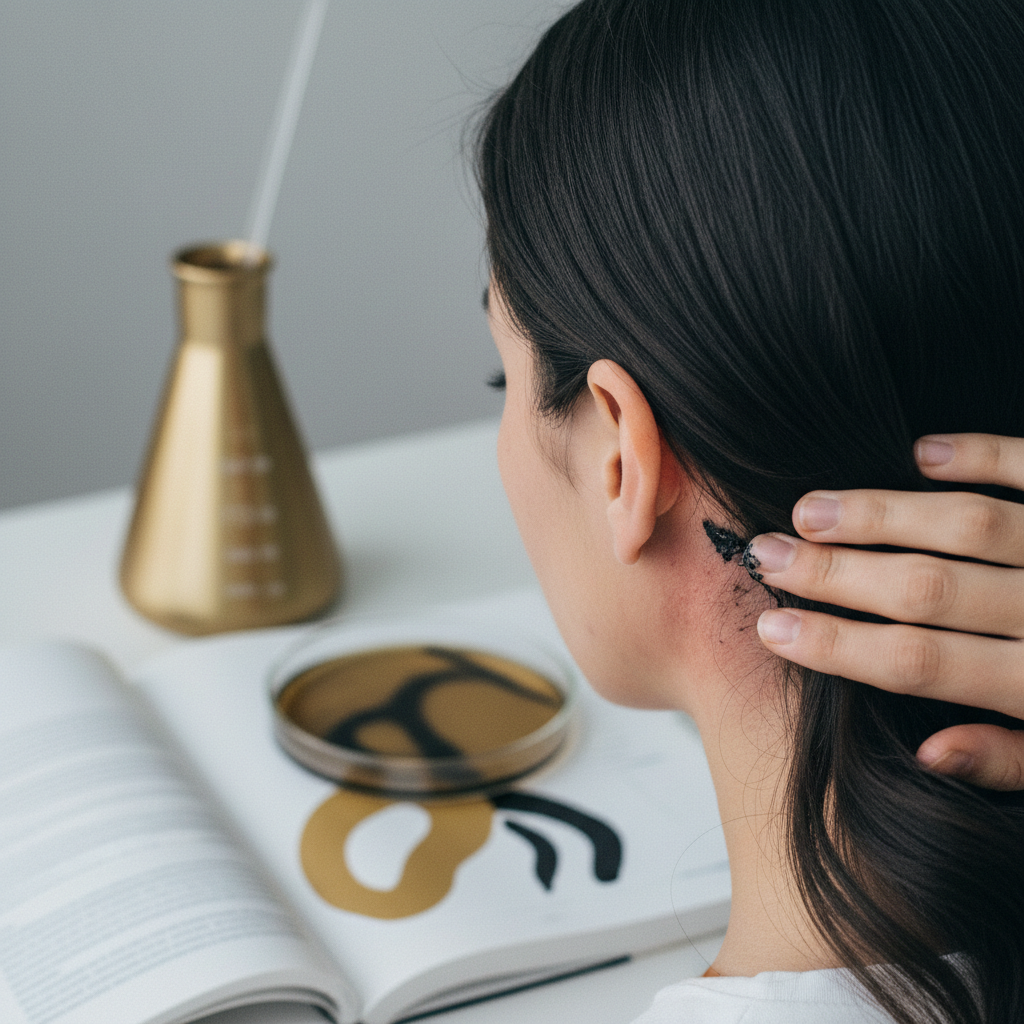
The evidence confirms that PPD itself is a pro-hapten. In its unoxidised state inside the dye bottle, it has low allergenic potency. However, once mixed with hydrogen peroxide and applied to the scalp, it oxidises into intermediate compounds such as Bandrowski's base. These oxidised intermediates bind readily to epidermal proteins, creating an antigen that triggers the immune system's T-cell response.
Scientific literature also demonstrates that black henna temporary tattoos significantly heighten the risk of developing a severe allergy. Black henna often contains illicitly high concentrations of PPD (sometimes exceeding 15 to 30 percent) directly on the skin without an oxidising coupler. This direct exposure primes the immune system, leading to violent reactions the next time the individual uses standard permanent hair dye.
What the evidence does not show
Research does not show that PPD causes systemic poisoning, internal organ damage, or reproductive toxicity when used in compliant cosmetic formulations under normal conditions. Extensive toxicological reviews by the Scientific Committee on Consumer Safety (SCCS) have repeatedly evaluated PPD and established that its primary risk profile is restricted to contact sensitisation.
Crucially, the evidence does not show that an allergy can be "cured" or desensitised through micro-exposures. Repeated exposure after initial sensitisation only accelerates and intensifies the immune reaction. Furthermore, clinical trials do not support the idea that "natural" or "organic" permanent dyes are automatically safe. If a hair dye permanently lightens or darkens hair through oxidation, it almost always contains PPD, PTD, or related chemical couplers, regardless of marketing claims.
Biological mechanism: why the scalp reacts
A reaction to PPD is not a standard skin irritation; it is a cell-mediated, type IV hypersensitivity reaction.
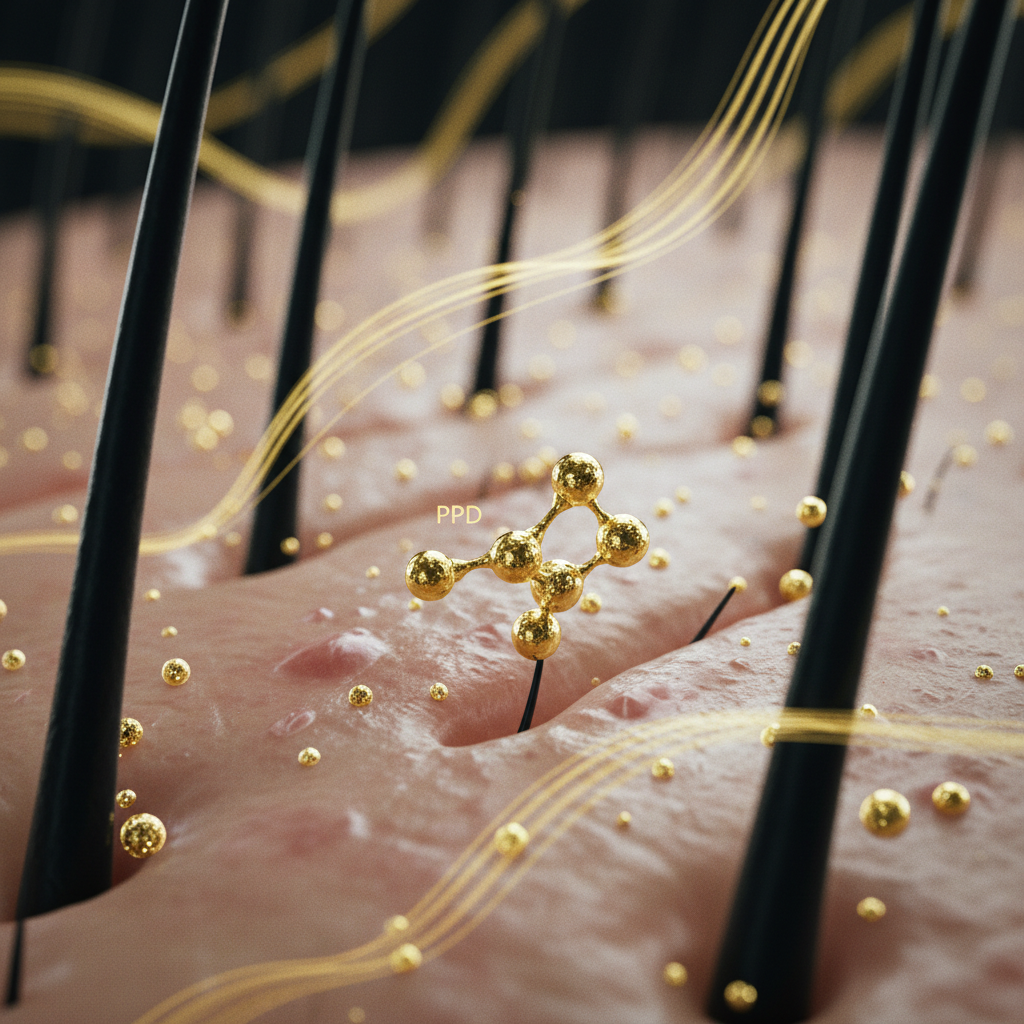
During initial exposure (the sensitisation phase), oxidised PPD molecules penetrate the stratum corneum and bind to epidermal proteins. Dendritic cells in the scalp, known as Langerhans cells, capture these protein conjugates, process them, and migrate to local lymph nodes. There, they present the allergen to naive T-lymphocytes, creating a population of memory T-cells programmed to recognise PPD.
When you dye your hair again months or years later (the elicitation phase), these memory T-cells rapidly recognise the PPD-protein complex. They release inflammatory cytokines, recruiting neutrophils, macrophages, and mast cells to the skin. This cascade dilates local blood vessels, causes tissue swelling (oedema), and damages epidermal cells, producing the classic vesicular blisters, redness, and raw sensations of allergic contact dermatitis.
Because this response relies on T-cell recruitment rather than circulating antibodies, symptoms take time to develop. This explains why reactions typically peak 48 to 72 hours after the salon visit.
| Reaction type | Irritant contact dermatitis | Allergic contact dermatitis (PPD allergy) | Severe / Systemic reaction |
|---|---|---|---|
| Immune involvement | No (direct chemical irritation) | Yes (Type IV T-cell mediated) | Yes (acute hypersensitivity) |
| Onset time | Immediate or within minutes | 24 to 72 hours after application | Minutes to several hours |
| Key symptoms | Stinging, burning, dry scalp | Blistering, intense itch, weepy rash | Facial oedema, eyelid swelling, dyspnoea |
| Spread of rash | Confined strictly to application site | Spreads to ears, neck, forehead, eyelids | Widespread rash, full face swelling |
| Future dye safety | Can often reuse dye with lower peroxide | Never reuse PPD or related oxidative dyes | Medical emergency; strict avoidance |
Recognising the signs of a PPD reaction
Symptoms of an adverse reaction fall along a spectrum from localised discomfort to dangerous systemic swelling.
Early and moderate signs include:
- Severe, persistent itching on the scalp that worsens two days after colouring.
- Burning sensations and fiery redness across the scalp, hair margins, ears, and neck.
- Raised bumps or fluid-filled vesicles (blisters) that ooze and crust over.
- Puffy eyelids, often making it difficult to open the eyes fully.
Severe signs indicating an emergency include:
- Rapid swelling of the lips, tongue, neck, or entire face (angioedema).
- Tightness in the chest, wheezing, or difficulty swallowing and breathing.
- Dizziness, confusion, or a sudden drop in blood pressure.
If respiratory difficulties or facial angioedema occur, phone emergency services immediately.
What you can do: immediate steps and management
If you suspect you are developing a reaction during or shortly after colouring:
- Rinse thoroughly: Wash the scalp immediately with copious amounts of lukewarm water and a mild, sulphate-free shampoo to remove residual dye residues.
- Neutralise remaining dye: Historically, dermatology clinics use a mild oxidiser such as dilute hydrogen peroxide (2 percent) or a rinse of potassium permanganate compresses to fully oxidise free PPD, rendering it chemically inert. At home, thorough washing is safest.
- Soothe the skin: Apply cold compresses to the neck, forehead, and scalp to constrict blood vessels and ease itching. Plain liquid paraffin or emollient creams can protect raw, weeping skin.
- Consult a pharmacist or GP: Mild to moderate dermatitis responds well to short courses of topical corticosteroid lotions prescribed for the scalp, alongside oral antihistamines to dampen histamine-driven pruritus.
When the cause may be something else
Not every itchy scalp after colouring stems from a PPD allergy. Distinguishing between genuine allergy and other scalp conditions prevents unnecessary lifestyle restrictions.
- Irritant contact dermatitis: Caused by high-volume hydrogen peroxide, ammonia, or persulphates in bleach stripping the protective scalp lipid barrier. This causes instant stinging without spreading beyond the product boundary.
- Seborrhoeic dermatitis: A fungal and inflammatory condition involving Malassezia yeast that produces greasy, yellowish scales. Dye application can irritate existing seborrhoeic patches without an allergy being present.
- Preservative allergies: Ingredients like methylisothiazolinone (MI) or fragrance blends in conditioners packaged with the dye can trigger contact dermatitis that mimics a PPD reaction. Formal patch testing by a dermatologist differentiates these culprits.
Safe alternatives for coloured hair
Receiving a positive diagnosis for a PPD allergy does not mean you can never change your hair colour again, but it does eliminate conventional oxidative dyes.
Safe options generally include:
- Pure henna and indigo: Natural, plant-derived powdered Lawsonia inermis (red/orange) and Indigofera tinctoria (blue/black). Ensure the powder is 100 percent pure and free of metallic salts or added PPD.
- Direct dyes (semi-permanent): True direct dyes sit on the hair cuticle without peroxide or ammonia couplers. Many vegetable-based or direct-pigment fashion colours do not contain PPD, though checking the ingredient deck remains mandatory.
- Toluene-2,5-diamine (PTD) alternatives: Some individuals with mild PPD sensitivity tolerate dyes formulated with PTD (often labelled as ME+ technology). However, dermatological studies reveal a cross-reactivity rate of up to 50 percent. Only attempt this under medical patch-test supervision.
- Highlighting off the scalp: Techniques such as foil highlights prevent bleach or toner from contacting the scalp skin.
Supporting the scalp barrier after chemical irritation
Once the acute allergic dermatitis has cleared and medical treatment concludes, the scalp's epidermal barrier remains compromised, dry, and fragile for several weeks. During this recovery phase, gentle care is vital. Use mild, nutrient-rich cleansers that do not strip remaining lipids or aggravate healing skin. Formulations like Watermans GrowMe Shampoo provide an intentionally gentle, sulphate-free cleansing base infused with natural botanicals, biotin, and rosemary that cleanse the scalp environment without the harsh detergent loads found in standard clarifying shampoos. Pair this with nourishing, non-occlusive treatments that support hair fibre health while the scalp restores its natural microbiome and barrier balance.
Frequently asked questions about PPD Hair Dye Allergy
Can a PPD Hair Dye Allergy develop suddenly after years of colouring?
Yes. Sensitisation is an acquired immune response. You can dye your hair uneventfully for decades, but once your immune system's T-cells cross the threshold of recognising oxidised PPD as a threat, a PPD Hair Dye Allergy develops permanently. Future exposures will consistently trigger allergic contact dermatitis.
How do I properly perform a patch test for hair dye?
Mix a pea-sized amount of dye and developer. Clean a small patch of skin behind your ear or on your inner elbow, apply the mixture with a cotton swab, and let it dry. Leave it uncovered and undisturbed for 48 hours. If any redness, swelling, burning, or itching develops, wash it off immediately and do not use the product.
Are ammonia-free hair dyes safe for people with a PPD allergy?
No. Ammonia-free dyes replace ammonia with alternative alkalisers, such as ethanolamine, to swell the hair shaft. However, they almost always rely on PPD or PTD to provide permanent colour. "Ammonia-free" does not mean "PPD-free." Always check the full ingredient listing on the box.
Will a PPD allergy cause permanent hair loss?
A PPD allergy does not attack the hair follicle stem cells, meaning it does not cause permanent follicular hair loss. However, severe inflammation, weeping, and aggressive scratching can lead to temporary telogen effluvium shedding or breakage of weakened hair fibres. Once the scalp heals, normal hair growth cycles resume.
Managing life with a PPD sensitivity
A confirmed PPD Hair Dye Allergy demands vigilance, but it is entirely manageable once you understand product labelling. Paraphenylenediamine remains the global workhorse of permanent hair colour due to its exceptional ability to bind natural-looking pigment deep inside the hair cortex. However, the immune system never forgets a sensitising event. If you have reacted to permanent dye, stop colouring immediately, seek a patch-test confirmation from a dermatologist, and switch to lab-verified direct dyes or pure botanical alternatives to protect your scalp health long term.
Sources and references
- European Society of Contact Dermatitis (ESCD). Guidelines on diagnostic patch testing for hair dye dermatitis. 2020.
- Scientific Committee on Consumer Safety (SCCS). Opinion on p-Phenylenediamine (CAS 106-50-3). European Commission, 2012.
- British Association of Dermatologists (BAD). Patient Information Leaflet: Paraphenylenediamine (PPD) Allergy. 2021.
- National Health Service (NHS). Hair dye reactions and chemical allergies. 2022.
- Contact Dermatitis Journal. Cross-reactivity patterns between p-phenylenediamine and other aromatic amines in clinical patch testing. Wiley, 2019.