Monilethrix: Causes, Symptoms, and Evidence-Based Management
8 min read ·
Monilethrix is a rare genetic hair shaft disorder causing beaded, fragile fibres that snap easily. Learn about causes, signs, dermoscopy, and management.
Quick answer: Monilethrix is a rare genetic hair shaft disorder characterised by beaded hair fibres that snap easily under everyday mechanical stress. Driven primarily by mutations in hair cortex keratin genes (such as KRT81, KRT86, and KRT83), it causes rhythmic alternating nodes and constrictions along the hair shaft. Because the constricted internodes lack normal structural integrity, severe hair breakage occurs close to the scalp. Monilethrix cannot be permanently cured, but gentle mechanical care and specialised medical management can significantly reduce fibre breakage.
Key takeaways
- Structural defect: Monilethrix produces a distinctive "beaded" fibre with swollen nodes and fragile, constricted internodes.
- Genetic origin: Most cases follow an autosomal dominant inheritance pattern linked to mutations in type II hair cortex keratins, though autosomal recessive forms exist.
- Breakage, not alopecia: The hair follicle remains active, but the fibre fractures at the fragile internodes, often mimicking diffuse patchy hair loss.
- Perifollicular keratosis: Small, rough, keratotic papules frequently form around scalp follicles, often accompanied by erythema.
- Management focus: Treatment focuses on minimising physical friction, chemical processing, and heat, alongside dermatological therapies such as oral minoxidil or retinoids.
Monilethrix: what the evidence shows
Monilethrix takes its name from the Latin monile (necklace) and the Greek thrix (hair), describing the necklace-like, beaded appearance of affected hair fibres. First described in medical literature in the late nineteenth century, it is classified as a congenital hair shaft dysplasia with increased fragility.
Dermatological investigations confirm that Monilethrix is predominantly an autosomal dominant condition with variable penetrance and expression. This means symptoms can range from subtle thinning restricted to the nape of the neck to widespread, near-total breakage across the scalp, eyebrows, eyelashes, and body hair.
Research published in human genetics and dermatological journals reveals that the dominant form is caused by point mutations in the genes encoding basic hair keratins: KRT81, KRT86, and KRT83. A rarer autosomal recessive form stems from mutations in the desmoglein 4 gene (DSG4), which regulates desmosomal adhesion in hair follicles.
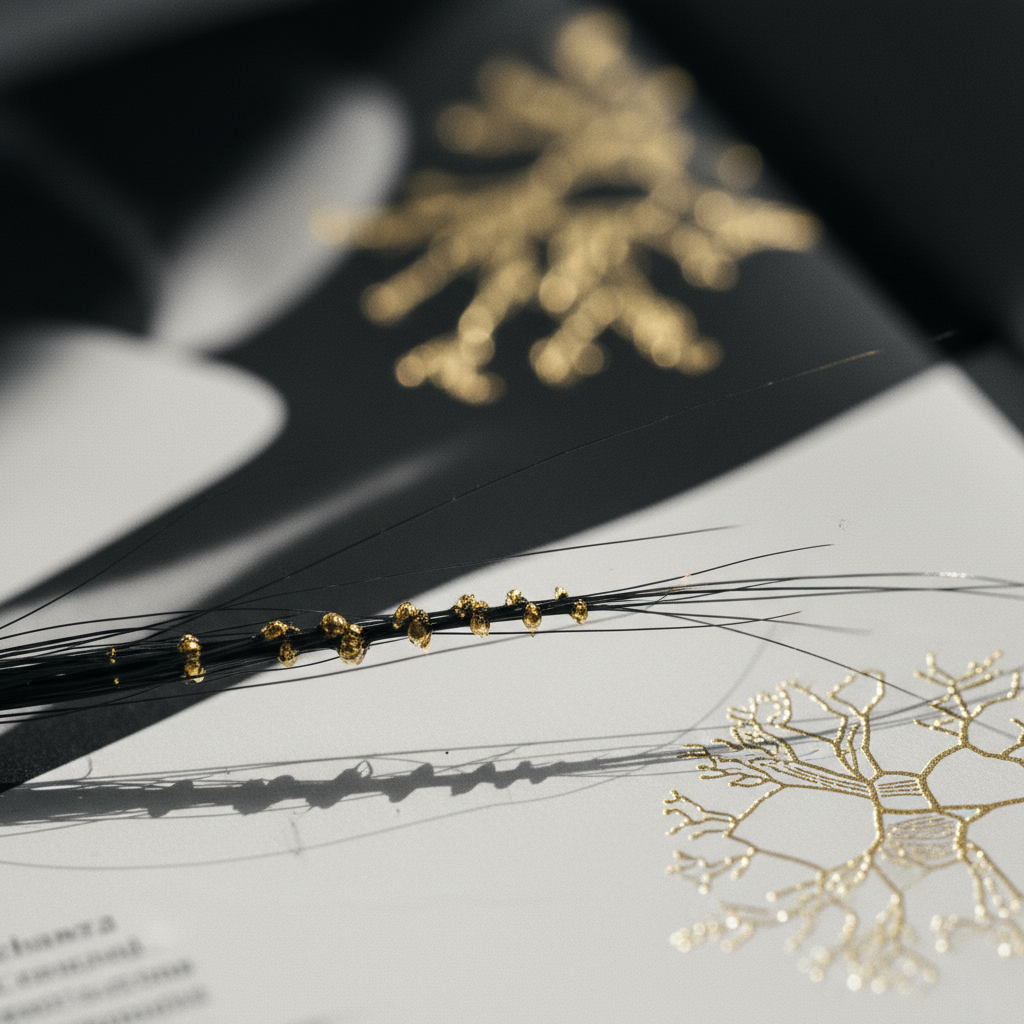
Under standard dermoscopy and light microscopy, hair shafts display a regular periodicity. Swollen elliptical nodes measure approximately normal hair shaft diameter (roughly 70 to 100 micrometres), while the intervening constrictions narrow to 20 to 40 micrometres. These constrictions lack a regular medulla and have a severely disrupted cuticle, making them structural weak points that fracture under minimal physical force.
 Node Internode (Constriction) Node
 (Normal) (Weak point / Snaps) (Normal)
 [======] \______/ [======]
Biological mechanism of beaded hair formation
The hair shaft develops through tightly coordinated protein synthesis and cross-linking within the precortical zone of the follicle. In healthy hair, keratin intermediate filaments align parallel to the growth axis, embedded in a matrix rich in cysteine and sulphur-containing proteins.
In Monilethrix, the genetic mutation alters the helix-termination motif of the keratin molecules. This disruption destabilises the intermediate filament network. The follicle exhibits a periodic rhythm in its metabolic and structural output:
- Cellular disruption: As matrix cells advance through the keratinisation zone, the defect impairs structural bonding at regular cyclical intervals.
- Constriction phase: During the vulnerable phase of the cycle, cortical cells fail to compact properly, producing a thin, unmedullated internode.
- Node phase: The follicle temporarily recovers full synthesis, forming a broader node that resembles normal fibre width.
- Surface damage: As the hair emerges past the infundibulum, the cuticular scales over the internodes rub off, leaving naked cortical cells exposed to atmospheric oxygen and friction.
Because normal tensile strength depends on intact cortex bundles, tensile loading tests show that these internodes fail under a fraction of the force that healthy hair withstands.
Clinical signs and diagnostic features
Monilethrix typically presents in early infancy, between the second and fifth months of life, although subtle variants can go unnoticed until childhood.
Typical presentations include:
- Short, brittle stubble: Neonatal lanugo hair sheds normally, but the replacement terminal hair fails to grow beyond 1 to 2 centimetres before snapping off.
- Perifollicular papules: Follicular hyperkeratosis appears across the scalp, especially over the occiput and nape. These feel rough, like goosebumps or sandpaper, and may feature a small horn-like plug.
- Predilection for friction zones: Breakage concentrates heavily where the head rubs against pillows, collars, or hats.
- Variable body involvement: While the scalp is the primary site, the condition can involve beard hair, eyebrows, eyelashes, axillary hair, and pubic hair.
- Nail changes: A minority of patients present with koilonychia (spoon nails) or longitudinal ridging.
Dermatologists diagnose the condition using trichoscopy (magnified scalp examination) or polarised light microscopy. Genetic testing confirms the exact variant where clinical clarity is required.
Monilethrix compared to other hair shaft defects
Because Monilethrix causes extensive fibre fracture, it is often confused with other congenital and acquired hair shaft disorders. The table below outlines the core diagnostic differences.
| Condition | Primary structural feature | Genetic basis | Primary scalp findings | Hair tensile strength |
|---|---|---|---|---|
| Monilethrix | Regular alternating nodes and constrictions (beading) | Genetic (KRT81, KRT86, KRT83, DSG4) | Perifollicular keratotic papules common | Extremely low; breaks at internodes |
| Pseudomonilethrix | Irregular node-like indentations along the shaft | Acquired or irregular inherited | Normal scalp, no keratotic papules | Moderate; snaps under repeated trauma |
| Trichorrhexis nodosa | Paintbrush-like fractures, swollen nodes without narrowing | Acquired (chemical/heat) or genetic (argininosuccinic aciduria) | Usually normal scalp skin | Low; splits at brush sites |
| Pili torti | Shaft flattened and twisted 180 degrees on its axis | Genetic (e.g., Björnstad syndrome) or acquired | Variable; sometimes keratosis pilaris | Low to moderate; fractures at twist apex |
| Trichothiodystrophy | Clean transverse fractures (trichoschisis), low sulphur | Genetic (DNA repair gene mutations) | Often dry, ichthyotic skin | Very low; brittle, dull, short |
Medical and clinical management
There is no gene therapy capable of reversing the underlying mutation in Monilethrix. Management revolves around medical interventions to support shaft thickness and meticulous physical care to limit fractures.
Pharmacological approaches
- Low-dose oral minoxidil: Doses ranging from 0.25 mg to 1.25 mg daily have demonstrated noticeable improvement in paediatric and adult case series. Minoxidil prolongs the anagen (growth) phase and encourages vasodilation, often yielding thicker hair fibres that withstand mechanical trauma better.
- Topical minoxidil: Often less tolerated than oral formulations because the alcohol and propylene glycol vehicles can exacerbate perifollicular irritation and scaling.
- Oral retinoids (Acitretin / Isotretinoin): Controlled dermatological use can reduce painful or prominent perifollicular hyperkeratosis. However, high doses can induce hair shedding, so therapy requires careful titration.
- Topical keratolytics: Mild preparations containing lactic acid, urea (5 to 10 percent), or salicylic acid help soften rough follicular papules without physical scrubbing.
Spontaneous changes
Monilethrix sometimes improves spontaneously around puberty or during pregnancy, likely influenced by hormonal shifts that alter follicular activity and sebum production. It rarely resolves completely, but adult hair often exhibits longer growth before fracturing.
Supportive home care and salon styling
Cosmetic handling must eliminate shear stress and abrasion. Stylists and individuals can protect delicate fibres with targeted adjustments:
- Zero mechanical friction: Replace cotton pillowcases with smooth silk or satin to reduce friction during sleep. Avoid tight hats, elastic headbands, and rough collar fabrics.
- Gentle detangling: Never backcomb, tease, or roughly brush the hair. Use wide-toothed combs or soft-bristle brushes, handling strands only when dry or pre-slip conditioned.
- Eliminate chemical processing: Permanent colour, bleaching, relaxers, and perms break disulphide bonds within the already fragile cortex, leading to complete structural failure.
- Minimise heat styling: Avoid blow dryers, straighteners, and curling wands. Heat rapidly denatures weak keratin at the narrow internodes.
- Hydrating formulations: Use conditioning agents that lower inter-fibre friction and seal the disrupted cuticles with light emollients and film-forming polymers.
The role of cosmetic hair care: what Watermans products can and cannot do
Understanding the exact nature of hair shaft disorders ensures realistic expectations. Monilethrix is an inherited genetic condition governing keratin filament assembly; no shampoo, conditioner, scalp serum, or cosmetic formula can rewrite genetic code, alter DNA expression, or eliminate the internodal narrowing.
Cosmetic products can, however, play a supportive role in environmental hair management. Watermans formulas, including the Grow Me Shampoo and Condition Me Conditioner, are engineered to cleanse the scalp gently and deliver conditioning agents that improve slip. In individuals managing fragile hair, enhanced slip reduces detangling friction, which helps limit breakage from everyday washing. They also support a clean, moisturised scalp environment around follicular openings. These are cosmetic benefits that promote stronger-feeling hair and better manageable condition; they are not medical treatments for genetic dysplasias.
Frequently asked questions about Monilethrix
Can Monilethrix be cured permanently?
No, Monilethrix cannot be cured permanently because it is caused by mutations in the genes responsible for keratin production. The condition is managed rather than eradicated. Dermatologists focus on reducing mechanical breakage, improving shaft quality with therapies like low-dose oral minoxidil, and smoothing rough perifollicular keratosis.
Does Monilethrix lead to permanent follicular scarring?
Monilethrix is generally a non-scarring condition. The hair follicle retains the biological ability to produce fibres throughout the individual's life. However, if the accompanying perifollicular keratosis becomes chronically inflamed or secondary bacterial infections occur from scratching, localized micro-scarring can occasionally develop.
At what age do symptoms of Monilethrix first appear?
Symptoms of Monilethrix typically become noticeable during early infancy, between 2 and 5 months of age. The initial fine newborn hair is shed normally, but the emerging terminal hair is fragile, snapping easily against bedding and leaving short, brittle patches primarily around the occiput.
How is Monilethrix diagnosed by a dermatologist?
Dermatologists usually diagnose Monilethrix using trichoscopy, which reveals the pathognomonic regularly spaced nodes and thin constrictions along the hair fibres. Polarised light microscopy of plucked or clipped hairs confirms the beaded appearance. When clinical presentation is atypical, genetic testing identifies specific mutations in KRT81, KRT86, or KRT83.
Summary
Monilethrix is an uncommon, inherited hair shaft defect that presents unique challenges for both patients and hair specialists. By understanding that its primary presentation is fibre breakage caused by structurally compromised internodes rather than follicular failure, treatment can focus on what genuinely helps: shielding hair from physical shear, moderating heat and chemical exposure, and exploring evidence-based dermatological therapies.
Sources and references
- British Association of Dermatologists. Clinical Guidelines and Patient Information: Monilethrix.
- National Center for Advancing Translational Sciences (NCATS). Genetic and Rare Diseases Information Center (GARD): Monilethrix.
- Winter, H., et al. "Mutations in the hair cortex keratin hHb6 cause the inherited hair disease monilethrix." Nature Genetics, 1997.
- Sinclair, R. D., et al. "Low-dose oral minoxidil for the treatment of monilethrix: A case series." Journal of the American Academy of Dermatology, 2020.
- Schweizer, J. "More than just beads: the cellular mechanism of monilethrix." Journal of Investigative Dermatology, 2006.
- World Health Organization. International Statistical Classification of Diseases and Related Health Problems (ICD-11): Hair shaft abnormalities.