Managing Scalp Psoriasis and Dandruff: Science and Care
9 min read ·
Learn the science behind managing scalp psoriasis and dandruff, from identifying cellular causes to gentle, evidence-based routines that restore balance.
Quick answer: Successfully managing scalp psoriasis and dandruff starts with identifying the underlying cause, as their biological mechanisms differ entirely. Dandruff stems from an overgrowth of Malassezia yeast and excess sebum, whereas scalp psoriasis is a chronic autoimmune disorder driving rapid skin-cell turnover. While dandruff responds well to over-the-counter antimicrobial washes, scalp psoriasis often requires targeted keratolytic agents and prescription anti-inflammatory therapies. The primary limitation is that neither condition has a permanent cure; both demand ongoing, consistent maintenance to keep flares and shedding under control.
Key takeaways
- Dandruff produces fine, greasy or dry flakes caused by an inflammatory reaction to Malassezia yeast metabolising scalp sebum.
- Scalp psoriasis produces thick, well-demarcated plaques covered in silvery-white scales, driven by immune-mediated epidermal hyperproliferation.
- Aggressive scrubbing or manual picking of psoriasis plaques can induce the Koebner phenomenon, worsening the plaque and triggering hair breakage or temporary shedding.
- Keratolytics such as salicylic acid soften and lift thick crusts, allowing topical treatments to reach the inflamed epidermis.
- A clinical evaluation by a GP or dermatologist is crucial if scaling bleeds, spreads past the hairline, or fails to improve within four weeks.
Managing Scalp Psoriasis and Dandruff: what the evidence shows
When approaching managing scalp psoriasis and dandruff, clinicians first assess the structural characteristics of the scale and the surrounding skin. Both disorders cause visible flaking and pruritus (itching), yet their origins, histology, and management pathways diverge significantly.
Dandruff represents a mild, non-inflammatory form of seborrhoeic dermatitis. The human scalp naturally harbours Malassezia globosa and Malassezia restricta. These lipid-dependent yeasts feed on triglycerides found in human sebum, breaking them down into free fatty acids such as oleic acid. In susceptible individuals, oleic acid penetrates the stratum corneum, disrupting the epidermal barrier and triggering an accelerated epidermal turnover rate. Healthy scalp skin cells shed invisibly every 28 to 30 days. In dandruff, this transit time drops to roughly 10 to 14 days, causing incompletely keratinised corneocytes to clump together into visible flakes.
Scalp psoriasis operates on an autoimmune pathway. Activated T-cells release pro-inflammatory cytokines, specifically interleukin-17 (IL-17), interleukin-23 (IL-23), and tumour necrosis factor-alpha (TNF-alpha). This cytokine cascade drives keratinocytes to proliferate uncontrollably, compressing the normal cell maturation cycle from nearly a month down to just 3 to 5 days. Immature nucleated cells accumulate on the scalp surface, generating thick, silvery-white plaques anchored to an erythematous (reddened or purplish on darker skin) base.
Because the underlying biology differs, your treatment strategy must match the pathology. Antifungals address the fungal driver of dandruff, whereas scalp psoriasis requires agents that slow cellular hyperproliferation and quiet the immune response.
| Feature | Dandruff (Seborrhoeic Dermatitis) | Scalp Psoriasis |
|---|---|---|
| Primary Mechanism | Reaction to Malassezia yeast metabolites | Autoimmune-driven keratinocyte hyperproliferation |
| Scale Appearance | Fine, white or yellowish, greasy or powdery | Thick, well-demarcated, silvery-white plaques |
| Underlying Skin | Mild pinkness or normal skin tone | Distinct, raised erythema (red, salmon, or purple) |
| Typical Location | Diffuse across the entire scalp | Patchy, often along hairline, nape, and behind ears |
| Spread | Confined to sebum-rich areas (scalp, eyebrows) | May extend past hairline onto forehead, neck, or body |
| Bleeding on Removal | Rare; skin beneath is intact | Common (Auspitz sign: pinpoint bleeding if scraped) |
| First-line Care | Ketoconazole, zinc pyrithione, piroctone olamine | Keratolytics (salicylic acid), topical corticosteroids |
What the evidence does not show
Misconceptions surrounding scalp conditions frequently delay effective relief. The evidence does not show that poor personal hygiene causes either condition. Dandruff is not the result of unwashed hair, nor is psoriasis caused by dirt. While infrequent washing allows sebum and yeast to accumulate, over-washing with harsh, high-pH detergents can disrupt the acid mantle (natural scalp pH sits between 4.5 and 5.5), aggravating barrier dysfunction.
Furthermore, evidence does not show that natural oils cure either issue. Applying pure olive oil, coconut oil, or heavy pomades to active dandruff often feeds Malassezia, worsening the yeast overgrowth. For psoriasis, oils may temporarily soften scale, but they do not arrest the systemic immune mechanisms driving the plaques.
Crucially, neither dandruff nor scalp psoriasis destroys the underlying hair follicle under normal circumstances. Flaking conditions do not directly cause permanent follicular hair loss (cicatricial alopecia). However, severe scratching can cause hair breakage along the shaft or induce telogen effluvium, where metabolic stress pushes follicles into a premature shedding phase.
The signs to look for
Distinguishing between these conditions requires examining the border, texture, and location of the scaling.
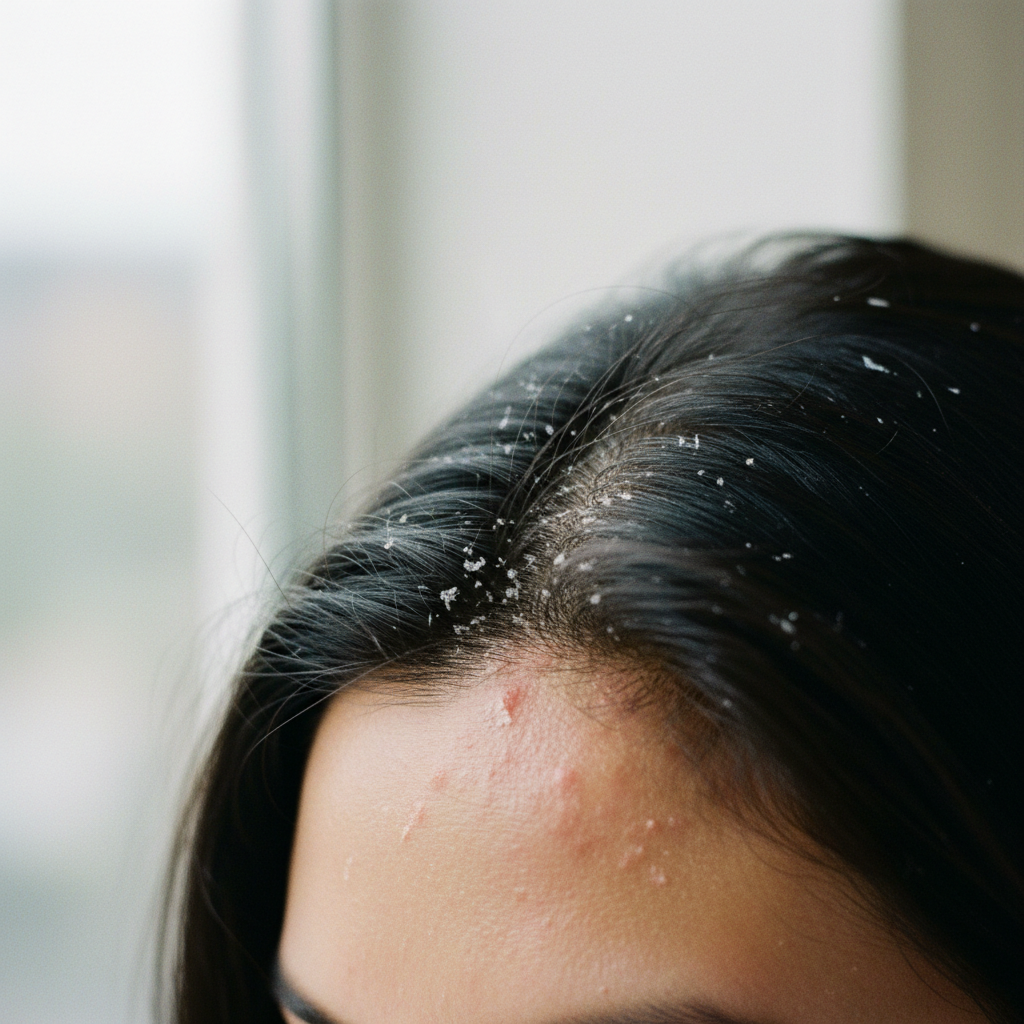
Dandruff flaking is typically loose and distributed evenly throughout the hair. The flakes detach easily with brushing. Itching is moderate, and while the scalp may feel tight or sensitive, there are rarely hard, raised borders.
Scalp psoriasis presents with firm, adherent plaques. You can easily feel the raised boundary between healthy skin and affected skin with your fingertips. These plaques frequently migrate past the frontal hairline onto the forehead or gather densely behind the ears and at the occipital ridge (the nape of the neck). If you attempt to lift or scratch a dry psoriasis scale, you may notice tiny pinpoint bleeding spots beneath it. This is known as the Auspitz sign, caused by dilated capillaries sitting close to the thin, rapidly dividing epidermal layer.
Practical steps for managing both conditions
Achieving a calm scalp involves targeted active ingredients, gentle mechanical handling, and protective washing habits.
Managing dandruff
- Rotate antimicrobial washes: Use active cleansers containing ketoconazole (1% to 2%), piroctone olamine, or selenium sulfide. Leave the lather on the scalp for 3 to 5 minutes so the active agent can contact the yeast population before rinsing.
- Support the acid mantle: Follow with a gentle, pH-balanced wash (pH 5.0 to 5.5) on alternate days to keep the scalp barrier intact without over-stripping natural lipids.
- Avoid occlusive oils: Steer clear of applying heavy, unformulated plant oils directly to the scalp while flares are active.
Managing scalp psoriasis
- Descaling (keratolysis): Topical treatments cannot penetrate a dense crust. Apply preparations containing 3% to 6% salicylic acid, urea, or coconut oil compound ointments to soften plaques. Allow them to sit for the recommended duration, then gently rinse.
- Never pick or scrape: Forcibly removing dry crusts induces the Koebner phenomenon, where physical trauma triggers new psoriasis lesions to erupt in that exact spot.
- Anti-inflammatory therapy: Under medical guidance, apply prescribed topical corticosteroids, vitamin D analogues (such as calcipotriol), or combination gels directly to the cleared skin to suppress cell overproduction.
- Use warm, not hot, water: Hot water strips barrier lipids and triggers neurogenic inflammation, intensifying itching and erythema.
When the cause may be something else
If scaling persists despite targeted care, the root issue might be an entirely different dermatological concern:
- Contact dermatitis: An allergic or irritant response to hair dyes (such as paraphenylenediamine, or PPD), fragrances, or preservatives like methylisothiazolinone. It presents with intense burning, widespread redness, and sudden peeling.
- Tinea capitis: A fungal ringworm infection more common in children, which invades the hair shaft itself, leading to localized patches of scaling accompanied by broken, stubbled hairs.
- Pityriasis amiantacea: A condition characterised by thick, silvery or yellowish scales that mat the bases of the hair shafts together like roof tiles. It can arise secondary to psoriasis, seborrhoeic dermatitis, or atopic eczema.
When to seek professional advice
Consult a GP, dermatologist, or qualified trichologist if:
- Scaling and itching persist after four weeks of dedicated over-the-counter care.
- Scaling extends noticeably onto the face, neck, or body.
- The scalp oozes, becomes tender, smells unpleasant, or crusts with yellow fluid, indicating a secondary bacterial infection.
- You observe patchy hair loss, thinning patches with broken hairs, or noticeable follicular scarring.
A dermatologist can perform a physical examination, dermoscopy, or a small punch biopsy to secure an accurate diagnosis and prescribe targeted medical treatments, such as phototherapy, potent topicals, or systemic biologic therapies.
Supporting daily scalp health with Watermans
When addressing scalp conditions, harsh stripping shampoos can compromise your skin's moisture barrier and weaken hair fibres. Watermans designs formulations centred on scalp vitality and fibre resilience. Watermans GrowMe Shampoo delivers a gentle, sulphate-free cleanse enriched with biotin, rosemary extract, allantoin, and hydrolysed lupin protein to support a balanced, healthy-feeling scalp environment. To complement this, Watermans ConditionMe Conditioner infuses moisture into lengths and ends, reducing friction and preventing mechanical hair breakage. While these cosmetic formulations do not treat or cure medical conditions like psoriasis, maintaining a calm, well-conditioned scalp provides the ideal foundation for strong, resilient hair growth.
Frequently asked questions about Managing Scalp Psoriasis and Dandruff
Can dandruff turn into scalp psoriasis over time?
No. Dandruff cannot transform into scalp psoriasis. Dandruff is a functional reaction to fungal metabolites and sebum, whereas psoriasis is an immune-mediated disorder governed by genetics and T-cell signalling. However, a person can have both conditions simultaneously, or mild psoriasis may initially be misdiagnosed as persistent dandruff.
Does managing scalp psoriasis and dandruff prevent hair shedding?
Yes, indirect shedding can be mitigated. While neither condition targets the hair follicle stem cells, uncontrolled inflammation and vigorous scratching cause mechanical hair breakage and can shock follicles into a temporary shedding state (telogen effluvium). Effectively managing scalp psoriasis and dandruff calms itching, prevents barrier damage, and preserves hair density.
How often should I wash my hair if I have these conditions?
Washing frequency depends on your hair texture and condition. Those managing dandruff usually benefit from washing two to three times weekly to clear excess sebum and yeast. For scalp psoriasis, washing should be frequent enough to remove softened scales and apply topical treatments, typically every two to three days using lukewarm water.
Can diet impact the severity of scalp psoriasis flares?
Diet plays a supportive role, particularly in psoriasis. As an inflammatory, systemic disorder, psoriasis flares correlate with metabolic health, alcohol consumption, and systemic inflammation. While diet alone will not resolve scalp plaques, a balanced anti-inflammatory diet rich in omega-3 fatty acids may complement your primary medical management plan.
Calm the scalp, protect the fibre
Successfully managing scalp psoriasis and dandruff demands a precise understanding of what is happening at the cellular level. By separating the fungal drivers of dandruff from the immune-mediated mechanisms of scalp psoriasis, you can apply the right active ingredients, avoid harmful mechanical trauma, and protect your scalp barrier. Consistent, gentle care calms visible irritation, keeps flaking under control, and fosters the optimal environment for healthy hair growth.
Sources and references
- British Association of Dermatologists (BAD). Psoriasis: an overview and management guidelines. Updated 2022.
- National Institute for Health and Care Excellence (NICE). Psoriasis: assessment and management (Clinical Guideline CG153). Updated 2021.
- NHS. Dandruff: causes, symptoms, and treatments. Reviewed 2023.
- Journal of the American Academy of Dermatology. Seborrheic Dermatitis and Dandruff: A Comprehensive Review. 2015.
- Dermatology and Therapy. Scalp Psoriasis: A Review of Pathophysiology, Diagnosis, and Treatment Options. 2020.
- British Association of Dermatologists (BAD). Seborrhoeic Dermatitis Patient Information Leaflet. Updated 2020.
Find these ingredients in Watermans products
- Zinc: you will find this ingredient in our Hair Vitamins.
- Oleic Acid: you will find this ingredient in our Camellia & Black Castor Hair & Body Oil.