The Guide to Male Pattern Hair Loss Stages
9 min read ·
Explore the male pattern hair loss stages using the clinical Hamilton-Norwood scale, including the biology of DHT miniaturisation and care options.
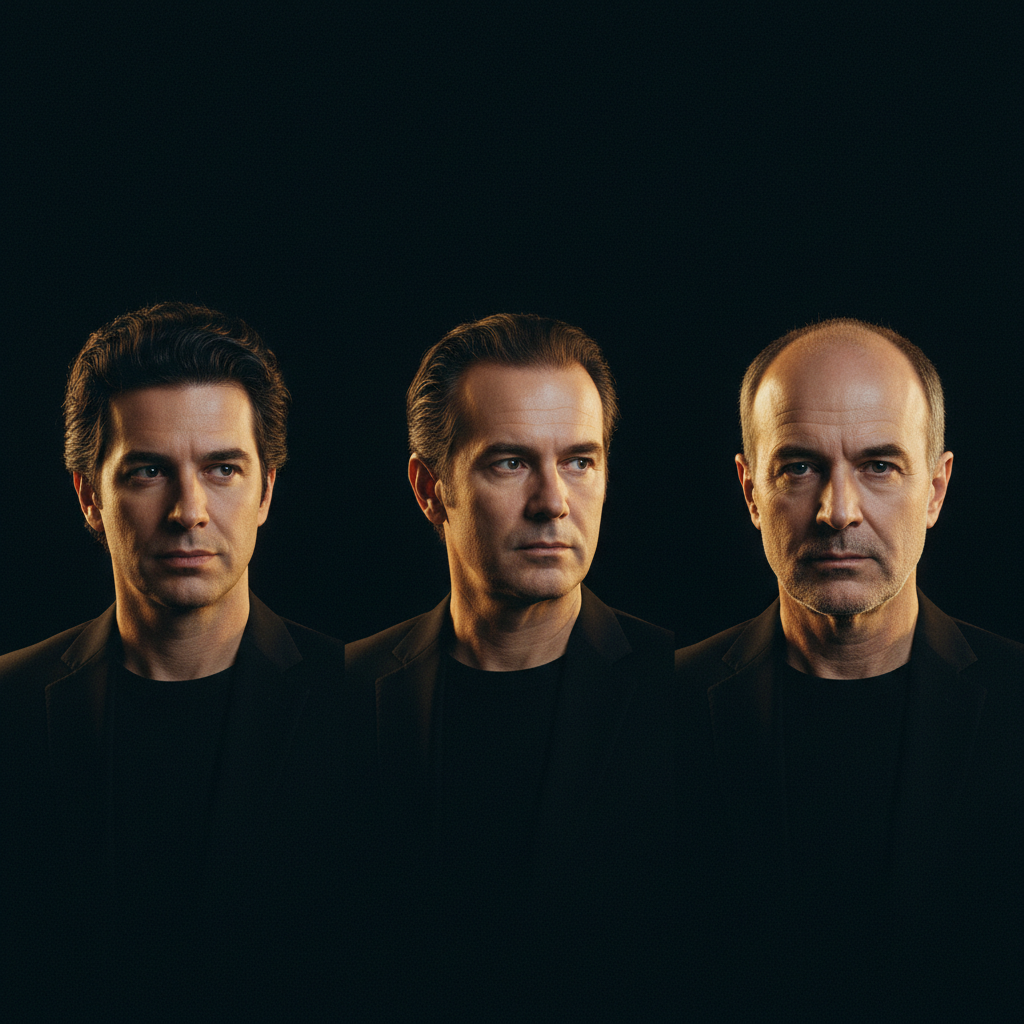
Quick answer: The Male Pattern Hair Loss Stages describe the progressive miniaturisation of scalp hair follicles, most commonly mapped using the clinical Hamilton-Norwood scale from stage 1 to stage 7. This progression typically begins with symmetrical temporal recession, advances to thinning at the crown (vertex), and culminates in extensive baldness leaving only a horseshoe band around the sides and back. The main limitation of these stages is that they track visual progression, not the underlying rate of follicle loss or non-androgenetic causes.
Key takeaways
- Male pattern baldness (androgenetic alopecia) accounts for approximately 95 percent of hair loss in men and follows a predictable clinical sequence.
- The standard diagnostic framework is the Hamilton-Norwood scale, which classifies progression across 7 distinct stages and several sub-variants.
- Follicular miniaturisation is driven by dihydrotestosterone (DHT) binding to androgen receptors in genetically susceptible scalp follicles.
- Early identification at stages 2 or 3 offers the widest window for retaining existing density and slowing further recession.
- Cosmetic care supports the condition of existing fibres and scalp health, but altering follicular miniaturisation requires clinical therapies.
Male Pattern Hair Loss Stages: what the evidence shows
The progression of androgenetic alopecia is visualised through the Male Pattern Hair Loss Stages, formally established by Dr James Hamilton in 1951 and later refined by Dr O'Tar Norwood in 1975. Clinical dermatologists and trichologists rely on the Norwood scale to standardise diagnoses, evaluate treatment response, and plan surgical restorations.
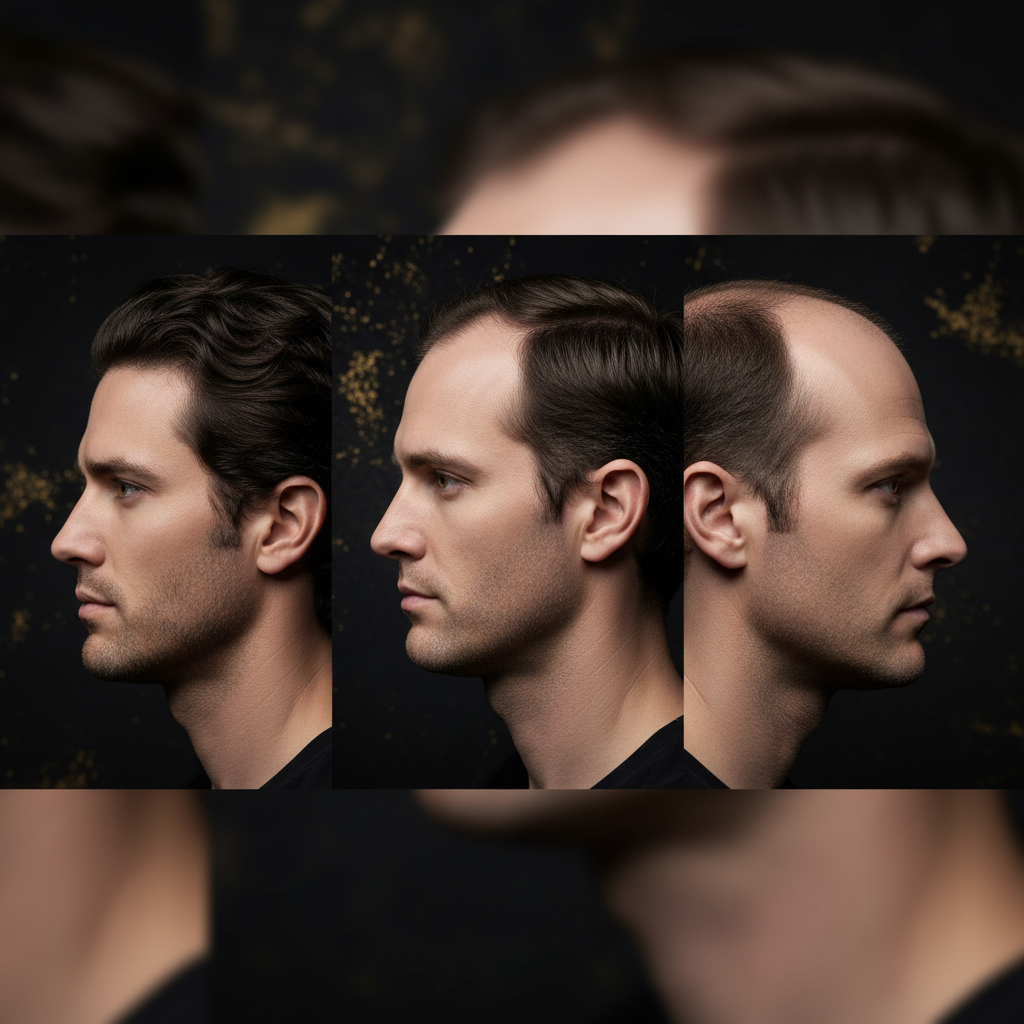
The scale outlines seven main clinical stages:
- Stage 1: Minimal or no recession of the frontal hairline. The adolescent hairline transitions slightly to an adult hairline without true miniaturisation.
- Stage 2: Mild, symmetrical triangular recession at the temples. This creates a distinct 'M', 'V', or 'U' shape along the anterior border. The hairline does not extend further back than a couple of centimetres in front of the coronal plane.
- Stage 3: The earliest clinically accepted stage of true male pattern baldness. Deep, symmetrical temporal recessions appear bare or sparsely covered by miniaturised vellus hair. In Stage 3 Vertex, recession is accompanied by simultaneous thinning at the crown.
- Stage 4: Severe frontotemporal recession accompanied by pronounced thinning or an overt bare spot at the vertex. A distinct bridge of moderately dense hair separates the frontal recession from the crown.
- Stage 5: The band of hair between the frontal recession and the vertex becomes narrower and sparser. Both regions enlarge substantially, starting to coalesce into a single expanse.
- Stage 6: The bridge of hair across the mid-scalp disappears entirely. The frontal and vertex areas merge into a single bald surface, while hair along the lateral sides and posterior scalp remains intact.
- Stage 7: The most extensive presentation. Only a thin, horseshoe-shaped fringe of hair survives around the back and lower sides of the head. Hair in this remaining band may also show lower density.
| Norwood Stage | Hairline Appearance | Vertex (Crown) Presentation | Clinical Significance |
|---|---|---|---|
| Stage 1 | Undisturbed or slight adult maturation | Fully dense | Baseline control; no clinical intervention required |
| Stage 2 | Mild triangular recession at temples | Fully dense | Early adult maturation; monitor for further movement |
| Stage 3 | Deep bare recessions at temples | Normal or early thinning | Clinical onset of androgenetic alopecia; optimal stage to begin therapy |
| Stage 4 | Marked frontal recession | Obvious patch of thinning | Distinct separation between front and vertex |
| Stage 5 | Extensive temporal loss | Large thinning patch | Bridge between front and crown begins breaking down |
| Stage 6 | Front and crown regions fully merged | Blended with frontal loss | Severe loss; surgical restoration options become limited |
| Stage 7 | Entire top of scalp is bare | Entirely denuded | End stage; only low-density horseshoe rim remains |
The biological mechanism behind the stages
The progression through these stages is governed by genetics and circulating androgens. The primary mediator is dihydrotestosterone (DHT), a potent androgen converted from testosterone by the intracellular enzyme 5-alpha reductase (specifically type II in follicular tissues).
Hair follicles in the frontal, temporal, and crown regions possess a high density of androgen receptors. When DHT binds to these receptors in genetically vulnerable men, it alters gene expression, leading to follicular miniaturisation.
During miniaturisation, the hair growth cycle changes fundamentally:
- The anagen (active growth) phase shortens from an average of 3 to 6 years down to mere months or weeks.
- The telogen (resting) phase lengthens, meaning shed hairs take significantly longer to be replaced.
- With each successive shortened cycle, the dermal papilla shrinks, producing a hair shaft with a smaller diameter, reduced pigmentation, and diminished tensile strength.
- Eventually, robust terminal fibres transition into fine, transparent vellus fibres before the follicle becomes dormant and fibro-atrophic.
Follicles situated around the occipital and lower parietal scalp (the sides and back of the head) are genetically programmed with far fewer androgen receptors and lower 5-alpha reductase activity, which is why the horseshoe band persists even in Stage 7.
What the evidence does not show
Popular assumptions often mischaracterise the speed and predictability of male pattern baldness. The scientific literature demonstrates several clear boundaries:

The stages do not progress at a uniform or linear rate. A man can transition rapidly from Stage 2 to Stage 4 within two years, then remain stable at Stage 4 for a decade before advancing again.
Miniaturisation is not caused by poor scalp blood flow. Reduced microcirculation observed in bald scalps is the consequence, not the primary cause, of follicular shrinkage. Blood vessels naturally down-regulate because a tiny vellus follicle requires far less oxygen and metabolic support than a full terminal follicle.
Everyday haircare habits do not cause progression between stages. Frequent shampooing, wearing hats, using styling wax, or sweating during exercise do not trigger DHT-mediated follicular miniaturisation. Hair visible in the shower drain during washing is fibre that has already completed its telogen phase.
Cosmetics cannot reverse an advanced stage. No topical cosmetic wash, botanical oil, or surface cleanser can regenerate a dormant, fibrotic follicle or alter systemic androgen reception.
What you can do: clinical and cosmetic care
Managing progression depends heavily on which of the stages you occupy. Once follicular atrophy is complete (typically in stages 6 and 7), non-surgical medical therapies cannot resurrect dead follicles.
Medical treatments evaluated by regulatory bodies such as the UK Medicines and Healthcare products Regulatory Agency (MHRA) and the US Food and Drug Administration (FDA) include:
- Oral 5-alpha reductase inhibitors: These reduce the systemic conversion of testosterone to DHT by roughly 70 percent, halting progression in the majority of men and stimulating modest regrowth in early-to-mid stages.
- Topical vasodilators: Direct application of licensed potassium channel openers prolongs the anagen phase and increases blood flow to the follicular papilla, assisting hair calibre.
- Surgical hair restoration: Follicular unit extraction (FUE) or transplantation (FUT) moves DHT-resistant donor follicles from the occipital band to the bare crown or receding hairline.
The role of cosmetic and scalp care
While medical treatments target hormonal pathways, cosmetic haircare plays a supportive role for remaining hair fibres. Maintaining an optimal scalp environment supports healthy follicular cycling and reduces premature mechanical fibre breakage.
Using a nourishing, sulphate-free cleanser formulated with caffeine, biotin, and botanical extracts helps keep the scalp clean, hydrated, and free from excess sebum accumulation. Watermans GrowMe shampoo and Conditioner are formulated to cleanse the scalp gently, fortify the hair cuticle, and create the ideal topical environment for thicker-, fuller-looking hair. While cosmetic formulas do not reverse genetic male pattern hair loss, they reduce hair breakage along the shaft, maximising the physical volume and appearance of thinning strands.
When the cause may be something else
Not all thinning fits the clinical stages of androgenetic alopecia. If your hair loss deviates from typical temporal and vertex recession, other conditions must be evaluated:
- Telogen effluvium: Marked by rapid, widespread shedding across the entire head, often triggered by severe physical illness, surgical trauma, thyroid dysfunction, or extreme psychological distress 2 to 4 months prior.
- Alopecia areata: An autoimmune disorder causing distinct, well-circumscribed, coin-sized circular smooth patches rather than gradual diffuse recession.
- Scarring (cicatricial) alopecias: Inflammatory scalp disorders like lichen planopilaris or frontal fibrosing alopecia that destroy follicles permanently, frequently accompanied by redness, scaling, burning, or itching.
- Nutritional deficiencies: Severe deficits in ferritin (iron stores), vitamin D, or zinc can compound thinning and accelerate the visible expression of genetic loss.
When to seek professional advice
Consult a GP, dermatologist, or registered trichologist if you notice rapid, patchy, or painful hair loss. Seek immediate medical guidance if shedding is accompanied by scalp inflammation, burning, pustules, or sudden eyebrow loss.
If you suspect you are entering Stage 2 or Stage 3 and wish to explore pharmaceutical options, consulting a clinician early offers the best biological opportunity to preserve hair mass before follicles complete the miniaturisation process.
Frequently asked questions about Male Pattern Hair Loss Stages
How fast do you progress through the Male Pattern Hair Loss Stages?
The progression rate varies considerably between individuals. Some men experience aggressive miniaturisation that moves from Stage 1 to Stage 5 within five years during their early twenties, while others take three decades to reach Stage 3. Progression often occurs in irregular bursts, influenced by genetics, age, and systemic health.
Can you reverse advanced stages of pattern baldness?
Once a follicle has fully miniaturised and undergone fibrous atrophy (typical of Stage 6 and Stage 7 bare skin), it cannot be re-activated with topical or oral medication. Regrowth is generally limited to restoring intermediate, miniaturised hairs seen in stages 2 through 4. For completely bald zones, surgical transplantation is the only method to repopulate active follicles.
At what age do the Male Pattern Hair Loss Stages usually begin?
Follicular miniaturisation can begin any time after puberty when systemic androgen levels rise. Approximately 20 percent of men exhibit noticeable Stage 2 or Stage 3 thinning by age 20, roughly 30 percent by age 30, and up to 50 percent by age 50.
Does a receding hairline always mean you will reach Stage 7?
No. Many men develop a mature Stage 2 hairline in their twenties and never progress further. Genetic susceptibility determines both the pattern and the ultimate severity of the loss. Having early temporal recession does not guarantee that you will advance to late-stage crown loss.
Overview of Male Pattern Hair Loss Stages
Understanding the Male Pattern Hair Loss Stages empowers you to distinguish between natural hairline maturation, temporary shedding, and genetic androgenetic alopecia. The earlier you recognise the shift from healthy terminal hairs to miniaturised vellus strands along the temples and crown, the broader your options remain for maintaining hair density. While clinically proven medical therapies address the hormonal drivers of follicular miniaturisation, gentle topical scalp hygiene and fibre-strengthening care help keep your remaining hair looking and feeling its strongest.
Sources and references
- Norwood, O. T. (1975). Male pattern baldness: classification and incidence. Southern Medical Journal, 68(11), 1359-1365.
- Hamilton, J. B. (1951). Patterned loss of hair in man; types and incidence. Annals of the New York Academy of Sciences, 53(3), 708-728.
- British Association of Dermatologists. (2020). Androgenetic Alopecia Clinical Guidelines.
- National Institute for Health and Care Excellence (NICE). (2021). Alopecia, androgenetic - Clinical Knowledge Summary.
- Kaufman, K. D. (2002). Androgens and alopecia. Molecular and Cellular Endocrinology, 198(1-2), 89-95.
Find these ingredients in Watermans products
- Zinc: you will find this ingredient in our Hair Vitamins.