Male Pattern Hair Loss: The Science, Stages, and Real Options
8 min read ·
Male Pattern Hair Loss affects up to 80% of men. Learn the science of DHT, follicular miniaturisation, Norwood stages, and proven management options.
Quick answer: Male Pattern Hair Loss, also called androgenetic alopecia in men, is a genetically determined condition caused by follicle sensitivity to dihydrotestosterone (DHT). It causes progressive miniaturisation of hair follicles at the temples and crown, leading to shorter growth cycles and finer hairs. Cosmetic products cannot alter genetic programming or reverse hormonal follicular miniaturisation, but clinically approved medical treatments can slow progression or promote regrowth if started before follicles completely scar over.
Key takeaways
- Male Pattern Hair Loss affects roughly 50 percent of men by age 50 and up to 80 percent by age 80.
- The primary driver is genetic sensitivity to dihydrotestosterone (DHT), not elevated circulating testosterone levels.
- Follicular miniaturisation progressively turns robust terminal hairs into fine, short vellus hairs.
- The condition follows distinct patterns, commonly tracked using the Hamilton-Norwood scale.
- Clinically proven medical interventions focus on DHT reduction or follicle stimulation, while cosmetic haircare helps maximise strand strength and scalp condition.
Male Pattern Hair Loss: what the evidence shows
Male Pattern Hair Loss is the most common form of progressive hair thinning in men worldwide. Robust dermatological consensus shows that the condition arises from a combination of polygenic inheritance and androgen activity within the dermal papilla.
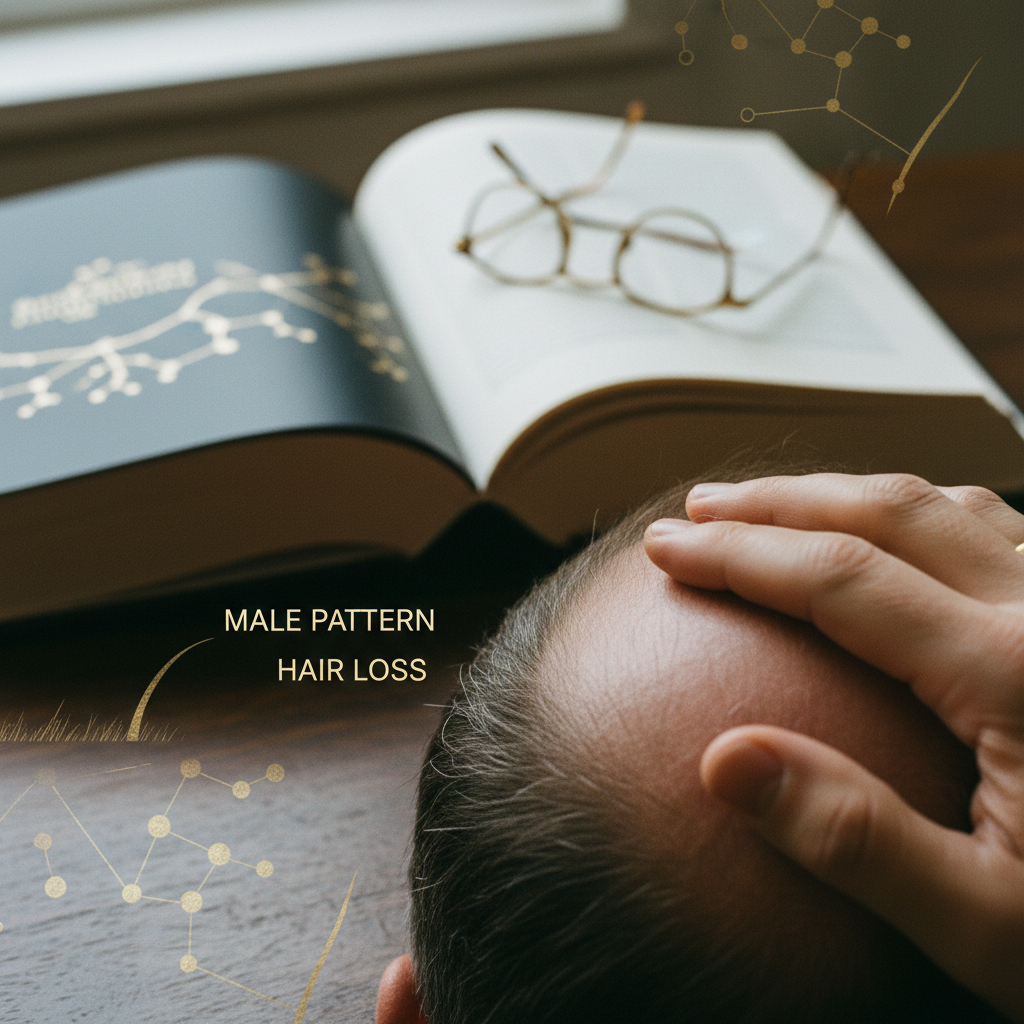
The primary biological catalyst is dihydrotestosterone (DHT), a potent androgen converted from circulating testosterone by the enzyme 5-alpha reductase (specifically type II within hair follicles). In genetically susceptible individuals, DHT binds to androgen receptors located in follicles across the frontal scalp, temples, and vertex. This binding triggers altered gene transcription that shortens the anagen (growth) phase of the hair cycle and extends the telogen (resting) phase.
Over successive cycles, affected follicles undergo miniaturisation. A follicle that once produced a thick, pigmented terminal hair begins producing progressively finer, shorter, and less pigmented fibres. Eventually, these strands resemble vellus hair (the fine fuzz found on facial skin). Without intervention, the dermal papilla shrinks further, and the follicular ostium can eventually close permanently.
Crucially, follicles at the back and lower sides of the head (the occipital and temporal margins) lack the high concentration of sensitive androgen receptors. This biological quirk explains why these areas remain intact and why surgeons use them as donor zones for hair transplants.
What the evidence does not show
Popular culture contains numerous persistent myths regarding Male Pattern Hair Loss that lack scientific support:
- It does not come solely from your mother's father. While the androgen receptor gene sits on the X chromosome (inherited maternally), genome-wide association studies show that dozens of other autosomal risk loci come from both parents.
- It is not caused by high testosterone levels. Men with this condition rarely have higher serum testosterone than men with full heads of hair. The difference lies in local receptor sensitivity and tissue 5-alpha reductase activity.
- It is not caused by poor circulation or clogged pores. While micro-inflammation can accompany the process, decreased blood flow is a consequence of follicular shrinkage, not the original cause. Wearing hats or failing to wash your hair does not trigger genetic miniaturisation.
- Shampoos cannot cure genetic balding. Cosmetic products do not suppress systemic 5-alpha reductase. They can support scalp health and reduce breakage along the hair shaft, but they do not alter your genetic code.
Signs to look for: patterns and stages
Recognising the early physical markers allows you to differentiate genetic thinning from other forms of shedding. Clinicians classify progression using the Hamilton-Norwood scale:
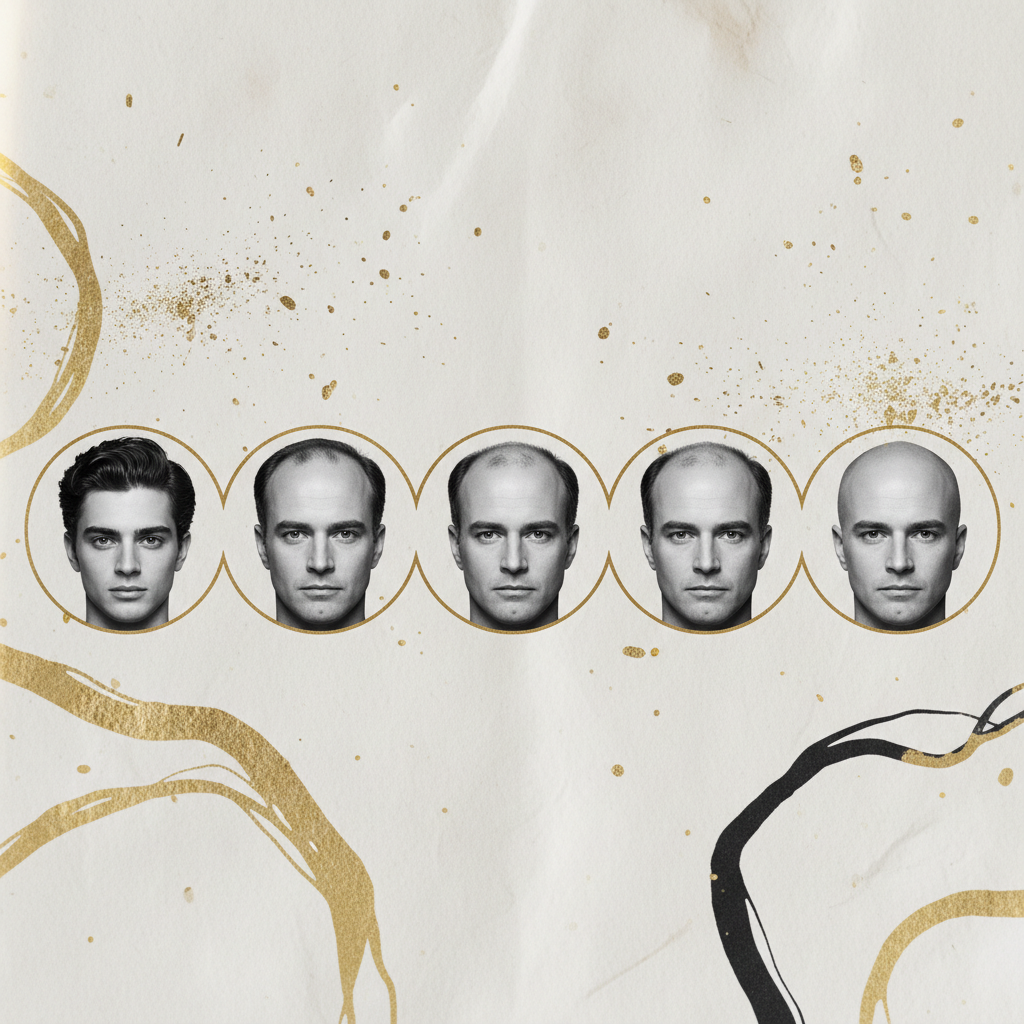
- Type I: Minimal or no recession along the frontal hairline.
- Type II: Mild, symmetrical triangular recession at the frontotemporal hairline (mature hairline).
- Type III: Deep frontotemporal recession that creates an M, U, or V shape. This is generally considered the threshold for cosmetic balding.
- Type IV: Severe frontotemporal recession accompanied by thinning or baldness at the vertex (crown), separated by a solid band of hair.
- Type V: The band of hair separating the temporal recession and crown thinning becomes noticeably sparse and narrow.
- Type VI: The frontal and crown regions merge into a single large bald area, with sparse hair remaining on top.
- Type VII: The most advanced stage, leaving only a horseshoe-shaped band of hair around the sides and back of the scalp.
In addition to hairline shape, watch for follicle calibre diversity. When you examine shed hairs under bright light, genetic miniaturisation shows hairs of wildly varying thicknesses, whereas normal shedding (telogen effluvium) features hairs of uniform thickness.
Male Pattern Hair Loss compared to other hair conditions
| Feature | Male Pattern Hair Loss | Telogen Effluvium | Alopecia Areata | Hair Shaft Breakage |
|---|---|---|---|---|
| Primary cause | Genetic sensitivity to DHT | Physiological stress, illness, shock | Autoimmune attack on follicles | Mechanical, chemical, or heat damage |
| Typical pattern | Temples, hairline, and crown | Diffuse thinning across the entire scalp | Discrete, smooth, round coin-sized patches | Uneven, ragged lengths; no specific pattern |
| Onset speed | Gradual (months to years) | Rapid (2 to 3 months post-trigger) | Rapid (days to weeks) | Gradual as physical damage accumulates |
| Follicle state | Miniaturised over time | Intact, temporarily resting | Intact, inflamed beneath surface | Completely healthy inside follicle |
| Reversibility | Progressive; requires ongoing management | Usually fully reversible on its own | Unpredictable; often regrows | High; regrows if damage ceases |
What you can do: evidence-based management
Management strategies fall into two distinct categories: clinical interventions aimed at preserving the follicle, and cosmetic practices designed to maintain fibre integrity and scalp comfort.
Clinical interventions
- Oral 5-alpha reductase inhibitors: Medications such as finasteride reduce serum and scalp DHT by roughly 60 to 70 percent. Clinical trials show they arrest hair loss progression in over 80 percent of men and produce visible regrowth in a substantial proportion over 12 to 24 months. These require a prescription and ongoing use.
- Topical potassium channel openers: Over-the-counter minoxidil (available in 2 percent and 5 percent solutions or foams) shortens the telogen phase and prolongs anagen, increasing follicle size and blood perfusion. It does not affect DHT directly.
- Low-level laser therapy (LLLT): Cleared by regulatory authorities, certain red light devices (650 nm wavelength) stimulate mitochondrial activity in follicular cells, showing modest efficacy in controlled trials.
- Surgical restoration: Hair transplantation relocates DHT-resistant follicles from the occipital scalp to thinning zones.
Cosmetic support and scalp care
Cosmetic products cannot alter your hormones, but a targeted routine preserves existing strands. Breakage from poor conditioning exacerbates the visual appearance of thinning.
- Maintain a clean, balanced scalp: Regular cleansing prevents sebum build-up and reduces the superficial micro-inflammation that frequently accompanies androgenetic alopecia.
- Minimise mechanical tension: Avoid aggressive towel drying or high-tension styling that adds traction to already miniaturised hairs.
- Fortify the hair fibre: Shampoos and conditioners containing proteins, niacinamide, and biotin coat the shaft, improving tensile strength and making each strand look visually denser.
The Watermans perspective: supporting thinning hair
Watermans focuses on the cosmetic health of your hair and scalp. While Male Pattern Hair Loss is a genetic, hormone-driven condition that requires clinical treatments to alter, cosmetic haircare plays an important complementary role.
Watermans Grow Me Shampoo and Conditioner are formulated with ingredients such as caffeine, biotin, argan oil, and rosemary extract. These formulations do not alter systemic DHT or claim to treat medical alopecia. Instead, they create an optimal scalp environment, gently remove follicle-clogging sebum, and condition fragile hair fibres to reduce breakage along the shaft. For men experiencing progressive thinning, maintaining fibre strength ensures you retain every millimetre of hair your follicles produce.
When the cause may be something else
Not all hair loss in men follows a pattern. If you notice any of the following signs, the issue may not be androgenetic alopecia:
- Diffuse, sudden shedding: If you are losing hundreds of hairs daily across your entire head, including the sides and back, consider telogen effluvium triggered by severe illness, rapid weight loss, or high fever.
- Patchy, circular bald spots: Smooth, coin-sized areas with no visible pores point toward alopecia areata, an autoimmune condition.
- Scalp pain, redness, or scaling: Itching, burning, pus-filled bumps, or crusting suggest scalp conditions like seborrhoeic dermatitis, fungal infections (tinea capitis), or scarring alopecias (lichen planopilaris).
- Systemic symptoms: Fatigue, joint pain, or unexplained weight shifts alongside hair thinning warrant checking thyroid function and ferritin levels.
Frequently asked questions about Male Pattern Hair Loss
At what age does Male Pattern Hair Loss typically start?
Male Pattern Hair Loss can begin anytime after puberty when androgen levels rise. While it is most commonly noticed in men in their late twenties and thirties, roughly 20 percent of men exhibit noticeable thinning by age 20. Early onset typically correlates with a stronger genetic predisposition.
Can Male Pattern Hair Loss be reversed naturally?
Male Pattern Hair Loss cannot be fully reversed through diet, natural oils, or lifestyle modifications alone. Because the condition is driven by genetics and DHT sensitivity, dietary changes or scalp massage cannot overcome cellular androgen receptor signalling. However, maintaining balanced nutrition prevents secondary deficiencies from accelerating thinning.
Does stopping clinical treatments make hair loss worse?
Stopping treatments does not accelerate loss beyond your genetic baseline, but you will rapidly lose whatever hair was maintained or regrown by the treatment. Within 6 to 12 months of cessation, your hair returns to the exact pattern and density it would have reached had you never treated it.
How do I tell the difference between a mature hairline and balding?
A mature hairline typically moves back roughly 1 to 2 centimetres above the upper forehead crease between the ages of 17 and 29, then stops, retaining clean, dense edges. In contrast, Male Pattern Hair Loss continues receding past this point, forming deeper frontotemporal recessions accompanied by fine, miniaturising hairs along the leading margin.
Summary
Managing Male Pattern Hair Loss begins with an accurate assessment of what is happening under the scalp. Because the condition is progressive and driven by genetics, early action provides the greatest opportunity to preserve follicular density. Combining evidence-based clinical treatments to protect sensitive follicles with high-performance cosmetic haircare to safeguard strand strength gives you the most reliable path to maintaining a fuller, healthier-looking head of hair.
Sources and references
- British Association of Dermatologists. Androgenetic Alopecia Guidelines.
- National Institute for Health and Care Excellence (NICE). Alopecia, androgenetic - male: Clinical Knowledge Summaries.
- American Academy of Dermatology. Hair loss: Who gets and causes.
- Journal of the American Academy of Dermatology. Systematic review of treatments for androgenetic alopecia.
Find these ingredients in Watermans products
- Niacinamide: you will find this ingredient in our Hair Mask.