How to Repair Bleached Hair: A Complete Evidence-Based Guide
8 min read ·
Learn how to repair bleached hair using proven cosmetic chemistry, bond repair, protein balancing, and acidic care to stop breakage and restore strength.
Quick answer: Learning how to repair bleached hair begins with accepting a biological reality: hair fibre is non-living keratin, meaning you cannot truly heal or regenerate it. Instead, learning how to repair bleached hair means using cosmetic chemistry to rebuild internal disulfide cross-links, replenish lost surface lipids, and restore tensile strength. While no salon treatment can return chemically lifted fibres to virgin condition, targeted protein therapy, lipid replacement, and acidifying post-care can arrest breakage, smooth lifted cuticles, and preserve your remaining length.
Key takeaways
- Bleaching permanently alters hair by oxidising melanin, stripping the protective 18-methyleicosanoic acid (18-MEA) lipid layer, and breaking internal disulfide bonds.
- Because hair is non-living tissue, genuine biological healing is impossible; cosmetic repair focuses on structural patching, bond building, and porosity control.
- Protein treatments supply hydrolysed keratin and amino acids to fill gaps in the damaged cortex, but they must be balanced with emollients to prevent brittleness.
- Acidic post-wash treatments (pH 3.5 to 4.5) help contract and flatten raised cuticle scales, reducing wet friction and mechanical snap.
- Severe breakage requires micro-trims alongside bond-multiplying technologies, as badly frayed, split ends will inevitably travel up the hair shaft.
How to repair bleached hair: what the evidence shows
When you ask how to repair bleached hair, cosmetic chemistry points toward three functional mechanisms: bond builders, hydrolysed proteins, and synthetic lipid restoration. Bleach penetrates deep into the cortex using alkaline swelling agents (such as ammonium hydroxide, raising pH to 10 or 11) and persulphate oxidisers. This reaction degrades natural cystine cross-links into cysteic acid, leaving the fibre porous, weak, and highly hydroscopic.
Peer-reviewed studies in cosmetic trichology show that while oxidised disulfide bonds cannot reform on their own, certain active molecules, including bis-aminopropyl diglycol dimaleate and maleic acid derivatives, can create artificial cross-links between free cysteine residues. These synthetic bridges temporarily restore tensile strength and limit breakage when the hair is wet.
Alongside bond repair, research confirms the efficacy of hydrolysed proteins (wheat, keratin, and silk with molecular weights between 500 and 2,000 Daltons). Because these proteins are sufficiently small, they penetrate the compromised cuticular envelope to deposit temporarily within void spaces in the cortex. Controlled tensile testing demonstrates that hair treated with low-molecular-weight proteins shows measurable increases in elasticity and breaking force compared to untreated bleached controls.
What the evidence does not show
There are persistent myths surrounding bleach recovery that scientific literature actively refutes:
- Natural oils cannot rebuild hair bonds. While plant oils (like argan or coconut) lubricate the shaft and slow water absorption, they lack the reactive chemistry required to cross-link damaged keratin proteins.
- Deep conditioners do not "heal" hair. Conditioners are topical coatings. They deposit cationic surfactants and silicones that wash out over successive shampoos; they do not regenerate living tissue.
- You cannot reverse split ends. Once the cortex separates and splinters, no product can glue it permanently back together. Split ends must be trimmed to prevent progressive longitudinal splitting.
The mechanism: what bleach does to the hair shaft
To understand restoration, you must understand the damage profile. Natural hair fibres are protected by an epicuticle coated in 18-MEA, a covalently bound fatty acid layer that renders the surface strongly hydrophobic.
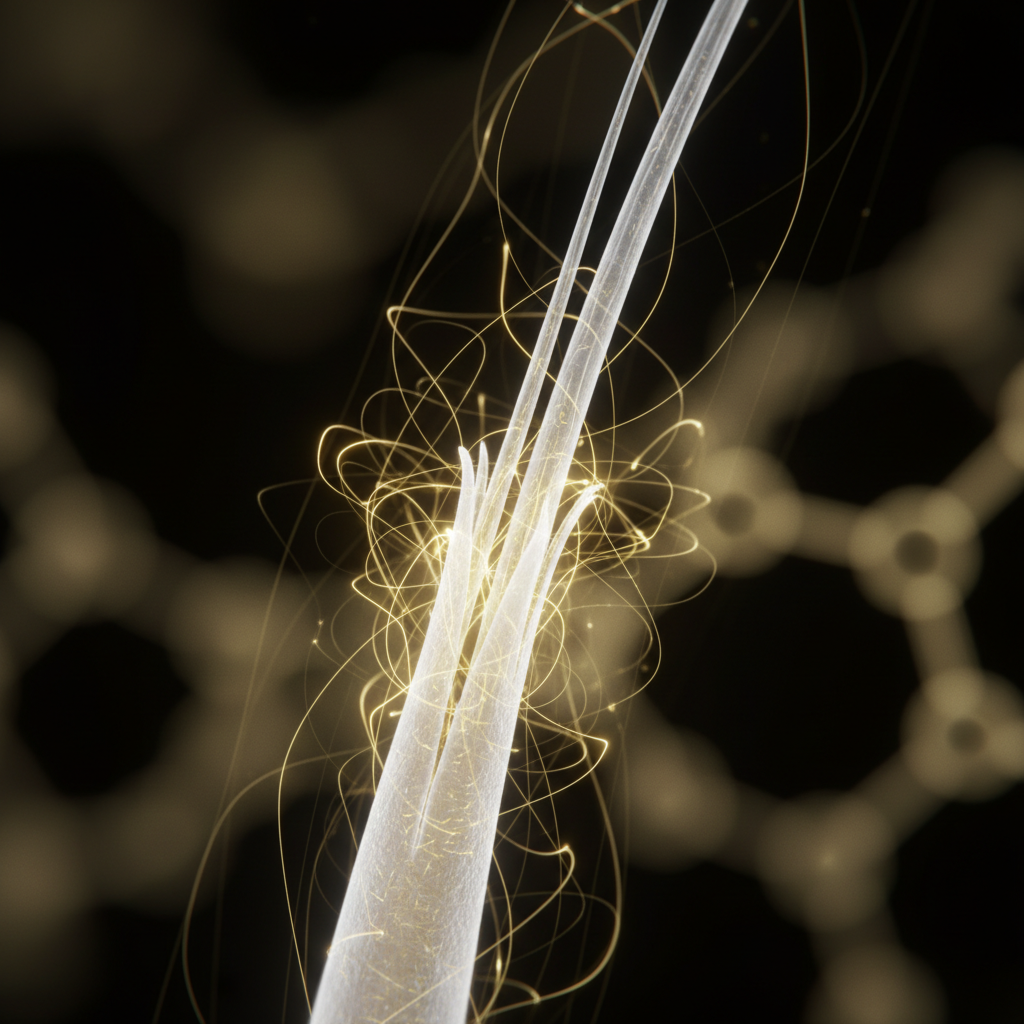
During bleaching, alkaline agents swell the cuticle scales open. Persulphates dissolve melanin granules inside the cortex, while simultaneously stripping away the 18-MEA layer. This transforms the fibre from hydrophobic (water-repelling) to hydrophilic (water-absorbing).
Hydrophilic bleached hair absorbs excessive water when washed, swelling rapidly and stretching dangerously under minimal tension. Furthermore, the loss of up to 50 percent of natural cystine content removes the structural scaffolding of the hair, making the shaft fragile, prone to knotting, and susceptible to severe mechanical breakage.
| Hair parameter | Virgin healthy hair | Bleached / over-processed hair | Restoration target |
|---|---|---|---|
| Surface lipid (18-MEA) | Intact, hydrophobic | Stripped, hydrophilic | Synthetic lipid coats (quats, ceramides) |
| Isoelectric point (pH) | pH 3.67 | Shifts acidic (high negative charge) | Acidic sealers (pH 3.5 to 4.5) |
| Cystine content | High (strong disulfide bonds) | Depleted (high cysteic acid) | Artificial cross-linkers & bond builders |
| Porosity | Low, uniform | High, uneven void spaces | Low-weight hydrolysed proteins |
| Wet elasticity | Returns to original length | Stretches, deforms, snaps | Balanced protein-moisture therapy |
Signs of severe bleach damage
Recognising the physical signs of over-processing helps you choose the correct corrective routine:
- Extreme wet stretchiness: If damp strands stretch out like chewing gum and fail to bounce back, the internal cortex has lost its structural elasticity.
- Immediate snapping: High-porosity hair that snaps audibly when brushed dry indicates profound protein depletion.
- Matting when wet: Without protective surface lipids, raised cuticle shingles catch on adjacent strands, creating dense, unyielding bird-nest tangles during washing.
- Dull, glassy appearance: Stripped cuticles scatter light rather than reflecting it, leaving hair looking matte and faded even after styling.
Practical protocol: how to manage and protect bleached strands
Executing an effective care plan requires a structured, multi-step regimen designed to replace lost functionality.
1. Introduce targeted bond-building treatments
Use active cross-linking treatments weekly. Apply them to damp, towel-dried hair prior to shampooing, allowing sufficient dwell time (at least 20 to 30 minutes) for the active compounds to diffuse into the open cortex.
2. Balance protein and moisture
Bleached fibres need both structural infill and lubrication. Use a hydrolysed keratin mask every two to three washes. Always follow protein treatments with a lipid-rich conditioner featuring ceramides or fatty alcohols (cetyl and stearyl alcohol) to prevent the fibre from becoming stiff and brittle.
3. Maintain an acidic wash routine
Choose shampoos and rinses formulated between pH 4.0 and 5.0. Acidic formulations contract the cuticle layers, reducing friction during lathering and sealing the outer envelope to preserve deposited conditioning agents.
4. Minimise mechanical stress
Wet bleached hair is at its weakest. Switch to wide-tooth detangling combs or flexible-bristle brushes, start detangling strictly at the ends, and sleep on smooth silk or satin pillowcases to eliminate nightly friction.
When the cause is something else
It is vital to distinguish chemical breakage from systemic hair loss. Bleach damages the hair shaft; it does not typically affect the subcutaneous hair follicle unless severe chemical burns occurred on the scalp during processing.
If you notice short, broken hairs without white bulbs across your sink or clothing, you are dealing with hair breakage. If you are experiencing diffuse shedding from the root, where fallen hairs retain their white dermal bulb, the cause is follicular (such as telogen effluvium or nutritional deficiencies) and entirely unrelated to cuticular bleach damage.
When to seek professional salon or clinical advice
If your hair is breaking off in large clumps near the scalp line, or if you suffered blistering, burning, or oozing during your lightening service, seek immediate professional care. Stylists can assess whether chemical over-processing has liquefied the outer sheath, requiring a corrective cut and professional-strength re-bonding. If scalp burns or follicular inflammation are present, consult a dermatologist or registered trichologist promptly.
Supporting bleached hair with Watermans
When rebuilding fragile, bleach-compromised strands, reducing physical tension on vulnerable roots is just as important as reinforcing the mid-lengths. Watermans hair care products are designed to support a balanced scalp environment and nurture fragile, breaking lengths. Formulated with hydrolysed lupin protein, biotin, and rosemary, Watermans formulas wash cleanly without harsh stripping agents, leaving over-processed hair feeling stronger, smoother, and visibly more resilient against everyday mechanical damage.
Frequently asked questions about How to Repair Bleached Hair
Can coconut oil repair bleached hair?
No, coconut oil cannot rebuild the chemical architecture of bleached hair. While its high lauric acid content allows it to penetrate the cortex and limit water absorption, it lacks the reactive groups needed to repair severed disulfide bonds. Use it as a lubricating pre-shampoo shield, but rely on bond builders for true structural reinforcement.
How often should I use protein treatments on bleached hair?
Use a targeted hydrolysed protein treatment once every 7 to 14 days, depending on your degree of porosity. Applying concentrated protein too frequently without adequate moisturising agents can cause protein overload, leaving the hair fibre rigid, brittle, and susceptible to snapping.
Is it possible to completely restore over-processed hair to its virgin state?
No. Because hair consists of non-living keratin cells, severe chemical alteration cannot be permanently cured. While cosmetic science excels at patching voids, restoring lubricity, and bridging broken cross-links, genuine virgin hair quality will only return as new, untreated hair grows from your scalp.
What is the fastest strategy for how to repair bleached hair that is snapping?
The fastest strategy for how to repair bleached hair that is actively snapping is to pause all heat styling, apply an intensive bond-building treatment, follow with a low-pH conditioning seal, and trim split ends. Minimise wet manipulation, as water weakens fragile hydrogen bonds within already compromised bleached fibres.
Summary
Understanding how to repair bleached hair is fundamentally about managing expectations and applying proven cosmetic chemistry. While damaged keratin cannot biologically regenerate, an intentional routine focused on bond reinforcement, low-weight protein infill, and acidic cuticle maintenance can successfully prevent ongoing breakage. Treat bleached fibres with care, protect them from heat and friction, and preserve your length while fresh, healthy hair grows out.
Sources and references
- Journal of Cosmetic Dermatology, "Chemical and physical changes in hair caused by bleaching," 2018.
- International Journal of Cosmetic Science, "Evaluation of the physical properties of human hair after chemical bleaching," 2015.
- Society of Cosmetic Chemists, "Surface architecture of damaged hair fibres and lipid replacement," 2020.
- British Association of Dermatologists, "Hair breakage and chemical trauma clinical overview," 2021.
Find these ingredients in Watermans products
- Biotin: you will find this ingredient in our Hair Growth Shampoo.