How Hair Cuticles Function: Anatomy, Protection, and Care
10 min read ·
Learn how hair cuticles function as a protective keratin shield, why they open and close, and how to prevent damage for stronger, shinier hair.

Quick answer: Understanding how hair cuticles function reveals how hair protects itself from everyday environmental stress, moisture loss, and mechanical wear. The hair cuticle is an outer barrier of 5 to 10 overlapping, shingle-like keratin scales that shields the inner cortex, locks in hydration, and governs surface texture and shine. However, cuticles are non-living biological structures. Once worn away, raised excessively, or broken by chemical processing or extreme heat, cuticles cannot biologically regenerate; they can only be temporarily smoothed, patched, and managed cosmetically.
Key takeaways
- The cuticle consists of 5 to 10 layers of dead, overlapping keratin cells glued together by a delicate cell membrane complex rich in lipids like 18-methyleicosanoic acid (18-MEA).
- Cuticle scales lay flat under slightly acidic conditions (pH 4.5 to 5.5) to keep the hair smooth, reflective, and resistant to mechanical friction.
- Alkaline products, chemical treatments, and high heat force cuticle scales open, leading to porosity, protein leaching, moisture loss, and fibre breakage.
- Hair cuticles do not have living cells or a blood supply, meaning biological self-repair is impossible once the scales erode.
- Effective haircare relies on pH-balanced products, conditioning agents, and lipid protection to seal the cuticle layer and prevent structural damage to the inner cortex.
How Hair Cuticles Function: what the evidence shows
Scientific research using scanning electron microscopy shows that how hair cuticles function is primarily as a protective, hydrophobic shield for the delicate inner structures of the hair fibre. Each hair strand features three distinct anatomical layers: the innermost medulla, the structural cortex containing keratin bundles and melanin pigments, and the outer cuticle.
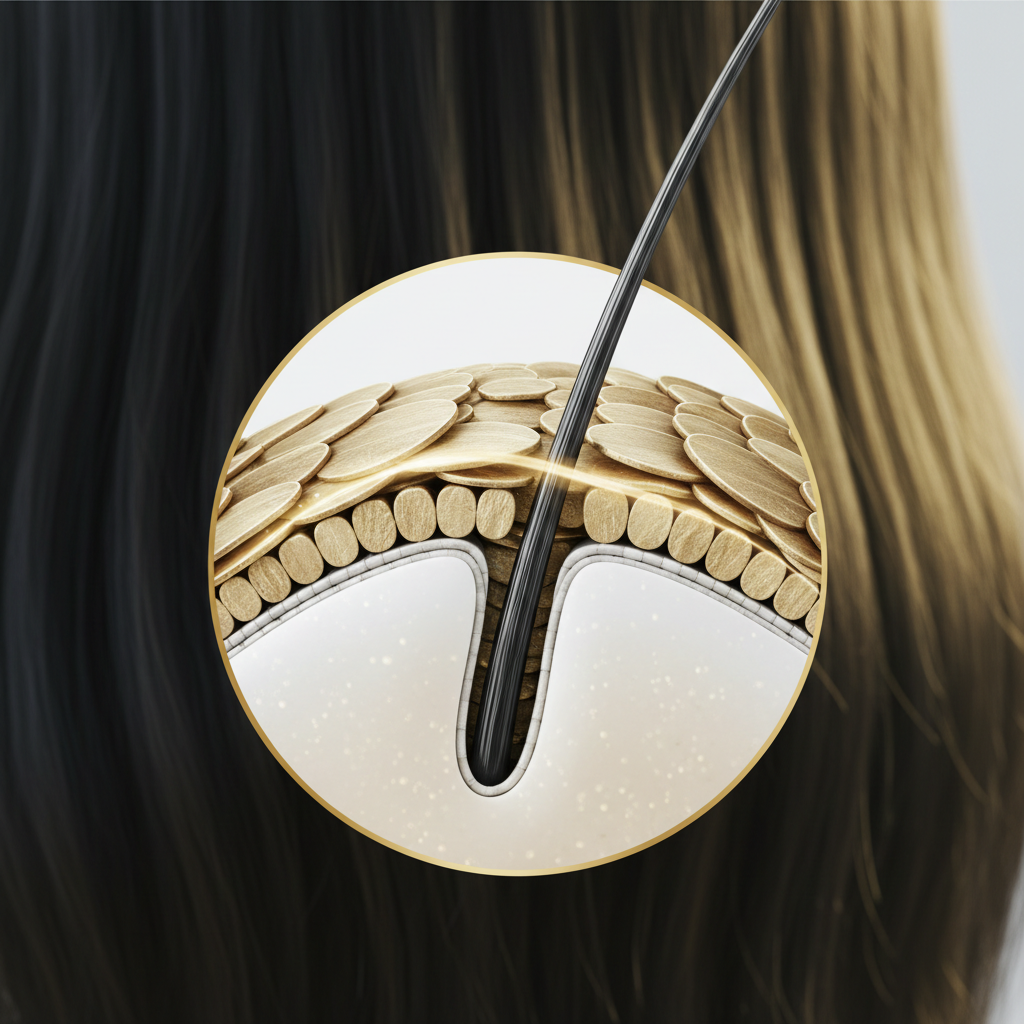
The cuticle forms a rigid, overlapping armour oriented toward the tip of the hair shaft. Each scale is roughly 0.5 to 1 micrometre thick and about 45 to 60 micrometres long. In healthy, unprocessed hair, these scales overlap like roof tiles or the scales of a pinecone. Because of this downward orientation, friction is minimised when strands glide past each other from root to tip.
Cuticle cells are rich in cystine, an amino acid that forms durable disulphide bonds. The outermost surface of each scale is coated with a specialised monomolecular lipid layer called the F-layer, composed predominantly of 18-methyleicosanoic acid (18-MEA). This thin fatty layer makes virgin hair naturally water-repellent (hydrophobic). It repels excess ambient humidity, resists chemical penetration, and provides a sleek, low-friction surface that reflects light evenly to create natural shine.
+-------------------------------------------------------------+
| OUTSIDE ENVIRONMENT |
+-------------------------------------------------------------+
 | (F-Layer: 18-MEA Lipids - Hydrophobic surface)
 v
+=============================================================+
| Epicuticle (Thin, highly cross-linked protein membrane) |
+-------------------------------------------------------------+
| Exocuticle (Dense keratin, high cystine / disulphide bonds)|
+-------------------------------------------------------------+
| Endocuticle (Low cystine, sensitive to swelling & water) |
+=============================================================+
 | (Cell Membrane Complex - Lipids and intercellular cement)
 v
+-------------------------------------------------------------+
| CORTEX (Keratin macrofibrils & structural strength) |
+-------------------------------------------------------------+
The sub-cellular anatomy of the cuticle
To understand how hair cuticles function, you must examine the sub-layers within each individual scale. A single cuticle cell is divided into distinct zones that react differently to water, pH, and mechanical stress:
- The Epicuticle: The outermost boundary of the scale, covered by the lipid F-layer. It is a tough, semi-permeable membrane that resists chemical attack while repelling water.
- The Exocuticle: The middle layer, making up roughly 40% of the cuticle scale's volume. It has a high concentration of cystine (over 15%), creating rigid structural integrity through extensive disulphide bonding.
- The Endocuticle: The innermost zone of the scale, containing very little cystine (roughly 3%) but abundant non-keratin proteins. Because it lacks dense disulphide cross-links, the endocuticle swells rapidly when wet. This swelling causes cuticle scales to lift outwards when hair is saturated with water.
- The Cell Membrane Complex (CMC): The lipid and protein "cement" that binds neighbouring cuticle cells together and anchors the entire cuticle sheath to the cortex.
What the evidence does not show
Cosmetics marketing frequently misrepresents cuticle biology. Here is what controlled scientific research clarifies:

- Cuticles cannot "heal" or "regenerate": Hair is non-living tissue (keratinised protein). Cuticle scales do not possess cellular machinery, blood vessels, or metabolic activity. Once stripped, chipped, or melted away, a scale is permanently lost.
- Products do not permanently "seal split ends": Conditioners, silicones, and hydrolysed proteins can temporarily glue split ends together through surface tension and polymer film formation. However, this is a temporary cosmetic fix that washes away with cleansing.
- The cuticle is not an absolute barrier: The cuticle is semi-permeable. While it slows down moisture transfer, water molecules, low-molecular-weight oils, and chemicals can diffuse through the cell membrane complex into the cortex.
The mechanisms of cuticle damage
When the cuticle functions properly, it protects the cortex from external destruction. When external factors disrupt the cuticle, hair health deteriorates through predictable physical mechanisms.
pH fluctuations
The natural pH of healthy hair and scalp sebum is slightly acidic, resting between 4.5 and 5.5. In this acidic range, the cuticle scales remain tightened, flat, and compact.
When hair encounters alkaline substances (such as tap water above pH 7.5, traditional soaps at pH 9 to 10, or bleaching agents at pH 11 to 12), the negative electrical charge on the hair surface surges. This charge repulsion forces the cuticle scales to lift and flare open. While this allows bleaching agents or permanent dyes to penetrate into the cortex, repeated alkaline swelling weakens the cell membrane complex, leaving the cuticle scales chipped or permanently ajar.
Thermal breakdown
Styling tools heated above 180 degrees Celsius degrade the keratin structure of the cuticle. Rapid evaporation of trapped water within the endocuticle creates internal steam pressure, causing microscopic blistering or "bubble hair." Extreme heat also strips away the protective 18-MEA lipid layer, turning hydrophobic hair into porous, hydrophilic hair that absorbs ambient humidity erratically and becomes prone to frizz.
Mechanical friction
Vigorous towel-drying, aggressive backcombing, and rough brushing when wet cause direct mechanical abrasion. Because wet hair has swollen endocuticles, wet scales are soft, flexible, and easily detached. Brushing against the grain (from tip to root) bends scales backwards, leading to scale fractures, longitudinal splitting, and fibre breakage.
| Cuticle State | Surface Property | Microscopic Appearance | Physical Characteristics | Common Causes |
|---|---|---|---|---|
| Intact (Healthy) | Hydrophobic (repels water) | Smooth, tightly overlapping, uniform scales | High shine, low friction, soft feel, low tangling | Gentle handling, acidic products (pH 4.5-5.5), minimal heat |
| Lifted (Porous) | Hydrophilic (absorbs water) | Raised scale edges, flared margins | Dull appearance, rough texture, prone to frizz and tangles | Alkaline water, harsh surfactants, mild heat exposure |
| Eroded / Stripped | Highly porous & vulnerable | Broken, chipped, or missing scales; exposed cortex | High breakage, split ends, loss of elasticity, rapid colour fading | Bleaching, chemical relaxers, excessive heat (>180°C), rough brushing |
Signs of cuticle disruption
You can assess cuticle integrity through visual and tactile signs:
- Rough, rasping texture: Running your fingers upwards from tip to root feels coarse or catches on your skin, indicating raised or cracked scales.
- Dullness and lack of shine: When cuticle scales lie flat, they create a mirror-like surface that reflects light evenly. When cuticles are raised or pitted, light scatters irregularly, making hair look matte or dull.
- Persistent tangling and matting: Exposed scales catch on neighbouring strands like Velcro, producing frequent knots and friction-induced breakage.
- High porosity: Damaged hair absorbs water almost instantaneously in the shower because the hydrophobic 18-MEA layer is gone, yet it dries into a brittle, frizzy state just as fast.
- Snapping along the shaft: Breakage occurs because the protective outer sleeve is compromised, leaving the tensile cortex vulnerable to mechanical stress. This is hair breakage, not hair shedding or follicular hair loss.
What you can do to protect cuticle function
Protecting the cuticle requires daily routines that minimise physical friction and preserve chemical stability:
- Maintain acidic pH balance: Use shampoos and conditioners formulated close to the hair's natural pH (4.5 to 5.5). Mildly acidic rinses contract the cuticle layer, keeping scales pressed flat against the cortex.
- Wash with care: Wet cuticle scales are vulnerable. Avoid rough scrubbing or piling hair on top of your head while shampooing. Cleanse the scalp and let the lather gently run down the lengths.
- Replenish surface lipids: Because chemical processing and heat strip 18-MEA, rely on conditioning agents like cetrimonium chloride, behentrimonium methosulphate, and plant-derived oils. These agents bind electrostatically to damaged, negatively charged sites, restoring slip and simulated hydrophobicity.
- Use thermal protection: Never apply direct heat tools without a heat protectant. Silicones and polymers form a temporary insulating shield over the cuticle, spreading heat evenly and buffering moisture loss.
- Minimise wet friction: Detangle hair only when coated in conditioner using a wide-tooth comb or flexible-bristle brush. Squeeze excess water using a smooth microfibre towel instead of rubbing with coarse cotton terry cloth.
When the cause may be something else
If your hair feels persistently brittle, thinning, or fragile despite diligent cuticle care, the issue may not stem solely from surface wear:
- Follicular shedding: If strands are falling out from the root with the white bulb attached, this is physiological shedding (telogen effluvium) or genetic hair thinning (androgenetic alopecia), not cuticle damage or shaft breakage. Cuticle treatments do not stop follicular loss.
- Internal nutritional deficits: Severe protein deficiencies, iron deficiency anaemia, or thyroid disorders can alter the internal keratin matrix formed in the hair follicle, resulting in structurally weak hair shafts that break regardless of cuticle state.
- Congenital hair shaft anomalies: Rare structural disorders, such as monilethrix (beaded hair) or trichorrhexis nodosa (node-like swellings), create intrinsic weak points along the cortex that mimic severe cuticle damage.
When to get professional advice
Consult a qualified trichologist or dermatologist if you experience sudden patches of hair loss, excessive shedding of more than 100 hairs daily for over three months, or scalp burning, itching, or scaling. If your hair breaks off near the root without obvious chemical damage, professional diagnostic evaluation using dermoscopy (trichoscopy) can differentiate between structural shaft defects, mechanical breakage, and follicular alopecia.
For non-medical cosmetic issues, an experienced stylist can assess hair porosity and recommend targeted bond-building or conditioning treatments to reinforce compromised strands.
Supporting cuticle integrity with Watermans
Maintaining cuticle health requires formulas that respect the biological needs of both the hair shaft and the scalp. Watermans approaches haircare with pH-balanced formulas designed to cleanse gently without stripping the hair's protective lipid barrier. Incorporating nourishing ingredients like hydrolysed lupin protein, biotin, and natural oils, Watermans products help smooth down raised scales, improve combability, and reduce surface friction. This external reinforcement supports stronger-feeling hair, minimises mechanical breakage, and helps retain essential moisture across all hair types.
Frequently asked questions about How Hair Cuticles Function
How do hair cuticles control moisture?
Hair cuticles control moisture through the hydrophobic F-layer, a lipid coating rich in 18-MEA. This barrier limits excessive water absorption from ambient humidity, which causes swelling and frizz, while preventing internal cortex hydration from evaporating too quickly. When cuticles are raised or missing, the hair becomes overly porous, losing moisture rapidly and becoming dry and brittle.
How hair cuticles function when exposed to heat?
When exposed to temperatures exceeding 180 degrees Celsius, how hair cuticles function becomes severely disrupted. The heat melts surface lipids, breaks keratin disulphide bonds within the exocuticle, and turns moisture in the endocuticle into steam. This creates internal pressure that lifts, cracks, and blisters the cuticle scales, exposing the inner cortex to environmental damage and breakage.
Can you permanently repair a damaged cuticle?
No, you cannot permanently repair a damaged cuticle because hair fibres are non-living biological tissue without cells that can regenerate. Once a cuticle scale is broken, lifted, or eroded away, it cannot grow back. Conditioning agents, polymers, and oils can coat the shaft, smooth down rough edges, and fill microscopic gaps, but these treatments are temporary and wash out over time.
Why does hair shine depend on the cuticle?
Hair shine depends directly on the alignment of the cuticle scales. When cuticles are intact, flat, and sealed at an acidic pH, they form a uniform, mirror-like surface that reflects light directly back to the eye. If the cuticles are lifted, broken, or stripped, the surface becomes irregular, scattering light in all directions and giving hair a dull, dry, and matte appearance.
Practical steps for resilient hair cuticles
Understanding how hair cuticles function provides the foundation for effective, science-backed hair maintenance. As the outermost shield of every strand, the cuticle protects the structural cortex against physical wear, heat degradation, and chemical stress. Because these non-living keratin scales cannot regenerate once lost, daily habits dictate hair longevity. By choosing pH-balanced cleansers, applying conditioning lipids, minimising mechanical friction, and using thermal protection, you preserve this vital barrier, ensuring smooth, strong, and radiant hair over time.
Sources and references
- Robbins, C. R. (2012). Chemical and Physical Behavior of Human Hair (5th ed.). Springer-Verlag New York.
- Dawber, R. (1996). Hair: Its structure and response to cosmetic preparations. Clinics in Dermatology, 14(1), 105-112.
- Swift, J. A. (1999). The mechanics of the hair cuticle: An electron-microscopic overview. International Journal of Cosmetic Science, 21(4), 227-239.
- Gavazzoni Dias, M. F. (2015). Hair cosmetics: An overview. International Journal of Trichology, 7(1), 2-15.
- Cruz, C. F., Costa, C., Gomes, A. C., Matamá, T., & Cavaco-Paulo, A. (2016). Human hair and the impact of cosmetic treatments: A review. Journal of Cosmetic Science, 67(3), 141-155.
Find these ingredients in Watermans products
- Biotin: you will find this ingredient in our Hair Growth Shampoo.