Understanding Hair Types and Textures: A Comprehensive Guide
5 min read ·
Hair Types and Textures describe the natural characteristics of your hair, including its curl pattern, strand thickness, and how it absorbs moisture.
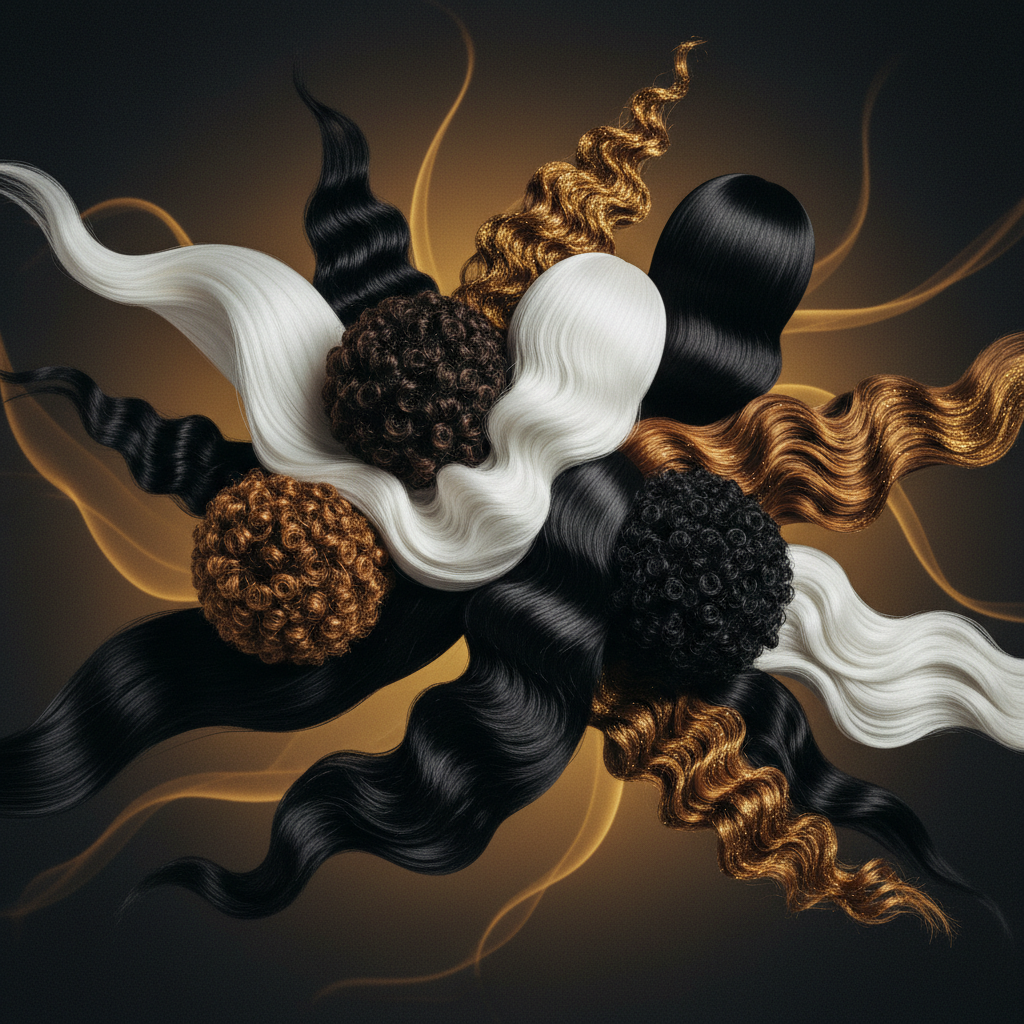
Quick answer: Hair Types and Textures refer to the inherent characteristics of your hair, encompassing its natural curl pattern, the thickness of individual strands, and its porosity. Understanding your specific Hair Types and Textures is crucial for selecting appropriate hair care products and routines that support hair health and appearance, though it's important to recognise that these classifications are models and individual hair can often have mixed characteristics or defy strict categorisation.
Key takeaways
- Hair type broadly categorises hair by its curl pattern: straight, wavy, curly, or coily.
- Hair texture refers to the circumference (thickness) of individual hair strands: fine, medium, or coarse.
- Hair porosity describes how effectively hair absorbs and retains moisture, categorised as low, normal, or high.
- The most widely used hair typing system, while helpful, is a simplified model; individual hair often exhibits characteristics from multiple categories.
- Scalp condition (oily, dry, normal, sensitive) significantly influences overall hair health and product choice.
- Understanding your unique Hair Types and Textures is fundamental for effective hair care, helping to prevent damage and optimise appearance.
Hair Types and Textures: what the evidence shows
Hair Types and Textures are classifications used to describe the intrinsic characteristics of human hair, primarily its natural curl pattern, the diameter of individual strands, and its ability to absorb and retain moisture. While these classifications provide a helpful framework for understanding hair and guiding care practices, it's important to remember they are descriptive models, not rigid scientific definitions. Real hair often presents a blend of characteristics.
Hair Typing Systems: Curl Pattern Classification
The most recognised system for classifying hair by its curl pattern categorises hair into four main types: straight (Type 1), wavy (Type 2), curly (Type 3), and coily (Type 4). Each main type is further subdivided (e.g., 1A, 1B, 1C) to indicate increasing curl definition or coarseness within that category. This system helps individuals identify general care needs, particularly regarding moisture and styling.
Type 1: Straight Hair
Straight hair has no natural curl, growing directly from the follicle without bends or curves. The smooth surface of straight hair allows natural scalp oils (sebum) to travel easily down the hair shaft, often making it prone to appearing oily. This type tends to be resilient but can lack volume and may be challenging to hold a curl.
- 1A: Very fine, thin, and soft, often struggling with volume.
- 1B: Medium texture, possessing more body than 1A and some ability to hold a curl.
- 1C: Thick, coarse, and often resistant to curling. It may have a slight natural bend.
Type 2: Wavy Hair
Wavy hair forms an 'S' shape, falling between straight and curly hair. It typically has more body than straight hair but less defined curls than Type 3 or 4 hair. Wavy hair can be prone to frizz and may require specific products to enhance wave definition.
- 2A: Fine, loose waves, easily straightened but can lack root volume.
- 2B: More defined 'S' waves, usually from the mid-lengths, often with a tendency towards frizz.
- 2C: Distinct, well-defined 'S' waves that start closer to the roots. This type can be thicker and more prone to frizz and tangles.
Type 3: Curly Hair
Curly hair features distinct corkscrew or spiral-shaped curls. The angled growth from the scalp contributes to this pattern. Due to the twists and turns, natural oils struggle to travel down the entire hair shaft, making curly hair more susceptible to dryness and, consequently, frizz and breakage. Shrinkage, where wet hair appears significantly longer than dry hair, is a common characteristic.
- 3A: Large, loose curls, typically shiny but still prone to frizz.
- 3B: Bouncier, tighter curls, with noticeable shrinkage.
- 3C: Tightly packed corkscrew curls, offering significant volume but highly prone to dryness and tangles.
Type 4: Coily Hair
Coily hair, often referred to as kinky hair, has very tight, small, zigzag or S-shaped coils that are densely packed. It exhibits the highest degree of shrinkage. Despite its voluminous appearance, coily hair is often the most fragile hair type due to the numerous bends and twists, which create points of weakness along the fibre. It is highly susceptible to dryness.
For more in-depth information on caring for these specific types, you can explore guides such as "Caring for Curly Hair", "How to Care for Afro Hair", "How to Moisturise Afro Hair", and "How to Detangle Afro Hair Without Breakage".
- 4A: Densely packed S-pattern coils.
- 4B: Z-pattern coils that are sharply angled and less defined, often having a cottony texture.
- 4C: The tightest coil pattern with little to no visible definition without manipulation. It experiences extreme shrinkage and is very prone to dryness and tangles.
Hair Texture: The Diameter of the Hair Strand
Separate from the curl pattern, "hair texture" describes the circumference or thickness of an individual hair strand. This characteristic is distinct from hair density, which refers to the number of hair follicles per square centimetre of scalp. Hair texture is generally classified as fine, medium, or coarse.
Fine Hair
Fine hair strands have the smallest circumference. Individual hairs are thin and can be barely visible. While soft and silky, fine hair is often prone to oiliness, tangling, and can struggle to hold styles, leading to a perceived lack of volume. It may also be more vulnerable to damage from chemical treatments or heat styling.
Medium Hair
Medium hair is the most common texture, with individual strands thicker than fine hair but not as thick as coarse hair. It generally possesses good strength and elasticity, holds styles well, and is less prone to breakage than fine hair.
Coarse Hair
Coarse hair strands have the largest circumference. It feels thick and strong and is often highly resistant to damage and breakage. However, coarse hair can be resistant to styling, prone to frizz, and may take longer to dry. It may also feel rougher to the touch.
To determine your hair texture, you can take a single shed strand of hair and roll it between your fingers. If you can barely feel it, it
Where Watermans fits
If you want a routine built around the science above, these are the products from the range that apply here: