Hair Elasticity Test: How to Assess Hair Strength and Prevent Breakage
8 min read ·
Learn how to perform and interpret a Hair Elasticity Test to identify protein or moisture imbalances, prevent mechanical breakage, and protect hair fibre health.
Quick answer: A Hair Elasticity Test measures your hair fibre's tensile strength and internal cortex health by assessing how much a wet strand stretches before returning to its original length. Healthy hair can stretch roughly 30 to 50 percent when wet without snapping. However, a manual salon pull test is subjective, cannot diagnose medical follicle conditions, and only reflects structural fibre integrity rather than overall scalp health or genetic hair loss.
Key takeaways
- Wet human hair stretches significantly more than dry hair, naturally extending up to 30 to 50 percent of its resting length if the internal cortex is intact.
- Hair that snaps immediately under light tension lacks moisture, protein cross-linking, or both, signalling structural damage.
- Hair that stretches endlessly like chewing gum without returning to its resting length suffers from severe protein loss, often caused by bleach, relaxers, or excessive heat.
- A manual elasticity assessment tests fibre condition, not follicle activity. It cannot detect alopecia or the underlying causes of telogen effluvium.
- The balance of water and alpha-keratin bonds governs elasticity, making targeted conditioning and protein treatments the primary corrective steps.
Hair Elasticity Test: what the evidence shows
The Hair Elasticity Test evaluates the mechanical strength of the hair shaft by stretching a wet strand between your fingers. In cosmetic science, elasticity represents the physical manifestation of the cortex's molecular architecture. Roughly 85 to 90 percent of your hair shaft consists of fibrous proteins called alpha-keratin, organised into coiled protofibrils held together by covalent disulphide bonds, ionic salt bridges, and weak hydrogen bonds.
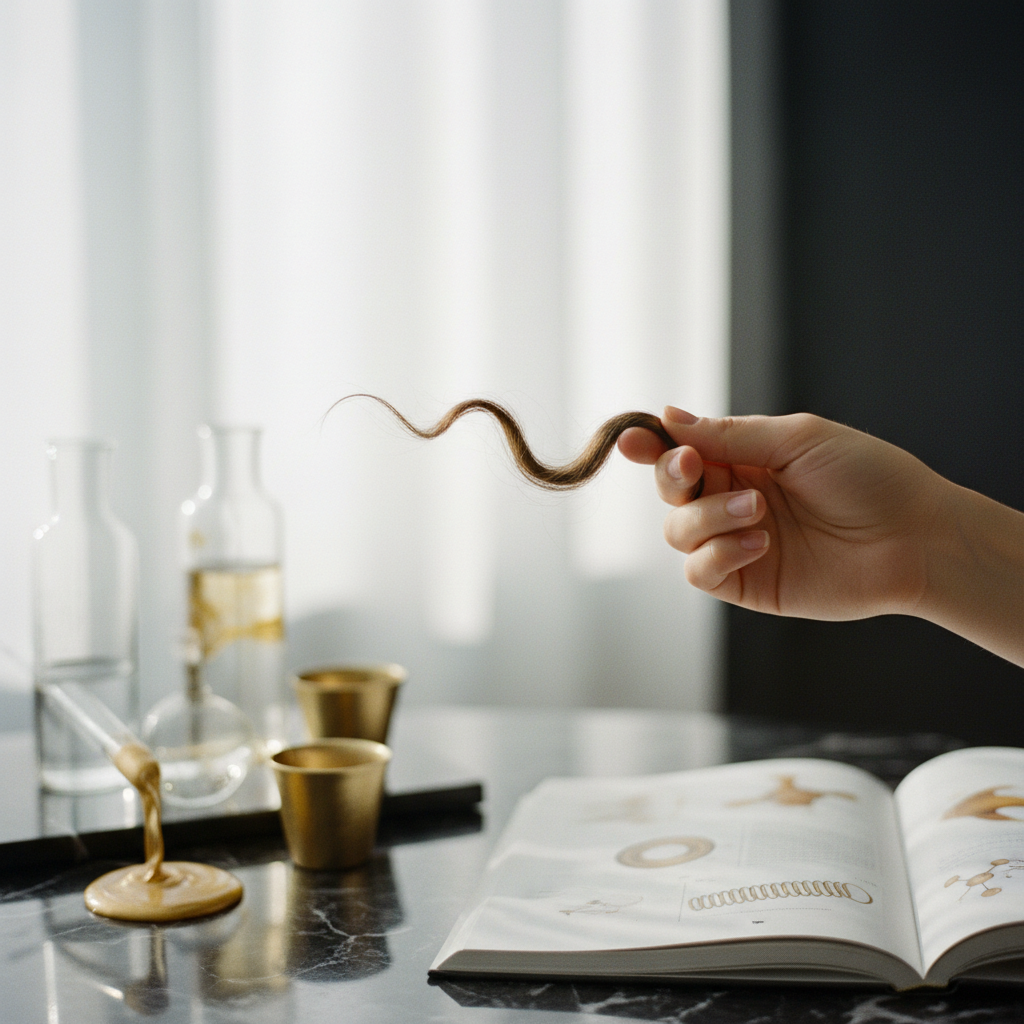
When hair absorbs water, hydrogen bonds temporarily break down. This allows the coiled polypeptide chains inside the cortex to unfurl into beta-sheet conformations under mechanical tension. Cosmetic research published in the Journal of Cosmetic Science confirms that virgin, undamaged wet hair can stretch between 30 and 50 percent beyond its resting length before reaching its yield point and snapping. Once tension releases, an intact hair fibre contracts back to its original length.
If your hair returns to its resting state after a gentle tug, your cortex possesses balanced hydration and intact structural protein networks. Stylists rely on this assessment before performing chemical services like perms, colouring, or relaxers, as compromised elasticity drastically increases the risk of catastrophic fibre breakage during alkaline processing.
How to perform a manual elasticity test at home
You do not need laboratory tensiometers to get a practical reading of your hair's tensile behaviour. Follow these steps to perform a reliable manual test:
- Clarify a single strand: Select a shed hair or isolate a single strand on your head. Ensure it is clean and free of heavy silicone serums or film-forming styling polymers, which can artificially inflate surface slip.
- Wet the fibre thoroughly: Spray the strand with lukewarm water. Dry hair only stretches roughly 15 to 20 percent before breaking, whereas wet hair reveals true cortical resilience.
- Anchor the ends: Hold the strand firmly between your thumb and forefinger on both hands, leaving approximately 3 to 5 centimetres of exposed hair between them.
- Pull gently and steadily: Slowly pull your hands apart, observing the resistance and extension of the strand.
- Release the tension: Note whether the strand returns to its starting length, remains stretched and limp, or snaps instantly.
| Elasticity classification | Behaviour under tension | Underlying fibre state | Primary corrective action |
|---|---|---|---|
| High / Normal | Stretches 30 to 50%, springs back to original length | Intact disulphide bonds, balanced moisture and protein | Maintain current routine; proceed with mild chemical treatments |
| Low / Brittle | Minimal stretch (under 15%), snaps almost immediately | Dehydrated cortex, surface cuticle erosion, or protein overload | Deep moisturising treatments, emollient conditioning, mild heat |
| Over-stretched / Mushy | Stretches excessively past 50%, feels gummy, does not bounce back | Severe protein loss, cleaved disulphide bonds from bleach/relaxers | Hydrolysed protein treatments, bond builders, minimise heat |
What the elasticity test does not show
While a Hair Elasticity Test offers quick insight into the physical resilience of your hair strands, it has clear clinical limitations:
- It cannot detect follicular hair loss: Snapping during an elasticity test represents hair breakage along the shaft. It does not reflect hair shedding, which occurs when hair detaches from the dermal papilla inside the follicle (such as in telogen effluvium or androgenetic alopecia).
- It lacks quantitative precision: A manual tug provides a subjective impression. It does not measure the exact force in Newtons or micro-strain percentages that laboratory stress-strain tensile testing instruments record.
- It cannot diagnose internal systemic health: Deficiencies in ferritin, vitamin D, or zinc alter hair production at the follicle level, but an elasticity test cannot tell you which internal biological pathway is compromised.
The mechanical and biochemical mechanism
Elasticity depends directly on two structural components: alpha-keratin helices and the non-keratinous intercellular cement (the cell membrane complex).
In virgin hair, disulphide cross-links formed by the amino acid cystine give the fibre its permanent mechanical resilience. When you apply alkaline chemicals such as bleach (ammonium persulphate) or sodium hydroxide relaxers, these strong sulphur bonds permanently cleave into cysteic acid residues. This process degrades the cortical matrix. Without adequate cross-linking, the protein coils stretch past their elastic limit without the physical spring force needed to pull them back.
Conversely, hair that snaps with zero stretch often suffers from extreme moisture depletion or an excess of rigid surface coatings. When moisture content drops below 10 percent, hydrogen bonds lock into rigid configurations. Without water molecules acting as internal plasticisers, the fibre turns brittle and fractures under minimal mechanical stress.
Warning signs of damaged elasticity
You do not always have to perform a manual stretch to spot compromised elasticity. Common daily symptoms include:
- Short broken hairs in your brush: Hair falling out from the root has a tiny white bulb on the end. Short fragments without a bulb point directly to mechanical breakage caused by poor elasticity.
- Tangles that knot instantly: Weakened fibres display lifted, shredded cuticles that snag on adjacent strands, creating stubborn knots that snap when combed.
- Spongy texture when washing: If your wet hair feels mushy, gummy, or behaves like stretched elastic bands under the shower, your cortex has suffered severe structural breakdown.
- Loss of curl definition: Naturally curly or wavy hair relies on internal cortical tension to maintain its spiral pattern. Severe elasticity loss causes curl patterns to drop into limp, frizzy waves.
Restoring elasticity: moisture and protein balance
Correcting elasticity requires tailoring your haircare routine to the specific structural deficiency identified during your test.
Addressing low elasticity and brittleness
If your hair snaps rapidly with minimal stretch, your fibres need immediate plasticisation:
- Use rinse-out and leave-in conditioners containing humectants like glycerin, panthenol, and aloe vera to pull ambient moisture into the shaft.
- Seal the cuticle with lightweight natural oils (such as argan or jojoba oil) to slow water evaporation from the cortex.
- Avoid frequent use of high-concentration hydrolysed protein treatments until your hair feels pliable again.
Addressing over-stretched, gummy hair
If your hair stretches excessively without snapping back, the cortex lacks structural density:
- Incorporate hydrolysed keratin, wheat protein, or silk amino acids. These low-molecular-weight proteins penetrate lifted cuticles and temporarily reinforce depleted cortical gaps.
- Apply bond-building formulations that focus on reforming bis-sulphide or hydrogen networks.
- Pause all bleaching, permanent oxidative colouring, and chemical straightening until the fibre shows improved mechanical resistance.
The role of Watermans haircare
Maintaining hair integrity requires supporting both the fibre along the shaft and the environment at the scalp surface. While cosmetic products cannot alter genetic hair loss patterns, targeted topicals help protect strands from premature breakage.
Watermans Grow Me Shampoo and Conditioner provide a gentle, sulphate-free cleanse enriched with hydrolysed lupin protein, biotin, rosemary, and niacinamide. Hydrolysed botanical proteins bind to vulnerable regions of the cuticle and outer cortex, helping to reinforce hair that shows signs of mechanical fatigue. Paired with moisturising botanicals, these formulas help preserve the delicate balance between flexibility and tensile strength without leaving rigid, brittle polymer residues behind.
When to seek professional advice
If your hair continues to snap despite focused conditioning, consult a qualified trichologist or experienced stylist. Severe chemical damage may reach a stage where the internal cortex cannot be functionally repaired, requiring a corrective haircut to stop splits from travelling up the shaft.
Furthermore, if you notice thinning patches on your scalp, a widening parting, or clumps of hair detaching with the root bulb attached, your issue is hair loss rather than breakage. Consult your GP or a dermatologist, who can evaluate blood markers, hormonal profiles, and scalp health to diagnose the root cause.
Frequently asked questions about Hair Elasticity Test
What is the purpose of a Hair Elasticity Test?
The Hair Elasticity Test evaluates the internal health of your hair shaft's cortex. By assessing how much a wet strand stretches and contracts, it identifies whether your hair requires moisture, protein, or professional chemical precautions before salon processing.
Should I perform the test on wet or dry hair?
Always perform the test on clean, wet hair. Dry hair only stretches 15 to 20 percent before breaking. Wetting the hair temporarily breaks hydrogen bonds, allowing the protein coils inside the cortex to unfurl fully and reveal their genuine tensile capacity.
Does low hair elasticity cause hair shedding?
No. Low hair elasticity causes hair breakage along the fibre, not hair shedding at the root. Shedding involves the biological growth cycle inside the dermal papilla, while elasticity reflects the physical strength of the already-grown hair strand.
Can severe protein overload ruin elasticity?
Yes. Excessive use of heavy, non-penetrating protein masks without balancing moisture can coat the hair and strip its flexibility. This makes the fibre excessively rigid, causing it to snap immediately when pulled rather than stretching naturally.
Summary
The Hair Elasticity Test remains one of the simplest, most effective diagnostic techniques to determine the structural condition of your hair. By distinguishing between brittle fibres in need of hydration and over-stretched strands starved of protein, you can tailor your routine to prevent breakage and maintain resilient, healthy-looking hair.
Sources and references
- Robbins, C. R. (2012). Chemical and Physical Behavior of Human Hair. 5th ed. Springer-Verlag.
- Journal of Cosmetic Science: "The mechanical properties of human hair: a review of tensile testing techniques and cosmetic applications" (Society of Cosmetic Scientists).
- British Association of Dermatologists: "Hair breakage versus shedding: clinical assessment guidelines."
- National Institute for Health and Care Excellence (NICE): "Alopecia: clinical assessment and diagnosis."
Find these ingredients in Watermans products
- Zinc: you will find this ingredient in our Hair Vitamins.
- Niacinamide: you will find this ingredient in our Hair Mask.
- Panthenol (Provitamin B5): you will find this ingredient in our Heat Protection Spray.
- Aloe Vera: you will find this ingredient in our Curly Hair Conditioner.