Dihydrotestosterone and Hair: The Biological Mechanism Explained
9 min read ·
Explore the science of Dihydrotestosterone and Hair: learn how DHT drives follicular miniaturisation, how genetics dictates sensitivity, and how to protect hair density.

Quick answer: The relationship between Dihydrotestosterone and Hair centres on follicular miniaturisation. Dihydrotestosterone (DHT) is a potent androgen derived from testosterone via the 5-alpha reductase enzyme. In genetically susceptible scalp follicles, DHT binds to androgen receptors, progressively shortening the anagen growth phase and shrinking the follicle. The primary limitation is genetics: circulating DHT levels alone do not dictate thinning, as follicular sensitivity and local receptor density determine whether hair loss actually occurs.
Key takeaways
- Dihydrotestosterone (DHT) is synthesised locally from testosterone by the intracellular enzyme 5-alpha reductase (types 1 and 2).
- DHT causes follicular miniaturisation only in follicles genetically programmed with high androgen sensitivity, predominantly at the hairline, temples, and crown.
- Miniaturisation shortens the anagen (growth) phase from years to months, causing terminal hairs to regress into thin, unpigmented vellus-like hairs.
- Serum levels of DHT do not always correlate with shedding or thinning; local tissue sensitivity and receptor density play the decisive role.
- Cosmetic topical products cannot alter systemic hormones, but they can support the scalp barrier, reduce physical breakage, and improve the appearance of hair density.
Dihydrotestosterone and Hair: what the evidence shows
Research into Dihydrotestosterone and Hair demonstrates that DHT is the primary hormonal trigger for androgenetic alopecia (pattern hair loss) in both men and women. Testosterone converts to DHT via the enzyme 5-alpha reductase. While DHT is crucial for male sexual development during gestation and puberty, its effect on adult scalp follicles is markedly different.

In genetically susceptible individuals, DHT exhibits up to five times greater binding affinity for androgen receptors than baseline testosterone. When DHT binds to receptors within the dermal papilla cells of vulnerable scalp follicles, it triggers a cascade of molecular signals. Clinical research published in peer-reviewed journals shows that this pathway upregulates inhibitory cytokines, including transforming growth factor beta (TGF-beta), which arrest normal cell proliferation in the hair matrix.
Over repeated growth cycles, the follicle undergoes miniaturisation. The active growing phase (anagen) shortens dramatically, often decreasing from a typical three to seven years down to just several weeks or months. Concurrently, the resting phase (telogen) lengthens. With each successive cycle, the resulting hair shaft emerges thinner, weaker, and with less pigment, eventually resembling fine vellus hair.
What the evidence does not show
The evidence does not show that high DHT automatically causes baldness across the entire scalp. Follicles located at the occipital zone (the back and lower sides of the head) generally lack the genetic sensitivity to DHT seen at the frontal hairline and vertex. This fundamental biological difference explains why donor hair taken from the back of the scalp survives and flourishes when transplanted to the crown.
Furthermore, research does not support the common myth that individuals experiencing pattern hair loss possess abnormally high circulating blood levels of testosterone or DHT. Most men and women with androgenetic alopecia present with normal serum hormone panels. The decisive factor is local androgen receptor density, 5-alpha reductase activity within the scalp tissue itself, and downstream genetic sensitivity.
Finally, evidence does not show that daily cosmetic shampoos or non-prescription styling treatments alter circulating endocrine hormone levels. Topical cosmetic formulas operate strictly at the surface and follicular orifice to clean, condition, and reduce mechanical breakage.
| Feature | Androgenetic Alopecia (DHT-mediated) | Telogen Effluvium (Diffuse Shedding) | Hair Breakage (Fibre Fracture) |
|---|---|---|---|
| Primary Root Cause | Genetic follicular sensitivity to DHT | Physiological stress, illness, or shock | Mechanical, chemical, or thermal trauma |
| Pattern of Thinning | Receding hairline, crown, and vertex | Diffuse shedding across the entire scalp | Patchy thinning, snapped ends, frizzy mid-lengths |
| Follicle Status | Miniaturised, produces fine vellus strands | Healthy follicle, prematurely enters rest | Follicle completely unaffected |
| Shed Hair Appearance | Thin, miniaturised fibres with or without root | Normal-diameter fibres with white keratin bulb | Short, fractured fragments without root bulbs |
| Typical Reversibility | Progressive without ongoing clinical management | High; self-corrects once trigger resolves | High; regrows normally once damage stops |
The biological mechanism of DHT in the follicle
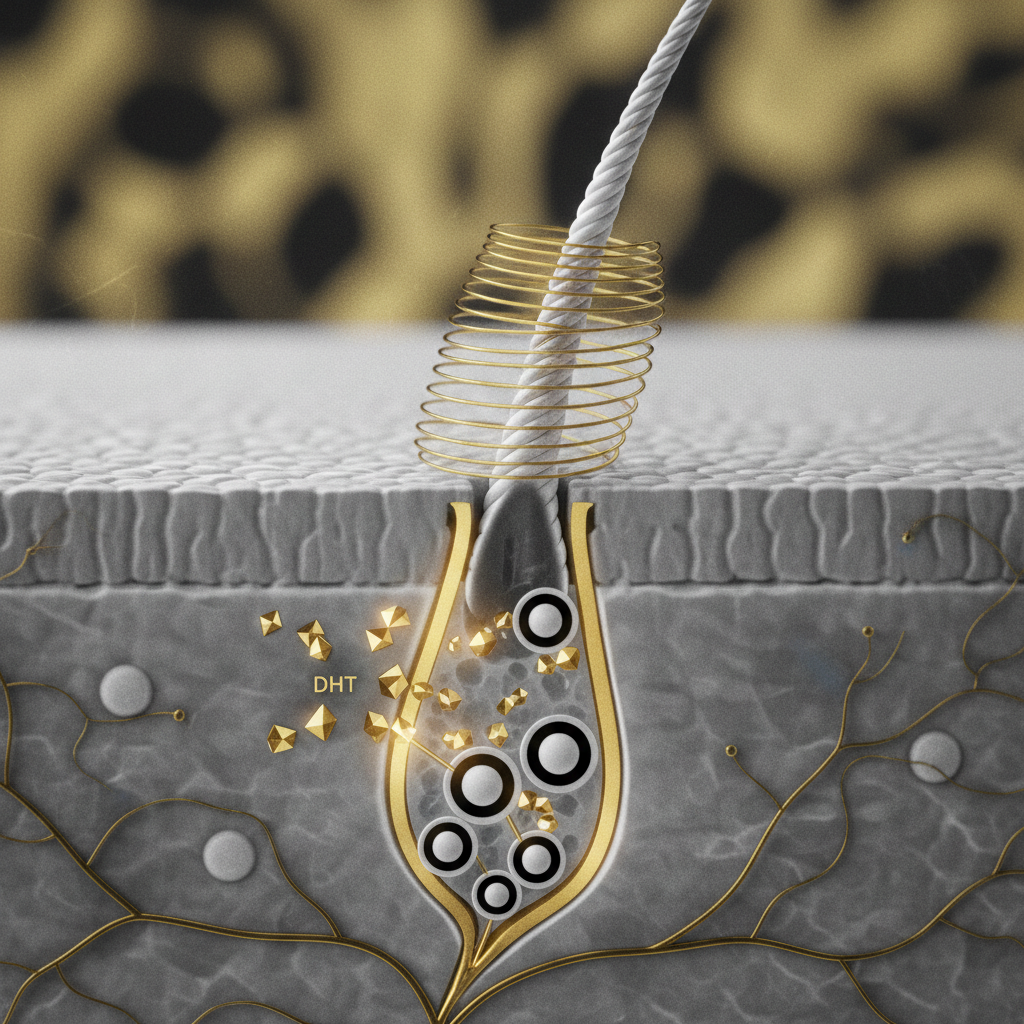
The biochemical pathway connecting Dihydrotestosterone and Hair operates within the dermal papilla, the vascular base that nourishes the hair follicle. The conversion of testosterone to DHT relies on 5-alpha reductase, which exists in two main isoenzymes: Type 1, found primarily in sebaceous glands and liver, and Type 2, heavily expressed in the inner root sheath of hair follicles and prostate tissue.
Circulating Testosterone
 │
 ▼ (5-Alpha Reductase Enzyme)
Dihydrotestosterone (DHT)
 │
 ▼ (Binds to Androgen Receptors in Dermal Papilla)
Expression of Inhibitory Signalling (TGF-β, DKK-1)
 │
 ▼
Suppression of Matrix Cell Division
 │
 ▼
Shortened Anagen Phase & Progressive Miniaturisation
Once DHT enters the dermal papilla cell, it binds directly to the androgen receptor, prompting the receptor complex to translocate into the cell nucleus. Inside the nucleus, it alters gene transcription.
This altered transcription increases the secretion of Dickkopf-1 (DKK-1) and TGF-beta. These signalling proteins suppress the Wnt/beta-catenin pathway, a cellular communication network essential for maintaining hair follicle stem cell activity and hair shaft elongation. Over successive hair cycles, the dermal papilla volume decreases, capillary microcirculation diminishes, and the follicle progressively loses its capacity to manufacture a robust, thick hair shaft.
Signs of DHT-related hair changes
Identifying whether hair changes stem from androgenetic activity requires observing specific physical patterns:
- Bitemporal recession: The hairline begins moving backward at the temples, creating an "M" shape in men.
- Crown and vertex thinning: A gradual reduction in density at the swirl or top of the head, widening outward over months or years.
- Widening central parting: In women, DHT sensitivity often presents as diffuse thinning across the crown with retention of the frontal hairline, classified on the Ludwig scale.
- Fibre diameter disparity: An increasing ratio of fine, short, wispy hairs intermingled among thick, terminal hairs on the top of the scalp.
- Preserved occipital density: Hair along the nape of the neck and above the ears retains its original thickness, diameter, and growth rate.
When the cause may be something else
Thinning is frequently conflated with DHT-mediated hair loss when another mechanism is at work.
Telogen effluvium
A physiological shock, severe viral illness, rapid weight loss, or high fever can push up to 30 percent of active follicles prematurely into the telogen (resting) phase. Two to three months later, massive diffuse shedding occurs across the entire scalp, not just the crown or hairline. Unlike DHT miniaturisation, telogen effluvium leaves follicle diameter intact and generally resolves once the underlying trigger is addressed.
Mechanical and chemical breakage
Cosmetic damage is often misidentified as hair loss. Excessive heat styling (temperatures exceeding 180 degrees Celsius), chemical bleach, and tight tension styles fracture the hair shaft. Inspect the shed hair: if the fibre lacks a tiny white bulb at the end and varies in length, it is breakage rather than follicular loss.
Nutritional and thyroid imbalances
Deficiencies in serum ferritin (iron stores), vitamin D, or zinc, alongside hypothyroidism or hyperthyroidism, directly impair metabolic activity in the hair matrix. These conditions produce generalised thinning that mimics or exacerbates genetic patterns.
Supporting hair density and scalp health
Addressing the visual effects of Dihydrotestosterone and Hair requires a dual strategy: medical management for internal follicular activity, and structured cosmetic care to preserve strand integrity.
Prescription pharmaceutical interventions, such as 5-alpha reductase inhibitors or topical vasodilators, work directly on the biological pathway under the care of a physician or dermatologist. These treatments focus on lowering local DHT synthesis or improving nutrient delivery to the follicle.
Cosmetically, maintaining scalp hygiene and hair fibre elasticity prevents secondary density loss. Use a gentle, sulphate-free shampoo to remove sebum, sweat, and environmental pollutants from the follicular ostium. Because miniaturised hairs have a smaller diameter, they snap easily under mechanical tension. Incorporating lightweight conditioning agents containing proteins, amino acids, and hydrolysed wheat strengthens the outer cuticle, reducing structural breakage.
The Watermans approach to scalp care
While cosmetic products do not treat medical alopecia or block systemic hormones, a healthy scalp microbiome provides the optimal foundation for growing hair. Watermans designs scalp-focused cosmetic formulations engineered to invigorate the scalp environment, fortify delicate fibres, and deliver fuller-looking hair.
Using topical botanicals such as rosemary extract, caffeine, biotin, and niacinamide, Watermans Grow Me shampoo and Condition Me conditioner focus on cleansing the scalp without stripping natural lipids, nourishing the hair cuticle, and reducing daily mechanical breakage on fragile, thinning strands.
Frequently asked questions about Dihydrotestosterone and Hair
What is the exact link between Dihydrotestosterone and Hair loss?
The link between Dihydrotestosterone and Hair is genetic follicular miniaturisation. When DHT binds to androgen receptors in susceptible scalp follicles, it shortens the anagen growth cycle and reduces follicular volume. Over time, affected follicles produce increasingly finer, shorter hairs until the follicle becomes dormant.
Does washing hair frequently reduce DHT on the scalp?
No, washing hair frequently does not eliminate DHT. DHT is produced internally within the cells of the dermal papilla and hair follicle sheath, not on the surface of the skin. While shampoo washes away surface sebum, dirt, and dead skin cells, it cannot rinse away internally bound hormones.
Can women experience DHT-related hair thinning?
Yes. Although women have significantly lower circulating testosterone levels than men, the enzyme 5-alpha reductase still converts testosterone into DHT in female scalp tissue. In women with genetic receptor sensitivity or shifting androgen-to-oestrogen ratios (such as during perimenopause), DHT can trigger female pattern hair loss.
Does high DHT cause body hair to fall out as well?
No. DHT operates through a biological paradox: while it inhibits follicle growth on the scalp in genetically susceptible areas, it stimulates and promotes terminal hair growth on the face, chest, axilla, and pubic regions.
Can hair miniaturised by DHT regrow naturally?
Follicles that have undergone advanced miniaturisation for many years rarely revert to thick terminal hairs naturally without clinical intervention. However, if addressed early while the follicle remains active, standard medical treatments combined with scalp-supportive cosmetic care can help preserve existing density and thicken partially miniaturised strands.
Summary on Dihydrotestosterone and Hair
Navigating the biology of Dihydrotestosterone and Hair comes down to recognising the role of genetics over simple hormone volume. DHT does not act as an arbitrary toxin; rather, it interacts with inherited follicular receptors to drive gradual miniaturisation in classic anatomical patterns. Distinguishing androgen-driven thinning from temporary telogen effluvium and everyday fibre breakage ensures you choose the correct approach, combining clinical therapies where appropriate with rigorous, non-stripping cosmetic care to keep your hair resilient.
Sources and references
- British Association of Dermatologists. Guidelines for the management of alopecia areata and androgenetic alopecia, 2021.
- National Institute for Health and Care Excellence (NICE). Alopecia androgenetica: clinical knowledge summary, 2022.
- Journal of Investigative Dermatology. "The Role of 5-Alpha-Reductase Isozymes in Androgenetic Alopecia", 2018.
- American Academy of Dermatology. "Hair loss: Who gets and causes", 2023.
- Endocrine Reviews. "Androgen Action in the Hair Follicle: Basic Science and Clinical Relevance", 2020.
Find these ingredients in Watermans products
- Zinc: you will find this ingredient in our Hair Vitamins.
- Niacinamide: you will find this ingredient in our Hair Mask.