DHT and Follicular Miniaturisation: The Biological Mechanism Explained
8 min read ·
Explore the biological link between DHT and Follicular Miniaturisation, how hair follicles shrink across growth cycles, and proven ways to address hereditary thinning.

Quick answer: The biological link between DHT and Follicular Miniaturisation drives androgenetic alopecia in genetically susceptible individuals. Dihydrotestosterone (DHT) binds to androgen receptors in dermal papilla cells, triggering molecular signals that shorten the anagen (growth) phase and progressively shrink hair follicles over successive cycles. This process transforms thick terminal hairs into thin vellus hairs. The main limitation is that topical cosmetics cannot cure genetic miniaturisation, and once a follicle undergoes complete fibrosis, the loss becomes permanent.
Key takeaways
- DHT is an active androgen formed when the enzyme 5-alpha reductase converts circulating testosterone within tissue.
- Follicular miniaturisation is a progressive, multi-cycle process that shortens anagen and lengthens telogen phases.
- The primary structural sign is follicular diameter diversity, where hairs growing side-by-side show varying thicknesses.
- Miniaturisation differs fundamentally from telogen effluvium (diffuse shedding) and mechanical hair breakage.
- Early intervention offers the highest chance of stabilising follicle diameter before tissue fibrosis occurs.
DHT and Follicular Miniaturisation: what the evidence shows
Research shows that DHT and Follicular Miniaturisation operate as an interconnected biological mechanism in hereditary hair loss (androgenetic alopecia). Dihydrotestosterone has roughly five times higher binding affinity for the androgen receptor than free testosterone. When DHT attaches to receptors in dermal papillae of susceptible follicles, it alters gene expression and suppresses essential growth factors.
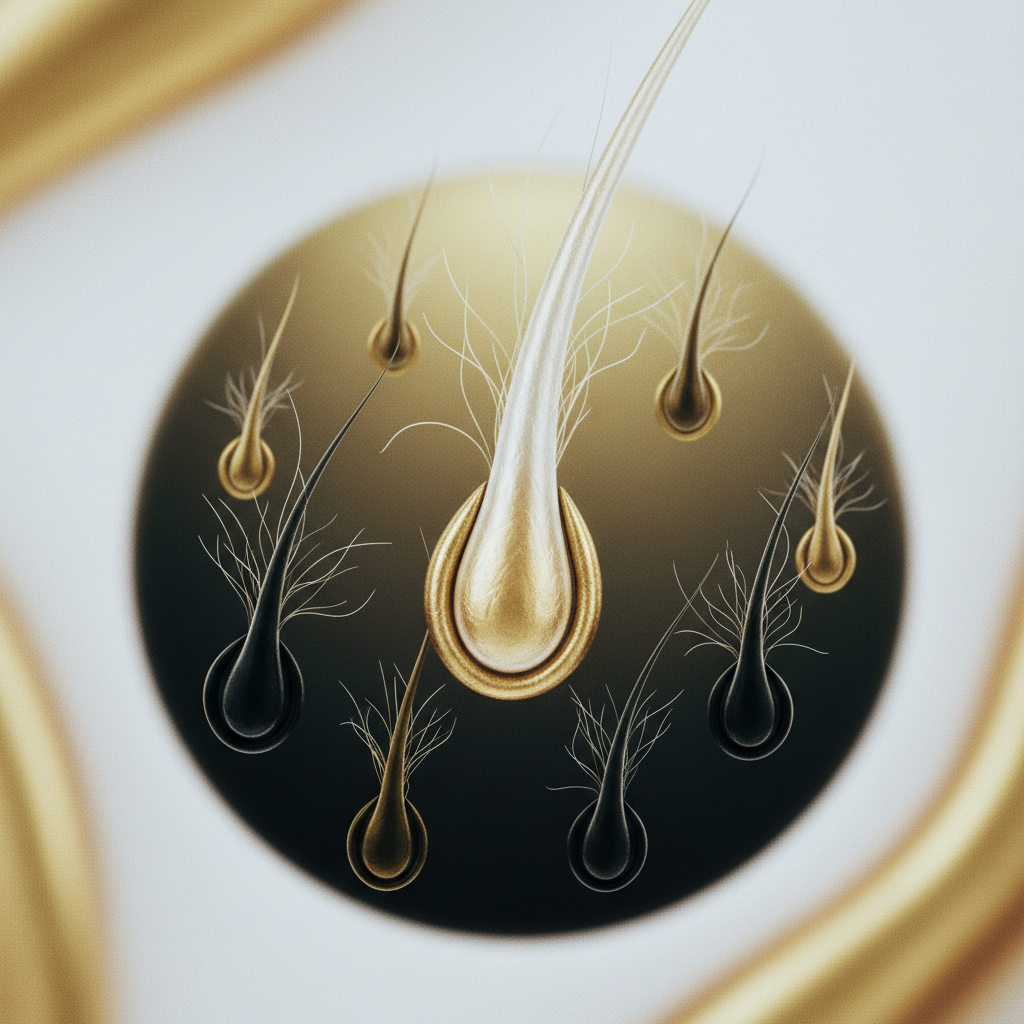
This interaction is not uniform across the human head. Hair follicles located on the vertex, temples, and crown contain higher concentrations of androgen receptors and type II 5-alpha reductase enzymes than occipital follicles (the back and lower sides). This genetic variation explains why pattern thinning spares the donor zone at the back of the neck while progressing across the crown.
Over consecutive growth cycles, the target follicle produces a progressively narrower, weaker fibre. Clinical dermoscopy reveals this shift through hair shaft diameter variation, often preceding visible scalp exposure by several years.
The biological mechanism of follicle shrinking
Understanding the cellular progression explains why gradual thinning occurs rather than sudden hair drop.
Testosterone + 5-Alpha Reductase
 │
 ▼
 DHT
 │
 ▼
Binds to Androgen Receptors in Dermal Papilla
 │
 ▼
Upregulates TGF-beta & Suppresses Wnt/beta-catenin
 │
 ▼
Shortened Anagen Phase + Prolonged Latent Phase
 │
 ▼
Follicle Miniaturisation & Eventual Fibrosis
- Enzymatic conversion: The enzyme 5-alpha reductase (specifically type II, concentrated in the outer root sheath and dermal papilla) converts testosterone to DHT.
- Receptor binding and signalling cascade: DHT binds to intracellular androgen receptors. This complex translocates to the cell nucleus, altering transcription. It upregulates inhibitory cytokines, notably Transforming Growth Factor-beta (TGF-beta) and Dickkopf-1 (DKK-1), which suppress cellular proliferation.
- Cycle disruption: The active anagen phase drops from its normal span of two to seven years down to a few months or weeks. Concurrently, the kenogen phase (the period between hair shedding and the emergence of a new hair) lengthens.
- Structural regression: The dermal papilla decreases in volume, losing extracellular matrix and cellularity. Each subsequent hair fibre emerges with a smaller calibre, reduced pigmentation, and diminished root depth. Eventually, robust terminal fibres become wispy, non-pigmented vellus hairs.
What the evidence does not show
Misconceptions regarding DHT and follicular decline remain common in salon consultations and online forums:

- High blood testosterone does not automatically cause miniaturisation: Men and women experiencing androgenetic alopecia frequently exhibit normal serum androgen concentrations. The decisive factor is local follicular sensitivity, receptor density, and enzyme expression, not systemic hormone excess.
- Miniaturisation does not happen overnight: A follicle does not shrink within a single shedding cycle. The process requires several full hair cycles, often taking three to eight years to become cosmetically apparent.
- DHT is not a toxic build-up on the scalp surface: While sebum contains traces of lipids and sterols, follicular miniaturisation is an internal biological signalling process taking place deep in the dermal papilla, not a simple external wax plug suffocating the pore.
- Cosmetics cannot alter your genetic receptor density: External products cannot rewrite androgen receptor gene coding. Cosmetic shampoos support hair fibre resilience and a balanced scalp environment, but they do not eliminate genetic predisposition.
Signs to look for: identifying miniaturisation
Recognising early signs allows individuals to address density shifts before permanent follicular scarring sets in. Stylists and individuals can look for specific structural differences:
| Parameter | Terminal Hair (Healthy) | Miniaturising Hair | Vellus Hair (End-stage) |
|---|---|---|---|
| Average Diameter | 60 to 90 micrometres | 30 to 55 micrometres | Under 30 micrometres |
| Anagen Duration | 2 to 7 years | Several months to 1 year | A few weeks |
| Follicular Depth | 4 to 5 mm (subcutis) | 2 to 3 mm (dermis) | Under 1 mm (upper dermis) |
| Pigmentation | Full, natural depth | Lighter, patchy melanin | None (translucent) |
| Medulla Presence | Continuous or interrupted | Fragmented or absent | Completely absent |
| Shedding Profile | Long, thick fibres | Short, fine tapered hairs | Barely visible fuzz |
Clinically, a dermatoscope (trichoscopy) provides the gold standard diagnosis. If more than 20 percent of hairs in a target zone exhibit diameter diversity (anisotrichosis), follicular miniaturisation is confirmed.
What you can do: clinical and supportive approaches
Managing follicular regression requires realistic timelines and layered strategies targeting biological causes and scalp health.
Evidence-based clinical interventions
Medical guidelines evaluate systemic and topical pharmaceutical inhibitors that address the underlying mechanism:
- 5-alpha reductase inhibitors: Oral options like finasteride block the type II enzyme, reducing scalp DHT levels by roughly 60 to 70 percent. This can halt miniaturisation and allow partially miniaturised follicles to regain calibre over 12 to 24 months.
- Vasodilators and channel openers: Topical minoxidil (typically 5 percent) does not block DHT directly, but it prolongs anagen duration and increases blood perfusion to the dermal papilla, enlarging miniaturised follicles.
- Low-level laser therapy (LLLT): Photobiomodulation using 650 nm light stimulates cellular respiration in dermal papillae, providing mild to moderate support for hair calibre.
Everyday supportive care
Maintaining scalp and hair integrity prevents secondary mechanical stress:
- Scalp hygiene: Regular cleansing removes oxidised sebum, micro-organisms, and environmental pollutants that trigger perifollicular inflammation, which accelerates miniaturisation.
- Tension management: Avoid traction hairstyles that pull on sensitive frontal follicles already weakened by androgens.
- Cosmetic enhancement: Watermans products, such as targeted scalp formulations and shampoos containing caffeine, rosemary, and biotin, provide a clean, invigorating scalp environment and coat fibres to create an immediately thicker appearance while supporting general hair strength.
When the cause may be something else
Thinning hair does not always stem from androgen-driven miniaturisation. It is critical to separate distinct hair conditions:
- Telogen effluvium: Characterised by sudden, diffuse hair shedding across the entire scalp, often shedding over 150 to 300 hairs per day. Triggered by severe physiological stress, illness, crash dieting, or thyroid dysfunction. Unlike miniaturisation, the shed fibres are uniform in thickness.
- Alopecia areata: An autoimmune disorder where T-lymphocytes target anagen hair bulbs, causing round, patchy bald spots. Exclamation-mark hairs appear under trichoscopy rather than gradual diameter tapering.
- Hair fibre breakage: Breakage occurs when physical manipulation, heat, or bleaching snaps the keratin shaft. The root remains securely in the scalp, and there is no shift in follicular diameter at the surface.
- Cicatricial (scarring) alopecias: Conditions like frontal fibrosing alopecia or lichen planopilaris destroy the stem cell niche in the follicle through inflammatory scarring, accompanied by erythema, itching, or scaling.
When to get professional advice
Consult a registered trichologist, GP, or consultant dermatologist if:
- You notice progressive widening of your parting or receding temples over a period of 6 to 12 months.
- Hair shedding begins abruptly following illness, surgery, or drastic dietary changes.
- Your scalp experiences pain, burning, intense itching, crusting, or scaling.
- Eyebrows or body hair also display signs of thinning.
- You are considering medical therapies like 5-alpha reductase inhibitors, which require prescription oversight and a discussion of potential systemic side effects.
Frequently asked questions about DHT and Follicular Miniaturisation
Can miniaturised hair follicles be restored to full thickness?
Yes, provided the follicle has not fully atrophied. If miniaturisation is caught in its early stages (when hairs are intermediate rather than true vellus), therapies that inhibit DHT or stimulate cellular metabolism can widen follicle diameter over 12 to 24 months. Once the pore closes with fibrotic scar tissue, regrowth is no longer biologically possible.
Does high DHT always cause baldness in men and women?
No. The relationship between DHT and Follicular Miniaturisation depends primarily on the genetic sensitivity of androgen receptors within the follicle, not just the quantity of circulating hormone. An individual with low or normal DHT levels but highly sensitive receptors can experience aggressive miniaturisation, while someone with high DHT and low receptor sensitivity may retain a full head of hair.
How does miniaturisation differ from standard hair shedding?
Standard hair shedding (telogen effluvium) involves healthy, full-calibre hairs detaching from the scalp in high numbers due to a temporary cycle shift. Follicular miniaturisation is a progressive narrowing of hair diameter across cycles. You may not notice dramatic clumps falling out, but the hair that grows back becomes progressively thinner, shorter, and less visible over time.
Can washing your hair remove DHT from the scalp?
Washing removes surface sebum, debris, and cosmetic residue, but it cannot wash away DHT bound to internal receptors. 5-alpha reductase converts testosterone inside the dermal papilla cells beneath the scalp surface. Regular washing maintains scalp hygiene and limits inflammation, but topical cleansing alone does not deactivate follicular androgen pathways.
Summary on DHT and hair follicle health
Navigating DHT and Follicular Miniaturisation requires understanding the complex biology of the human hair follicle. While dihydrotestosterone provides the biochemical trigger, cellular genetics dictate which follicles shrink and which remain resilient. Intervening early with validated treatments, combined with a supportive scalp-care routine, gives you the best opportunity to preserve follicle function and maintain long-term hair density.
Sources and references
- British Association of Dermatologists. Guidelines for the management of alopecia areata and androgenetic alopecia. (2018).
- Journal of Investigative Dermatology. "Dihydrotestosterone and its role in androgenetic alopecia: mechanisms of follicular regression." (2019).
- NHS UK. Hair loss (alopecia): causes, investigations, and clinical treatments. (Reviewed 2023).
- Dermatologic Clinics. "Trichoscopy in androgenetic alopecia: diagnostic criteria and differential diagnosis." (2021).
- Endocrine Reviews. "Androgen action in the human hair follicle: basic biology to clinical practice." (2020).
Find these ingredients in Watermans products
- Biotin: you will find this ingredient in our Hair Growth Shampoo.