Dermal Papilla Function: The Biological Engine of Hair Growth
8 min read ·
Explore the core dermal papilla function, from controlling hair growth cycles and fibre thickness to managing androgen-driven hair miniaturisation.

Quick answer: Dermal papilla function centres on acting as the primary control centre for hair growth, orchestrating follicle cycling, fibre thickness, and regeneration. Located at the base of the hair bulb, this cluster of specialised mesenchymal cells releases chemical signals that direct neighbouring epithelial cells to divide and build the hair shaft. However, optimal dermal papilla function is limited by genetic sensitivity, hormonal shifts such as dihydrotestosterone (DHT) exposure, and microvascular health, meaning cellular signaling can degrade over time without clinical intervention.
Key takeaways
- The dermal papilla is a cluster of mesenchymal cells at the base of the hair follicle that directs the entire hair growth cycle.
- Dermal papilla signaling determines the duration of the anagen (growth) phase as well as the physical diameter of the hair shaft.
- Androgens, particularly dihydrotestosterone (DHT), alter dermal papilla signaling in genetically susceptible follicles, inducing miniaturisation.
- Cellular cross-talk between the dermal papilla and surrounding matrix cells relies heavily on the Wnt/beta-catenin pathway.
- Topically supporting the scalp environment can improve hair condition and reduce breakage, but reversing true dermal papilla loss requires medical oversight.
Dermal Papilla Function: what the evidence shows
Dermal papilla function represents the command engine of the human hair follicle. Located at the base of the hair bulb and enveloped by the germinative hair matrix, the dermal papilla consists of specialised fibroblast-like cells derived from the embryonic mesenchyme. Research published in journals such as Development and the Journal of Investigative Dermatology demonstrates that these cells govern the size of the follicle, dictate whether a hair grows or rests, and produce the biochemical cues necessary to construct a hair shaft.
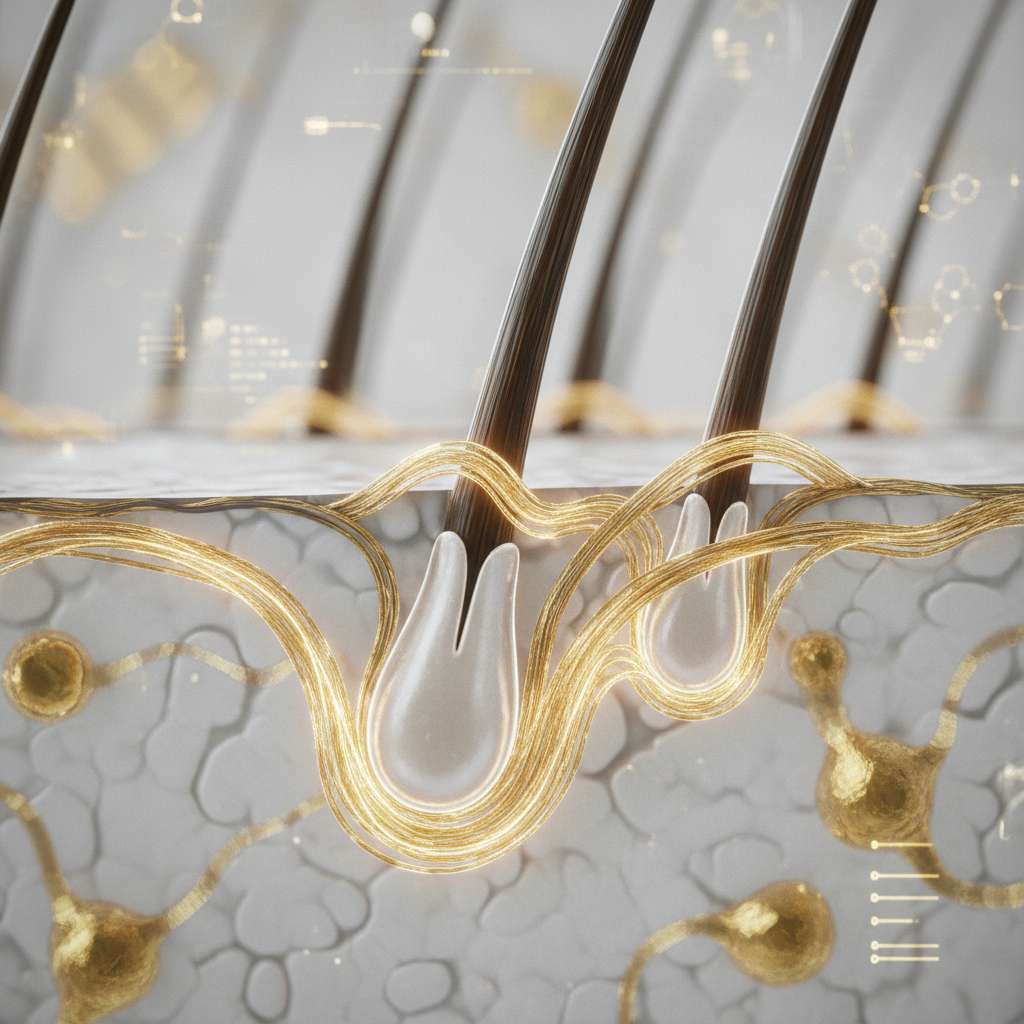
During embryogenesis, the dermal papilla condenses beneath the surface epithelium, prompting the downward growth of the hair follicle peg. Throughout adult life, its primary duty is regulating the hair cycle: anagen (active growth), catagen (regression), and telogen (quiescence). When a follicle prepares to enter anagen, signals from the dermal papilla activate epithelial stem cells residing in the hair follicle bulge and the secondary hair germ.
The volume of the dermal papilla directly correlates with hair shaft thickness. Follicles with a large, highly populated dermal papilla produce thick, terminal hairs with diameters ranging from 60 to 100 micrometres. If the cell count within the papilla declines, the resulting hair shaft emerges significantly thinner, ultimately resembling vellus hair (under 30 micrometres).
+-------------------------------------------------------+
| HAIR BULB ARCHITECTURE |
| |
| [ Outer Root Sheath ] [ Inner Root Sheath ] |
| \ / |
| [ Matrix Epithelial Cells ] |
| | |
| (Chemical Signals) |
| ^ |
| [ DERMAL PAPILLA CELLS ] |
| | |
| (Blood Microcapillaries) |
+-------------------------------------------------------+
The cellular signaling mechanisms of the dermal papilla
The dermal papilla communicates with adjacent matrix cells through complex paracrine signaling pathways. Rather than acting as a passive anchor, it actively secretes growth factors, morphogens, and extracellular matrix components that instruct surrounding epithelial cells to proliferate and differentiate into the inner root sheath and hair cortex.
Key signaling pathways and molecules include:
- The Wnt/beta-catenin pathway: This pathway serves as the master switch for anagen initiation and maintenance. High levels of beta-catenin signaling inside dermal papilla cells maintain the follicle in an active growth phase. If this pathway is suppressed, the follicle prematurely transitions into catagen.
- Fibroblast Growth Factors (FGF-7 and FGF-10): Secreted by dermal papilla cells, these paracrine factors bind to receptors on adjacent matrix keratinocytes, stimulating rapid cell division.
- Vascular Endothelial Growth Factor (VEGF): The dermal papilla stimulates surrounding angiogenesis. Follicles require robust microvascular networks to deliver oxygen, amino acids, and glucose to rapidly dividing matrix cells.
- Bone Morphogenetic Proteins (BMPs): BMP signaling works in dynamic opposition to Wnt signaling, helping coordinate the timing of follicle regression and resting phases.
What impairs dermal papilla function?
While dermal papilla cells are naturally resilient, their signaling capacity diminishes under specific physiological stressors. The most extensively studied disruptor is androgen sensitivity.
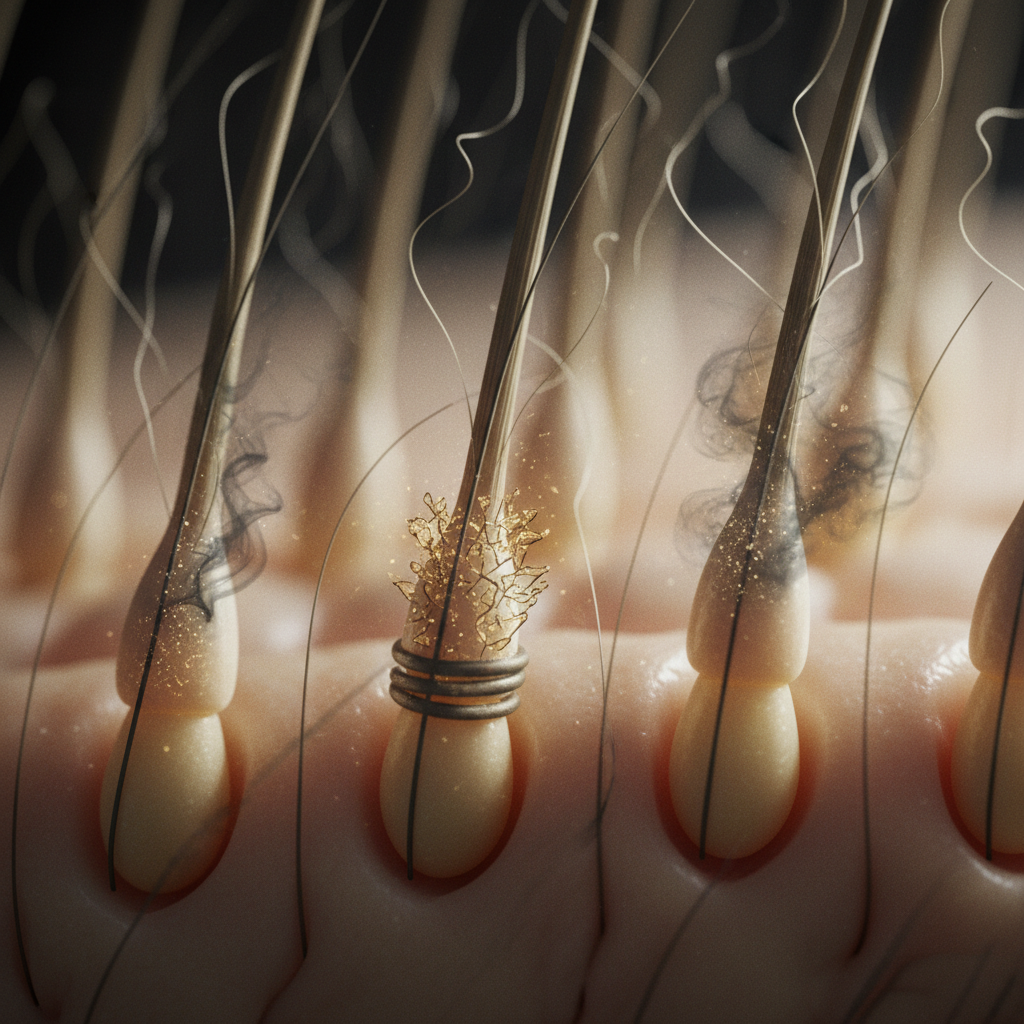
In individuals genetically predisposed to androgenetic alopecia, dermal papilla cells in androgen-sensitive zones (the crown, frontal hairline, and temples) express high concentrations of androgen receptors and the intracellular enzyme 5-alpha reductase. When testosterone enters these cells, 5-alpha reductase converts it to dihydrotestosterone (DHT).
DHT binding alters dermal papilla gene expression. Instead of producing growth-promoting factors like FGF-7 and VEGF, the cells secrete inhibitory cytokines, notably Transforming Growth Factor-beta (TGF-beta) and Dickkopf-1 (DKK-1). TGF-beta halts keratinocyte proliferation and triggers apoptosis in the hair bulb, while DKK-1 directly antagonises the pro-growth Wnt/beta-catenin pathway. Over successive hair cycles, this inhibitory cascade forces the follicle to shorten its anagen phase and shrink, transforming thick terminal hairs into fine, wispy fibres.
Beyond genetics and hormones, chronic micro-inflammation (perifollicular inflammation), oxidative stress from environmental exposure, and age-related cellular senescence can reduce the number and vitality of functional dermal papilla cells.
| Characteristic | Healthy Dermal Papilla | Miniaturised Dermal Papilla |
|---|---|---|
| Cell Count | High (several hundred cells) | Substantially depleted |
| Primary Signals | Wnt, beta-catenin, FGF-7, VEGF | TGF-beta, DKK-1, IL-6 |
| Capillary Network | Rich, dense microvasculature | Constricted, sparse blood flow |
| Anagen Duration | 2 to 7 years | Few months to 1 year |
| Shaft Diameter | 60 to 100 micrometres (terminal) | Less than 30 micrometres (vellus-like) |
| Extracellular Matrix | Plentiful versican, collagens | Compacted, reduced matrix volume |
What the evidence does not show
It is vital to separate verified follicular biology from marketing hype. Dermal papilla cells reside approximately 4 to 6 millimetres beneath the surface of the scalp in mature terminal follicles.
The evidence does not show that standard topical cosmetic ingredients penetrate deeply enough in meaningful concentrations to alter gene expression inside dermal papilla cells. While scalp tonics and nourishing shampoos can dramatically improve the condition of the scalp surface, reinforce the hair cuticle, and minimise breakage along the hair shaft, they do not restructure dermal papilla genetics.
Furthermore, controlled clinical research does not support the idea that vigorous manual scalp massage alone can overcome genetically programmed DHT signaling. While mechanical stimulation can temporarily increase local blood flow, it does not stop the cellular transformation triggered by 5-alpha reductase.
Supporting the follicle: what you can do
While you cannot rewrite your genetics at home, you can create the biological and mechanical conditions that allow follicles to function at their best:
- Protect the scalp barrier: Maintain a balanced scalp microbiome and a clean surface. Excess sebum, build-up, and microbial imbalances (such as overgrowths of Malassezia) generate oxidative stress and micro-inflammation that stress the upper follicle.
- Prioritise nutritional fundamentals: Dermal papilla cells require adequate micronutrients to synthesize proteins and maintain extracellular matrix integrity. Iron (ferritin), zinc, vitamin D, and essential amino acids play documented roles in supporting cellular metabolism.
- Minimise physical and chemical trauma: Differentiate between true follicular changes and hair breakage. Harsh bleaching, high-heat styling, and rough detangling snap the hair shaft, making hair appear sparse even when dermal papilla function remains entirely healthy.
- Target microcirculation: Gentle scalp stimulation and regular cleansing support a clean, healthy scalp environment, reducing external burdens on the follicular unit.
Watermans and cosmetic scalp care
Watermans focuses on the health of the scalp and the external hair fibre. Products like Watermans Grow Me Shampoo and Condition Me Conditioner are formulated with ingredients such as biotin, caffeine, rosemary, niacinamide, and argan oil.
From a cosmetic standpoint, these formulations support the scalp ecosystem, wash away sebum build-up that harbour inflammatory triggers, and deliver conditioning agents that coat the hair fibre. This results in stronger-feeling hair, reduced breakage during styling, and a visibly fuller appearance. While cosmetic products do not treat medical conditions such as androgenetic alopecia or replace pharmaceutical interventions that target dermal papilla receptors, they serve as a practical foundation for day-to-day hair maintenance and scalp hygiene.
When to seek professional advice
If you observe persistent changes in your hair density, it is critical to consult a dermatologist or a qualified trichologist. Seek professional evaluation if you notice:
- A widening central parting or receding temples that progress over several months.
- Sudden, excessive daily shedding (more than 100 to 150 hairs daily) across the entire scalp, which may signal telogen effluvium or systemic deficiencies.
- Scalp redness, intense itching, burning, scaling, or pustules, which can point to scarring alopecias (such as lichen planopilaris or frontal fibrosing alopecia) that destroy dermal papillae permanently.
- Patchy, coin-sized areas of complete hair loss, typical of autoimmune conditions like alopecia areata.
A specialist can use trichoscopy to examine the follicular openings, gauge miniaturisation ratios, and check the status of your follicles before significant papilla depletion occurs.
Frequently asked questions about Dermal Papilla Function
Can a dead dermal papilla be regenerated?
If a hair follicle undergoes complete fibrosis (scarring) and the dermal papilla is entirely destroyed, natural biological regeneration does not occur. However, in cases of miniaturisation from pattern hair loss, the papilla is typically dormant or depleted rather than dead. Early medical intervention can often reactivate signaling before the structure is irreversibly lost.
How does DHT affect dermal papilla function?
DHT binds to androgen receptors inside susceptible dermal papilla cells, changing their gene transcription. Instead of releasing signals that encourage hair growth, the cells produce inhibitory factors like TGF-beta and DKK-1. This causes the follicle to shrink and shortens the growth phase over consecutive cycles.
How does dermal papilla function influence hair thickness?
The physical volume and total cell count of the dermal papilla dictate the size of the hair bulb and matrix. A larger dermal papilla with more active cells signals a wider matrix area, which produces a thick terminal hair fibre. When cell count drops, the hair fibre grows out progressively thinner.
Does poor circulation harm dermal papilla function?
Yes. Dermal papillae are heavily vascularised by capillary loops that supply oxygen, amino acids, and vital nutrients. Compromised microcirculation or chronic vascular constriction can restrict the cellular energy needed for rapid protein synthesis, contributing to a shortened growth phase and premature follicle resting.
Summary
Understanding dermal papilla function demystifies the biological reality of hair growth and thinning. As the cellular architect of the follicle, this tiny mesenchymal structure directs everything from cycle duration to fibre diameter via sophisticated biochemical signaling. While cosmetic haircare plays an essential role in keeping the scalp clean, reducing breakage, and making hair feel fuller, long-term preservation of the dermal papilla requires managing internal factors, protecting vascular health, and seeking timely medical advice when pattern loss appears.
Sources and references
- Journal of Investigative Dermatology: "The Hair Follicle Dermal Papilla: A Core Organizer of Hair Growth and Cycling"
- Development: "Mesenchymal-epithelial interactions during hair follicle morphogenesis and cycling"
- British Association of Dermatologists: "Guidelines for the management of alopecia areata and androgenetic alopecia"
- Experimental Dermatology: "The Dermal Papilla: An Invaluable Component of the Hair Follicle"
- National Institute for Health and Care Excellence (NICE): "Alopecia androgenetica: Clinical knowledge summaries"
Find these ingredients in Watermans products
- Zinc: you will find this ingredient in our Hair Vitamins.
- Niacinamide: you will find this ingredient in our Hair Mask.