Cuticle Layer Anatomy and 18-MEA: Structure and Function
8 min read ·
Explore Cuticle Layer Anatomy and 18-MEA: discover how this vital lipid layer protects hair from friction, chemical damage, and hygral fatigue.
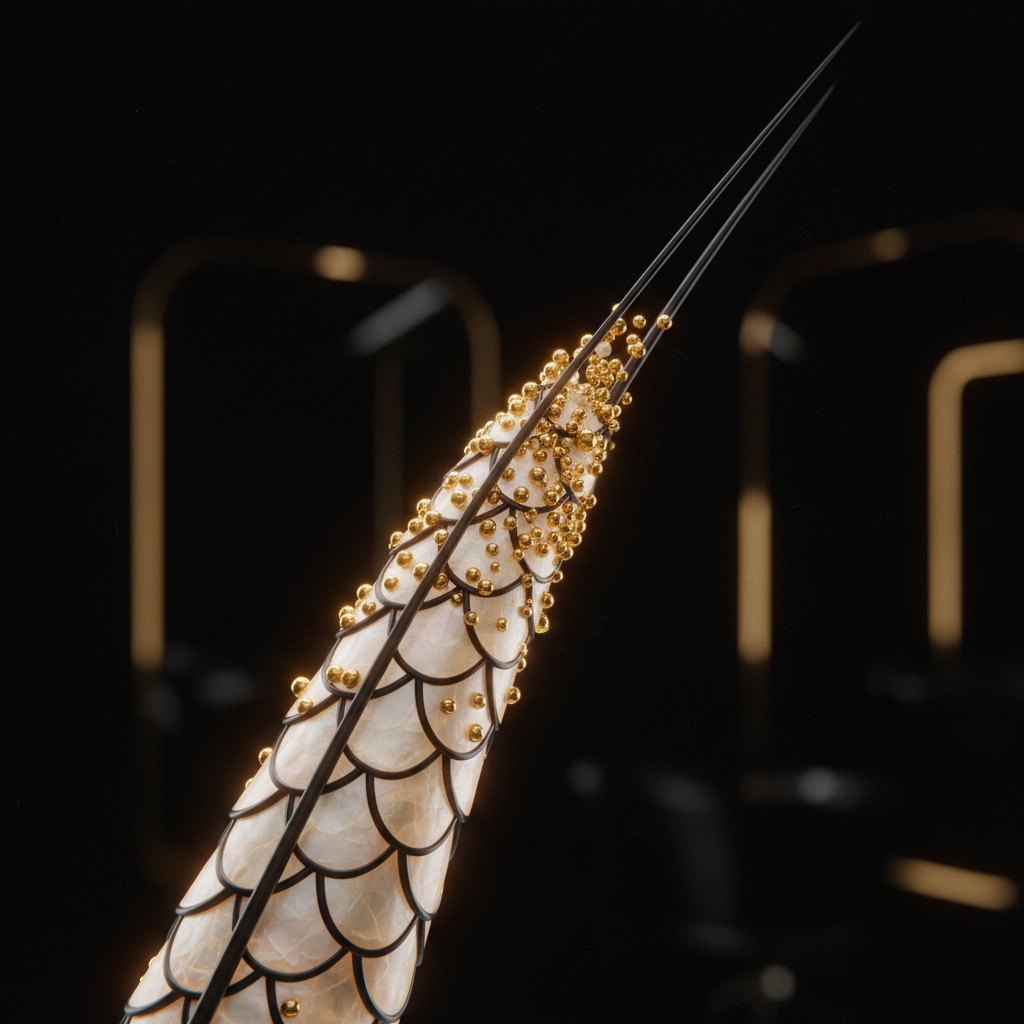
Quick answer: Understanding Cuticle Layer Anatomy and 18-MEA reveals how hair defends itself against daily physical and chemical stress. The cuticle consists of overlapping keratinised cells coated by an essential lipid layer called 18-methyleicosanoic acid (18-MEA), which renders virgin hair naturally hydrophobic, smooth, and friction-resistant. However, because hair fibres are non-living biological structures, once chemical bleaching, permanent colour, or excessive heat strips this covalently bound 18-MEA fatty layer, the body cannot biologically regenerate it, requiring cosmetic conditioning agents to simulate its protective properties.
Key takeaways
- The hair cuticle consists of 5 to 10 overlapping cellular scales that shield the inner cortex from environmental and mechanical damage.
- 18-methyleicosanoic acid (18-MEA) is a branched fatty acid covalently linked via thioester bonds to the outermost epicuticle, creating an invisible, water-repellent barrier.
- Alkaline chemical processes such as bleaching, perming, and permanent dyeing sever these thioester bonds, permanently removing the primary lipid layer.
- Losing 18-MEA switches hair from hydrophobic (water-repelling) to hydrophilic (water-absorbing), leaving fibres prone to hygral fatigue, friction, tangling, and breakage.
- Cosmetic treatments cannot regrow or chemically rebuild covalent 18-MEA bonds, but specialised conditioning lipids and cationic surfactants can deposit functional hydrophobic substitutes.
Cuticle Layer Anatomy and 18-MEA: what the evidence shows
Research into Cuticle Layer Anatomy and 18-MEA demonstrates that hair surface health depends on both physical cellular geometry and specialised surface biochemistry. The cuticle is not a flat, inert sheet. It is an intricate architectural structure composed of multiple stratified layers.
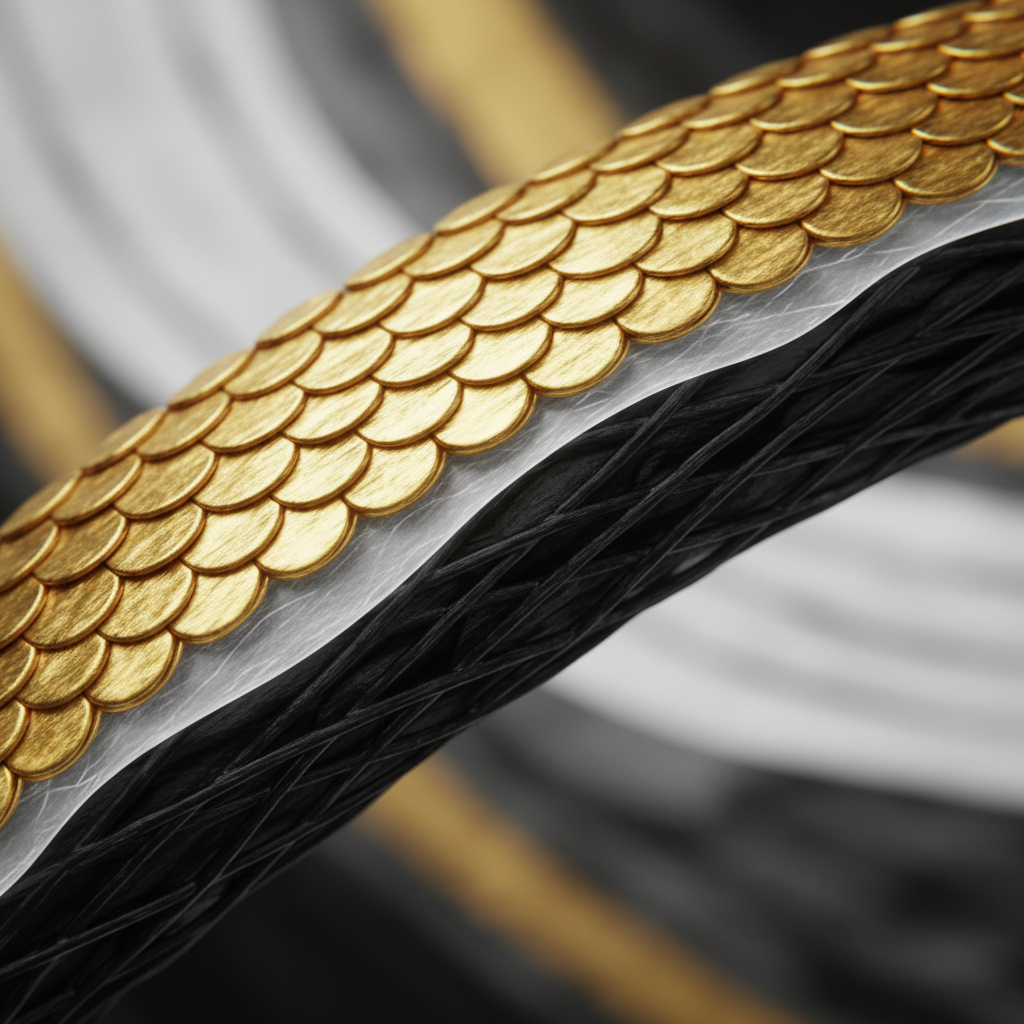
Working from the outside inward, each individual cuticle scale consists of:
- The Epicuticle: A thin membrane (approximately 2 to 5 nanometres thick) rich in cystine, covered on its outermost face by the F-layer.
- The F-layer (Fatty Layer): A monomolecular layer consisting predominantly of 18-methyleicosanoic acid (18-MEA). This branched-chain C21 fatty acid is chemically bonded to underlying proteins via covalent thioester linkages.
- The A-layer: A cross-linked, cystine-dense protein layer (roughly 30% cystine) that provides mechanical rigidity and chemical resistance.
- The Exocuticle: A sub-layer containing approximately 15% cystine, contributing structural stiffness.
- The Endocuticle: The innermost, low-cystine layer (roughly 3% cystine) with higher swelling capacity, making it vulnerable to enzymatic and physical breakdown.
Studies published in the Journal of Cosmetic Science and dermatological literature confirm that 18-MEA accounts for the primary hydrophobic nature of virgin hair. When intact, it ensures that water beads on the surface (exhibiting a high contact angle above 90 degrees). This lipid coating reduces inter-fibre friction by up to 50%, enabling strands to glide over one another without catching or snapping.
| Cuticle Component | Typical Thickness / Proportion | Cystine Content | Primary Function |
|---|---|---|---|
| F-layer (18-MEA) | ~1 nm (monomolecular) | Negligible (Lipid) | Provides hydrophobicity, lowers surface friction, prevents water absorption |
| Epicuticle | 2 to 5 nm | High (~12%) | Semi-permeable membrane anchoring surface lipids |
| A-layer | 50 to 100 nm | Very High (~30%) | High cross-linking density protects against physical penetration |
| Exocuticle | 150 to 300 nm | Moderate (~15%) | Mechanical support and structural stiffness |
| Endocuticle | 150 to 300 nm | Low (~3%) | Cushioning layer; swells easily when exposed to water |
| Cell Membrane Complex (CMC) | ~30 nm | Low | Lipid-protein adhesive bonding overlapping cuticle scales together |
What the evidence does not show
Scientific analysis does not show that severed 18-MEA can ever naturally re-grow. Because the visible hair shaft consists of dead, non-vascular, keratinised protein, no cellular division or metabolic synthesis occurs along the shaft. Follicular sebaceous glands produce sebum (primarily squalene, wax esters, and triglycerides), but sebum is physically distinct from 18-MEA and cannot form covalent thioester bonds with hair keratin.
Furthermore, no cosmetic shampoo, mask, or bond-builder can permanently reform the original thioester bond between 18-MEA and the epicuticle in ambient home or salon conditions. Products marketing 18-MEA replenishment deposit the lipid via temporary physical adsorption or ionic interactions. These treatments wash away over time, requiring repeated application to sustain slip and water repellency.
The mechanism: how 18-MEA is lost
The thioester bond anchoring 18-MEA to cysteine residues in the epicuticle is sensitive to alkaline hydrolysis and oxidation.
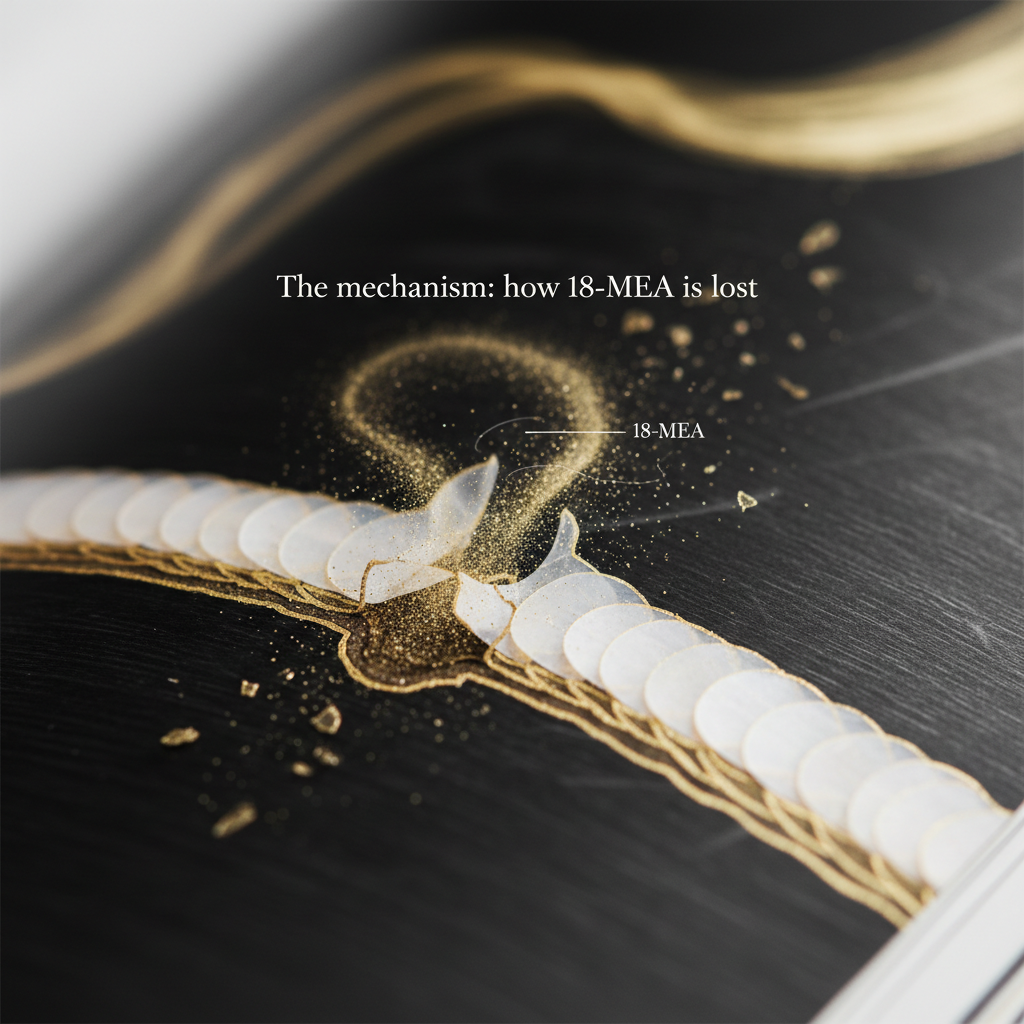
During alkaline processing (such as oxidative bleaching or permanent colouring, typically operating between pH 9.0 and 10.5), hydrogen peroxide and persulphate salts oxidise the thioester linkages. This chemical reaction cleaves the bond, liberating 18-MEA from the fibre surface. In its place, oxidation creates cysteic acid groups carrying negative ionic charges.
The consequence is a dramatic surface transition:
- Virgin Hair: Hydrophobic, low surface energy, net neutral-to-low negative charge, low water uptake, low inter-fibre friction.
- Chemically Damaged Hair: Hydrophilic, high surface energy, strong negative surface charge (high cysteic acid density), rapid water uptake, high friction.
Without 18-MEA, water easily penetrates the endocuticle and inner cortex. The fibre swells excessively when wet and contracts when dry, a cycle known as hygral fatigue. Over time, repeated swelling forces the edges of the cuticle scales to lift, crack, and break away, exposing the fragile cortex to mechanical snapping.
Signs of cuticle and 18-MEA degradation
You can identify the breakdown of Cuticle Layer Anatomy and 18-MEA through clear physical cues:
- Instant Wetting: Droplets of water sink immediately into the fibre rather than beading on the surface.
- Prolonged Drying Time: Stripped hair absorbs excessive water inside the cortex, taking substantially longer to dry naturally.
- Wet Combing Resistance: Wet strands feel rough, stick together, and tangle stubbornly due to elevated friction.
- Loss of Shine: Lifting cuticle scales scatter light irregularly, replacing healthy shine with a matte, dull appearance.
- Static and Flyaways: Dry, 18-MEA-deficient fibres exhibit higher negative electrostatic charges that repel neighbouring strands.
- Increased Hair Breakage: Elevated mechanical drag during brushing snaps the shaft, generating short, fragmented hairs rather than shedding from the root.
What you can do to protect and simulate 18-MEA
While you cannot rebuild the original biological bond, practical habits and cosmetic ingredients help maintain cuticle structure and replicate the function of 18-MEA.
1. Minimise Alkaline and Oxidative Stress
Restrict high-lift bleaching, high-volume peroxide developers, and harsh relaxers. If you colour your hair, opt for lower-pH glosses, bond-protecting additives, and targeted root touch-ups to avoid repeatedly processing previously treated lengths.
2. Deposit Cationic Conditioners
Damaged cuticle surfaces develop strong negative electrical charges due to exposed cysteic acid. Cationic conditioning agents, including behentrimonium chloride, cetrimonium chloride, and amodimethicone, bind electrostatically to these negative sites. They smooth down the cuticle edges and lower surface friction, mimicking 18-MEA.
3. Seek Synthetic 18-MEA Analogues
Some advanced conditioners formulate free 18-methyleicosanoic acid or quaternised fatty acids (such as Quaternium-33). These ingredients use their cationic charge to anchor the fatty chain onto the damaged epicuticle, creating a temporary hydrophobic film that lasts between washes.
4. Control Heat and Moisture
Keep straighteners and curling irons below 185 degrees Celsius, as high heat degrades surface lipids and blisters the cuticle. Apply protective leave-in serums before heat styling to buffer the cuticle against thermal stripping.
When the cause may be something else
If your hair appears dull, limp, or brittle, cuticle stripping is not the only possible culprit.
- Hard Water Mineral Build-up: Calcium and magnesium ions bond with fatty residues, forming an insoluble film that creates roughness resembling cuticle damage. A chelating wash clarifies this build-up.
- Product Over-accumulation: Non-cleared silicones and polyquats can build up over time, leaving fibres stiff and brittle.
- Systemic Follicular Issues: Breakage along the shaft is structural, but diffuse shedding from the scalp (telogen effluvium) or patterned hair thinning (androgenetic alopecia) originate within the hair follicle beneath the skin. Never confuse shaft breakage with follicular hair shedding.
Professional care with Watermans
When managing hair prone to mechanical stress, supporting both the cuticle and scalp environment is critical. Watermans focuses on evidence-led formulas that preserve fibre resilience. Using sulphate-free, pH-balanced cleansers such as Watermans GrowMe Shampoo helps avoid excessive cuticle swelling during cleansing, while botanical conditioners and nourishing oils protect fragile mid-lengths and ends against mechanical friction, reducing premature fibre breakage.
Frequently asked questions about Cuticle Layer Anatomy and 18-MEA
What is the primary role of Cuticle Layer Anatomy and 18-MEA in hair health?
Cuticle Layer Anatomy and 18-MEA work together to provide physical defence and surface hydrophobicity. The overlapping cuticle scales shield the delicate inner cortex, while the 18-MEA lipid layer seals the surface. This repels excess water, lowers inter-strand friction, prevents tangles, and gives healthy hair its natural gloss.
Can 18-MEA be restored once it is bleached away?
No, 18-MEA cannot be permanently reattached via biological means once chemical bleaching or dyeing breaks the thioester bonds. Cosmetic ingredients like quaternised lipids (such as Quaternium-33), fatty alcohols, and silicones can temporarily mimic its water-repelling and friction-lowering properties, but they wash away and require regular reapplication.
How does losing 18-MEA cause hair breakage?
When 18-MEA is lost, hair becomes hydrophilic and absorbs high volumes of water, swelling the inner cortex and stressing cuticle scales. This raises surface friction by up to 50%, making combing difficult. The continuous mechanical strain, combined with lifted cuticle scales, leads directly to shaft snapping and split ends.
Does sebum replace 18-MEA?
No, sebum cannot replace 18-MEA. Sebum is an oily mixture of squalene, triglycerides, and wax esters produced by sebaceous glands that lubricates the fibre surface loosely. In contrast, 18-MEA is a specific branched fatty acid that is chemically bound to the proteins of the epicuticle. Sebum lacks the chemical bonding necessary to recreate the F-layer.
What is the normal pH range to keep cuticles flat?
The natural surface of hair and scalp sits at an acidic pH of 4.5 to 5.5. Cleansers and treatments formulated within this range keep the cuticle scales compact and closed, preventing excess swelling and protecting underlying structures.
Understanding cuticle integrity
Understanding Cuticle Layer Anatomy and 18-MEA clarifies why virgin hair behaves so differently from chemically processed strands. Because hair fibres cannot repair themselves, preserving the natural 18-MEA lipid layer and minimising alkaline damage remain the gold standard in haircare. When processing cannot be avoided, using pH-balanced care and lipid-replenishing conditioners provides the necessary protection to maintain elasticity, manageability, and strength.
Sources and references
- Journal of Cosmetic Science: The Surface Architecture of Human Hair and the Role of 18-Methyleicosanoic Acid (2004)
- Robbins, C. R.: Chemical and Physical Behavior of Human Hair, 5th Edition, Springer (2012)
- International Journal of Trichology: Hair Cosmetics: An Overview (2015)
- Society of Cosmetic Chemists: Structure and Properties of the Epicuticle and F-Layer (2008)