Curly Hair Types: Understanding Hair Texture and Care
10 min read ·
Curly Hair Types refer to the natural shape and pattern of hair strands, influenced by genetics and follicle shape, which impacts how hair behaves and what care it needs.
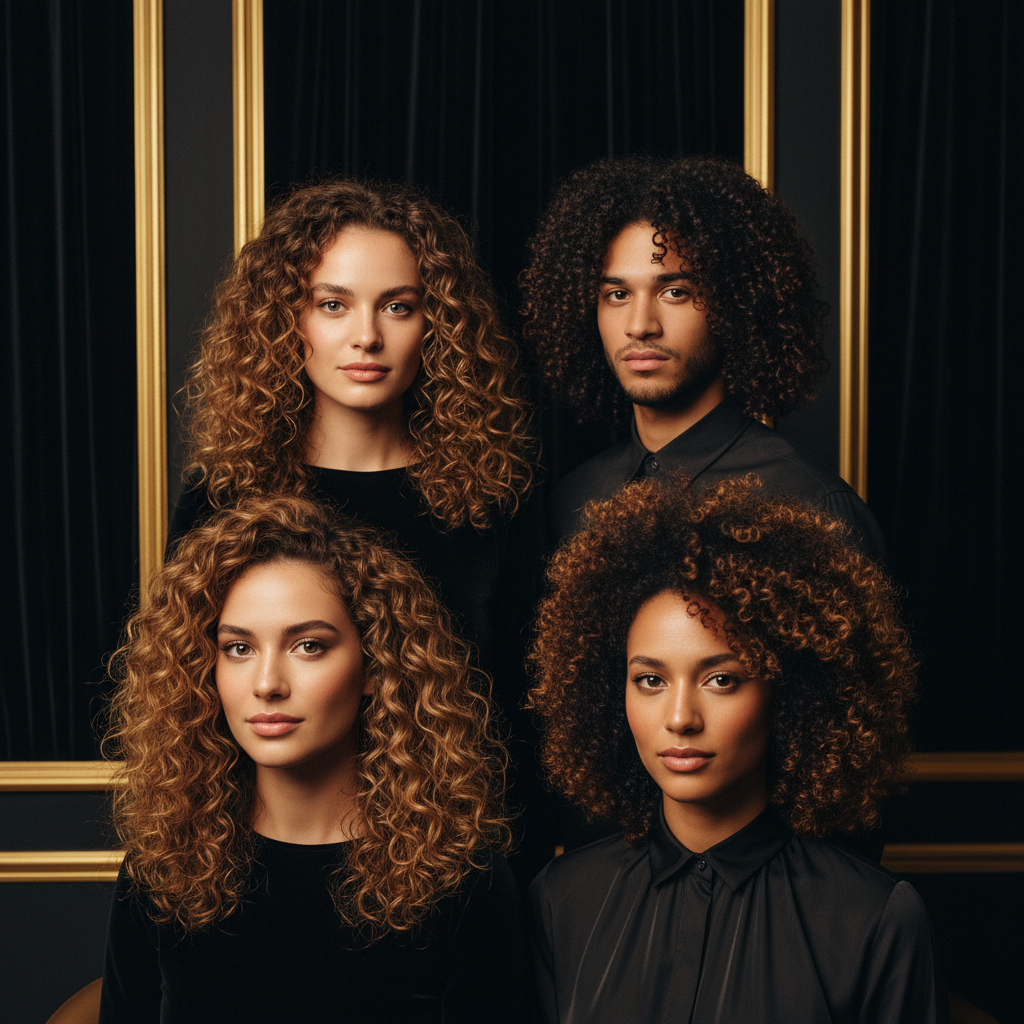
Quick answer: Curly Hair Types describe the natural curl pattern of hair, largely determined by the shape of the hair follicle. While classification systems exist, it's important to remember that these are descriptive tools, not rigid categories, and individual hair can vary significantly. Understanding your specific curl type can help you choose appropriate products and care routines to maintain hair health and manage common concerns like dryness and frizz, but hair characteristics are complex and go beyond simple classification.
Key takeaways
- Curly hair's unique helical structure, caused by an oval hair follicle, makes it naturally more prone to dryness and breakage than straight hair.
- Hair typing systems, such as the Andre Walker system, provide a descriptive framework for understanding different Curly Hair Types, though they are not scientific classifications.
- Moisture is crucial for all Curly Hair Types, as sebum struggles to travel down the curved hair shaft, leading to natural dryness.
- The cuticle layer of curly hair can be more raised, contributing to frizz and making it susceptible to environmental damage.
- Understanding your hair's porosity and density, alongside its curl pattern, offers a more comprehensive approach to effective hair care.
- Proper care for Curly Hair Types includes gentle cleansing, deep conditioning, and protective styling to minimise breakage and maintain hydration.
Curly Hair Types: what the evidence shows
Curly hair is characterised by its distinctive helical shape, which is primarily determined by the elliptical or oval cross-section of the hair follicle. The more oval the follicle, the more pronounced the curl. This unique structure impacts several key aspects of hair health and behaviour, differentiating Curly Hair Types from straight or wavy hair.
The mechanism of curl formation
The shape of the hair follicle plays a fundamental role in determining hair texture. Hair grows from these follicles, which are small, tunnel-like structures in the skin. If a follicle is perfectly round, it tends to produce straight hair. As the follicle becomes more oval or elliptical, the hair strand growing from it follows a more curved path, resulting in waves, curls, or coils. This genetic predisposition means that individuals are born with a specific hair texture.
Beyond follicle shape, the distribution of keratin proteins within the hair fibre also contributes to curl. Some research suggests an uneven distribution of keratin, particularly orthocortex and paracortex cells, across the hair shaft's diameter may cause differential growth and tension, leading to the hair bending and twisting into a curl. The disulfide bonds, which are strong chemical links within the hair's protein structure, are also distributed differently in curly hair, contributing to its unique resilience and potential fragility.
Why curly hair is often drier and more prone to breakage
One of the most significant characteristics of Curly Hair Types is their tendency towards dryness. Sebum, the natural oil produced by the scalp, struggles to travel efficiently down the tortuous, spiral path of a curly hair strand compared to a straight one. This means the ends of curly hair often receive less natural lubrication, leaving them more vulnerable to dryness and environmental factors. This lack of natural moisture can lead to the hair feeling rougher and looking duller.
The unique structure also contributes to increased fragility and a higher risk of breakage. The bends and twists in curly hair create natural weak points where the hair fibre is under greater stress. The cuticle, the outermost protective layer of the hair, may also be more raised or lifted in curly hair, particularly at the curves. A lifted cuticle allows moisture to escape more easily and makes the hair more susceptible to damage from friction, manipulation, and environmental exposure. This can manifest as frizz, especially in humid conditions, or increased hair breakage if not properly cared for.
Hair typing systems: a descriptive guide
While the scientific mechanisms behind curl are complex, several hair typing systems have emerged to help individuals describe and understand their hair textures. The most widely recognised is the Andre Walker Hair Typing System, popularised by Oprah Winfrey's stylist. This system categorises hair into types 1 (straight), 2 (wavy), 3 (curly), and 4 (coily), with further sub-classifications (a, b, c) based on the tightness of the curl pattern.
It's important to view these systems as descriptive tools rather than rigid scientific classifications. Hair texture is a spectrum, and many people have a combination of Curly Hair Types on their head. Furthermore, factors like hair porosity, density, and strand width also significantly influence how hair behaves and how it should be cared for, often more so than the curl pattern alone.
The Andre Walker Hair Typing System explained
These descriptions provide a general guide. Your hair may not fit neatly into one category, or you might have different types across your head.
Type 2: Wavy Hair Wavy hair forms a distinct "S" shape and sits between straight and curly hair. It can be easily straightened but also holds a curl.
- 2a: Fine, loose "S" waves, easily straightened, can lack volume.
- 2b: Medium texture, more defined "S" waves, some frizz potential.
- 2c: Coarse, well-defined "S" waves, often with some loose spirals, prone to frizz.
Type 3: Curly Hair Type 3 hair forms distinct loops or spirals. These Curly Hair Types can range from loose, bouncy curls to tight corkscrews. They typically require more moisture than wavy hair.
- 3a: Large, loose curls, often the size of a fat chalk stick. Tends to be shiny and well-defined.
- 3b: Medium, springy curls, similar in size to a marker. Can be prone to frizz without proper moisture.
- 3c: Tight, densely packed corkscrew curls, about pencil-sized. High volume and significant shrinkage.
Type 4: Coily Hair Coily hair is characterised by very tight, small, and often zigzag-shaped coils. It is generally the most fragile of the Curly Hair Types, prone to extreme shrinkage and dryness, demanding consistent moisture and very gentle handling.
- 4a: Densely packed, S-shaped coils, similar to a crochet needle in size. Can maintain moisture better than 4b or 4c.
- 4b: Z-shaped coils with sharper angles, high shrinkage. Can have a cotton-like texture when dry.
- 4c: Tightly packed, zigzag coils with less defined pattern without manipulation. Experiences the most shrinkage and is the most delicate.
Beyond curl pattern: porosity and density
While curl pattern is visible, hair porosity and density are equally, if not more, important for tailoring a hair care routine. Understanding these characteristics can significantly improve the health and appearance of all Curly Hair Types.
- Porosity: This refers to your hair's ability to absorb and retain moisture. Low porosity hair has tightly bound cuticles, making it difficult for moisture to penetrate but also for it to escape. High porosity hair has raised or damaged cuticles, absorbing moisture quickly but losing it just as fast. Medium porosity hair is generally balanced. You can learn more in "Understanding Hair Porosity: How Your Hair Absorbs and Retains Moisture".
- Density: This refers to the number of individual hair strands on your head. Low density hair means fewer strands, while high density means many. Density influences how much product you need and how hair holds style.
Caring for Curly Hair Types: what you can do
Effective care for Curly Hair Types focuses on maximising moisture, minimising damage, and preserving the natural curl pattern. A consistent, gentle routine is key.
Moisture is paramount
Given the natural dryness of curly hair, prioritising moisture is non-negotiable. Look for hydrating shampoos, rich conditioners, and leave-in products. Regular deep conditioning treatments are highly beneficial. Ingredients like shea butter, argan oil, and humectants (like glycerin and hyaluronic acid, discussed in "Humectants: Understanding How They Hydrate and Protect Your Hair") can help attract and seal in moisture.
Gentle cleansing
Over-washing can strip Curly Hair Types of their natural oils, exacerbating dryness. Consider co-washing (washing with conditioner only) or using a sulfate-free shampoo (see "Sulfate-Free Shampoo Benefits") designed for curly hair. When you do shampoo, focus on cleansing the scalp and allow the lather to rinse down the hair strands without excessive scrubbing of the lengths.
Conditioning and detangling
Always follow shampoo with a good conditioner. Detangle gently while the hair is saturated with conditioner, using your fingers or a wide-tooth comb, starting from the ends and working your way up. This prevents breakage and helps define curls. Learn more about effective conditioning in "The Science of Conditioners: How Hair Care Formulations Work".
Styling and protection
Apply styling products to wet hair to lock in moisture and define curls. Air drying is often preferred to minimise heat damage (see "Heat Styling: Understanding Its Effects and How to Protect Your Hair"), but if using heat, always apply a heat protectant on all Curly Hair Types. Protective styles like braids or twists can reduce daily manipulation and breakage. Sleeping on a silk or satin pillowcase can also reduce friction and preserve curl definition overnight.
When to get professional advice
If you are experiencing significant hair breakage, hair shedding, or scalp issues that don't improve with adjusted care, it's wise to consult a dermatologist or a trichologist. They can diagnose underlying conditions that may be affecting your hair and scalp health.
Frequently asked questions about Curly Hair Types
What makes hair curly?
Hair becomes curly due to the shape of its follicle. An oval-shaped follicle causes the hair strand to grow in a curved or helical pattern. Genetic factors determine the follicle shape, which in turn dictates whether hair will be straight, wavy, curly, or coily. The internal structure of the hair fibre, including the distribution of certain proteins, also plays a role in defining the curl's tightness and pattern.
Do Curly Hair Types need special products?
Yes, Curly Hair Types generally benefit from products specifically formulated to address their unique needs, primarily moisture and breakage prevention. Products designed for curly hair often contain hydrating ingredients, are sulfate-free, and help to define curls without weighing them down. Using these can help manage frizz, enhance curl pattern, and reduce dryness more effectively than general hair products.
Can straight hair become curly, or vice versa?
While temporary changes are possible due to styling, hormonal shifts (like pregnancy), or certain medications, the fundamental genetic structure of your hair follicle determines your natural Curly Hair Types. Straight hair cannot permanently become naturally curly, nor can curly hair become naturally straight without chemical treatments that alter the hair's protein bonds. These chemical alterations are not permanent as new hair will grow in its natural state.
How often should I wash my Curly Hair Types?
The ideal washing frequency for Curly Hair Types varies by individual, but generally, less often is better to preserve natural oils. Many people with curly hair wash every 2 to 4 days, or even once a week. If your scalp feels oily or you use a lot of styling products, a clarifying wash (see "How to Do a Clarifying Wash: A Guide to Deep Hair Cleansing") every few weeks can be beneficial to remove build-up.
What's the difference between wavy and curly hair?
Wavy hair (Type 2) forms an "S" shape and tends to lie closer to the head, often being easier to straighten. Curly hair (Type 3) forms more distinct loops or spirals that spring away from the head, exhibiting more volume and requiring greater moisture. Coily hair (Type 4) has even tighter, smaller spirals or zigzag patterns. The distinction lies in the tightness and definition of the curl pattern.
Understanding Curly Hair Types
Understanding Curly Hair Types goes beyond simple classification; it's about recognising the unique structural and physiological characteristics that demand specific care. From the elliptical follicle that dictates curl formation to the inherent dryness and fragility, each aspect influences how best to maintain its health and vibrancy. By focusing on deep hydration, gentle handling, and suitable products, you can embrace and nurture your natural curl pattern, reducing common issues like frizz and breakage. Embracing a tailored routine allows your Curly Hair Types to thrive.
Sources and references
- American Academy of Dermatology Association. (n.d.). Hair problems: Tips for healthy hair. Aad.org
- Gavazzoni Dias, M. F. R. (2015). Hair Cosmetics: An Overview. International Journal of Trichology, 7(1), 2 to 15. Doi: 10.4103/0974-7753.153007
- Loussouarn, G. (2016). African and Caucasian Hair. In Practical Dermatology (pp. 149-160). Springer, Cham.
- National Center for Biotechnology Information (NCBI). Genetics of Human Hair Form. Ncbi.nlm.nih.gov
- The Trichological Society. (n.d.). Hair Anatomy and Structure. Trichological.org.uk
Find these ingredients in Watermans products
- Argan Oil: you will find this ingredient in our Hair Growth Shampoo.
- Shea Butter: you will find this ingredient in our Curly Hair Conditioner.