Chelating Shampoo vs Clarifying Shampoo: Evidence, Differences, and When to Use Each
10 min read ·
Discover the differences between a Chelating Shampoo vs Clarifying Shampoo, how minerals and buildup affect hair, and which formula suits your water type.

Quick answer: When comparing a Chelating Shampoo vs Clarifying Shampoo, the core distinction lies in what each formula removes. Clarifying shampoos use strong surfactants to strip away surface debris such as sebum, styling polymers, and cosmetic silicones. Chelating shampoos contain specialised bonding agents (chelators like EDTA or citric acid) designed to bind to and remove mineral ions, heavy metals, and chlorine from deep inside the hair cortex. Neither product treats biological hair loss, and overusing either can cause fibre dehydration and brittle breakage.
Key takeaways
- Different targets: Clarifying shampoos target organic surface buildup (waxes, heavy oils, styling polymers). Chelating shampoos target inorganic mineral deposits (calcium, magnesium, iron, copper, and pool chlorine).
- Active chemistry: Clarifying relies heavily on anionic surfactants, whereas chelating requires active sequestering agents such as tetrasodium EDTA, disodium EDTA, or sodium phytate.
- Water hardness matters: If you wash your hair in hard water (above 120 to 180 mg/L of calcium carbonate equivalent), standard clarifying formulas often leave mineral deposits behind, making a chelator necessary.
- Risk of fibre snapping: Neither formula causes follicular hair loss or shedding, but frequent use of either strips protective surface lipids (18-MEA), leading to cuticle lifting and mechanical breakage.
- Usage cadence: Clarifying shampoos work well once every 1 to 2 weeks for regular styling product users. Chelating shampoos are best reserved for once every 2 to 4 weeks or as a pre-chemical salon treatment.
Chelating Shampoo vs Clarifying Shampoo: what the evidence shows
Understanding the chemical difference between a Chelating Shampoo vs Clarifying Shampoo prevents unnecessary damage and wasted effort at the washbasin.
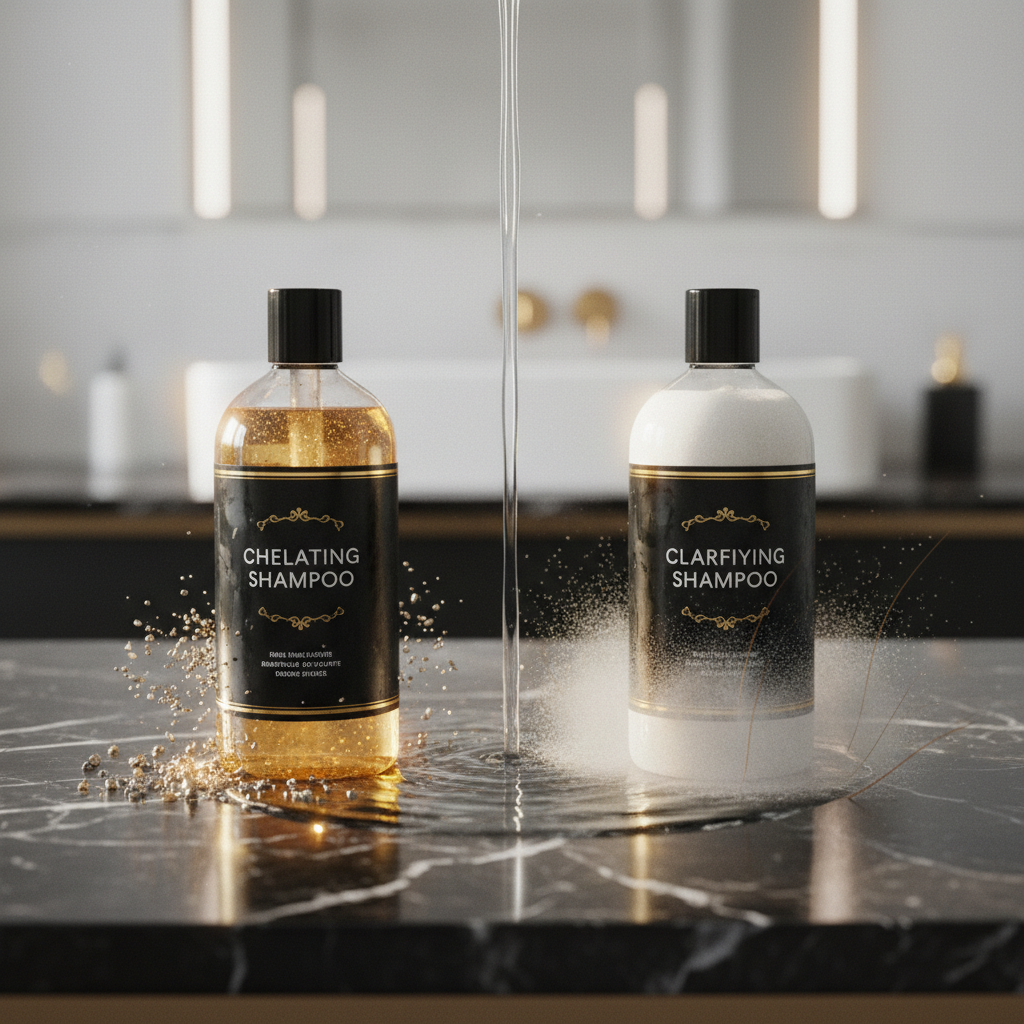
Clarifying shampoos act as heavy-duty cleansers. Their formulations feature high concentrations of primary surfactants (such as sodium laureth sulfate, ammonium laureth sulfate, or strong olefin sulfonates) formulated at a slightly elevated pH (often between 5.5 and 6.5). This opens the hair cuticle slightly, allowing the micellar action of the surfactants to dissolve stubborn cosmetic coatings. These coatings include dimethicone, polyquaterniums, and petrolatum-based pomades that standard gentle daily cleansers leave behind.
Chelating shampoos go an important step further. Chelators are chemical ligands that form multiple coordinate bonds with a single metal ion, enclosing the ion in a stable, ring-like complex. When hard water minerals (calcium and magnesium) or tap water heavy metals (copper and iron) bind to keratin proteins in the hair shaft, standard surfactants simply glide over them. A chelator enters the fibre, sequesters the mineral ion, makes it water-soluble, and washes it cleanly down the drain.
Research published in the International Journal of Cosmetic Science demonstrates that metal accumulation, particularly copper, catalyses oxidative damage when hair is exposed to UV light or hydrogen peroxide bleach. Clarifying formulas cannot halt this reaction because they do not extract bound copper. A true chelator neutralises this risk.
| Feature | Clarifying Shampoo | Chelating Shampoo |
|---|---|---|
| Primary Target | Organic residues (sebum, waxes, styling polymers, silicones) | Inorganic minerals (calcium, magnesium, iron, copper, chlorine) |
| Key Ingredients | High-load anionic surfactants (SLES, ALS, C14-16 Olefin Sulfonate) | Sequestering agents (Tetrasodium EDTA, Disodium EDTA, Phytic Acid) |
| Action Depth | Hair fibre surface and outer cuticle layers | Outer cuticle and inner keratin protein matrix |
| Ideal Water Type | Soft water or mildly hard water | Moderate to very hard water, well water, chlorinated pools |
| Frequency | Once every 7 to 14 days | Once every 14 to 30 days (or before chemical services) |
| Effect on Colour | Can cause moderate fading of artificial pigments | Can alter tone by stripping brassy mineral films; preserves bleach integrity |
What the evidence does not show
There is no scientific evidence that clarifies or chelates treat the living hair follicle. Neither product resolves conditions like androgenetic alopecia or telogen effluvium.
Follicles reside roughly 4 mm below the surface of the scalp, fed by microcapillaries. Mineral buildup and styling residue sit on the non-living keratin shaft and the superficial stratum corneum. Removing this buildup does not stimulate cellular division in the hair matrix.
Furthermore, heavy clarifying does not "detox" the scalp or cure chronic seborrhoeic dermatitis. While clearing heavy oils helps reduce the food supply for Malassezia yeast, harsh surfactants can disrupt the scalp barrier, accelerating trans-epidermal water loss and causing reactive sebum production or irritation. Finally, mineral exposure does not stunt hair growth rates; it merely degrades the mechanical strength of the existing strand, causing it to snap before reaching its potential length.
The mechanism: surfactants versus chemical sequestration
To see why the difference matters, look at how the chemistry works at the microscopic level.
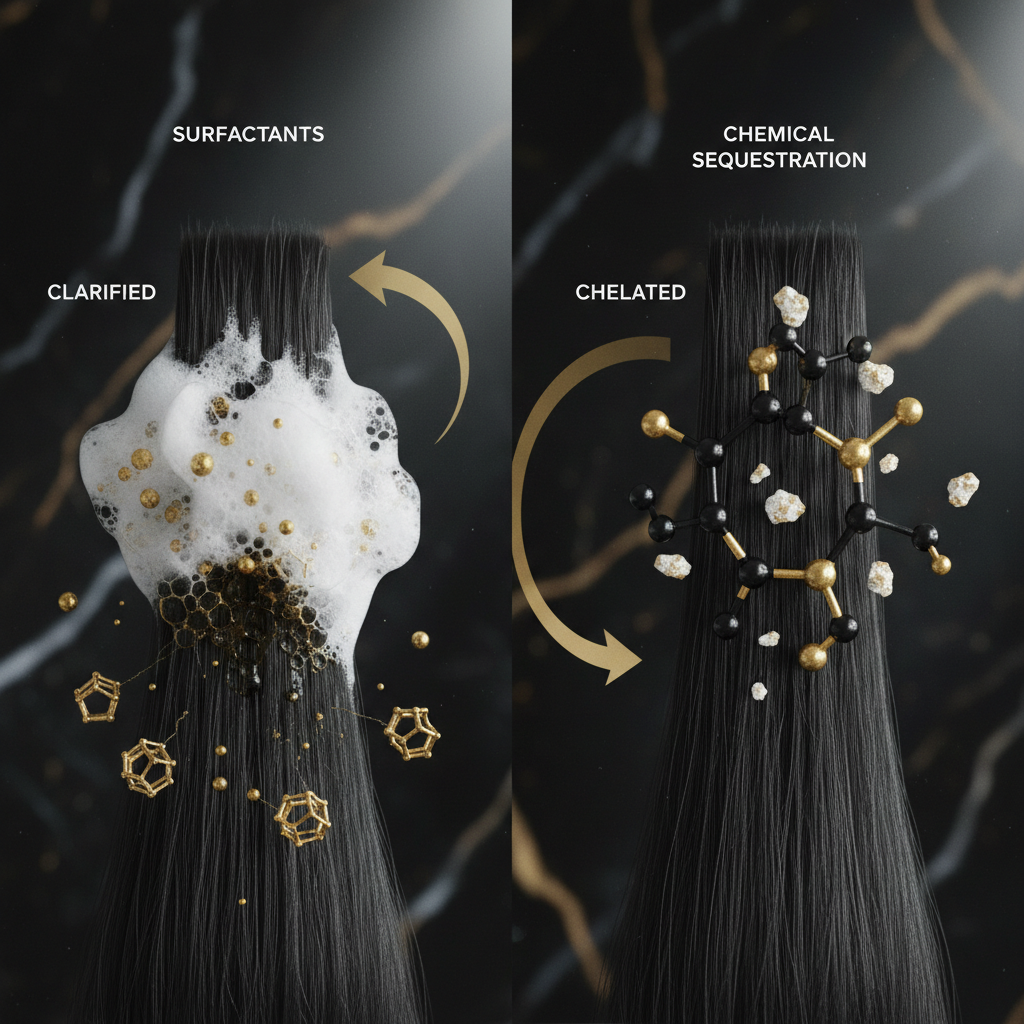
Surfactant cleaning (clarifying)
Surfactants possess a hydrophilic (water-loving) head and a lipophilic (oil-loving) tail. When you massage a clarifying shampoo across the hair, the lipophilic tails embed themselves into non-polar cosmetic oils, sebum, and silicones. The hydrophilic heads point outwards toward the wash water.
Rinsing pulls these structures (micelles) away, dragging the trapped surface oils with them. However, mineral ions carry a distinct ionic charge that binds chemically to negative sites on damaged hair keratin. Surface micelles lack the binding strength to tear these mineral bonds apart.
Chemical sequestration (chelating)
Chelation comes from the Greek word chele, meaning claw. Molecules such as ethylenediaminetetraacetic acid (EDTA) or phytic acid wrap around positively charged divalent and trivalent cations ($Ca^{2+}$, $Mg^{2+}$, $Fe^{3+}$, $Cu^{2+}$) like a claw.
Because the chelating agent has a vastly higher binding affinity for these metals than keratin has, the metal breaks its bond with your hair and anchors itself to the chelator instead. Once sequestered within this organic ring, the mineral becomes completely inert, fully soluble in water, and rinses out effortlessly.
The signs: which formula does your hair actually need?
Choosing the right bottle requires checking your hair symptoms and your local environment.
Signs you need a clarifying shampoo:
- Product slippage and limpness: Your hair feels weighed down, refuses to hold a curl, and looks greasy within hours of washing.
- Sticky or waxy feel: When your hair is dry, pulling a finger down the strand reveals a distinct drag or tacky coating.
- Dullness from silicones: Hair appears matte despite using shine serums, caused by layering insoluble conditioning agents.
- Soft water environments: You live in an area with soft water, but you use dry shampoos, heavy hairsprays, or styling waxes regularly.
Signs you need a chelating shampoo:
- Greenish or brassy discolouration: Blonde or grey hair develops a greenish cast (copper oxidisation from pool water or piping) or stubborn orange-brown tinges (iron from well water).
- Chalky, straw-like texture: Hair feels brittle, stiff, and rough even after applying rich deep-conditioning masks.
- Poor chemical service results: Perms fail to take, colour looks muddy or uneven, or lightener swells and heats up aggressively in the foil.
- High water hardness: Your local tap water leaves white crust on your kettle and shower screen (typical of water over 180 mg/L $CaCO_3$).
What you can do to protect your hair
If your hair needs deep cleansing, use these practical steps to prevent brittle fibre damage:
- Check your water supply: Look up your local water authority's water hardness report. If you are in a hard water zone, a clarifying shampoo alone will not solve mineral-induced stiffness.
- Pre-treat dry lengths: If your ends are bleached or heavily compromised, apply a light drop of pure oil to the bottom 5 cm before using a clarifying or chelating shampoo to shield fragile tips from over-stripping.
- Control your timing: Do not let a chelating or clarifying formula sit on the hair for longer than the manufacturer states (usually 2 to 5 minutes). Prolonged exposure strips 18-methyleicosanoic acid (18-MEA), the primary lipid barrier protecting your hair cuticle.
- Follow with deep conditioning: Always pair both treatments with an intensive, low-pH conditioner or mask. This realigns the cuticle scales and restores slip, reducing post-wash mechanical friction and snapping.
- Consider a shower filter limitation: Standard carbon shower filters remove chlorine odour, but they do not soften water or filter out dissolved calcium and magnesium. Do not rely on a carbon filter as a replacement for chelation in hard water zones.
When the cause may be something else
Before assuming your dull, thinning, or brittle hair is caused by product residue or mineral buildup, rule out other factors.
If you notice hairs falling out from the root with a white bulb attached, this is follicular shedding, not fibre breakage. Buildup cannot trigger telogen effluvium, which is typically prompted by systemic events such as nutritional deficiencies (ferritin, vitamin D, zinc), hormonal shifts, thyroid imbalance, or severe illness.
Similarly, if your scalp is red, inflamed, stinging, or peeling in thick greasy scales, you may have seborrhoeic dermatitis, scalp psoriasis, or contact dermatitis. Using aggressive chelating or clarifying shampoos on an inflamed scalp can tear the epidermal barrier further. Seek guidance from a trichologist or dermatologist if scalp symptoms or root-shedding persist.
Watermans: holistic care for hair vitality
At Watermans, our focus is supporting the long-term vitality of your scalp and hair fibre through smart, nourishing routines. While specialised clarifying and chelating washes have an occasional place in a routine to strip away unwanted residues, daily growth and strength require consistent care.
Watermans Grow Me Shampoo is formulated with premium active ingredients such as biotin, caffeine, argan oil, rosemary extract, niacinamide, and lupin protein. Rather than stripping the hair fibre, it cleanses gently while delivering targeted nutrients directly to the scalp environment, promoting fuller-looking, stronger-feeling hair from root to tip. Pairing an occasional reset wash with our targeted, nutrient-dense formulas ensures your scalp stays balanced and your lengths remain resilient against breakage.
Frequently asked questions about Chelating Shampoo vs Clarifying Shampoo
Can I use a clarifying shampoo instead of a chelating shampoo?
If your goal is removing hairspray, wax, or silicone buildup, a clarifying shampoo works perfectly. However, if your problem stems from hard water minerals (calcium, iron, copper) or swimming pool chlorine, clarifying formulas lack the sequestering agents needed to break mineral bonds. In hard water areas, a clarifying shampoo leaves mineral films untouched.
How often should you use a Chelating Shampoo vs Clarifying Shampoo?
Most people need a clarifying shampoo once every 7 to 14 days, depending on how many styling products they use. Chelating shampoos are far more intensive and should generally be used once every 3 to 4 weeks, or immediately before a salon chemical service (such as bleach or colour) to prevent uneven processing and oxidative damage.
Will chelating shampoos strip my hair colour?
Chelating shampoos can cause some artificial pigment to lift, but they are often used intentionally by colourists prior to colouring. Minerals like iron and copper distort dye molecules, making hair look muddy or brassy. Chelating removes these deposits, creating a clean canvas so fresh colour deposits evenly and lightener does not react dangerously with metals.
Does hard water cause hair loss?
No. Hard water minerals do not cause follicular hair loss or alopecia. Minerals bind to the outer keratin layers of the hair shaft, making the fibre stiff, inflexible, and prone to tangling. This friction increases mechanical breakage (the fibre snapping along the shaft during brushing), which reduces hair density but does not affect the root.
Can I make a DIY chelating rinse at home using apple cider vinegar?
While diluted apple cider vinegar has a mild acidic pH that helps close the cuticle, it contains very low concentrations of natural chelating agents. It cannot match the binding capacity of lab-formulated chelators like disodium EDTA. Using concentrated kitchen acids can also irritate your scalp and dry out your hair fibre without effectively removing stubborn copper or iron.
Maintaining balance with high-cleansing shampoos
The choice between a Chelating Shampoo vs Clarifying Shampoo comes down to identifying the specific residue weighing your hair down. Clarifying shampoos remain the gold standard for breaking down cosmetic films, synthetic oils, and everyday styling buildup. Chelating shampoos provide the targeted chemical power needed to strip stubborn hard water minerals, copper, and chlorine from deep within the fibre matrix.
By matching the right product to your local water quality and styling routine, and following every session with barrier-repairing conditioning, you can keep your hair free of buildup while protecting the structural integrity of every strand.
Sources and references
- International Journal of Cosmetic Science, "Impact of water hardness on hair properties and the role of chelating technologies", 2014.
- Journal of the Society of Cosmetic Chemists, "The interaction of metal ions with human hair", 1998.
- Dermatology and Therapy, "Hair Cosmetics: An Overview", 2015.
- Drinking Water Inspectorate (DWI), "Hardness of Water Supplies in England and Wales", Technical Guidance Document, 2021.
- Cosmetics & Toiletries, "Chelating Agents in Cosmetic Formulations", 2019.
Find these ingredients in Watermans products
- Zinc: you will find this ingredient in our Hair Vitamins.