Chelating Shampoo: The Science of Mineral and Metal Removal for Hair
8 min read ·
Learn how a chelating shampoo removes hard water mineral buildup, chlorine, and heavy metals from hair to restore natural shine and prevent mechanical breakage.
Quick answer: A chelating shampoo is an intensive cleansing wash formulated with chemical chelating agents, such as tetrasodium EDTA or citric acid, that bind to and neutralise mineral deposits, heavy metals, and chlorine trapped on the hair fibre. While regular clarifying formulas only strip away surface sebum and styling product residues, a chelating formula extracts deep mineral buildup from hard water. However, its primary limitation is its potency: frequent use can excessively strip natural lipids, leading to mechanical dryness and fibre breakage if used too often.
Key takeaways
- Chelating formulas target inorganic mineral deposits such as calcium, magnesium, copper, and chlorine, whereas standard clarifying shampoos primarily target organic styling products and sebum.
- Active chelating agents work via molecular bonding (chelation), forming a water-soluble ring around metallic ions to pull them off the cuticle layer.
- Hard water deposits make hair feel rough, brittle, and dull, while copper deposits can cause blond hair to turn green and accelerate oxidative damage during bleaching.
- Chelating cleansers are not meant for daily washing; most hair types only require treatment once every 2 to 4 weeks followed by a rich conditioning mask.
- Removing mineral accumulation prevents hair fibre breakage, but chelating treatments do not treat medical hair loss or follicular shedding conditions.
Chelating Shampoo: what the evidence shows
A chelating shampoo serves a distinct cosmetic role that standard surfactant cleansers cannot match. Water supplies across vast regions contain dissolved geological minerals, chiefly calcium carbonate and magnesium sulphate. When you wash your hair in hard water (defined generally as water exceeding 120 mg/L of dissolved minerals), these metal ions do not simply rinse away. They bond electrostatically to the negative charges on the hair shaft's keratin proteins, forming an insoluble precipitate often referred to as mineral scale.
Cosmetic science research published in the International Journal of Cosmetic Science confirms that hard water minerals alter the physical feel and mechanical properties of the hair fibre. Calcium and magnesium salts attach to the cuticle edges, causing them to flare outward rather than lie flat. This increases inter-fibre friction, resulting in tangles, reduced shine, and elevated rates of mechanical breakage during combing.
Furthermore, trace copper ions found in tap water (often leaching from household copper plumbing) accumulate within the hair cortex over time. When copper is present in hair, it acts as a catalyst for free-radical oxidation during ultraviolet light exposure or chemical bleaching services. This oxidation degrades structural keratin proteins and compromises the hair's tensile strength. A well-formulated chelating wash captures and neutralises these embedded ions, preserving fibre integrity before salon chemical services.
Clarifying vs. chelating: understanding the difference
Many people confuse clarifying and chelating cleansers. While both provide a deeper cleanse than daily shampoos, their chemical mechanisms differ significantly.
| Feature | Regular Clarifying Shampoo | Chelating Shampoo |
|---|---|---|
| Primary Target | Organic polymers, waxes, silicones, sebum | Inorganic minerals (calcium, magnesium, iron, copper) and chlorine |
| Active Mechanism | High concentrations of strong surfactants (e.g., sodium laureth sulphate) | Chelating agents (e.g., tetrasodium EDTA, disodium EDTA, sodium phytate) |
| Penetration Depth | Surface cuticle and sebum coat | Cuticle layer and outer regions of the cortex |
| Ideal Use Case | Post-styling product buildup, greasy roots | Hard water areas, swimmer's hair, pre-chemical salon prep |
| Frequency | Once weekly or fortnightly | Once every 2 to 4 weeks (or as needed) |
| Effect on Swimmer's Hair | Minimal effect on green copper tint | Actively removes green copper deposits |
How the chelation mechanism works
The word chelate derives from the Greek word chele, meaning "claw." In chemistry, chelation describes the process by which a particular organic molecule surrounds a metallic ion and forms multiple coordinate bonds with it.
When you lather your hair with a chelating formula, the chelating agent (most commonly tetrasodium EDTA, disodium EDTA, or phytic acid) seeks out positively charged polyvalent cations like Ca2+, Mg2+, Cu2+, and Fe3+. The chelator acts like a microscopic claw, grasping the metal ion from several sides to create a stable, neutral, water-soluble complex. Once locked inside this molecular ring, the mineral can no longer stick to the hair's keratin structure. When you rinse the lather down the drain, the trapped minerals wash away with it.
Because mineral deposits raise the surface friction of the hair shaft, stripping them away restores the natural smoothness of the cuticle scales. This allows light to reflect evenly, restoring vibrancy and shine.
Signs your hair needs mineral removal
You do not need to chelate your hair on a fixed weekly schedule if minerals have not accumulated. Look for these specific physical indicators that inorganic buildup is affecting your hair:
- Persistent stiffness: Hair feels dry, brittle, or coated like straw even immediately after applying a deep conditioner.
- Lack of lather: Your regular shampoo suddenly stops foaming well in the shower, which happens when hard water salts interfere with surfactant lathering.
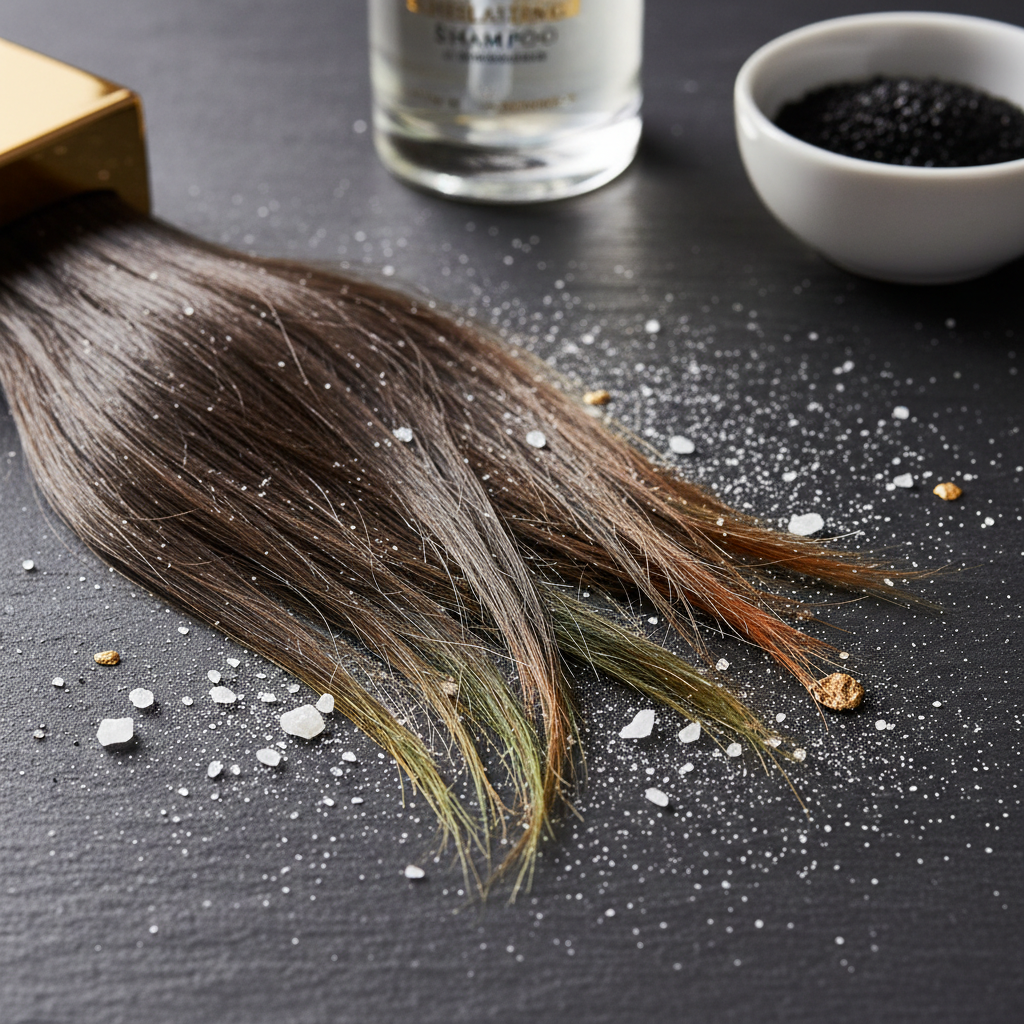
- Discolouration: Highlights or naturally light hair take on an ashy, muddy brassiness, or develop a greenish tint after swimming in chlorinated pools containing oxidised copper.
- Unpredictable colour results: Hair dye takes unevenly, processes darker than intended, or fades abnormally fast due to mineral interference.
- Persistent dullness: Hair lacks shine and looks flat despite thorough washing, caused by microscopic mineral crusts scattering reflected light.
What a chelating shampoo cannot do
While chelating is an essential maintenance step for anyone dealing with hard water, understanding what the treatment cannot fix is just as crucial:
- It does not treat hair loss: Mineral buildup can cause strand breakage due to surface friction, but it does not cause androgenetic alopecia, alopecia areata, or telogen effluvium. True hair loss occurs at the follicular level underneath the scalp, where topical minerals do not cause follicular miniaturisation.
- It does not repair split ends: Chelation removes minerals, but it cannot re-bond split or broken ends. Once the keratin structure is physically fractured, only a trim can remove the damage.
- It does not replace routine conditioning: Chelating agents strip away foreign mineral deposits, but they also clear out beneficial conditioning agents and moisture-retaining lipids. Skipping conditioner after chelation leaves the hair cuticle open and susceptible to mechanical damage.
How to use a chelating wash safely
Because chelating formulas are powerful, using them correctly protects the hair fibre from unnecessary dryness.
- Assess your local water hardness: If you live in a soft water region (under 60 mg/L of calcium carbonate), you rarely need a dedicated chelating cleanser unless you swim regularly in public pools. If your water is moderately hard to very hard (above 180 mg/L), incorporate it periodically.
- Apply to wet hair: Wet your hair thoroughly with warm water. Apply a moderate amount of chelating cleanser to the roots and work it down the lengths of your hair.
- Allow contact time: Unlike ordinary shampoos that you rinse away immediately, a chelating cleanser needs between 2 and 5 minutes on the hair. This dwell time gives the chelating molecules sufficient opportunity to bind with bonded metal ions.
- Rinse thoroughly: Rinse with plenty of running water to carry away the encapsulated mineral complexes.
- Replenish moisture immediately: Always follow with an intensive conditioning treatment or hair mask formulated with fatty alcohols, humectants, and natural oils. This restores the lipid barrier and smooths down the cuticle layer.
- Limit frequency: Limit use to once every 2 to 4 weeks. If you swim multiple times a week, you may use it more frequently, provided you compensate with adequate conditioning.
Supporting hair health and fibre resilience
Clearing away harsh environmental minerals is only one component of keeping hair in top condition. For overall hair resilience, supporting scalp health and the hair growth cycle from the root is equally important. Watermans focuses on topical formulas designed to invigorate the scalp environment, deliver rich botanical nutrients, and supply the building blocks necessary for stronger-feeling, thicker-looking hair. When your scalp and follicle margins are clean and well-nourished, the emerging hair fibre is far better equipped to withstand environmental stress, styling strain, and mechanical friction.
Frequently asked questions about Chelating Shampoo
Can I use a chelating shampoo on colour-treated hair?
Yes, but do so with caution. A chelating formula can strip cosmetic artificial pigment molecules along with minerals, leading to premature fading. However, using a chelating cleanser 24 to 48 hours before an in-salon colouring service is often recommended by stylists, as clearing out mineral deposits prevents uneven dye uptake and chemical hot spots.
How do I know if my shampoo is actually chelating?
Check the ingredients list on the bottle. A genuine chelating formula lists specific chelating agents near the middle or top of the ingredient deck. Look for tetrasodium EDTA, disodium EDTA, sodium phytate, pentasodium pentetate, or high concentrations of citric acid paired with these compounds.
Will a shower filter replace the need for a chelating shampoo?
Standard carbon shower filters remove chlorine and certain odours, but they do not soften water or remove dissolved calcium and magnesium ions. Only an ion-exchange water softener system can physically remove hard water minerals. Therefore, even with a typical shower filter, using a mineral-removing wash periodically remains beneficial in hard water areas.
Can a chelating wash cause hair breakage?
If used properly, it prevents breakage by lowering surface friction. However, overusing a strong chelating cleanser without following up with an intensive moisturising mask can strip away the hair's protective F-layer (the natural lipid coating on the cuticle). This leaves the hair dry, making it prone to snapping during detangling.
Summary
Maintaining healthy hair requires addressing external environmental factors alongside regular washing. A chelating shampoo provides a targeted, scientifically grounded solution to the stubborn mineral and metal buildup left behind by hard tap water and swimming pools. By using a chelating wash every few weeks, you effectively strip away dulling calcium, magnesium, and copper deposits, restoring natural movement, brightness, and manageable texture to your hair.
Sources and references
- International Journal of Cosmetic Science, "Investigation of the effects of hard water on hair fibre properties," 2018.
- Journal of the Society of Cosmetic Chemists, "The role of metal ions in cosmetic treatments and hair integrity," 2011.
- World Health Organization (WHO), "Hardness in Drinking-water: Background document for development of WHO Guidelines for Drinking-water Quality," 2011.
- American Academy of Dermatology (AAD), "Hair care basics: How to wash and condition without damaging hair," 2022.
Find these ingredients in Watermans products
- Copper: you will find this ingredient in our Hair Vitamins.