Cell Membrane Complex Hair: Structure, Function, and Repair
9 min read ·
The cell membrane complex hair network is the vital lipid-protein glue that binds cuticles and cortices. Learn how it degrades and how to protect hair elasticity.
Quick answer: The cell membrane complex hair structure is the intercellular adhesive that binds cuticle layers together and anchors cortical cells inside the fibre. Composed of lipids, proteins, and 18-methyleicosanoic acid (18-MEA), it regulates moisture movement, gives hair its elasticity, and stops cuticle scales from flaking off. Chemical processing, heat, and ultraviolet radiation degrade this complex, leaving hair dry, fragile, and porous. While topical treatments cannot regrow biological lipids, biomimetic conditioning agents can reinforce the damaged pathway to reduce mechanical breakage.
Key takeaways
- The cell membrane complex (CMC) makes up roughly 2 to 3 percent of total hair weight, yet it dictates cuticle adhesion and internal moisture dynamics.
- It consists of three structural layers: a central lipid-rich delta layer sandwiched between two protein-dense beta layers.
- Alkaline chemical services (such as bleaching or relaxers) strip the protective surface lipids and dissolve inner CMC proteins, accelerating fibre breakdown.
- Lipid depletion inside the CMC increases cuticle lifting, split ends, and moisture loss.
- Cosmetic ingredients such as ceramides, fatty acids, and biomimetic 18-MEA help patch CMC erosion, though they wash out over time and require consistent replenishment.
Cell Membrane Complex Hair: what the evidence shows
The role of the cell membrane complex hair network is well documented in cosmetic trichology and structural biophysics. The CMC is essentially the intercellular cement of the hair shaft. Without it, individual cuticle cells would separate from one another, and cortical macrofibrils would dissociate.
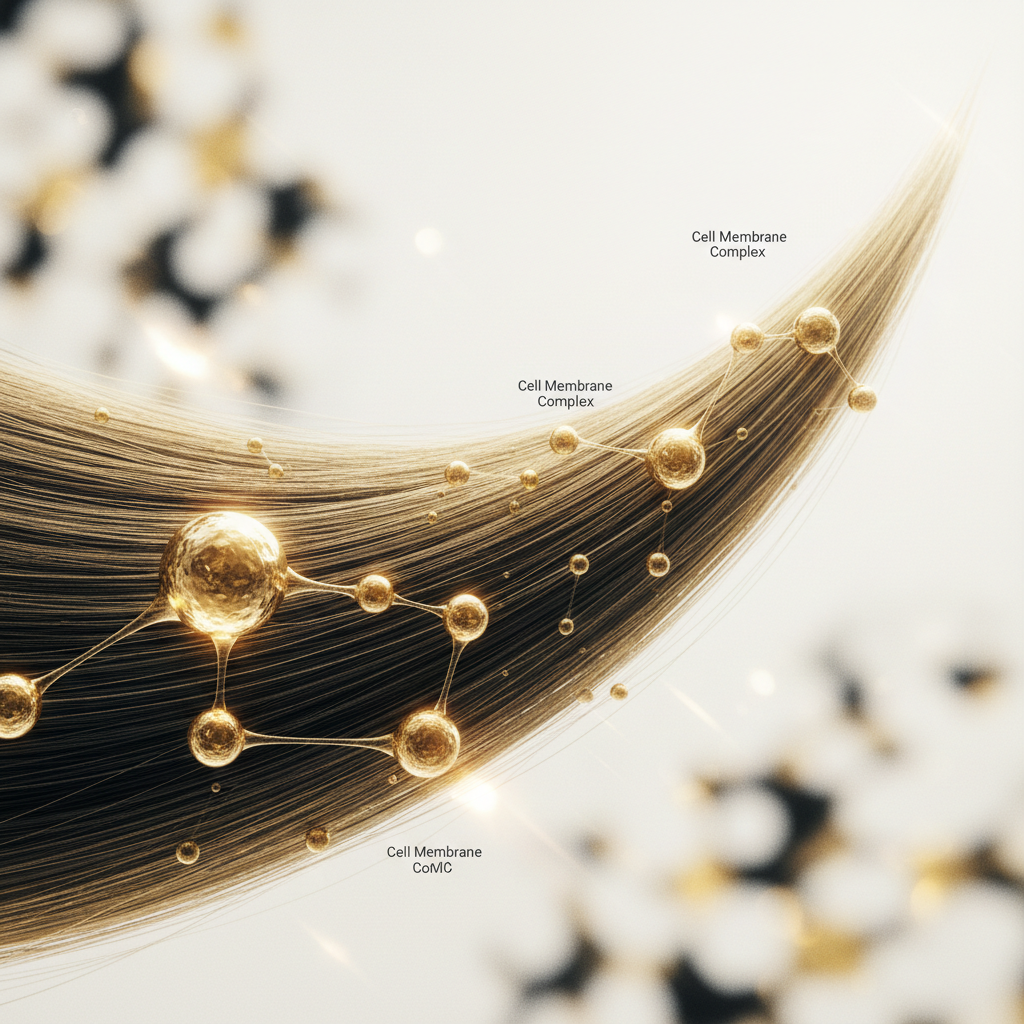
Biophysical research shows that the CMC runs throughout the entire hair strand. It exists as two distinct environments:
- Cuticle-Cuticle CMC: The boundary layer sealing overlapping cuticle scales on the fibre surface.
- Cortex-Cortex CMC: The interstitial matrix holding the spindle-shaped cortical cells together within the inner core.
The structure is divided into a three-layer sandwich measuring roughly 25 to 30 nanometres in total thickness. The central core, termed the delta layer, is primarily composed of hydrophilic (water-binding) proteins and enzymes. Flanking the delta layer on either side are the beta layers, which are dense bands of hydrophobic lipids. These lipids include free fatty acids, cholesterol, ceramides, and cholesterol esters.
On the outermost virgin hair surface, the beta layer anchors 18-methyleicosanoic acid (18-MEA), a branched fatty acid covalently bound via thioester bonds to cuticular keratin. This creates a natural water-repellent shield known as the F-layer.
When chemical treatments or heat degrade the CMC, the adhesive fails. Studies examining worn hair fibres under transmission electron microscopy consistently show lipid loss in the beta layers, followed by the delamination of cuticle scales. This process directly increases friction, promotes tangling, and leads to hair breakage.
Biological structure: the components of the CMC
Understanding how the cell membrane complex functions requires looking at its three core structural components.
| Component | Biological Composition | Primary Function in Hair | Vulnerability |
|---|---|---|---|
| Delta Layer | Low-sulphur globular proteins, acidic residues | Acts as a flexible cushion; allows restricted, controlled moisture transport | Dissolves easily in high-pH chemical environments (bleach, perms, relaxers) |
| Beta Layers | Saturated fatty acids, cholesterol, ceramides | Creates a hydrophobic seal; prevents excessive swelling and lipid extraction | Stripped by harsh surfactants, heat styling, and industrial solvents |
| 18-MEA (F-Layer) | Covalently bound 18-methyleicosanoic acid | Makes hair hydrophobic; reduces surface friction; repels atmospheric moisture | Removed permanently by single chemical alkaline lifting processes (pH 9.0+) |
The mechanical role of the CMC
The CMC is not just a passive glue. It provides flexibility. Keratin intermediate filaments inside cortical cells provide tensile strength (resistance to stretching), but the CMC provides shear modulus (resistance to twisting and bending).
When you comb, style, or bend your hair, the protein-lipid layers of the CMC glide slightly over one another. This movement distributes mechanical stress evenly. When the CMC dries out or loses its lipid component, the hair fibre stiffens, becomes brittle, and snaps under everyday tension.
How the cell membrane complex degrades
Degradation of the CMC follows a predictable path across three primary triggers:
Chemical processing
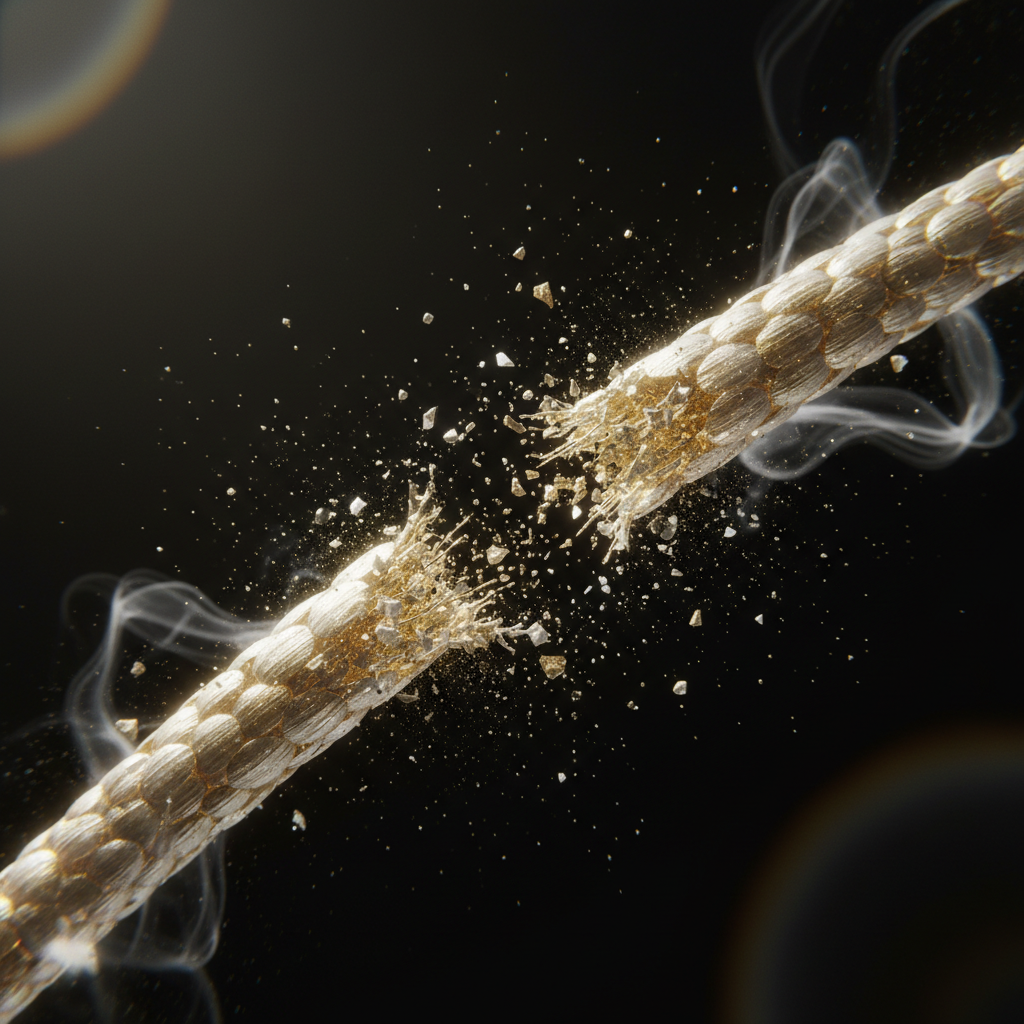
Peroxide, persulphates, and reducing agents used in bleaching, dyeing, and permanent waving hydrolyse the thioester bonds holding 18-MEA to the cuticle. Once 18-MEA is gone, water rapidly enters the delta layer. High-pH treatments (often pH 9.0 to 11.0) cause the internal cortex to swell, rupturing the intercellular cement and washing out unbound ceramides and sterols.
Thermal exposure
Styling tools heated beyond 180 degrees Celsius melt and oxidise free surface lipids. Thermal degradation alters the crystalline structure of the lipid bilayers in the beta layer, causing the cuticle scales to lift and peel away from the cortex.
Photodegradation (UV light)
Ultraviolet radiation triggers the production of free radicals within the CMC. These reactive oxygen species break down the lipid chains and cross-link the proteins in the delta layer, rendering the adhesive brittle.
What the evidence does not show
There is no evidence that topical haircare products can permanently recreate the biological F-layer once the native 18-MEA lipid bond is broken.
Advertising often suggests that cosmetic formulas can "rebuild" or "fuse" the internal cellular cement of the hair permanently. In reality, hair is non-living biological tissue. It cannot synthesise new lipids, nor can it reform covalent thioester bonds at home.
While biomimetic lipids, ceramides, and plant sterols can slip between lifted cuticle scales and mimic the function of the natural CMC, they do so via temporary hydrogen and ionic bonding. As soon as you wash with clarifying surfactants, these deposited lipids begin to wash out. Conditioning is a maintenance process, not a permanent biological repair.
Furthermore, a damaged cell membrane complex does not cause hair loss at the follicle. It causes hair breakage along the shaft. Follicular shedding (such as telogen effluvium) or pattern thinning (androgenetic alopecia) originate beneath the scalp in the living dermal papilla, not within the dead fibre structure of the CMC.
Signs of CMC degradation
When the cell membrane complex breaks down, the hair shows distinct physical changes:
- Hydrophilic behaviour: Healthy virgin hair is naturally hydrophobic; a drop of water beads on its surface. When the CMC and F-layer are degraded, the fibre absorbs water instantly like a sponge, leading to hygral fatigue (damage from repeated swelling and shrinking).
- Cuticle flaking and roughness: Without the beta-layer lipids holding scales flat, the cuticle flaps upward. Hair feels rough, catches easily when combed, and looks dull because light scatters instead of reflecting evenly.
- Micro-splitting: Individual strands split midway down the shaft, not just at the tips. This occurs because cortex-to-cortex adhesion has failed, allowing cortical fibres to separate internally.
- Loss of elasticity: The hair fibre snaps when gently stretched while damp, rather than rebounding to its original length.
Practical steps: protecting and mimicking the CMC
Because the hair fibre cannot self-repair, you must rely on external protective and structural reinforcement routines.
Replenish with biomimetic lipids
Look for conditioning formulations containing ingredients that mirror the natural components of the beta layer:
- Ceramides (e.g., Ceramide NP, Ceramide AP): Reinforce intercellular spaces and reduce scale lift.
- Fatty acids and sterols (e.g., behenic acid, cholesterol, phytosterols): Restore lipid barriers between cortex bundles.
- Quaternised 18-MEA analogues (e.g., Quaternium-33): Positively charged conditioning agents that adsorb electrostatically onto negatively charged, damaged hair surfaces to mimic the missing F-layer.
Control pH levels
Maintain hair products within a physiological pH window of 4.5 to 5.5. Acidic environments keep the cuticles compacted, physically shielding the delicate delta layer of the CMC from atmospheric moisture and swelling.
Lower heat temperatures
Keep thermal styling tools below 175 degrees Celsius. Apply silicone-based or hydrolysed-protein heat protectants to form a sacrificial barrier, sparing the internal lipids from direct thermal oxidation.
Gentle surfactant cleansing
Avoid aggressive, high-foaming cleansers that pull naturally occurring sterols out of the cuticle. Choose milder surfactant systems that cleanse the scalp without stripping the remaining lipid cement from mid-lengths and ends.
When the cause may be something else
If your hair appears dry and lifeless despite using lipid-rich conditioners, consider alternative causes:
- Hard water mineral buildup: Calcium and magnesium ions bind to keratin sites, masking the cuticles and creating a rough, straw-like texture that mimics CMC loss. A chelating wash clears this.
- Protein overload: Using intensive protein masks without balanced moisture can make fibres stiff and snap-prone. This feels similar to lipid deficiency but requires softening emollients rather than structural proteins.
- Follicular shedding: If hair is falling out with a white bulb intact at the root, the issue is internal or biological shedding, not CMC failure along the shaft. Consult a doctor or dermatologist for shedding investigations.
Supporting hair structure with Watermans
When managing hair prone to fibre wear, caring for the scalp alongside the strand supports long-term condition. The Watermans collection focuses on gentle, balanced routines that complement the hair's natural architecture.
Watermans GrowMe Shampoo delivers a sulphate-free cleanse that purifies the scalp without aggressively stripping essential surface lipids from the hair shaft. Pairing it with Watermans ConditionMe Conditioner helps replenish the hair with hydrolysed lupin protein, niacinamide, and softening emollients. This helps smooth down lifted cuticle scales, reduces surface friction, and supports fibre resilience against everyday breakage.
Frequently asked questions about Cell Membrane Complex Hair
What is the primary role of the cell membrane complex hair structure?
The cell membrane complex hair structure functions as biological glue. It binds cuticle scales to one another and secures cortical cells within the core. This adhesive prevents fibre delamination, cushions mechanical stress during brushing, and maintains the hair fibre's moisture barrier.
Can a damaged cell membrane complex be permanently restored?
No. Hair fibres are non-living biological structures without blood flow or cellular repair mechanisms. While biomimetic lipids, ceramides, and quaternised conditioning agents can coat and reinforce degraded areas, these topical solutions wash out over time and require ongoing application.
How does bleaching damage the cell membrane complex?
Bleaching involves strong alkaline agents and peroxide that dissolve the outer 18-MEA lipid layer (the F-layer) and oxidise the internal delta layer of the CMC. This removes the natural waterproof seal, leaving the inner cortex exposed to moisture loss and mechanical snapping.
What ingredients help replenish the CMC?
Formulations containing ceramides, cholesterol, free fatty acids, and Quaternium-33 (a synthetic analogue of 18-MEA) provide targeted cosmetic benefits. These ingredients slip into the depleted spaces between cuticles and mimic the lubricating beta layer of the CMC.
Does cell membrane complex loss cause baldness?
No. CMC degradation occurs along the non-living hair shaft and causes hair breakage, splitting, and roughness. Baldness and follicular thinning stem from hormonal, genetic, or systemic factors inside the follicle beneath the scalp, entirely separate from CMC breakdown.
Summary
The cell membrane complex hair network is a vital structural system that governs cuticle adhesion, fibre flexibility, and surface hydration. When chemical processes, excessive heat, or environmental stressors degrade its protein-lipid layers, the hair shaft loses its natural defence against daily wear. Although cosmetic treatments cannot regrow these lost biological lipids permanently, using biomimetic ceramides, managing product pH, and limiting thermal styling will help safeguard the remaining fibre structure and keep breakage to a minimum.
Sources and references
- Chemical and Physical Behavior of Human Hair (Clarence R. Robbins, 5th Edition, Springer, 2012)
- Journal of Cosmetic Science: "The Cell Membrane Complex of Human Hair and Its Role in Hair Properties" (Society of Cosmetic Chemists)
- International Journal of Trichology: "Hair Cosmetics: An Overview" (2015)
- British Association of Dermatologists: Guidelines on hair shaft structural abnormalities (bad.org.uk)
Find these ingredients in Watermans products
- Niacinamide: you will find this ingredient in our Hair Mask.