Castile Soap in Haircare: pH Balance, Cuticle Integrity, and the Evidence
8 min read ·
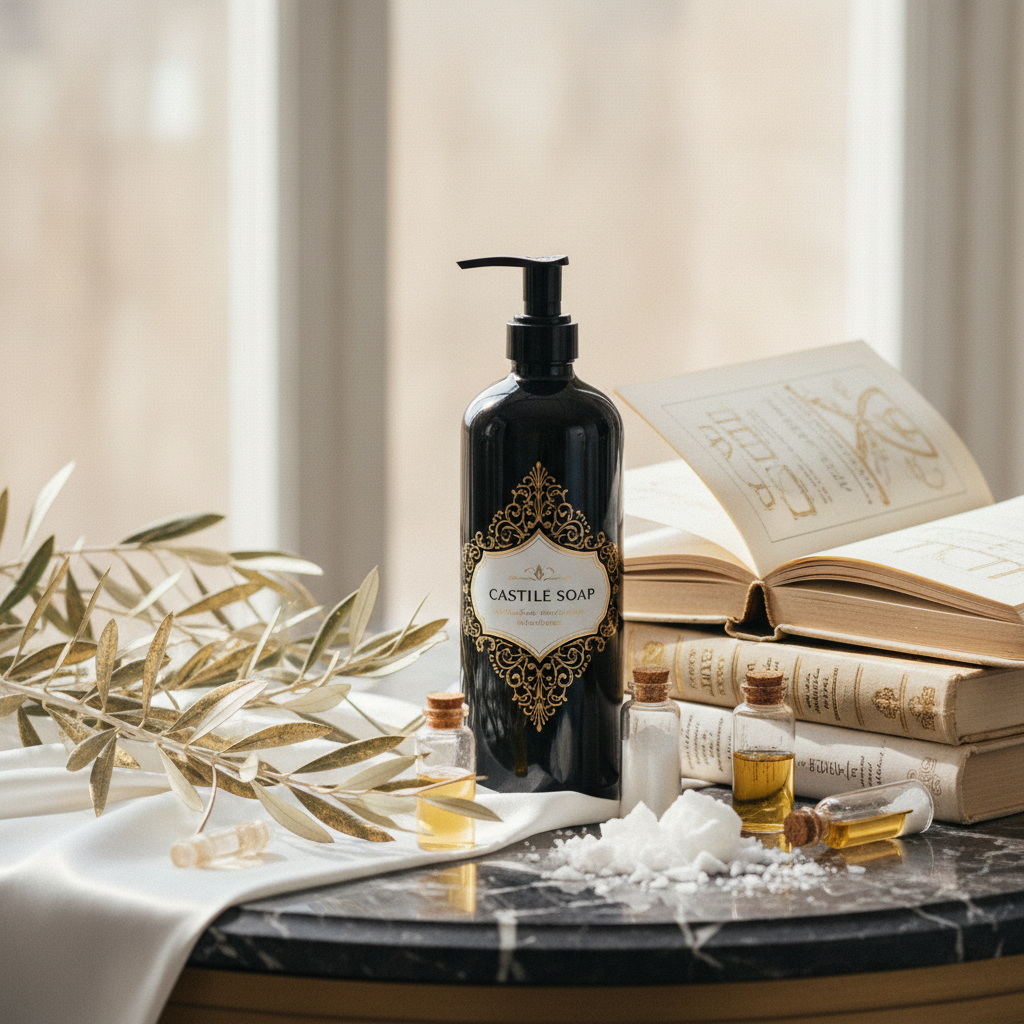
Castile soap is a natural, vegetable-based cleanser, but its high alkaline pH can lift hair cuticles and trigger fibre breakage if used without care.

Quick answer: Castile soap is a traditional, vegetable oil-based cleanser made by saponifying plant fats (historically olive oil) with potassium hydroxide or sodium hydroxide. While widely praised for being biodegradable and free from synthetic surfactants, pure Castile soap has an alkaline pH between 8.9 and 10.0. When used on human hair and scalp, which thrive at an acidic pH of 4.5 to 5.5, it frequently disrupts the cuticle layer, increases friction, and risks mechanical fibre breakage if used without careful formulation or corrective rinsing.
Key takeaways
- Castile soap is produced via true saponification, yielding an alkaline natural surfactant rather than a synthetic detergent (syndet).
- Hair fibre has an isoelectric point near pH 3.67, and the scalp acid mantle sits between pH 4.5 and 5.5; the high pH of Castile soap (8.9 to 10.0) forces the cuticle scales to swell and flare.
- In hard water areas, fatty acid soaps bind with calcium and magnesium ions, precipitating insoluble soap scum onto hair strands.
- Castile soap does not cause follicular hair loss or alopecia, but chronic cuticle swelling and friction can accelerate fibre breakage and split ends.
- If you use Castile cleansers, following with a diluted acidic rinse helps restore cuticle alignment and remove mineral film.
Castile: what the evidence shows
Research into hair fibre biology demonstrates that cosmetic pH directly dictates cuticle integrity. Castile soap relies on the saponification of triglycerides, yielding salts of fatty acids (such as potassium olivate or sodium olivate) alongside natural glycerin. Because these salts represent the conjugate bases of weak fatty acids, their aqueous solutions are inherently alkaline, typically measuring between pH 8.9 and 10.0.
A landmark study published in the International Journal of Trichology (2014) evaluated the pH of commercial shampoos and soaps, noting that alkaline cleansers increase the negative electrical charge on the hair surface. This surge in static charge expands inter-fibre friction, which weakens cuticle cohesion. Under an alkaline wash, water penetrates the cortex more rapidly, causing the fibre to swell. As the protective overlapping shingles of the cuticle lift, the inner protein structure becomes vulnerable to combing friction, leading to tangible roughness, tangling, and cosmetic dullness.
Furthermore, sebum regulation on the scalp depends on an intact acid mantle. Normal scalp skin maintains an acidic pH to suppress opportunistic micro-organisms, notably the yeast Malassezia, which is linked to seborrhoeic dermatitis and dandruff. Repeated application of alkaline Castile solutions temporarily neutralises this acid barrier, requiring several hours for the skin to re-acidify naturally.
What the evidence does not show
There is no clinical evidence that Castile soap treats, prevents, or directly causes medical hair loss, including androgenetic alopecia, alopecia areata, or telogen effluvium. Conflating hair shedding with breakage is a frequent mistake in informal haircare communities.
When users report excessive hair in their brush after switching to natural soap bars, the phenomenon almost always stems from mechanical breakage along the shaft or increased frictional pull detaching telogen hairs that were already scheduled to shed. Castile soap does not alter hair follicle cycling, nor does it penetrate the dermis to manipulate hormone receptors or dermal papilla activity.
The mechanism: saponification, alkaline swelling, and hard water scum
To understand how Castile interacts with hair, one must look at both its chemical structure and its interaction with domestic tap water.

Cuticle swelling and the isoelectric point
The outer sheath of human hair consists of five to ten layers of dead, overlapping keratinocytes (cuticle cells). The hair fibre reaches its isoelectric point around pH 3.67, where its net electrical charge is neutral. Between pH 4.5 and 5.5, hair remains relatively compact and hydrophobic.
When exposed to an alkaline agent like Castile soap (pH ~9.0):
- The negative charge of the keratin fibre multiplies rapidly.
- The outer cuticle cells swell and lift away from the shaft.
- Light reflects poorly off the irregular surface, resulting in a matte, lacklustre appearance.
- Exposed cortical cells become prone to moisture loss and physical abrasion from towels and combs.
The hard water interaction
Pure soaps behave very differently from modern synthetic detergents in the presence of dissolved minerals. When liquid or bar Castile soap meets hard water (containing calcium and magnesium ions at concentrations above 120 mg/L), a double replacement reaction takes place:
2 RCOO-K+ (soluble soap) + Ca2+ -> (RCOO)2Ca (insoluble scum) + 2 K+
The resulting calcium and magnesium carboxylates are completely insoluble in water. They deposit as a tacky, waxy film on the flared cuticles of the hair shaft. This film creates a coarse texture that resists rinsing, increases inter-strand friction, and makes detangling difficult without causing mechanical breakage.
| Cleanser Characteristic | Traditional Castile Soap | Formulated Syndet Shampoo |
|---|---|---|
| Primary Surfactant Source | Saponified plant oils (potassium/sodium olivate) | Synthetic detergents (e.g., glucosides, isethionates) |
| Typical pH Range | 8.9 to 10.0 | 4.5 to 6.5 |
| Cuticle Response | Swells and flares open | Remains sealed and flattened |
| Reaction with Hard Water | Forms insoluble calcium/magnesium scum | Remains fully soluble; rinses clean |
| Scalp Acid Mantle Impact | Temporarily disrupts; neutralises barrier | Preserves normal cutaneous microflora |
| Primary Hair Risk | Frictional breakage and dullness | Ingredient-specific irritation if poorly balanced |
Signs of cuticle stress from Castile soap
If you wash your hair with Castile soap, several clinical and cosmetic indicators suggest that your hair structure is struggling with the alkaline exposure:
- Tackiness while wet: Hair feels coated, sticky, or impossible to run fingers through before drying.
- Increased combing resistance: The comb catches easily, leading to audible snapping of strands.
- Lack of shine: Dried hair appears chalky, matte, or unevenly textured.
- Scalp tightness or flaking: The stripping of natural lipids alongside elevated pH can prompt compensatory dryness or irritant dermatitis.
- Split ends and mid-shaft fractures: Fragile ends break off prematurely, creating the illusion that hair has ceased growing.
What you can do: protective practices and acidic rinses
For individuals committed to using Castile cleansers due to environmental values or chemical sensitivities, specific steps can minimise fibre trauma:
- Dilute heavily before application: Never pour neat liquid Castile soap onto the scalp. Dilute it at a ratio of at least 1 part soap to 10 parts warm water.
- Apply an acidic closing rinse: To counteract alkaline swelling, use a mild acid rinse immediately after washing. A solution of 15 to 30 ml raw apple cider vinegar diluted in 500 ml cool water brings the surface back toward a pH of 4.0 to 4.5. This encourages the cuticle scales to lie flat and helps dissolve residual calcium scum.
- Use a chelating treatment in hard water: If you live in an area with hard water, an occasional chelating wash containing disodium or tetrasodium EDTA helps strip the stubborn mineral-soap deposits that vinegar alone cannot lift.
- Minimise wet combing: Never aggressively brush hair that has just been cleansed with an alkaline base. Use a wide-tooth comb only after applying an acidic leave-in conditioner to re-establish surface lubricity.
When the cause may be something else
If you notice widespread thinning, a widening parting line, or bald patches, these symptoms are unrelated to Castile soap. Such presentations indicate systemic follicular changes rather than topical soap reactions. Underlying conditions may include:
- Androgenetic alopecia: Patterned follicular miniaturisation driven by dihydrotestosterone (DHT) sensitivity.
- Telogen effluvium: Widespread shedding occurring 2 to 3 months after a physiological stressor, illness, nutritional deficit (such as ferritin or vitamin D deficiency), or hormonal shift.
- Cicatricial (scarring) alopecia: Inflammatory destruction of the follicular stem cell region, requiring immediate medical intervention.
Watermans: balancing cleanse with scalp physiology
While simple traditional soaps appeal for their minimalist formulations, modern trichological science favours cleansers that support scalp biology directly. Watermans hair products are engineered with balanced pH profiles that respect the natural acid mantle of the scalp and the delicate cuticle alignment of the hair shaft. By avoiding harsh alkaline environments and integrating active botanical complexes, biotin, and hydrolysed lupin protein, these formulations support a healthy scalp environment and promote stronger-feeling, fuller-looking hair without the structural compromises associated with unbuffered soaps.
Frequently asked questions about Castile
Is Castile soap safe for daily hair washing?
Castile soap is generally unsuitable for daily hair washing. Its alkaline pH of roughly 9.0 to 10.0 repeatedly lifts the cuticle and alters the natural acid mantle of the scalp. Over time, daily use typically leads to chronic moisture loss, tangling, and mechanical breakage.
Does Castile soap cause hair loss?
Castile soap does not cause follicular hair loss or hormonal thinning. However, its high pH raises the hair cuticle, increasing friction between strands. This friction often causes hair fibres to snap along the shaft during brushing, which is easily mistaken for true shedding from the root.
Why does Castile soap leave hair feeling waxy?
This waxy feeling happens when the fatty acid salts in Castile soap react with calcium and magnesium ions in hard water. The reaction creates an insoluble substance called soap scum that coats the raised cuticles of the hair and resists standard rinsing.
Can I use Castile soap on coloured or bleached hair?
You should avoid using Castile soap on chemically treated or bleached hair. Colouring and bleaching already compromise the cuticle layers; the high alkalinity of Castile lifts them further, leading to accelerated colour fading, porosity, and severe fibre breakage.
How do I use an apple cider vinegar rinse with Castile soap?
Mix 15 to 30 ml of raw apple cider vinegar with 500 ml of cool water. After rinsing the Castile cleanser out completely, pour the diluted mixture evenly over your scalp and hair lengths. Let it sit for one minute before a final cool water rinse to restore the hair's acidic balance.
Conclusion
Traditional Castile soap remains a time-honoured, biodegradable surfactant that excels at general cleaning, but its high alkalinity poses distinct challenges for human hair. Because hair fibres and the scalp require an acidic environment between pH 4.5 and 5.5, unbuffered Castile formulas inevitably disturb the protective cuticle and precipitate mineral film in hard water. If you choose to cleanse with traditional soap, proper dilution and corrective acidic rinses are essential steps to maintain fibre resilience and prevent unnecessary breakage.
Sources and references
- Gavazzoni Dias, M. F., et al. (2014). The Shampoo pH can Affect the Hair: Myth or Reality? International Journal of Trichology, 6(3), 95-99.
- Robbins, C. R. (2012). Chemical and Physical Behavior of Human Hair (5th ed.). Springer-Verlag.
- Ali, S. Y., & Yosipovitch, G. (2013). Skin pH: From Basic Science to Basic Skin Care. Acta Dermato-Venereologica, 93(3), 261-267.
- Evans, A., & Wickett, R. (2012). Practical Modern Hair Science. Allured Business Media.
Find these ingredients in Watermans products
- Vitamin D: you will find this ingredient in our Hair Vitamins.