Bubble Hair Deformity: Causes, Signs, and Recovery
8 min read ·
Bubble Hair Deformity is a heat-induced shaft defect where trapped water forms cavities in the hair cortex. Learn its causes, signs, and prevention.
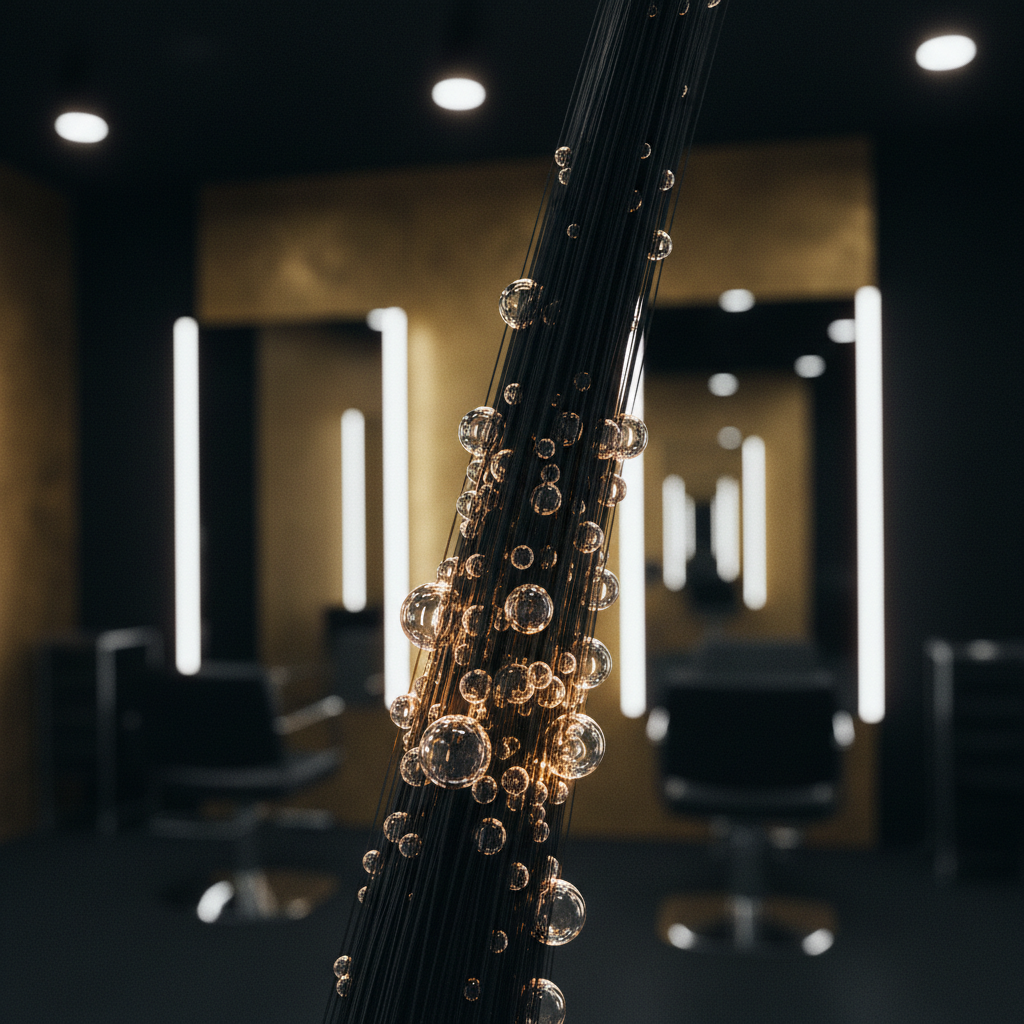
Quick answer: Bubble Hair Deformity is an acquired hair shaft defect caused by thermal injury, where trapped water inside damp hair vaporises rapidly under extreme heat (such as hair dryers or straighteners) to form microscopic, gas-filled cavities within the cortex. This results in severe hair breakage, localised thinning, and dry, brittle strands that snap easily. Because the physical structure of the hair fibre is permanently compromised, the condition cannot be reversed with cosmetic treatments; the damaged length must be cut away to resolve it.
Key takeaways
- Bubble Hair Deformity is entirely physical, triggered by rapid thermal expansion of water trapped inside the hair shaft.
- It presents as severe fibre breakage and fragile, kinky strands, not follicular hair loss or shedding from the scalp.
- Under light microscopy or dermoscopy, affected fibres show distinct, evenly spaced air cavities (bubbles) along the cortex.
- Chemical processing like bleaching makes hair more porous, drastically increasing vulnerability to thermal cavity formation.
- Topical treatments, conditioners, and oils cannot mend bubble hair; the only true remedy is trimming off the affected lengths.
Bubble Hair Deformity: what the evidence shows
First documented in dermatological literature in the early 1990s, Bubble Hair Deformity occurs when thermal styling tools heat damp hair too quickly. Hair naturally holds ambient water, typically between 10% and 15% of its total weight, and wet hair holds significantly more. When high-heat styling appliances (such as curling tongs, flat irons operating above 160°C to 200°C, or hair dryers held too close) contact damp fibres, the liquid water transforms into steam almost instantly.
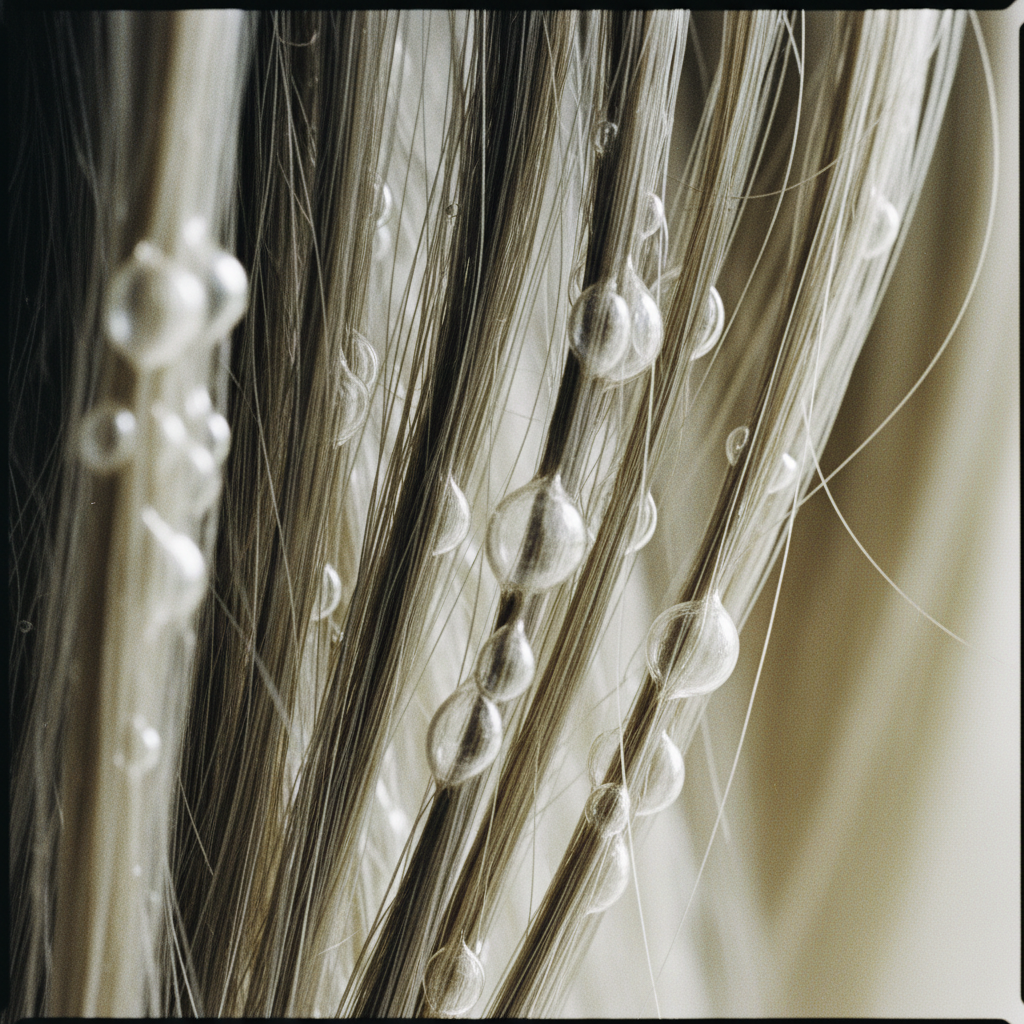
Because the dense outer cuticle acts as a pressurised barrier, this water vapour cannot escape freely. The sudden internal steam pressure forces the protein matrix of the hair cortex to expand and balloon outward, creating hollow, gas-filled voids known as bubbles. This weakens the structural integrity of the keratin fibres, causing the shaft to buckle, kink, and snap under routine handling like brushing or washing.
Dermatologists and trichologists identify this deformity through dermoscopy or light microscopy. Under low magnification, the hair shaft looks like Swiss cheese or a string of beads, featuring clear, oval-shaped cavities spaced unevenly along the fibre. These cavities deform the outer cuticle, producing visible bulging and extreme brittle fragility.
What the evidence does not show
Bubble Hair Deformity is often misunderstood by individuals who mistake rapid mid-shaft snapping for shedding or permanent hair loss.
- It is not an internal or systemic illness: Bubble hair is not linked to vitamin deficiencies, thyroid problems, hormonal shifts, or genetic metabolic issues.
- It does not affect follicular health: The hair follicle below the scalp surface remains healthy and completely undamaged. The scalp itself is not diseased.
- It is not hair shedding: The hair roots remain securely anchored in the anagen or telogen phases. The issue is purely mechanical fibre breakage along the shaft.
- It cannot be repaired with bond builders or proteins: While commercial bond repairers and deep masks temporarily smooth the outer cuticle, they cannot fill gas-filled voids or restore the melted, expanded keratin matrix inside the cortex.
Signs to look for
Identifying Bubble Hair Deformity early prevents ongoing breakage from spreading higher up the hair shaft. The signs are distinctive:
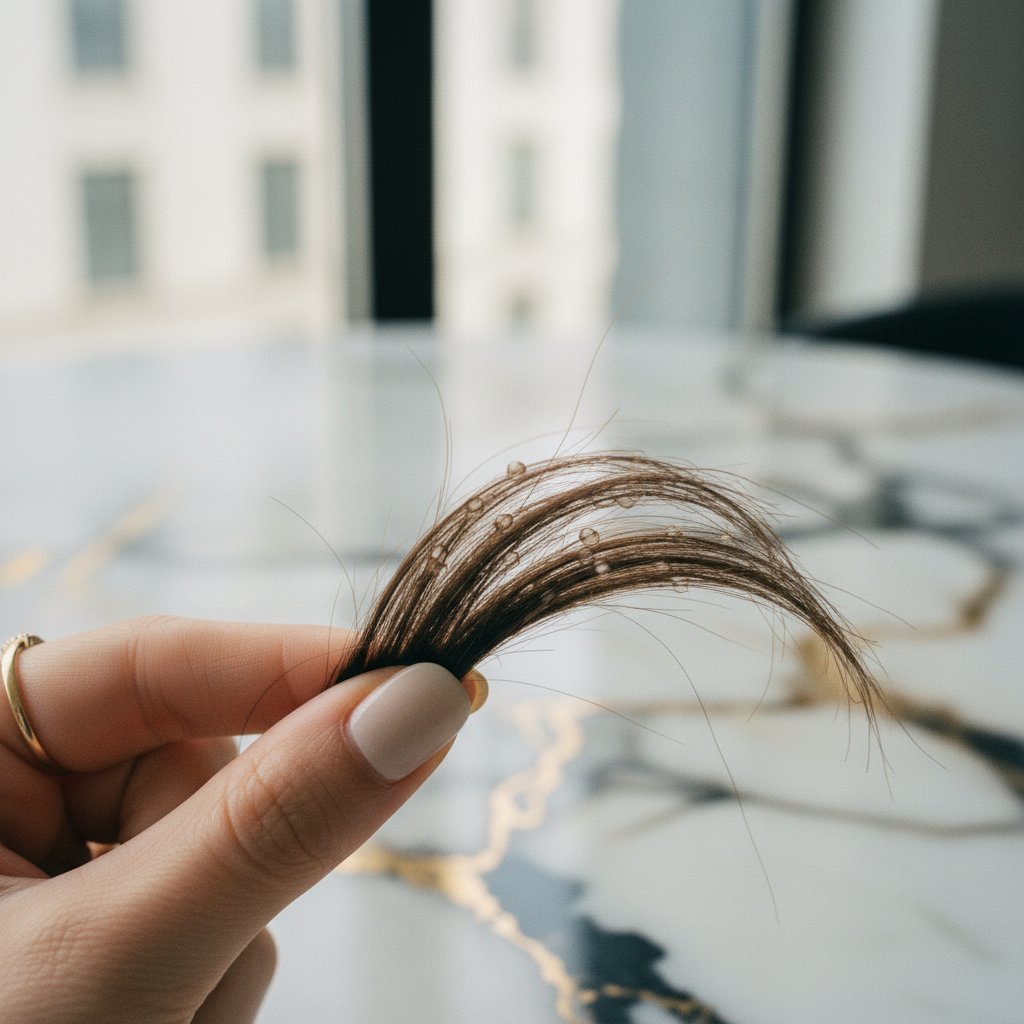
- Sudden, localised brittleness: Hair feels stiff, straw-like, and frizzy in specific patches, often where heat tools are held longest (such as the crown, bangs, or ends).
- Mid-shaft snapping: Short broken pieces of hair fall onto your shoulders or sink, noticeably lacking a white root bulb.
- Abnormal curling or kinking: Individual straight hairs can take on a crinkled, irregular, or bent appearance due to internal structural deformities.
- Colour alteration: In darker hair, the air pockets refract light differently, sometimes giving the damaged section a lighter, dull, or frosted visual appearance.
- Tangles and matted patches: The cuticles covering the bubbles become cracked and elevated, catching on adjacent strands and creating stubborn, dry knots.
Comparison: Bubble hair vs other hair shaft defects
| Feature | Bubble Hair Deformity | Trichorrhexis Nodosa | Monilethrix |
|---|---|---|---|
| Primary Cause | Rapid thermal heating of damp hair | Mechanical, chemical, or heat trauma | Genetic mutation (keratin genes) |
| Microscopic Look | Oval, gas-filled cavities inside cortex | Frayed brush-like ends colliding | Beaded appearance with periodic thinning |
| Origin | Acquired via styling habits | Acquired (most common) or congenital | Congenital (inherited) |
| Fibre Integrity | Weakened by hollow air pockets | Split and fractured outer cuticle | Snaps at narrow internodes |
| Follicle Status | Healthy and normal | Healthy and normal | Often accompanied by follicular keratosis |
| Resolution | Cut off damaged hair, adjust heat | Reduce physical/chemical friction | Managed dermatologically; lifelong |
What you can do to manage and prevent it
Because bubble hair represents permanent structural destruction within the cortex, you cannot reverse existing bubbles. However, you can manage the appearance of the hair while it regrows and prevent future occurrences through specific daily habits.
- Cut away the damaged lengths: The single definitive treatment is trimming or cutting off the section containing the bubbles. If left alone, the weak points will continue to fracture, split, and fray higher toward the scalp.
- Never apply high heat to wet or damp hair: Allow hair to air-dry completely, or dry it gently on a cool to medium airflow setting before introducing hot tools. Straighteners and curling irons should strictly touch bone-dry strands.
- Keep styling tools below 175°C: High heat (temperatures exceeding 180°C to 200°C) dramatically increases the rate of internal water boiling. Lowering your tool's heat setting provides a wider margin of safety.
- Maintain movement with hair dryers: Keep hair dryers at least 15 centimetres away from the hair surface, and keep the nozzle in steady motion rather than concentrating heat on a single spot.
- Use leave-in conditioning agents: Cationic conditioners and silicone-based serums reduce friction on uninjured hair, minimising the drag of brushes against delicate cuticles.
When the cause may be something else
If your hair is breaking or snapping without a history of hot tool usage, the diagnosis may not be Bubble Hair Deformity. Several other shaft anomalies and practices present with brittle fibres:
- Over-bleaching or chemical burns: Excessive chemical processing can disintegrate disulphide bonds, leaving the hair elastic and mushy when wet, snapping under minimal tension without displaying the discrete air cavities of bubble hair.
- Trichorrhexis nodosa: The most common acquired shaft defect, caused by repetitive mechanical friction, harsh shampooing, or mild chronic heat. Under a microscope, it looks like two paintbrushes jammed into each other rather than rounded gas bubbles.
- Pili torti: A condition where the hair shaft is flattened and twisted 180 degrees along its axis, leading to fragile hair that breaks easily, often appearing in childhood.
- Tight traction styling: If your hair loss shows up around the temples or hairline with short broken stubble, mechanical tension from tight braids or ponytails is more likely the culprit.
Supporting hair health with Watermans
When recovering from extensive thermal damage, supporting healthy, resilient new growth from the scalp becomes essential while you gradually trim off damaged lengths.
Watermans Grow Me Shampoo and Condition Me Conditioner provide a targeted, sulphate-free cosmetic approach to support your hair care routine. Formulated with caffeine, biotin, argan oil, niacinamide, and rosemary extract, these formulas help maintain an optimal scalp environment for fresh growth.
While no topical cosmetic can reverse structural bubble voids once they form inside the hair fibre, the moisturising ingredients in Watermans Condition Me smooth surviving strands, improve slip, and reduce daily mechanical friction, helping you protect your delicate hair as healthy new lengths emerge.
When to seek professional advice
Consult a qualified trichologist or dermatologist if you experience sudden, unexplained hair breakage that does not correlate with your heat-styling habits. A professional can examine your strands using dermoscopy to confirm whether Bubble Hair Deformity is present or if you are dealing with a congenital shaft disorder, a fungal infection like tinea capitis, or concurrent telogen effluvium.
Seek medical advice immediately if your hair changes are accompanied by scalp redness, pain, scaling, pustules, or patches where the hair follicles look completely smooth and absent.
Frequently asked questions about Bubble Hair Deformity
Can deep conditioning treatments cure Bubble Hair Deformity?
No. Deep conditioning treatments, protein packs, and bond-building masks cannot cure Bubble Hair Deformity. Once intense heat vaporises moisture and creates hollow voids in the cortex, the structural integrity of the keratin matrix is permanently destroyed. Conditioners can temporarily coat the cuticle to make hair feel softer, but they cannot fill or eliminate the internal gas bubbles. The only definitive solution is cutting the affected hair away.
Does Bubble Hair Deformity cause permanent baldness?
No, it does not cause permanent baldness or scalp alopecia. The deformity is confined entirely to the external hair shaft above the skin. The dermal papilla and hair follicle beneath the scalp remain unharmed and functional. New hair emerging from the scalp will grow out with normal structure and strength, provided you do not repeat the thermal mistakes that created the bubbles.
How hot does a styling tool have to be to cause bubble hair?
Bubble hair typically occurs when styling appliances exceed 160°C to 180°C on damp hair, or when hair dryers operating on high settings are held motionless against wet strands. At these temperatures, moisture trapped within the fibre heats past its boiling point in milliseconds, creating instantaneous steam pressure that forces open the hollow cavities.
How is Bubble Hair Deformity diagnosed by a professional?
A dermatologist or trichologist diagnoses the condition by performing a light microscopic examination or trichoscopy on a few shed or clipped strands. Under 10x to 40x magnification, the clinician can clearly observe the distinctive oval-shaped, air-filled cavities within the cortex of the hair shaft, differentiating it clearly from other defects like trichorrhexis nodosa or monilethrix.
Summary
Bubble Hair Deformity serves as a clear reminder of how vulnerable hair fibres are to rapid thermal stress. While hair requires moisture to maintain elasticity, applying aggressive heat to wet or damp strands creates internal boiling that permanently damages the cortex. By trimming away the brittle, compromised lengths, respecting proper drying stages, and moderating your heat tool temperatures, you can ensure your hair grows back strong, smooth, and resilient.
Sources and references
- British Association of Dermatologists. Hair shaft abnormalities and thermal injury guidelines. 2021.
- American Academy of Dermatology. How to prevent hair damage from heat styling. 2022.
- Detwiler, S. P., Carson, J. L., & Brinkhous, K. M. Bubble hair: Case manufacture and literature review. Journal of the American Academy of Dermatology, 1994.
- Gummer, C. L. Bubble hair: a physical abnormality. British Journal of Dermatology, 1994.
- Sinclair, R., & de Berker, D. Hair shaft defects. Dermatologic Clinics, 1997.
Find these ingredients in Watermans products
- Niacinamide: you will find this ingredient in our Hair Mask.