Bleached Hair Care: The Evidence-Based Guide to Protecting Chemically Lightened Strands
9 min read ·
Master bleached hair care with evidence-based tips on bond repair, lipid replacement, and breakage prevention to keep fragile, lightened strands strong.
Quick answer: Effective Bleached Hair Care focuses on compensating for permanent chemical damage to the hair fibre. Bleaching oxidises natural melanin while stripping the protective lipid layer (18-MEA) and degrading internal keratin bonds, leaving hair porous, dry, and fragile. A successful care regimen relies on bond builders, hydrolysed proteins, pH-balanced cleansers, and lipid-replenishing conditioners to minimise friction and mechanical breakage. However, Bleached Hair Care cannot biologically heal or regenerate dead keratin fibres, meaning ongoing preventative maintenance is essential until new hair grows.
Key takeaways
- Bleaching permanently alters the hair cortex and strips the cuticle's protective 18-methyl eicosanoic acid (18-MEA) lipid layer.
- Chemical lightening increases fibre porosity, allowing rapid water absorption and subsequent swelling that weakens wet hair.
- Successful maintenance requires an intentional balance of bond-multiplying treatments, hydrolysed proteins, and deep-acting emollient lipids.
- Hair shedding from the follicle must not be confused with chemical breakage snapping along the bleached shaft.
- Using low-pH products (pH 4.5 to 5.5) helps contract the cuticle scale edges to reduce tangling and moisture loss.
Bleached Hair Care: what the evidence shows
Scientific research reveals that Bleached Hair Care requires managing structural changes caused by alkaline persulphate salts and hydrogen peroxide. These chemicals penetrate the cuticle to oxidise melanin pigments. In doing so, they convert cystine, the primary amino acid providing tensile strength via disulphide cross-links, into cysteic acid.
Studies show that bleaching can decrease cystine levels in human hair by 15 to 45 percent depending on the processing time and developer concentration. This loss directly compromises the mechanical resilience of the hair fibre. Furthermore, the outer fatty acid sheath, composed primarily of 18-MEA, is almost entirely removed during high-lift bleaching. Without this natural hydrophobic layer, hair becomes hydrophilic. It absorbs water too readily, swells excessively when wet, and experiences heightened friction during washing and brushing.
Bleached Hair Care is therefore not about making hair feel soft through cosmetic silicones alone. It is a systematic process to reinforce broken molecular bonds, seal the lift on the cuticle layer, and restore simulated lipids to minimise daily mechanical breakage.
What the evidence does not show
Research does not show that any cosmetic treatment can permanently repair, regenerate, or fuse damaged hair back into its original, virgin state. Hair fibre is biologically dead tissue once it emerges past the scalp surface. While bond-building molecules (such as bis-aminopropyl diglycol dimaleate or maleic acid complexes) cross-link single sulphur hydrogen bonds to form artificial bridges, they do not reproduce native cellular membranes.
Similarly, evidence does not show that split ends can be sealed permanently. Leave-in serums and oils act like temporary adhesives via surface tension, but mechanical friction from sleeping or brushing quickly reopens the split. The only permanent resolution for severe distal splitting is trimming the damaged length. Finally, there is no clinical evidence that chemical bleaching itself causes follicular hair loss or hormonal alopecia, provided the chemical mixture does not induce severe chemical burns on the scalp tissue.
The biological and chemical mechanism of bleaching
Understanding the microscopic breakdown of hair helps you select the right products. Hair consists of three structural layers: the outermost protective cuticle, the structural cortex, and the central medulla.
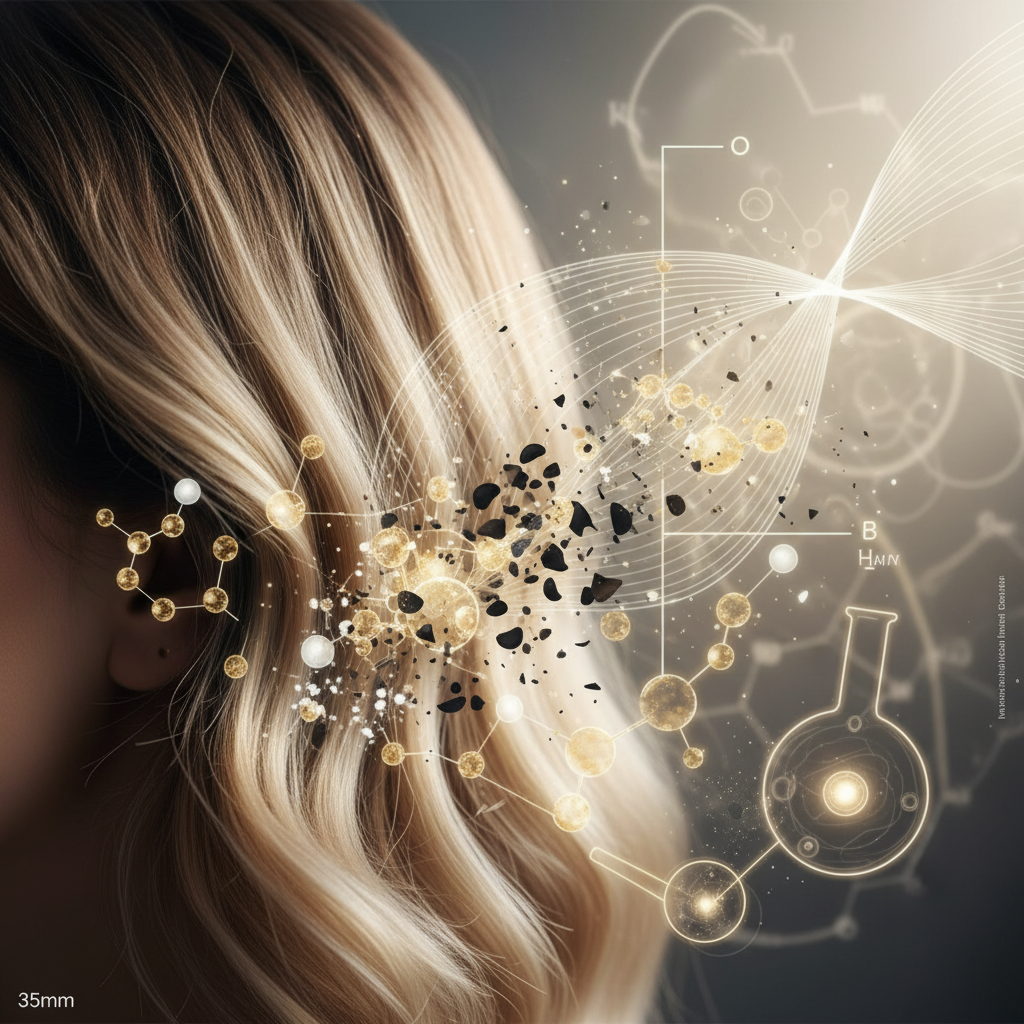
The cuticle consists of overlapping, shingle-like cells coated with 18-MEA. During a bleaching service, high-alkalinity agents (often reaching a pH between 9.0 and 11.0) force the cuticle scales open. This lets hydrogen peroxide and persulphate salts diffuse directly into the cortex. Inside, the chemical reaction generates reactive oxygen species that degrade both eumelanin and pheomelanin granules, converting dark pigments into lighter, oxidised variants.
As an unavoidable secondary effect, this oxidation cleaves disulphide bonds within the keratin polypeptide chains. The loss of these structural bonds reduces the wet elasticity of the fibre. When stretched, healthy hair returns to its original length, but over-bleached hair stretches uncontrollably and snaps under minimal load.
| Property | Virgin Hair | Bleached Hair | Care Implication |
|---|---|---|---|
| Surface Nature | Hydrophobic (repels excess water) | Hydrophilic (absorbs excess water) | Requires lipid replacement to restore slip |
| Cuticle Condition | Flat, tightly closed, intact 18-MEA | Lifted, chipped, stripped of 18-MEA | Requires acidic (pH 4.5 to 5.5) sealers |
| Internal Bond State | Intact disulphide cross-links | Oxidised into cysteic acid | Benefits from bond-building formulations |
| Porosity | Low to medium | High | Rapidly loses colour and internal hydration |
| Wet Tensile Strength | High (withstands normal brushing) | Very low (prone to catastrophic snap) | Never detangle forcefully while soaked |
Signs of bleached hair damage
Bleaching compromises hair in predictable stages. Look for these visual and tactile signs to tailor your routine:
- Excessive wet elasticity: When wet, strands feel gummy or resemble wet chewing gum, stretching far beyond normal limits before snapping without springing back.
- Extreme porosity: Hair absorbs water instantly in the shower, taking hours to dry naturally because the spongy cortex holds onto water molecules.
- Persistent matting and tangling: Without the lubricating 18-MEA layer, raised cuticle scales catch on neighbouring strands like Velcro, leading to severe knots at the nape.
- Transverse fractures (breakage): Short, brittle pieces shed during styling without a white bulb at the root, indicating mechanical failure along the shaft rather than shedding from the scalp.
- Dullness and colour fade: The damaged cuticle cannot reflect light evenly, leaving blonde tones looking brassy, flat, or chalky within days of salon toning.
How to build an effective Bleached Hair Care routine
Caring for bleached lengths requires a targeted regimen that shields fragile fibres from friction, water fatigue, and heat.
1. Wash with low-pH, sulphate-free cleansers
Alkaline environments swell the cuticle, worsening structural weakness. Choose shampoos with a pH between 4.5 and 5.5. Mild surfactants such as sodium cocoyl isethionate or coco-glucoside clean the scalp without aggressively stripping whatever natural sebum manages to coat the mid-lengths. Wash the scalp primarily and let the running lather gently cleanse the bleached ends.
2. Alternate bond builders with hydrolysed proteins
Bond-building treatments work at the cortex level to bridge damaged molecular pathways, while hydrolysed proteins (such as hydrolysed wheat, soy, or keratin proteins) fill microscopic gaps in the cuticle layer. Use an intensive bond-repair treatment once a week, followed by a protein-rich conditioner every two to three washes to restore firm structure.
3. Replenish moisture and slip with fatty acids
Because bleached hair lacks natural lipids, apply emollients that can coat the fibre. Look for fatty alcohols (cetyl and stearyl alcohol) alongside lightweight vegetable oils like argan, jojoba, or squalane. These ingredients mimic the missing 18-MEA, smoothing down rough cuticle edges and cutting down on detangling friction.
4. Minimise mechanical stress and heat
Wet bleached hair is at its absolute weakest. Never brush through soaking wet hair with a dense bristle brush; use a wide-tooth comb or flexible detangling brush on hair pre-coated with leave-in conditioner. Keep heat styling to an absolute minimum. When blow-drying is necessary, use a heat protectant up to 230 degrees Celsius and rely on medium, controlled airflow rather than high direct heat.
Breakage versus shedding: when the cause is something else
It is vital to distinguish between cosmetic damage and physiological scalp conditions. If you notice an influx of hair around your bathroom, inspect the fallen strands carefully.
Bleached hair breakage presents as varied, short fragments without a root bulb. This snapping is caused by mechanical manipulation over chemically weakened keratin. Conversely, true hair shedding (such as telogen effluvium) features full-length strands ending in a small, white keratinised bulb, which came directly out of the follicle. If your scalp is suddenly visible across wide zones or you lose more than 100 to 150 full-length hairs a day for months, bleaching is not the primary culprit. The trigger could be iron deficiency, thyroid dysfunction, sudden physiological stress, or hormonal shifts.
Supporting bleached hair with Watermans
While chemical bleaching attacks the hair fibre's physical structure, long-term hair density relies on healthy, undisturbed follicles. For those dealing with fragile, lightened lengths who also want to encourage a healthy scalp environment for new growth, Watermans Grow Me Shampoo provides a nourishing option.
Formulated without harsh sulphates, it cleanses the scalp gently, keeping mechanical irritation low while delivering beneficial ingredients like biotin, rosemary extract, niacinamide, and caffeine. Pairing an invigorating scalp cleanser with a targeted, reconstructive hair mask provides a comprehensive approach: protecting existing bleached strands from breaking while supporting the natural scalp biology beneath.
When to seek professional advice
Consult a professional colourist or a trichologist under the following circumstances:
- Chemical burns or scalp irritation: If bleaching causes weeping sores, persistent burning, blistering, or intense scalp tenderness, visit a doctor or dermatologist immediately.
- Extensive "chemical cut": If the hair breaks off en masse close to the scalp, stop all chemical processing. A qualified stylist can assess whether bond builders or corrective cutting can stabilise the remaining length.
- Unexplained root shedding: If you experience diffuse, heavy hair shedding that persists beyond three months, consult your GP or a trichologist to run routine blood panels for ferritin, vitamin D, and thyroid function.
Frequently asked questions about Bleached Hair Care
How often should I wash bleached hair?
Most people with bleached hair find washing two to three times a week ideal. Because chemically processed hair is stripped of natural oils, daily washing can cause dryness and cuticle swelling. Washing too infrequently, however, allows product build-up and sebum to irritate the scalp. Focus shampoo at the roots, rinse with lukewarm water, and always follow with an emollient conditioner.
Can Bleached Hair Care completely repair split ends?
No, Bleached Hair Care cannot permanently mend split ends. Once the keratin structure splits along the longitudinal axis of the fibre, the bond is permanently broken. While leave-in treatments containing silicones, vegetable oils, or cationic polymers can temporarily glue the split closed until the next wash, the only permanent way to eliminate split ends is having them trimmed by a stylist.
Why does bleached hair turn yellow or brassy?
Bleached hair turns brassy because the lightening process reveals the naturally warm underlying pigments in melanin. As the initial post-bleach toner gradually washes away, these warm yellow and orange undertones become visible. Additionally, mineral deposits from hard wash water and UV exposure oxidise residual pigments, making brassiness more noticeable. You can counteract this by using purple toning shampoos or glosses every few washes.
What is the biggest mistake people make with Bleached Hair Care?
The most frequent mistake in Bleached Hair Care is roughly brushing or detangling hair when it is soaking wet. Wet bleached hair loses much of its structural tensile strength and stretches far too easily. Brushing without a slip-providing leave-in product can easily snap fragile strands. Always blot hair gently with a microfibre towel first, apply a detangler, and work from ends to roots.
Maintaining strength and condition
Bleached hair requires a conscious shift in your daily routine. Chemical lightening removes natural colour pigments while permanently changing the fibre's biological and physical characteristics. By accepting that bleached strands lack natural water resistance and structural disulphide bonds, you can protect them effectively.
Focus your Bleached Hair Care on gentle handling, acidic pH products, consistent bond reinforcement, and protecting the fibre from extreme heat. With thoughtful maintenance and realistic expectations, you can enjoy bright, lightened hair while keeping mechanical breakage to an absolute minimum.
Sources and references
- Chemical and Physical Behavior of Human Hair (Clarence R. Robbins, Springer, 5th Edition, 2012)
- International Journal of Cosmetic Science, "The effect of chemical bleaching on hair keratin oxidation and tensile properties", 2010
- Journal of the Society of Cosmetic Chemists, "Surface architecture of human hair and the role of 18-methyleicosanoic acid", 1997
- British Association of Dermatologists, "Hair Breakage and Chemical Processing", Clinical Reference Guide
- NHS, "Hair loss and cosmetic hair damage", 2023
Find these ingredients in Watermans products
- Vitamin D: you will find this ingredient in our Hair Vitamins.