Afro Hair Breakage vs Shedding: How to Tell the Difference
9 min read ·
Learn how to identify Afro Hair Breakage vs Shedding by checking strand length and root bulbs. Discover biomechanics, causes, and effective hair care tips.
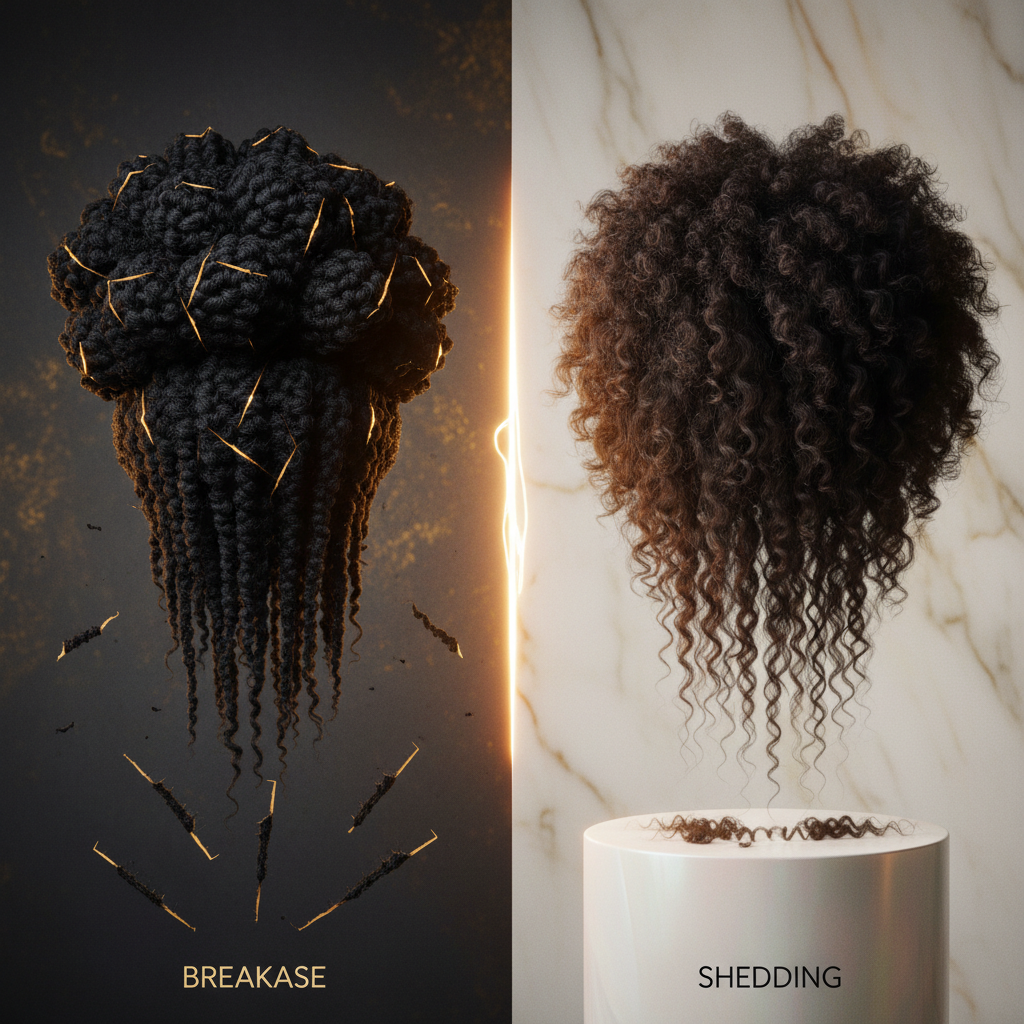
Quick answer: Understanding Afro Hair Breakage vs Shedding comes down to examining the root of the strand. Shedding is a natural physiological process where a full-length hair reaches the end of its telogen cycle and detaches from the follicle, complete with a tiny white bulb. Breakage occurs when structural weakness causes the hair shaft to fracture into shorter pieces along its length, leaving no bulb. The main limitation is that severe breakage can mimic shedding volume, masking acute mechanical or chemical damage.
Key takeaways
- Shedding is driven by the internal hair growth cycle and produces strands of full length with a distinct white keratin bulb attached.
- Breakage is caused by mechanical, chemical, or thermal trauma fracturing the hair shaft, leaving shorter fragments without a bulb.
- Normal shedding averages 50 to 100 hairs daily, whereas breakage has no baseline and indicates structural vulnerability.
- Afro-textured hair possesses unique elliptical geometry with natural torsion points, making it inherently more susceptible to breakage than straight or wavy hair types.
- Protective handling, adequate moisture retention, and gentle detangling can halt breakage, but true excessive shedding requires internal medical or follicular assessment.
Afro Hair Breakage vs Shedding: what the evidence shows
The distinction in Afro Hair Breakage vs Shedding centres on the biological difference between follicular turnover and fibre fatigue. Published trichological literature consistently establishes that shedding (telogen release) is an involuntary, biological phase of the hair growth cycle. The follicle transitions from anagen (growth) through catagen (regression) to telogen (rest), culminating in exogen, where the mature hair strand detaches.
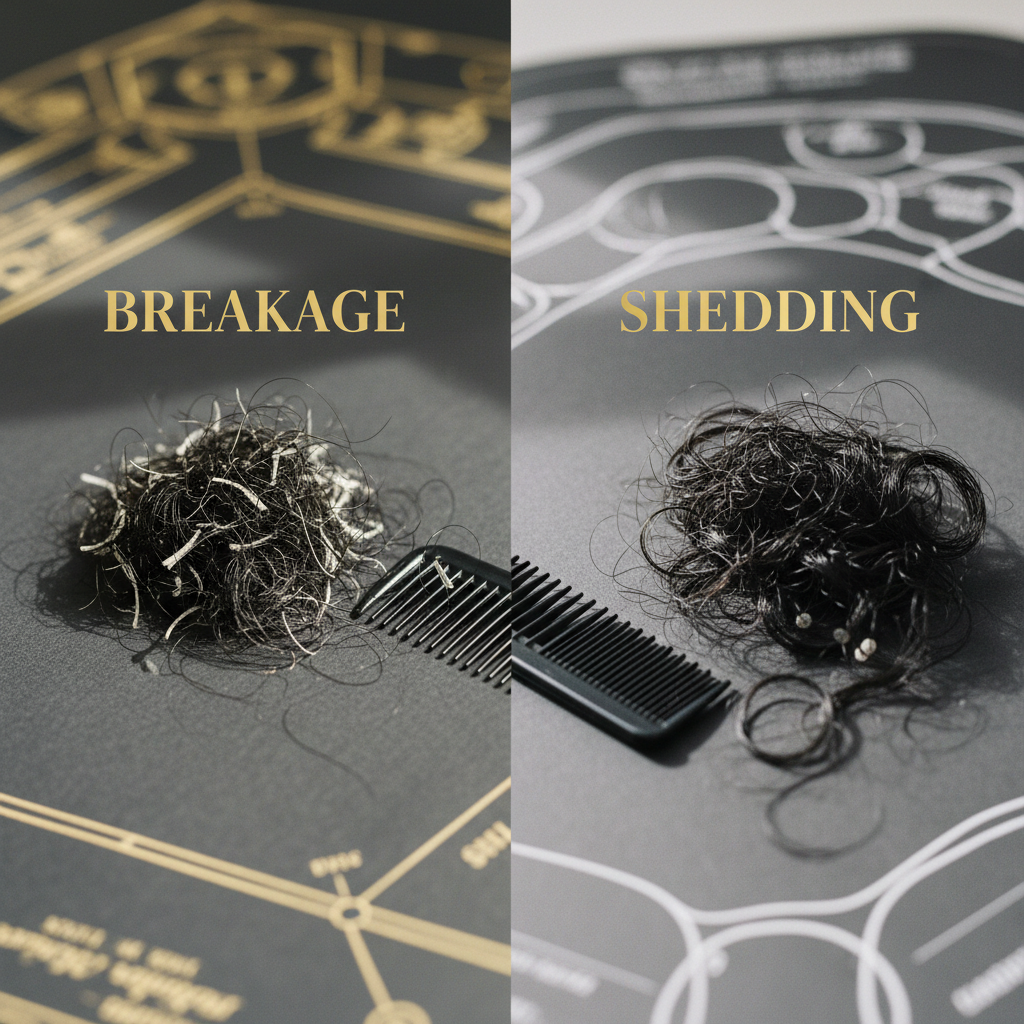
In contrast, hair breakage is an external physical failure. The structural integrity of Afro-textured (Type 4) hair makes it distinct from European or Asian hair types. Electron microscopy studies show that Afro hair fibres have an asymmetrical, highly elliptical cross-section. Along the tightly coiled spiral of the strand, diameter varies unevenly. These twists create built-in stress concentration points, also known as torsion nodes. When mechanical tension (such as combing, brushing, or tight styling) is applied, stress concentrates at these points rather than dispersing along the shaft, leading to premature fracture.
| Feature | Hair Shedding (Telogen Exogen) | Hair Breakage (Fibre Fracture) |
|---|---|---|
| Origin point | Follicle opening at the scalp | Along the hair shaft |
| Visible bulb | Yes, a tiny white or translucent keratin bulb | No bulb; ends appear snapped, frayed, or split |
| Strand length | Full, natural length of the grown strand | Varied lengths, typically short fragments |
| Daily baseline | 50 to 100 strands per day | 0 strands (breakage is never biologically required) |
| Primary driver | Hormonal shifts, internal health, natural hair cycle | Dryness, mechanical manipulation, chemical services |
| Response to topical care | Minimal direct impact on telogen timing | Substantial reduction via conditioning and lubrication |
The biomechanics of Afro hair breakage
Afro hair fibres produce sebum like any other hair type, but the tight curvature of the coils impedes the migration of natural lipids from the scalp down the length of the shaft. Consequently, the mid-lengths and ends suffer from persistent lipid depletion.
Lipids act as a natural hydrophobic barrier that prevents cuticle lifting and protects the internal protein core, the cortex. When the cuticle scales lift or wear away through friction, the cortex is exposed. Afro hair contains lower overall tensile strength under dry conditions compared to straight fibres because moisture levels significantly alter fibre flexibility. When dried out, hair loses elasticity. If combed under dry conditions, the fibre snaps cleanly at a torsion point, a process classified clinically as trichorrhexis nodosa.
Chemical processing, such as permanent relaxers, bleaching, or oxidative colour, strips the protein matrix by cleaving disulphide bonds. When these bonds break down, the cortex softens permanently. Without adequate tensile strength, everyday friction against cotton pillowcases, clothing collars, and combs causes rapid mechanical fracture.
Identifying the signs: the white bulb test
The most reliable clinical diagnostic test between shedding and breakage remains the white bulb test.
- Collect the loose strands found in your comb, brush, or shower drain.
- Place the strands against a contrasting dark surface or hold them up to natural light.
- Inspect both ends of each strand closely.
- If you see a small, firm, translucent or white bead at one tip, you are holding a shed hair. That bead is the keratinised telogen root sheath.
- If both ends are blunt, tapered, feathered, or split, and the strand is shorter than your typical hair length, you are observing hair breakage.
A routine stretch test can also indicate whether breakage is imminent. Gently stretch a wet, single strand of hair. Healthy hair can stretch up to 30 percent of its resting length and return to normal without snapping. Hair that snaps instantly with little to no stretch suffers from protein brittleness or severe dehydration.
Practical strategies to prevent breakage
Halting breakage requires modifying your handling routine to protect vulnerable torsion points.
- Detangle exclusively on wet, lubricated hair: Never detangle dry Afro-textured hair. Apply a slippery leave-in conditioner or water-based product to reduce friction coefficients between individual strands.
- Adopt wide-tooth implements or finger-detangling: Work upwards from the tips to the roots in small, manageable sections. Fine-tooth combs snag on tight curl patterns, causing instant shear fractures.
- Maintain moisture-protein balance: Hydrolysed vegetable proteins or amino acid complexes temporarily patch cuticular gaps, while plant oils (such as jojoba, argan, or shea butter) seal in hydration, keeping fibres pliant.
- Optimise protective styling: Styles like twists, braids, and tuck-and-pin updos protect the ends from atmospheric friction. However, styles installed with excessive tension can cause traction-induced breakage or traction alopecia.
- Sleep on low-friction fabrics: Cotton absorbs moisture and generates friction against cuticles. Silk or satin pillowcases and bonnets maintain fibre hydration and eliminate nighttime mechanical abrasion.
For those caring for tight curls, dedicated conditioning ranges like Frojus provide curl-specific slip, moisture, and cuticle protection formulated precisely for coils prone to snapping.
When shedding turns into excessive loss
While shedding 50 to 100 strands a day is normal, certain physiological triggers can prematurely force large numbers of anagen hairs into the telogen phase. This condition, known as telogen effluvium, becomes noticeable roughly two to three months after a physiological shock. Common triggers include:
- Sudden hormonal changes (such as postpartum recovery or stopping oral contraceptives).
- Nutritional deficiencies (notably low serum ferritin, iron, zinc, or vitamin D).
- High psychological stress or physical illness involving high fevers.
- Rapid, severe weight loss or restrictive dieting.
- Thyroid dysfunction (both hypothyroidism and hyperthyroidism).
In telogen effluvium, you will see high volumes of shed hairs displaying intact white bulbs across the scalp, often leading to diffuse thinning rather than localised bald patches.
When to seek professional advice
Distinguishing between shedding and breakage can usually be done at home, but certain symptoms require professional evaluation by a registered trichologist or a consultant dermatologist. Seek formal assessment if you notice:
- Localised patches of absolute hairlessness, particularly around the hairline, temples, or crown.
- Scalp irritation, erythema, scaling, pustules, or persistent itching accompanying the loss.
- High shedding rates (hundreds of full-length hairs daily) lasting longer than three months.
- Thinning along the temples or hairline where tension styles have been worn, which may indicate early traction alopecia.
- Sudden, unexplained texture changes where hair becomes coarse, unruly, or won't grow past a specific length despite gentle handling.
If thinning is follicular, medical treatments or blood panels may be necessary to correct the root cause.
A focused scalp approach: Watermans GrowMe
When managing shedding related to the scalp environment alongside general hair maintenance, keeping follicles clear and nourished is critical. The Watermans GrowMe formula provides a targeted, topical cosmetic blend designed to maintain optimal scalp conditions. Enriched with caffeine, biotin, argan oil, rosemary extract, and niacinamide, it helps invigorate the scalp surface, clears sebum accumulation, and improves the appearance of hair density. While it does not alter the underlying genetics of androgenetic alopecia or repair snapped fibres, regular use fosters a cleaner, well-supported scalp environment that helps healthy hair grow to its full potential.
Frequently asked questions about Afro Hair Breakage vs Shedding
How can I tell if my Afro hair is breaking or shedding?
Inspect the ends of loose strands under good lighting. In Afro Hair Breakage vs Shedding, the key indicator is the root bulb. Shed hair has a distinct, small white or clear bulb on one end and represents the full length of your hair. Broken hair is usually shorter, uneven, and lacks a bulb, showing blunt or split ends where the shaft fractured.
Is it normal to see broken hairs every wash day?
A small number of snapped fragments is common due to the mechanical friction of washing and detangling, but widespread breakage is not normal. While daily shedding of 50 to 100 strands with bulbs is expected biological turnover, broken hair fragments indicate cuticle damage, severe dryness, or aggressive detangling that requires a gentler moisture routine.
Can tight protective styles cause both breakage and shedding?
Yes. Tight braiding or weaving creates prolonged physical tension on the shaft and the follicle. Along the shaft, the friction and tight bends snap the hair, leading to severe breakage. At the follicular level, excessive tension forces hairs out of the follicle prematurely or damages the root entirely, a condition that can progress from acute shedding to permanent traction alopecia.
How much shedding is normal for Afro hair after taking down braids?
If your hair has been in braids for four to six weeks, you can expect to see several hundred shed hairs during the take-down process. Because hair sheds 50 to 100 strands daily, hair shed inside a protective style is trapped within the braids rather than falling away. This sudden accumulation is normal shedding, provided the strands contain white bulbs and are not broken fragments.
Does moisture stop hair shedding?
No. Moisture prevents breakage, not biological shedding. Applying conditioners, butters, and leave-in products improves fibre elasticity and prevents the hair shaft from snapping under stress. However, physiological shedding is regulated internally by follicular biology, genetics, and hormones, which topical hydrators cannot alter.
Choosing the right care for your hair
Evaluating Afro Hair Breakage vs Shedding gives you the clarity needed to address your hair concerns correctly. Treat breakage externally: reduce heat and chemical exposure, detangle carefully with plenty of slip, protect your ends, and use moisturising routines tailored to tightly coiled structures. Treat excessive shedding internally: examine nutritional markers, monitor systemic health changes, and consult a medical professional if heavy shedding persists. By responding to what your strands are truly telling you, you can protect your length and maintain a healthy, balanced scalp.
Sources and references
- British Journal of Dermatology, "Morphological and structural characteristics of Afro-ethnic hair," 2007.
- Journal of the American Academy of Dermatology, "Structural differences in hair types and their clinical significance," 2012.
- International Journal of Cosmetic Science, "The mechanical properties of curly hair and breakage under tensile stress," 2009.
- NHS, "Hair loss (alopecia) causes and diagnostics," 2023.
- Journal of Investigative Dermatology, "The hair growth cycle and mechanisms of telogen release," 2018.
Find these ingredients in Watermans products
- Biotin: you will find this ingredient in our Hair Growth Shampoo.
- Zinc: you will find this ingredient in our Hair Vitamins.
- Niacinamide: you will find this ingredient in our Hair Mask.
- Shea Butter: you will find this ingredient in our Curly Hair Conditioner.