Afro Hair Breakage and Care: The Biomechanical Reference Guide
8 min read ·
Understand the science behind Afro Hair Breakage and Care, covering fibre geometry, moisture balance, friction reduction, and proven strategies to retain length.
Quick answer: Afro Hair Breakage and Care centres on understanding the unique elliptical geometry and curl architecture of tightly coiled fibres. Afro-textured hair has natural points of structural weakness along the shaft where coils twist, making it particularly vulnerable to mechanical snapping, moisture depletion, and chemical damage. Proper care requires preserving fibre elasticity through moisture-protein balance, lubricating protective styling, and low-friction detangling. Cosmetic products strengthen hair and reduce breakage, but they cannot alter underlying follicular growth patterns or reverse irreversible split ends.
Key takeaways
- Afro-textured hair fibres have an elliptical cross-section and irregular diameter, creating natural stress points along the twists where breakage commonly occurs.
- Breakage is the structural fracture of the hair shaft; it is fundamentally distinct from shedding, where whole strands release naturally from the follicle with an intact bulb.
- High lipid depletion, lower natural moisture retention, and high friction from handling accelerate fibre failure.
- Low-manipulation styling, pH-balanced conditioning (pH 4.5 to 5.5), and emollient lubricants significantly reduce mechanical stress during grooming.
- Water-in-oil emulsions, penetrating plant oils, and hydrolysed proteins help support tensile strength, though split ends must ultimately be trimmed.
Afro Hair Breakage and Care: what the evidence shows
Research into hair biomechanics shows that Afro-textured hair produces the same amount of sebum at the scalp as other hair types, but the tight coils and twists impede the natural distribution of sebum along the fibre. Studies published in the International Journal of Dermatology and the Journal of Cosmetic Science demonstrate that Afro hair has an asymmetrical, elliptical cross-section with uneven cuticle distribution. The cuticle layer is typically thinner at the outer bends of the coils, leaving the underlying cortex exposed to environmental and physical trauma.
Tensile testing consistently reveals that coiled fibres fail at lower mechanical force thresholds than straight or wavy fibres. This is not due to inferior keratin quality, but rather because mechanical force concentrates at the tightest curves along the shaft instead of distributing evenly down a straight cylinder.
The evidence confirms that Afro Hair Breakage and Care requires targeted lubrication and tensile support. Cosmetic formulations that deposit conditioning agents, such as cationic surfactants and hydrolysed proteins, reduce inter-fibre friction and temporarily increase the force required to snap the strand.
What the evidence does not show
Controlled research does not support the idea that tight coils are inherently unhealthy or naturally stunted in growth. Afro hair grows at an average rate of roughly 0.9 to 1.0 centimetres per month, compared to 1.2 centimetres for European hair and 1.3 centimetres for Asian hair. When individuals experience an apparent lack of growth, the underlying issue is almost always mechanical breakage matching or exceeding the rate of follicular output, not a failure of the follicle itself.
Furthermore, no topical cosmetic oil, butter, or cream can mend a fractured cortex permanently. While products can smooth the cuticle and temporarily glue split ends together using polymer films, the structural integrity of a severed fibre cannot be biologically regenerated. Trimming remains the only permanent resolution for severe split ends (trichoptilosis).
The mechanism: why afro-textured fibres snap
To understand how breakage happens, you have to look at both the internal structure and external handling of the hair fibre:
Structural stress points
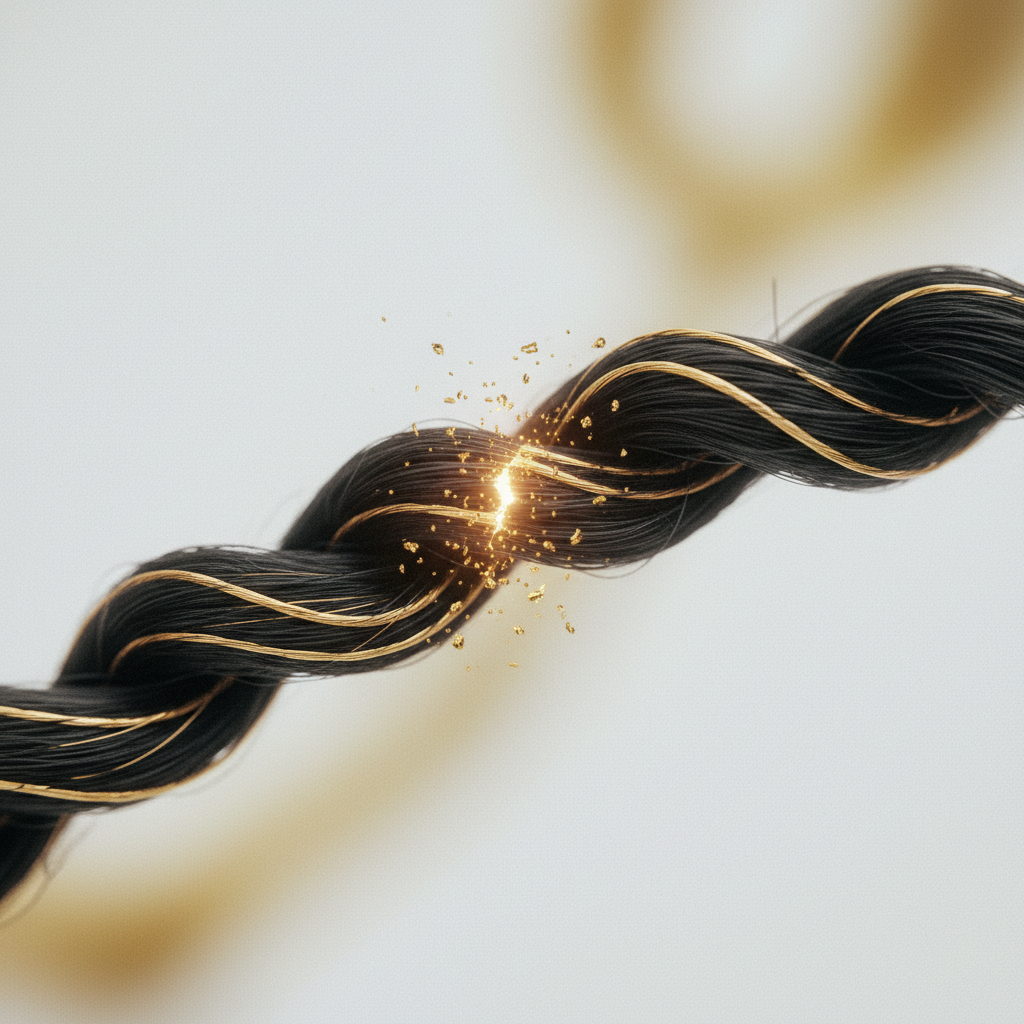
Every twist, turn, and crimp along an afro-textured strand represents a natural mechanical stress point. When you stretch a curly hair fibre, tensile stress concentrates disproportionately at these outer bends. Straight fibres distribute load uniformly, but coiled fibres experience shear forces across their narrowest diameters, causing micro-fractures in the cuticle and cortex.
Cuticle wear and porosity
The cuticle scale layers on afro hair are often thinner or less organised around sharp curvatures. Frequent combing lifts and chips these scales, exposing the inner cortex. Once the cortex loses its protective outer sheath, internal moisture escapes rapidly, the hair becomes highly porous, and the keratin protein chains degrade.
Friction and knotting
Tightly coiled fibres naturally wrap around neighbouring strands, forming inter-fibre friction and single-strand knots (trichonodosis). Combing through these knots creates sudden tension spikes that exceed the fibre's tensile strength, snapping the shaft mid-length or shattering the tip.
Signs to look for: breakage vs shedding
Telling the difference between breakage and natural shedding is vital for choosing the right care plan.
| Feature | Hair Shedding (Telogen Phase) | Hair Breakage (Fibre Fracture) |
|---|---|---|
| Strand Length | Full length of your hair | Short, uneven, fragmented pieces |
| Root Bulb | White, tiny keratin bulb present at the tip | No bulb present; ends are blunt, frayed, or split |
| Location Found | In the shower drain, comb, or brush evenly | Scattered on clothing, bathroom counters, or pillows |
| Underlying Cause | Natural hair cycle or systemic shift (telogen effluvium) | Mechanical friction, dryness, heat, or chemical trauma |
| Primary Intervention | Internal health assessment, dermatology consultation | Moisture-protein balance, protective handling, trims |
Practical care strategies to minimise breakage
Managing afro hair successfully depends on maintaining high moisture levels, minimising physical friction, and supporting protein integrity.
1. Hydrate and seal strategically
Water is the ultimate hydrator, but water evaporates rapidly from high-porosity coils. Use a layered method: apply a water-based leave-in conditioner first to hydrate the cortex, follow with a fatty acid-rich cream, and finish with a light sealing oil to slow moisture loss. Products formulated around pH 4.5 to 5.5 keep the cuticle scales lying flat and compact.
2. Detangle only when wet and lubricated
Never detangle afro-textured hair while dry. Dry combing generates severe friction that easily fractures brittle strands. Saturate hair with water and a high-slip conditioner before using your fingers or a wide-toothed comb, working patiently from the ends upward toward the roots.
3. Balance moisture with protein
If hair feels mushy, limp, or overly stretchy when wet, it likely needs hydrolysed protein to patch porous gaps in the cortex. If hair feels stiff, brittle, and snaps like dry twigs, it is overloaded with protein or lacking water and needs rich emollient conditioning.
4. Reduce daily manipulation
Protective and low-manipulation styles (such as two-strand twists, loose braids, or buns) tuck delicate ends away from clothing friction and atmospheric dryness. Ensure protective styles are never installed with tight tension on the scalp, which can trigger traction alopecia.
5. Protect fibres overnight
Cotton pillowcases absorb natural oils and snag delicate cuticles. Sleep on a silk or satin pillowcase, or wrap your hair in a satin bonnet, to eliminate overnight surface friction.
When the cause may be something else
If you notice wide patches of scalp showing, diffuse thinning across the crown, or smooth bald spots, you are not dealing with simple shaft breakage. Conditions such as traction alopecia, central centrifugal cicatricial alopecia (CCCA), androgenetic alopecia, or telogen effluvium originate at the hair follicle. These conditions require medical diagnosis rather than cosmetic conditioning.
When to get professional advice
Consult a registered trichologist or a consultant dermatologist if:
- You see red, tender, flaking, or scarred areas on the scalp.
- Shedding exceeds 100 to 150 full-length strands a day for more than six weeks.
- Hair breaks off within millimetres of the scalp across large sections.
- You notice progressive recession around the hairline or temples.
Supporting your routine with Watermans and Frojus
When curating an intentional routine for curly and coiled hair textures, dedicated products can support fibre resilience and scalp balance. Watermans offers nutrient-rich scalp formulas that promote an optimal follicular environment, supporting stronger-feeling hair from the root.
For textured coils seeking tailored moisture, products from Frojus are designed specifically to respect afro, curly, and wavy hair patterns. By delivering balanced slip, targeted emollients, and essential hydration, these formulations help mitigate the mechanical stress that drives daily breakage.
Frequently asked questions about Afro Hair Breakage and Care
Why does afro hair break more easily than straight hair?
Afro hair breaks more easily because of its tightly coiled, elliptical structure. Each bend and twist represents a point of mechanical stress where force concentrates during brushing or styling. In addition, the cuticle is naturally thinner at these turns, leaving the cortex more exposed to environmental dryness and everyday physical friction.
How often should I wash afro hair to prevent breakage?
Most people with afro-textured hair benefit from washing every 7 to 10 days. Washing too frequently can strip natural lipids and induce hygral fatigue (the weakening of the fibre from repeated swelling and drying), while waiting too long allows product build-up to block hydration and irritate the scalp.
Can deep conditioners repair already broken hair?
Deep conditioners cannot mend a completely broken or split strand permanently. They contain conditioning agents, fatty alcohols, and proteins that temporarily fill in cuticle cracks, smooth the fibre surface, and improve elasticity. This prevents further unraveling, but severely split ends must be trimmed to stop fractures traveling up the shaft.
How does Afro Hair Breakage and Care differ between relaxed and natural hair?
Relaxed hair has had roughly 30% of its internal disulphide bonds permanently broken by chemical processing, making it significantly weaker and more brittle than natural hair. While natural hair primarily requires intense moisture and knot-management, chemically relaxed hair requires higher structural protein support alongside emollient lubrication to avoid catastrophic snapping at the line of demarcation.
Do protective styles completely stop hair breakage?
Protective styles reduce daily mechanical handling, which helps prevent breakage, but they do not eliminate it entirely. If braids or twists are installed too tightly, left in longer than 6 to 8 weeks, or taken down roughly without lubrication, they can cause substantial fibre breakage and follicular stress.
Concluding thoughts on Afro Hair Breakage and Care
Mastering Afro Hair Breakage and Care is a matter of biomechanics rather than good luck. By respecting the natural geometry of tightly coiled strands, providing continuous moisture, and minimising harsh mechanical friction, you give your hair fibres the resilience they need to flourish. Keep manipulation gentle, listen to the protein-moisture balance of your strands, and treat every coil as the delicate, intricate structure that it is.
Sources and references
- British Association of Dermatologists. "Hair Loss and Hair Care Guidelines." bad.org.uk, 2021.
- Franbourg, A., et al. "Current research on ethnic hair." Journal of the American Academy of Dermatology, 2003. DOI: 10.1067/mjd.2003.277.
- Kamath, Y. K., et al. "Mechanical and surface properties of African-American hair." Journal of Cosmetic Science, 2008.
- Khumalo, N. P., et al. "African hair length in a diverse Caucasian population: the role of grooming frequency." Journal of the American Academy of Dermatology, 2007. DOI: 10.1016/j.jaad.2006.09.006.
- Robbins, C. R. Chemical and Physical Behavior of Human Hair. 5th ed., Springer, 2012.