How to Treat Scalp Buildup: Causes, Solutions, and Clinical Advice
7 min read ·
Discover how to treat scalp buildup safely and effectively. Learn the scientific causes, proper clarifying methods, and how to tell residue apart from dandruff.
Quick answer: Learning how to treat scalp buildup requires identifying whether the accumulation stems from cosmetic product residue, dead skin cells, or excess sebum. Effective management combines targeted surfactant cleansing, gentle chemical exfoliation such as salicylic acid, and mechanical scalp massage. The main limitation is that cosmetic cleansing cannot cure underlying medical dermatoses like seborrhoeic dermatitis or psoriasis, which require medical assessment and pharmacological treatment rather than simple clarifying washes.
Understanding how to treat scalp buildup is essential for maintaining both follicular hygiene and fibre health. Left unchecked, accumulation can create an occlusive barrier across the epidermal surface, trapping microorganisms, dulling hair shine, and triggering low-grade inflammatory responses.
Key takeaways
- Scalp buildup is primarily a composite of sebum, shedding corneocytes, environmental pollutants, and cosmetic residues (such as silicones, polymers, and heavy waxes).
- Cleansing frequency and surfactant choice must align with sebum production rates and styling habits; co-washing alone often accelerates residue accumulation.
- Chemical exfoliants, notably beta-hydroxy acids like salicylic acid, penetrate lipophilic environments more effectively than physical scrubs.
- True cosmetic buildup must be distinguished from chronic inflammatory skin conditions such as seborrhoeic dermatitis and scalp psoriasis.
- Physical scraping of the scalp with fingernails or aggressive tools risks micro-tears, secondary bacterial infection, and traction damage to hair fibres.
How to treat scalp buildup: what the evidence shows
When dermatologists evaluate how to treat scalp buildup, the clinical strategy focuses on emulsifying lipophilic debris without compromising the skin barrier. The stratum corneum naturally sheds dead cells (corneocytes) continuously through desquamation. However, when sebum output is elevated or when leave-in polymers accumulate, these dead cells adhere together instead of shedding invisibly.
Peer-reviewed studies indicate that surfactant selection plays a critical role. Anionic surfactants (such as sodium laureth sulfate or ammonium laureth sulfate) possess high detergency and negative charges that bind to dirt and grease, suspending them in water to be rinsed away. When individuals rely exclusively on gentle, non-ionic surfactants or conditioning washes ("co-washes"), cationic agents such as polyquaterniums can gradually accumulate on both the hair shaft and the perivascular follicular openings.
Clarifying shampoos formulated at an optimal physiological pH (between 4.5 and 5.5) effectively strip these deposits. Research demonstrates that maintaining an acidic pH prevents excessive swelling of the hair cuticle and preserves the acid mantle of the scalp, keeping microbial populations such as Malassezia yeasts within normal physiological parameters.
The mechanism of scalp accumulation
Scalp buildup is rarely a single substance. It is typically a matrix formed by three primary contributors:
- Endogenous lipids (Sebum): The scalp contains roughly 400 to 900 sebaceous glands per square centimetre. These glands secrete triglycerides, squalene, wax esters, and free fatty acids. When triglycerides oxidize upon contact with air and ultraviolet light, they produce squalene peroxides and malodorous free fatty acids that irritate the skin.
- Corneocyte retention: Normal cell turnover takes approximately 28 days. Excess sebum acts as a biological adhesive, trapping non-shedding corneocytes on the surface.
- Exogenous styling products: Cationic conditioning polymers, water-insoluble silicones (such as dimethicone), synthetic waxes, dry shampoos (often containing aluminium starch octenylsuccinate or talc), and hairsprays settle at the root area.
Over time, this composite creates a persistent film. This film clogs follicular infundibula, potentially leading to follicular occlusion, micro-inflammation, and an environment ripe for fungal proliferation.
Signs of cosmetic buildup vs other scalp conditions
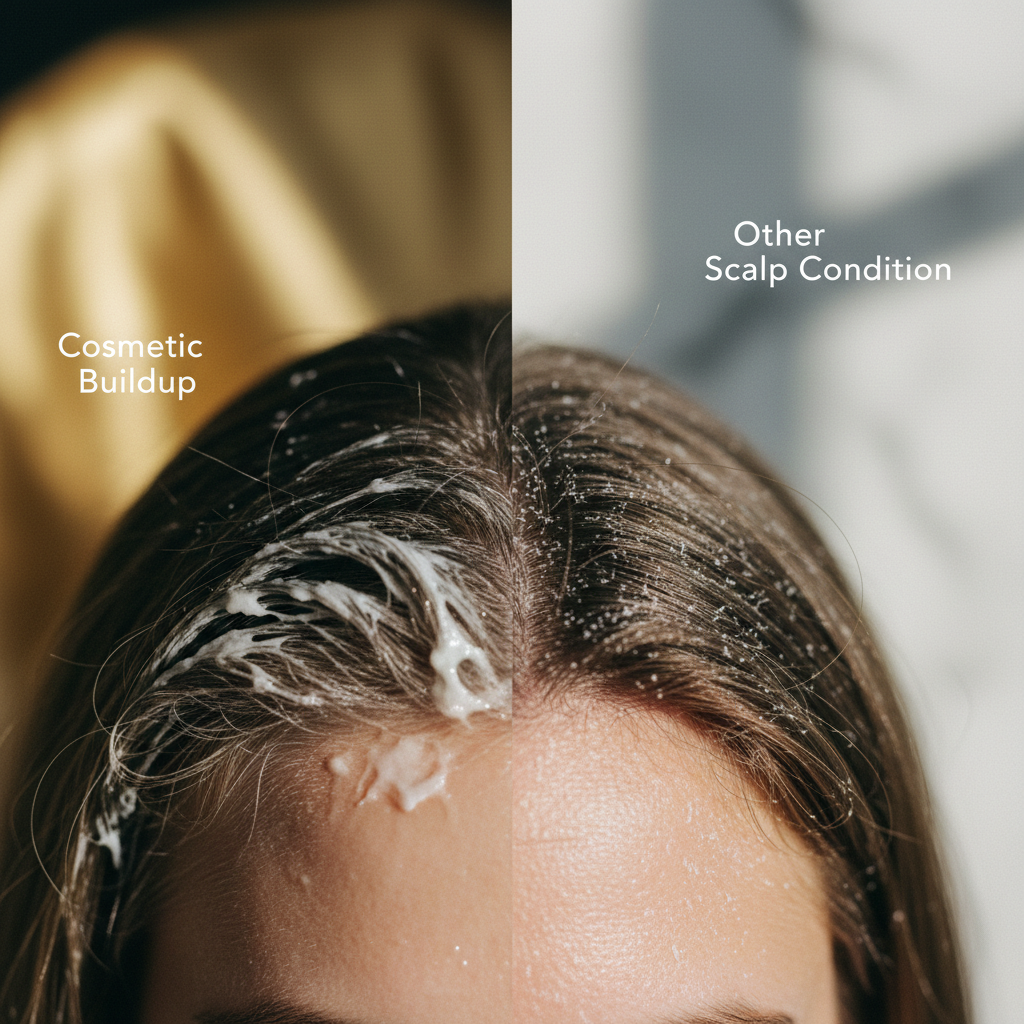
Distinguishing cosmetic residue from inflammatory dermatological conditions ensures you apply the correct protocol.
| Feature | Cosmetic / Sebum Buildup | Seborrhoeic Dermatitis | Scalp Psoriasis |
|---|---|---|---|
| Primary Cause | Styling residues, sebum, infrequent washing | Inflammatory reaction to Malassezia metabolites | Autoimmune hyperproliferation of keratinocytes |
| Appearance | Greasy film, off-white powdery or sticky residue | Greasy, yellowish flakes adhering to red patches | Well-demarcated, thick, silvery-white plaques |
| Itch Level | Mild to moderate, often relieved immediately by washing | Moderate to severe, chronic | Moderate to intense, burning sensation common |
| Location | Uniform across hair-bearing areas | Scalp margin, nasolabial folds, behind ears | Scalp, elbows, knees, lower back |
| Response to Clarifying | Clears rapidly after 1 to 2 washes | Temporary reduction; recurs without antifungal actives | Poor; clarifying alone can aggravate dryness |
Practical steps: what you can do to clear buildup
A systematic approach resolves cosmetic buildup while protecting the hair shaft:
- Incorporate a clarifying wash: Use a dedicated clarifying shampoo once weekly or fortnightly depending on product use. Look for formulations containing chelating agents (such as tetrasodium EDTA) if you live in a hard-water area, as dissolved minerals bind with sebum to form stubborn soap curds.
- Apply targeted chemical exfoliants: Formulations containing 0.5% to 2% salicylic acid are lipid-soluble. This allows the acid to penetrate sebum-filled follicles, dissolving the intercellular cement binding dead cells.
- Adopt the double-cleanse method: The first wash breaks surface oils and cosmetic polymers; the second wash cleanses the scalp epidermis directly. Ensure you massage the cleanser with the pads of your fingers for at least 60 seconds.
- Limit dry shampoo reliance: Starch-based dry shampoos absorb oil cosmetically but do not remove it. Layering powder upon sebum creates an ideal substrate for bacterial and fungal growth. Limit dry shampoo to emergency touch-ups between wet washes.
- Rinse thoroughly: Dedicate at least two full minutes to rinsing cleansing agents and conditioners. Residue from thick, conditioning masks left near the scalp is a frequent source of non-biological buildup.
What the evidence does not show
There is no credible scientific evidence that physical scalp scrubs with large, jagged particles (such as crushed walnut shells or coarse sea salt) offer superior cleansing compared to properly formulated liquid surfactants. In practice, mechanical abrasion frequently causes micro-fissures in the scalp epidermis, dislodges telogen-phase hairs prematurely, and abrades the cuticle scales of adjacent hair fibres.
Furthermore, evidence does not show that natural oils (such as coconut or olive oil) "dissolve" scalp buildup effectively in human subjects. While lipids can soften sebum plugs, applying heavy vegetable oils feeds lipophilic yeasts like Malassezia furfur, frequently worsening scalp irritation and flaking.
The Watermans approach to follicular hygiene
Watermans approaches scalp care from the perspective of root wellness and hair density. A clean, unobstructed follicular environment is foundational for natural hair vitality. Formulations like Watermans GrowMe Shampoo incorporate mild, effective surfactants balanced with botanical extracts, rosemary, caffeine, and biotin. This design helps clarify surface debris and environmental grime while preserving vital barrier moisture, leaving the scalp refreshed and primed for optimal growth cycles.
When to seek professional advice
Consult a GP, dermatologist, or qualified trichologist if:
- The scalp displays marked erythema (redness), weeping, crusting, or bleeding.
- Scaling extends beyond the hairline to the eyebrows, ears, or chest.
- The sensation of burning or itching disrupts sleep or daily tasks.
- Shedding increases significantly or patchy hair loss becomes noticeable.
- Standard clarifying and over-the-counter anti-dandruff shampoos yield zero improvement after three consecutive weeks of use.
Frequently asked questions about How to Treat Scalp Buildup
Can baking soda be used for how to treat scalp buildup?
No, using baking soda is not recommended. Baking soda has an alkaline pH of roughly 8.3 to 9.0, which disrupts the scalp's natural acid mantle (pH 4.5 to 5.5). This alkaline shift swells and frays the hair cuticle, strips essential lipids, and leaves the scalp vulnerable to bacterial colonization and irritation.
Does scalp buildup directly cause permanent hair loss?
Cosmetic buildup does not cause permanent follicular miniaturisation (androgenetic alopecia). However, chronic neglect leading to severe follicular inflammation can cause telogen effluvium (diffuse shedding) or secondary folliculitis. Keeping follicles clean ensures unhindered fibre emergence and long-term scalp health.
How often should you clarify to manage buildup?
For individuals with oily scalps or those who use daily silicone-based styling products, clarifying once every 7 to 10 days is ideal. If you have dry, coarse, or chemically processed hair, clarifying once every two to three weeks is generally sufficient to avoid drying the lengths.
Will apple cider vinegar clear heavy scalp buildup?
Diluted apple cider vinegar (pH 2.8 to 3.2) can help lower hair porosity, smooth cuticles, and dissolve mild mineral deposits from hard water. However, it lacks the micellar surfactants needed to emulsify heavy waxes, synthetic polymers, and concentrated sebum deposits.
Closing thoughts on how to treat scalp buildup
Mastering how to treat scalp buildup is a matter of consistent, biologically sound hygiene rather than harsh scrubbing. By using properly formulated surfactants, integrating gentle chemical exfoliants when necessary, and respecting the delicate scalp barrier, you create the optimal environment for strong, healthy-looking hair. Maintain a steady routine, listen to your skin's barrier needs, and seek clinical advice whenever flaking is paired with inflammation.
Sources and references
- American Academy of Dermatology Association. "Dandruff: How to treat." aad.org.
- Borda, L. J., & Wikramanayake, T. C. (2015). "Seborrheic Dermatitis and Dandruff: A Comprehensive Review." Journal of Clinical and Investigative Dermatology, 3(2), 10.
- D'Souza, P., & Rathi, S. K. (2015). "Shampoo and Conditioners: What a Dermatologist Should Know?" Indian Journal of Dermatology, 60(3), 248-254.
- Gavazzoni Dias, M. F. (2015). "Hair cosmetics: An overview." International Journal of Trichology, 7(1), 2-15.
- Trüeb, R. M. (2018). "The Impact of Oxidative Stress on Hair." International Journal of Cosmetic Science, 37(S2), 25-30.