Traction Alopecia vs Breakage: Key Differences and Care
10 min read ·
Understand the difference between Traction Alopecia vs Breakage, from root damage and fibre snapping to clinical signs, prevention, and treatment options.

Quick answer: The core distinction in Traction Alopecia vs Breakage comes down to anatomy: traction alopecia is true hair loss caused by mechanical tension damaging the root follicle beneath the scalp, whereas hair breakage is structural fibre snapping along the exposed hair shaft. Traction alopecia can cause permanent follicular scarring if sustained tension continues over years, while breakage leaves the follicle entirely intact. Both conditions often share styling triggers like tight braids or extensions, but their clinical signs and recovery pathways are completely different.
Key takeaways
- Traction alopecia occurs at the root and involves follicular strain, perifollicular erythema, and potential follicle destruction.
- Hair breakage involves physical failure of the keratin fibre along the shaft, leaving the underlying follicle healthy and active.
- A white bulb at the end of a shed strand indicates the fibre left the follicle naturally or under tension; a broken strand lacks this bulb and features frayed, blunt, or split ends.
- The "fringe sign" (retained fine vellus hairs along the frontal hairline) is a diagnostic hallmark of early traction alopecia.
- Early-stage traction alopecia is reversible by removing mechanical tension, but late-stage scarring alopecia causes irreversible hair loss.
- Cosmetic hair products cannot regrow scarred follicles, but conditioning treatments can significantly reduce mechanical shaft breakage.
Traction Alopecia vs Breakage: what the evidence shows
Understanding Traction Alopecia vs Breakage requires separating root pathology from fibre mechanics. Dermatological research published in journals such as the British Journal of Dermatology and the Journal of the American Academy of Dermatology defines traction alopecia as an acquired form of alopecia resulting from prolonged or repetitive mechanical tension on the hair follicle. It is most commonly associated with hairstyles that pull the hair tightly, including high ponytails, tight braids, weaves, dreadlocks, and heavy extensions.
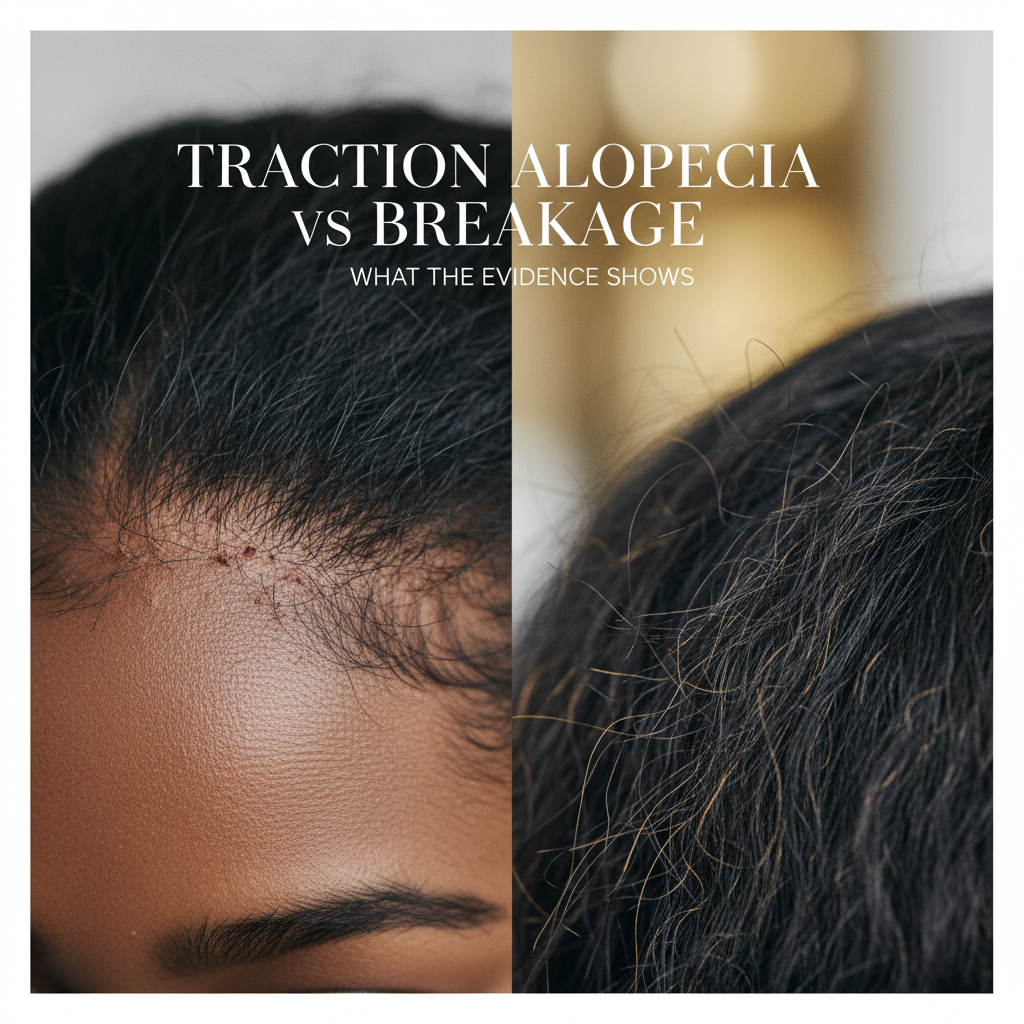
When tension pulls on the hair shaft continuously, it transmits mechanical force down to the follicular unit. In its early stages, this mechanical irritation produces perifollicular erythema (redness around the pores), folliculitis (small pustules or bumps), and scalp tenderness. If the tension continues over months or years, the repetitive trauma triggers subclinical inflammation, weakens follicular anchorage, and eventually leads to follicular miniaturisation and irreversible fibrotic scarring. Once the follicle undergoes fibrotic replacement, it can no longer produce a terminal hair.
Hair breakage, by contrast, is not an alopecia at all. It is structural failure of the hair fibre itself, governed by the physics of tensile strength and cuticle integrity. The human hair fibre is composed of a protective outer cuticle surrounding an inner cortex of keratin intermediate filaments. Chemical treatments (bleaching, relaxers, permanent dyes), high heat styling (flat irons operating above 180°C), and environmental degradation strip the lipid layer (18-methyl eicosanoic acid) and chip away cuticle scales. When fragile, dry, or chemically processed hair is subjected to mechanical stress like combing, brushing, or elastic bands, the cortex snaps. The follicle beneath the scalp remains completely undamaged and continues its natural anagen (growth) cycle uninterrupted.
| Feature | Traction Alopecia | Hair Breakage |
|---|---|---|
| Site of Damage | Hair follicle beneath the scalp | Hair shaft above the scalp surface |
| Primary Mechanism | Sustained tension and mechanical strain on root | Cuticle degradation and fibre tensile failure |
| Visual Appearance | Receding hairline, widening parts, sparse patches | Uneven lengths, split ends, flyaways, frizz |
| Shed Strand Anatomy | Intact strand, often with a visible white root bulb | Short, snapped segments with no bulb |
| Scalp Sensations | Tenderness, stinging, pimples, bumps, itching | Usually none; scalp remains comfortable |
| Reversibility | Fully reversible early; permanent if scarred | Always temporary; new growth emerges continuously |
| Typical Location | Frontotemporal hairline, temples, nape | Crown, nape, ends, or wherever styling friction occurs |
What the evidence does not show
The scientific literature is clear on what cannot cause or cure these two conditions. Clinical evidence does not show that topical cosmetic shampoos, scalp oils, or conditioning masks can revive scarred follicles in late-stage traction alopecia. Once histopathology reveals that fibrous connective tissue has replaced the follicular infundibulum, medical treatments and topicals cannot generate new hair follicles.
Equally, evidence does not support the idea that chemical damage alone causes traction alopecia. A chemical relaxer or bleach damages the fibre shaft, precipitating profound hair breakage, but unless intense physical pulling accompanies the service, it does not induce traction-mediated follicular loss. Finally, controlled dermatological trials do not show that taking generic biotin supplements repairs mechanical breakage or halts traction alopecia unless an underlying clinical deficiency exists, which is exceptionally rare in balanced diets.
The biological mechanisms compared
To understand why these conditions behave differently, one must look at how stress acts on human tissue versus dead keratinised protein.
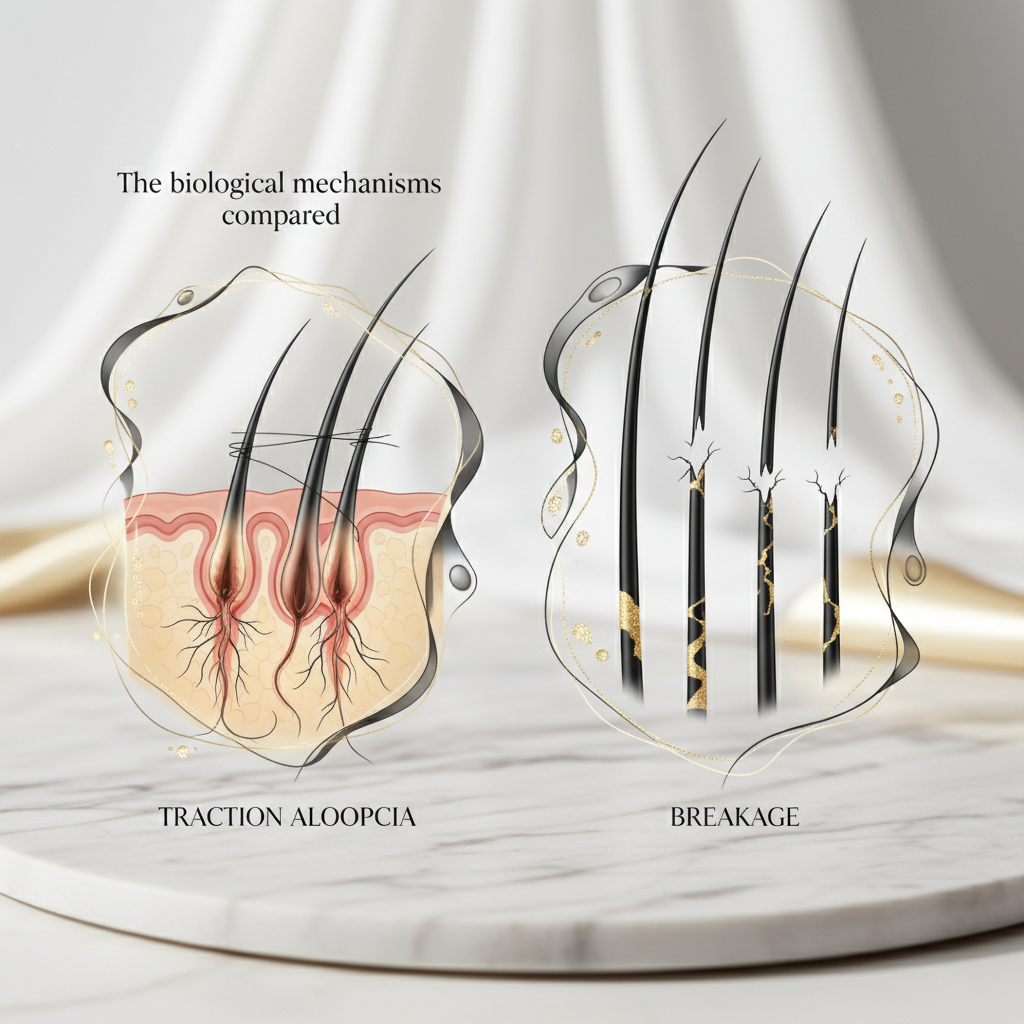
In traction alopecia, mechanical stress pulls the hair bulb away from its blood supply in the dermal papilla. This continuous micro-trauma incites an inflammatory cascade. Mast cells and lymphocytes accumulate around the upper follicle. This ongoing inflammation causes mechanotransductive changes: the outer root sheath cells detach, pushing anagen hairs prematurely into catagen (regression) and telogen (resting) phases. Over time, the follicular stem cell niche in the bulge region is compromised, leading to permanent atrophy.
In hair breakage, the mechanism is purely macromolecular. Virgin hair can withstand significant stretching, extending by roughly 30% of its dry length before breaking. However, repeated heat exposure over 180°C denatures the alpha-keratin helix structure into disordered beta-keratin sheets. Chemical processes like alkaline relaxers (pH 12 to 14) or bleaches break the cystine disulphide bonds that give the cortex its cross-linked rigidity. When the cuticle is stripped, moisture escapes rapidly, fibre porosity climbs, and friction between neighbouring strands surges. Brushing this compromised fibre generates mechanical stress that exceeds its reduced yield point, causing clean transverse fractures (trichoclasis) or longitudinal fraying (trichoptilosis).
Signs to look for: how to tell them apart
A close visual inspection and gentle manual assessment can usually reveal whether you are dealing with traction alopecia or breakage:
- Check the shed hairs: Collect the shed strands on your brush or pillow. Look closely at the ends under bright light. If the strand matches the full length of your hair and has a tiny white bulb (keratinised root sheath) at one end, it was pulled or shed from the root. If the pieces are short, varied in length, and have blunt or frayed ends with no bulb, you are looking at fibre breakage.
- Inspect the frontal hairline: Traction alopecia heavily favours areas experiencing the most directional pull, typically the temples, anterior hairline, and behind the ears. Look for the "fringe sign", a dermatological indicator where a thin band of short, fragile vellus hairs remains intact along the very edge of the hairline while the larger terminal hairs just behind them have been pulled out.
- Assess scalp comfort: If your scalp feels sore, itchy, or tight after styling, or if you notice small red bumps (tenting and folliculitis) around your braids or ponytail base, your follicles are under dangerous traction. Hair breakage produces no scalp sensations.
- Examine hair density versus fibre length: If the scalp is visibly shining through in distinct zones but individual remaining strands are full-length, traction alopecia is likely. If the scalp is evenly covered with dense follicles but the overall canopy looks frizzy, thin at the perimeter, and uneven, fibre breakage is the culprit.
Practical steps to take
Resolving either issue requires targeted intervention matched to the true physical cause.
For traction alopecia:
- Eliminate tension immediately: Loosen all restrictive hairstyles. Switch to low-tension styles like loose buns secured with silk scrunchies, soft twists, or wearing hair down.
- Implement style rotation: Never wear tight styles back to back. Allow the scalp a minimum of two to four weeks of zero-tension recovery between protective styles.
- Weight management: Avoid excessively long or heavy synthetic braiding hair, which exerts continuous gravitational pull on fine perimeter follicles.
- Monitor early symptoms: If a hairstyle causes pain, headache, or pimples, take it down immediately. Pain is an inflammatory signal indicating active follicular strain.
For hair breakage:
- Minimise heat and chemical overlap: Reduce styling tool temperatures to below 180°C and always use a heat protectant. Avoid applying chemical relaxers or permanent bleach over previously processed hair shafts.
- Restore fibre lubrication: Use conditioners rich in fatty alcohols and hydrolysed proteins to lower inter-fibre friction, replenish surface lipids, and smooth raised cuticle scales.
- Gentle detangling: Detangle fragile hair only when damp and saturated with a high-slip conditioner, using a wide-tooth comb or flexible detangling brush working upwards from ends to roots.
- Friction reduction: Sleep on a smooth satin or silk pillowcase to prevent nocturnal friction that snaps weakened fibres.
When the cause may be something else
Thinning and shedding can easily be misdiagnosed. If neither traction nor shaft breakage explains your symptoms, consider other conditions:
- Telogen Effluvium: A generalised, rapid shedding across the entire scalp, typically shedding 100 to 300 hairs daily, usually occurring two to three months after a physiological shock, severe illness, surgical procedure, childbirth, or extreme psychological stress.
- Androgenetic Alopecia: Pattern hair loss driven by genetic sensitivity to dihydrotestosterone (DHT), presenting as gradual miniaturisation at the crown and temple in men, or diffuse widening of the central parting in women, without scalp redness or breakage.
- Alopecia Areata: An autoimmune disorder causing discrete, sharply demarcated, coin-sized smooth patches of hair loss, often exhibiting "exclamation mark" hairs around the borders.
- Trichotillomania: A behavioural impulse control disorder where individuals repeatedly pull out their own hair, resulting in irregular patches of broken hairs at varied lengths without systemic inflammation.
When to seek professional advice
Consult an NHS GP, board-certified dermatologist, or registered trichologist if you notice signs of advanced traction alopecia. Crucial red flags include visible scalp scarring where follicular openings (pores) have disappeared, forming smooth, shiny skin; persistent scalp burning, itching, or tenderness that lasts days after taking down a style; or persistent pustules and crusting along your hairline. A dermatologist can perform a dermoscopic evaluation (trichoscopy) or a 4mm punch biopsy to assess whether follicles remain viable and may prescribe short-term topical corticosteroids to halt active inflammation before permanent scarring occurs.
Supporting hair condition: Watermans
While cosmetic solutions cannot revive scarred follicles in late-stage traction alopecia, maintaining an optimal scalp environment and strengthening surviving hair fibres against mechanical breakage is essential for overall hair health.
Watermans Grow Me Shampoo and Condition Me Conditioner are formulated without harsh sulphates, providing a gentle cleanse that clears excess sebum and surface debris from the scalp without stripping delicate moisture. Packed with biotin, rosemary extract, caffeine, and hydrolysed lupin protein, these formulations help support a healthier-looking, revitalised scalp environment while coating weakened hair fibres to reduce everyday combing friction and breakage. Using a high-performance, strengthening cosmetic routine helps keep existing strands resilient, pliable, and fuller-looking while you practice healthy, tension-free styling habits.
Frequently asked questions about Traction Alopecia vs Breakage
How can I quickly test for Traction Alopecia vs Breakage at home?
Look at your shed hair ends under a bright lamp. Breakage shows short, uneven pieces without a root bulb, featuring blunt or frayed tips. Traction alopecia involves full-length strands ending in a distinct, tiny white bulb pulled from the scalp, frequently paired with visible recession at the temples or hairline.
Can hair breakage eventually lead to traction alopecia?
No, hair breakage cannot directly turn into traction alopecia because breakage is confined to the dead hair shaft. However, the two often occur simultaneously. For instance, tight chemical-treated braids can cause fibres to snap along the braid (breakage) while simultaneously exerting destructive tension on the root (traction alopecia).
Is traction alopecia permanent once it starts?
Not in its early stages. If you remove mechanical tension when you first notice tenderness, redness, or thinning, your follicles can recover and regrow full terminal hairs. However, if chronic tension continues for years, the follicle undergoes irreversible fibrotic scarring, resulting in permanent hair loss.
Can deep conditioning treatments stop traction alopecia?
No. Conditioning treatments coat, lubricate, and strengthen the hair shaft to prevent fibre breakage, split ends, and surface friction. Because traction alopecia is a physical root condition caused by scalp tension, topical cosmetic conditioners cannot prevent or reverse follicular pulling damage.
A balanced approach to Traction Alopecia vs Breakage
Navigating the difference between Traction Alopecia vs Breakage requires listening to your scalp and examining your hair fibres objectively. Root damage demands immediate mechanical relief by abandoning restrictive styling practices, while shaft damage calls for chemical caution, thermal restraint, and moisture-rich cosmetic care. By identifying whether your challenge lies in follicular strain or structural fibre fragility, you can protect both your hairline and your hair lengths from lasting damage.
Sources and references
- British Association of Dermatologists. Traction Alopecia Guidelines and Patient Information, 2020.
- Journal of the American Academy of Dermatology. Dermatological Manifestations of Traction-Induced Hair Disorders, 2018.
- Billero, V. & Miteva, M. Traction alopecia: the root of the problem. Clinical, Cosmetic and Investigational Dermatology, 2018.
- Robbins, C. R. Chemical and Physical Behavior of Human Hair. Springer Science & Business Media, 5th Edition, 2012.
- American Academy of Dermatology. Hairstyles that pull can lead to hair loss, 2021.