Scalp Care Guide: The Complete Scientific Manual for Follicle Health
8 min read ·
Master your routine with this evidence-based Scalp Care Guide. Learn how barrier function, pH balance, and sebum control support optimal follicle health.
Quick answer: A comprehensive Scalp Care Guide centres on preserving the skin barrier, balancing sebum production, and managing microbial populations such as Malassezia yeasts. Healthy hair growth depends on an uninflamed follicular environment with an acidic surface pH between 4.5 and 5.5. While cosmetic routines resolve surface dryness, flaking, and sebum buildup, topical scalp care cannot cure genetic hair loss or autoimmune disorders. Those underlying conditions require medical diagnosis and clinical treatment alongside everyday scalp maintenance.
Key takeaways
- The scalp is living skin with roughly 100,000 hair follicles, a dense capillary network, and the highest concentration of sebaceous glands on the human body.
- Scalp surface pH naturally sits between 4.5 and 5.5, an acidic range that deters pathogen overgrowth and keeps the stratum corneum intact.
- Flaking stems from two distinct causes: simple dry skin (small, powdery flakes) and seborrhoeic dermatitis (greasy, yellowish flakes driven by Malassezia overgrowth).
- Scalp hygiene directly affects follicle health. Chronic sebum buildup oxidises into squalene peroxides, triggering follicular micro-inflammation and premature hair shedding.
- Physical massage improves cutaneous blood perfusion temporarily, but does not alter genetic hair miniaturisation caused by dihydrotestosterone (DHT).
Scalp Care Guide: what the evidence shows
Clinical dermatology demonstrates that the biological state of the scalp dictates the structural integrity of emerging hair fibres. Research published in the International Journal of Trichology and the British Journal of Dermatology confirms that oxidative stress on the scalp leads to poorer hair retention and weakened cuticle formation.
When sebum remains on the skin surface for extended periods, exposure to environmental UV radiation and ambient oxygen oxidises squalene and free fatty acids. These oxidised lipids irritate the epidermal layers, sparking an inflammatory cascade around the follicular infundibulum. Over time, unresolved micro-inflammation can accelerate the transition of growing anagen hairs into the resting telogen shedding phase.
Furthermore, the scalp hosts a complex microbiome dominated by Cutibacterium acnes, Staphylococcus epidermidis, and lipophilic Malassezia yeasts. When excess sebum accumulates, Malassezia globosa and Malassezia restricta metabolise triglycerides into irritating free fatty acids, specifically oleic acid. In susceptible individuals, oleic acid compromises the skin barrier, accelerating epidermal turnover from the normal 28 days down to 7 to 10 days. This accelerated turnover causes immature, nucleated corneocytes to clump together and shed as visible dandruff.
What the evidence does not show
A well-formulated routine does not cure every hair concern. The evidence sets clear boundaries:
- Topical scalp care does not reverse androgenetic alopecia: Male and female pattern hair loss stems from genetic follicle sensitivity to systemic dihydrotestosterone (DHT). Topical cleansers, scrubs, and oils cannot alter systemic hormone synthesis or genetic receptors.
- Scalp exfoliation does not accelerate inherent growth rate: Healthy hair grows approximately 1 to 1.25 centimetres per month, regulated by genetics, systemic nutrition, and capillary circulation. Clearing dead skin cells prevents follicular blockage, but it does not speed up biological growth velocity.
- Natural oils do not hydrate the scalp: Oils are occlusives or emollients; they trap moisture or soften rough cell margins, but they do not deliver water. Applying heavy plant oils to an actively inflamed, flaky scalp often feeds lipophilic yeasts and worsens seborrhoeic conditions.
The biological mechanisms of the scalp barrier
Understanding this Scalp Care Guide requires looking closely at three biological systems: the stratum corneum, the acid mantle, and the sebaceous gland network.
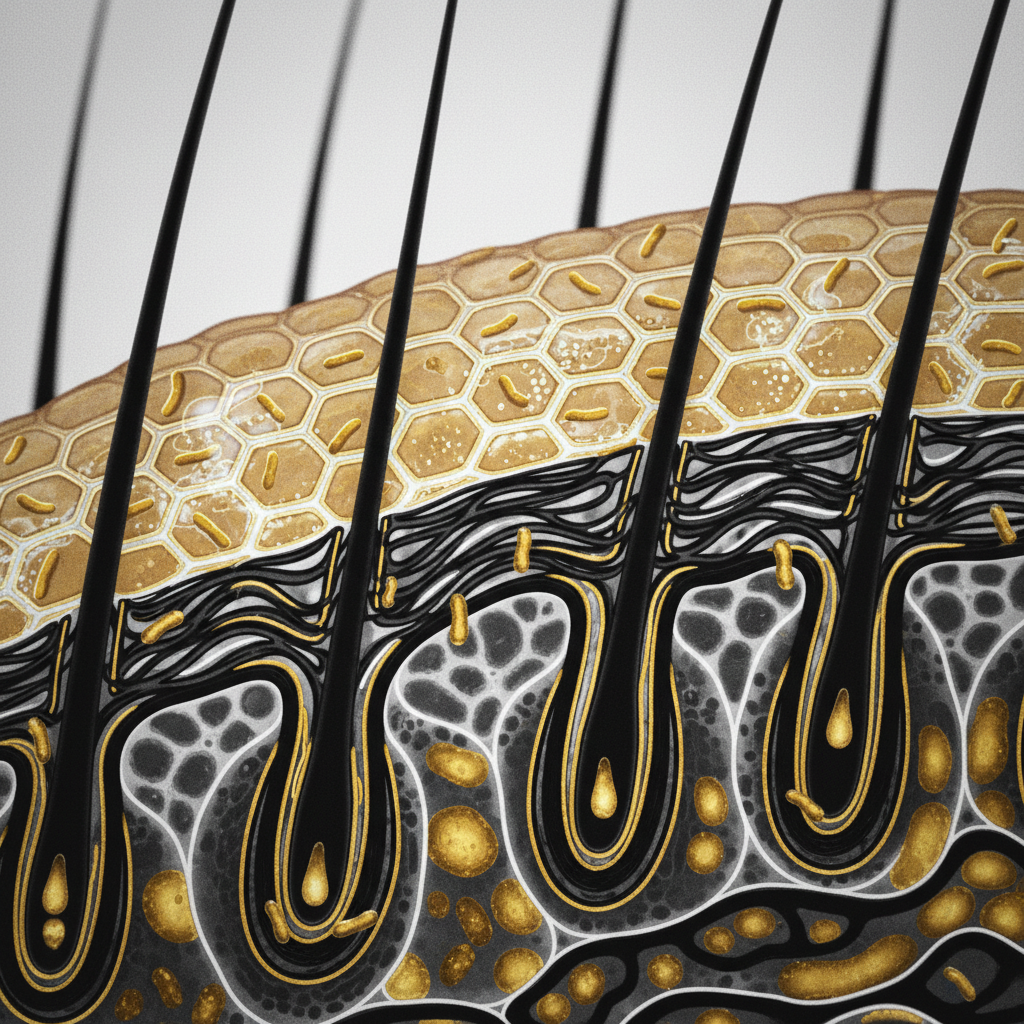
The stratum corneum and moisture barrier
The outermost skin layer functions like a brick wall. Corneocytes serve as the bricks, surrounded by an intercellular lipid mortar of ceramides, cholesterol, and free fatty acids. When this mortar breaks down through harsh surfactant washing or scratching, transepidermal water loss (TEWL) rises sharply. Dehydrated skin becomes tight, itchy, and prone to micro-fissures that invite bacterial penetration.
The acid mantle
Perspiration and sebum combine on the surface to produce an acidic film with a normal pH of 4.5 to 5.5. This acidity is essential. It keeps enzymes functioning to break down old cellular bonds gracefully while inhibiting opportunistic pathogens. Cleansing with high-pH alkaline soaps (pH 8.0 to 10.0) strips the acid mantle, swelling the hair cuticles and leaving the scalp skin vulnerable to irritation.
Acid Mantle Dynamic:
Sebum + Sweat ---> Acidic Surface Film (pH 4.5 - 5.5)
 |
 +------------------+------------------+
 | |
Inhibits harmful microbes Regulates desquamation
(e.g., pathogenic bacteria) (natural shedding of dead cells)
Sebaceous regulation and lipid peroxidation
Each follicle features attached sebaceous glands that produce sebum. Sebum softens the skin and coats the emerging hair shaft. However, overproduction (hyperseborrhoea) creates an ideal breeding ground for lipophilic yeasts. When sebum sits unwashed, it degrades into inflammatory peroxides, irritating the surrounding skin and destabilising the follicle anchor.
Identifying your scalp condition
Treating the scalp effectively depends on identifying what is actually happening on the skin. Use this comparison to guide your approach:
| Characteristic | Dry Scalp | Dandruff (Pityriasis Capitis) | Seborrhoeic Dermatitis |
|---|---|---|---|
| Primary Cause | Moisture deficit, damaged barrier | Malassezia yeast reaction | Severe yeast overgrowth, high sebum |
| Flake Appearance | Small, dry, white, powdery | Medium, loose, white or grey | Large, greasy, yellow, adherent |
| Skin State | Tight, rough, lacks natural oil | Normal to slightly oily | Erythematous (red), inflamed, oily |
| Pruritus (Itching) | Mild to moderate, feeling of tightness | Moderate, intermittent | Intense, persistent itching |
| Best Intervention | Humectants, gentle low-pH cleansing | Anti-fungal actives (zinc pyrithione, piroctone olamine) | Ketoconazole, medical anti-inflammatory agents |
Daily and weekly scalp care: practical steps
A consistent scalp routine relies on four core actions: cleansing, exfoliating, balancing, and protecting.
1. Cleansing properly
Wash at a frequency matched to your sebum output. Individuals with oily scalps generally need daily or alternate-day washing to prevent lipid peroxidation. Those with dry, curl-dominant, or coily hair patterns often fare best washing every 4 to 7 days to preserve moisture. Focus your shampoo directly on the skin, using the pads of your fingers in circular motions for at least 60 seconds. Avoid using fingernails, which create microscopic abrasions.
2. Targeted exfoliation
Chemical exfoliants generally outperform harsh physical scrubs. Alpha-hydroxy acids (like lactic acid or glycolic acid) dissolve dead surface cells, while beta-hydroxy acids (salicylic acid at 1% to 2%) penetrate into the oily follicle pore to dissolve stubborn sebum plugs. Limit chemical exfoliation to once or twice weekly. Over-exfoliating strips the barrier and causes reactive rebound oiliness.
3. Barrier hydration
If your scalp feels tight or dry after washing, apply lightweight humectants directly to towel-dried skin. Look for formulations containing hyaluronic acid, glycerin, panthenol (provitamin B5), or aloe vera. These ingredients draw water into the stratum corneum without leaving heavy, pore-clogging lipid residues that could feed yeasts.
4. Supporting healthy circulation
Gentle scalp massage stimulates localized cutaneous blood flow through mechanical shearing forces. Spend three to five minutes using gentle, circular pad pressure across the temporal, parietal, and occipital regions. While massage cannot resurrect dormant, miniaturised follicles in genetic baldness, it temporarily aids oxygen and nutrient delivery to functioning tissue.
Watermans: supporting the scalp ecosystem
A healthy topical routine provides the ideal foundation for strong hair fibres. Watermans Grow Me Shampoo and Condition Me Conditioner are formulated with this philosophy in mind.
Featuring revitalising ingredients such as biotin, rosemary extract, caffeine, and niacinamide alongside gentle surfactants, the system cleanses away oxidised sebum without stripping the delicate acid mantle. By supporting the scalp barrier and delivering conditioning nutrients directly to the skin surface, it maintains an optimal environment for fuller-looking, resilient hair.
When to seek clinical advice
Cosmetic routines have their limits. Consult a GP, dermatologist, or qualified trichologist if you notice:
- Persistent, inflamed red patches with silvery scales, which may indicate scalp psoriasis.
- Sudden, patchy hair shedding leaving smooth round discs, characteristic of alopecia areata.
- Scalp pain, burning, pustules, or follicular scarring, which can signal cicatricial (scarring) alopecias.
- Flaking and intense redness that do not improve after three to four weeks of over-the-counter anti-dandruff care.
Frequently asked questions about Scalp Care Guide
How often should I wash my hair according to this Scalp Care Guide?
Washing frequency depends entirely on your sebum production and hair texture. Oily scalps and fine hair typically require daily or alternate-day cleansing to remove oxidised lipids and prevent micro-inflammation. Dry, coarse, or afro-textured hair benefits from washing every 5 to 7 days, allowing natural oils to protect the lengths while ensuring the scalp is refreshed regularly.
Can I apply coconut oil or olive oil to treat my dry scalp?
Pure plant oils are rarely ideal for a flaky scalp. While they soften skin, they do not hydrate it because they lack water. Furthermore, lipophilic yeasts like Malassezia feed directly on the fatty acids in coconut and olive oil, which can worsen dandruff and seborrhoeic dermatitis. Lightweight humectants such as hyaluronic acid or glycerin are safer and more effective.
Does a flaky scalp always mean dandruff?
No. Flaking often signals simple dehydration of the stratum corneum. Dry scalp produces tiny, dry, powdery flakes accompanied by a feeling of tightness across the head. True dandruff is an inflammatory reaction to yeast overgrowth in the presence of sebum, resulting in larger, yellowish, greasier flakes that stick to the hair and skin.
Will regular scalp massage stop genetic hair loss?
Scalp massage temporarily increases local cutaneous blood circulation, but it cannot stop or reverse androgenetic alopecia. Pattern hair thinning is driven by genetic sensitivity to dihydrotestosterone (DHT) binding to follicular receptors. Addressing that process requires proven clinical and medical treatments rather than mechanical stimulation alone.
Summary: putting your scalp first
Healthy hair is produced by a balanced, calm, and well-nourished scalp. By using this Scalp Care Guide to protect your skin barrier, maintain an acidic pH, and clear away oxidised sebum, you establish the best possible conditions for your hair follicles. Pay close attention to what your skin tells you, adjust your washing frequency to your sebum levels, and seek medical guidance promptly if inflammation or persistent shedding arises.
Sources and references
- British Association of Dermatologists. Dandruff and Seborrhoeic Dermatitis Guidelines. 2020. Bad.org.uk
- Trüeb, R. M. Shampoos: Ingredients, benefits and adverse effects. Journal of the European Academy of Dermatology and Venereology, 2018. DOI: 10.1111/jdv.15044
- Schwartz, J. R., et al. The role of oxidative damage in poor scalp health: resolving the dandruff and seborrheic dermatitis phenotype. International Journal of Trichology, 2015. DOI: 10.4103/0974-7753.160100
- National Health Service (NHS). Itchy scalp and dandruff overview. 2023. Nhs.uk
- Gaitanis, G., et al. The Malassezia genus in skin and systemic diseases. Clinical Microbiology Reviews, 2012. DOI: 10.1128/CMR.00021-12
Find these ingredients in Watermans products
- Zinc: you will find this ingredient in our Hair Vitamins.
- Oleic Acid: you will find this ingredient in our Camellia & Black Castor Hair & Body Oil.
- Niacinamide: you will find this ingredient in our Hair Mask.
- Panthenol (Provitamin B5): you will find this ingredient in our Heat Protection Spray.
- Aloe Vera: you will find this ingredient in our Curly Hair Conditioner.