How to Measure Hair Density: Clinical and At-Home Methods
9 min read ·
Learn how to measure hair density accurately using home tests and clinical trichoscopy, separating follicle count from strand diameter for better care.
Quick answer: Learning How to Measure Hair Density involves determining the number of individual hair strands per square centimetre of scalp surface. You can estimate it at home using a visual scalp inspection or a ponytail circumference test, while dermatologists measure it precisely using dermoscopy, phototrichograms, or trichometry. The main limitation of at-home methods is that they often conflate fibre thickness with actual follicular count, making coarse, low-density hair appear identical to fine, high-density hair without specialised magnifying tools.
Key takeaways
- Hair density refers strictly to the number of follicular units and individual strands per square centimetre of your scalp, not the thickness of each individual strand.
- An average human scalp contains roughly 80,000 to 120,000 hairs, translating to approximately 150 to 300 hairs per square centimetre.
- At home, the ponytail circumference test and the visual scalp parting test offer quick, practical estimates of low, medium, or high density.
- Clinical methods like trichoscopy, phototrichograms, and Cross Sectional Trichometry provide exact numeric data and separate true hair density from hair shaft diameter.
- True density changes primarily through biological shedding (such as telogen effluvium) or follicular miniaturisation (androgenetic alopecia), rather than mechanical breakage along the shaft.
How to Measure Hair Density: what the evidence shows
When clinicians investigate How to Measure Hair Density, they assess the spatial distribution of hair follicles across different anatomical zones of the scalp. Published dermatological data indicates that human scalp hair density varies significantly by genetics, age, and natural pigmentation. For instance, people with naturally blonde hair average around 130,000 to 140,000 scalp hairs, brown and black hair types average roughly 100,000 to 110,000, and red hair types average approximately 80,000 to 90,000.
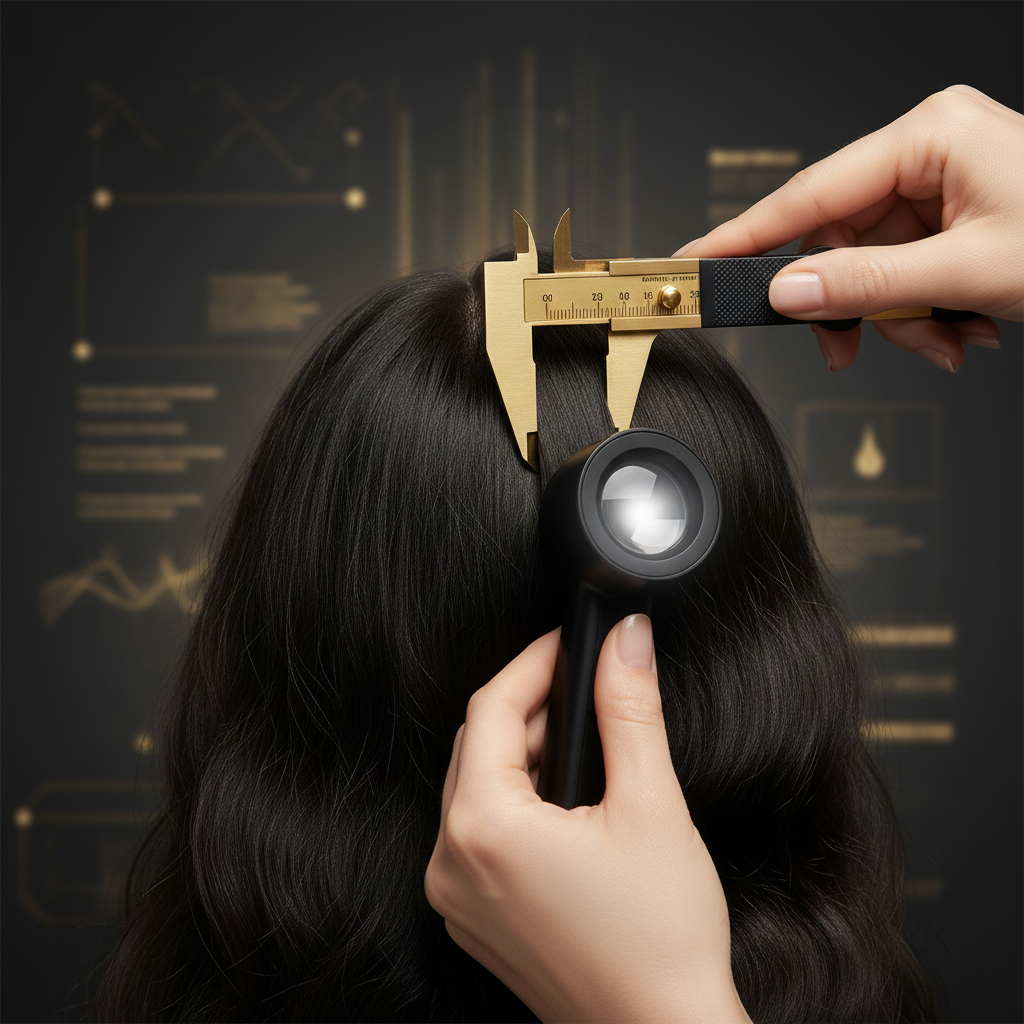
In clinical practice, measurement relies on objective, repeatable instruments:
- Trichoscopy (Dermoscopy): A specialist uses a handheld polarised video dermatoscope magnified between 10x and 70x. By framing a calibrated field (usually one square centimetre), the practitioner counts individual hairs, calculates follicular units (which naturally group in clusters of one to four hairs), and assesses empty follicular ostia (yellow dots).
- Phototrichogram: This technique pairs trichoscopy with image analysis software. A small patch of scalp (roughly 1 square centimetre) is trimmed and photographed over a 48 to 72 hour interval. This calculates not only total density per square centimetre, but also the ratio of actively growing (anagen) to resting (telogen) fibres, as growing fibres lengthen noticeably while resting ones do not.
- Cross Sectional Trichometry: This uses a specialised mechanical device to gather an exact bundle of hairs from a predefined surface area and measure its total cross-sectional mass. This helps differentiate whether overall thinning is driven by a drop in density or by shaft miniaturisation.
At-home assessments cannot match this precision, but they provide practical baselines. The most widely used self-assessment is the ponytail circumference test:
- Gather your hair into a secure ponytail at the back or crown of your head, ensuring all available lengths are included.
- Wrap a flexible measuring tape around the base of the elastic band to record the circumference in inches or centimetres.
- A circumference under 5 cm (roughly 2 inches) typically indicates low density.
- A circumference between 5 cm and 7.5 cm (2 to 3 inches) indicates medium density.
- A circumference over 7.5 cm (more than 3 inches) indicates high density.
However, this test has a major caveat: individuals with very coarse (wide diameter) strands will produce a larger ponytail circumference even if they have fewer follicles per square centimetre, while individuals with very fine strands and dense follicle distribution will produce a smaller bundle.
What the evidence does not show
The evidence does not show that topical cosmetic products can create brand-new hair follicles where none genetically existed. Human follicle count is permanently established before birth, at around week 22 of gestational development. No shampoo, oil, or supplement can increase your baseline follicle count beyond your biological ceiling.
Furthermore, research does not support the common belief that counting shed hairs on your pillow or in the shower drain measures density. A healthy scalp sheds between 50 and 100 hairs per day as part of the natural cycle. Shedding only reduces density if the rate of shed outpaces new anagen emergence, or if the emerging fibres undergo progressive miniaturisation.
Finally, measuring density does not diagnose the cause of thinning. A drop in density only confirms that fewer active, full-terminal fibres occupy a given area; it cannot distinguish between systemic nutrient deficiencies, hormonal shifts, autoimmune conditions, or mechanical traction without a clinical history and scalp biopsy or blood panel.
Density vs. Diameter: Understanding the mechanism
To accurately interpret your measurements, you must separate density from diameter.
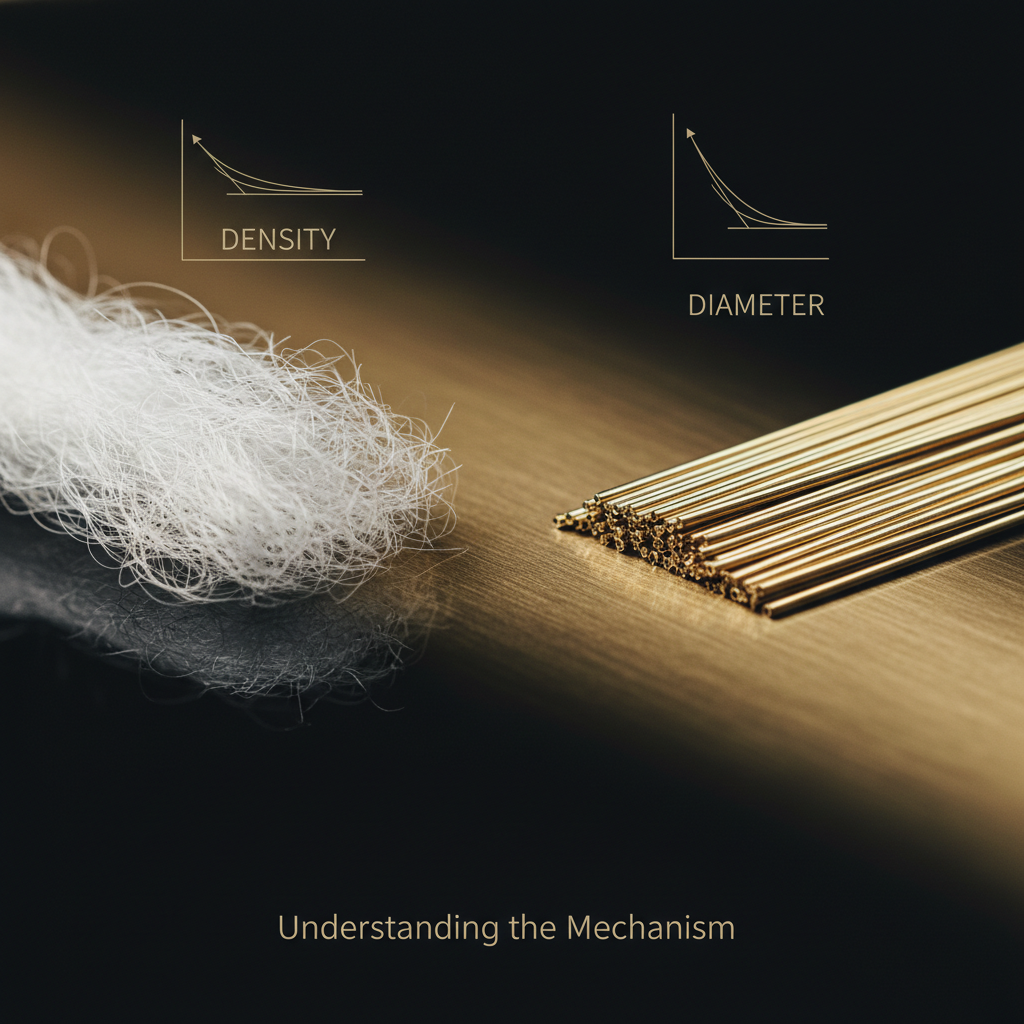
- Hair density is purely quantitative: how many follicles occupy one square centimetre of scalp tissue.
- Hair diameter is qualitative: the micro-millimetre thickness of the individual hair shaft. A fine hair strand measures roughly 40 to 60 microns in diameter, medium hair measures 60 to 80 microns, and coarse hair exceeds 80 microns.
If you have high density and fine diameter, your scalp may be completely covered, but individual strands will feel soft, delicate, and prone to tangling. Conversely, if you have low density and coarse diameter, your scalp may show slightly through parts, yet individual strands feel thick, wiry, and substantial. Confusing these two variables leads to incorrect product selection and misdiagnosed hair changes.
| Metric | Low Density | Medium Density | High Density |
|---|---|---|---|
| Follicle count per cm² | Under 150 hairs/cm² | 150 to 220 hairs/cm² | Over 220 hairs/cm² |
| Ponytail circumference | Under 5 cm (< 2 inches) | 5 cm to 7.5 cm (2 to 3 inches) | Over 7.5 cm (> 3 inches) |
| Scalp visibility at rest | Clearly visible without parting | Visible only along distinct part lines | Difficult to see even when parted |
| Styling response | Easily weighed down by heavy butters | Balances light to medium weight stylers | Absorbs heavy products without looking flat |
| Clinical tools required | Trichoscopy, pull test | Digital dermatoscope | Automated phototrichogram |
Everyday steps to monitor and support density
If you want to track your hair density over time without specialist equipment, consistency is crucial.
- Conduct standardised monthly photos: Part your hair down the centre, on the left, and across the vertex in clear, indirect natural light. Keep the camera distance, room lighting, and hair moisture level identical every month. Fluorescent lighting or flash photography can blow out highlights and make healthy density look sparse.
- Perform the visual parting test: Look in a well-lit mirror without moving your hair. If you can see your scalp clearly across broad areas without parting it, your density is on the lower end. If you must deliberately use a comb to expose scalp skin, your density is medium to high.
- Protect existing fibres against premature breakage: Breakage snaps the fibre along its length, leaving the root intact in the scalp. While breakage does not reduce true follicular density, it mimics it by stripping bulk from the mid-lengths and ends. Minimise aggressive thermal styling above 185°C and treat wet hair gently to preserve tensile integrity.
- Maintain scalp hygiene: Follicular health requires a clean environment. Sebum oxidation, heavy styling residue, and microbial imbalances (such as Malassezia overgrowth) can trigger mild perifollicular inflammation, which disrupts the hair cycle and accelerates shedding.
Watermans: Supporting the appearance of fuller hair
When managing lower density or hair that feels increasingly sparse, targeted topical care helps create optimal conditions for hair retention. Watermans GrowMe Shampoo and ConditionMe Conditioner are formulated to cleanse the scalp environment thoroughly without stripping natural moisture, supporting scalp microcirculation and resilience. Ingredients like biotin, rosemary, caffeine, and niacinamide help invigorate the scalp surface and support hair strength. While cosmetics cannot create new follicles or alter your genetic density, keeping the scalp clear and reinforcing fragile lengths helps preserve existing strands, producing a visibly fuller, denser appearance.
When to seek professional advice
You should consult a GP, registered trichologist, or dermatologist if you observe:
- A widening part line or noticeable thinning at the vertex or temples over a 3 to 6 month period.
- Sudden, excessive diffuse shedding where hairs come out in handfuls during washing or gentle brushing.
- Scalp symptoms including persistent itching, burning, pain, redness, or pustules.
- Discrete, smooth circular patches of complete hair loss, which may indicate alopecia areata.
- Excessive shedding accompanied by systemic symptoms like unexplained fatigue, rapid weight shifts, or irregular menstrual cycles.
Frequently asked questions about How to Measure Hair Density
Can you measure hair density on short hair?
Yes. On short hair, the ponytail circumference test will not work, but the visual scalp parting test and dermoscopy work exceptionally well. Stylists and trichologists use a hand lens or digital trichoscope placed directly against the scalp to count active follicles within a small square grid.
How often should you check your hair density?
Checking your hair density once every three to six months is ideal. Scalp hair grows at an average rate of 1 to 1.25 cm per month, and follicular cycles run in multi-year phases. Checking weekly or daily will only cause unnecessary stress, as biological density changes take months to become visible.
What is the most accurate clinical method for How to Measure Hair Density?
The most accurate clinical method for How to Measure Hair Density is a digital phototrichogram combined with high-resolution trichoscopy. This setup measures the exact number of hairs per square centimetre, calculates the thickness of each individual fibre in microns, and determines the percentage of growing versus shedding hairs.
Does cutting your hair make it denser?
No. Cutting your hair has no biological impact on the follicle beneath the skin. Trimming removes split, frayed ends that make the lower lengths look wispy, creating a blunt, straight edge that creates the visual illusion of thicker, denser hair.
Monitoring your hair density with confidence
Understanding How to Measure Hair Density allows you to separate real, follicular changes from everyday breakage and temporary shedding. Whether you use the ponytail circumference test at home or visit a dermatologist for dermoscopy, tracking density helps you tailor your product choices, styling habits, and care routine to your scalp's actual biology. When monitored consistently over time, objective measurements replace guesswork with clarity, ensuring you address thinning early and maintain your hair in peak condition.
Sources and references
- British Association of Dermatologists. (2021). Telogen Effluvium and Hair Shedding Guidelines.
- Rudnicka, L., Olszewska, M., & Rakowska, A. (2012). Atlas of Trichoscopy: Dermoscopy in Hair and Scalp Disease. Springer.
- Sinclair, R. (2007). Healthy hair: what is it? Journal of Investigative Dermatology Symposium Proceedings, 12(2), 2 to 5.
- Messenger, A. G., et al. (2010). British Association of Dermatologists' guidelines for the management of alopecia areata. British Journal of Dermatology, 166(5), 916 to 926.
- Blume-Peytavi, U., et al. (2011). Hair Growth and Disorders. Springer-Verlag Berlin Heidelberg.
Find these ingredients in Watermans products
- Niacinamide: you will find this ingredient in our Hair Mask.