How to Fix Heat Damaged Hair: The Dermatological and Cosmetic Guide
10 min read ·
Learn how to fix heat damaged hair using evidence-based cosmetic care, protein restructuring, and practical techniques to restore strength and prevent breakage.
Quick answer: Learning how to fix heat damaged hair starts with understanding that hair fibres are non-living biological structures. You cannot biologically regenerate cooked keratin proteins once they denature. Instead, solving how to fix heat damaged hair involves cosmetic repair: restructuring weakened bonds temporarily with hydrolysed proteins, sealing lifted cuticle scales with lipid-rich conditioners, minimising further thermal styling, and progressively trimming split ends. Severely fractured fibre requires trimming, while moderately compromised hair can regain elasticity, shine, and tensile strength through targeted conditioning.
Key takeaways
- Hair fibre is metabolically dead, meaning heat damage cannot biologically heal or regenerate like living tissue.
- Keratin denatures at approximately 155 to 160 degrees Celsius, while wet hair subjected to heat can experience bubble hair formation at much lower temperatures.
- Cosmetic repair relies on cationic surfactants, film-forming polymers, hydrolysed vegetable or keratin proteins, and rich emollient lipids to smooth the cuticle.
- Heat damage represents mechanical and thermal breakage along the hair shaft, not follicular hair loss or shedding from the scalp.
- Prevention using evidence-backed heat protectant polymers reduces heat transfer by up to 50 percent, protecting the cortex from irreversible structural degradation.
How to Fix Heat Damaged Hair: what the evidence shows
When you search for how to fix heat damaged hair, cosmetic science provides a clear distinction between structural restoration and biological healing. The hair shaft consists of three layers: the protective outer cuticle, the structural cortex composed of alpha-keratin filaments, and the central medulla. Repeated exposure to curling wands, flat irons, and intense blow-drying degrades these layers systematically.
Thermal styling tools frequently operate between 180 and 230 degrees Celsius. Peer-reviewed dermatological studies confirm that hair proteins undergo structural denaturation when exposed to temperatures exceeding 155 degrees Celsius. At this threshold, the alpha-helical coiled-coil keratin chains unwind into disordered beta-sheet configurations. When this happens, hair loses its natural elasticity, tensile strength, and moisture retention capacity.
Cosmetic repair focuses on filling the structural voids left by melted keratin. Hydrolysed proteins, such as wheat, soy, or keratin peptides, possess molecular weights small enough (roughly 1,000 to 3,000 Daltons) to penetrate micro-fissures in the cuticle and outer cortex. Simultaneously, conditioning agents containing cationic surfactants (such as behentrimonium chloride) bind electrostatically to the negative charges exposed on damaged hair fibres, smoothing down flared cuticle scales and reducing friction.
What the evidence does not show
Marketing campaigns often promise that deep conditioners or bonding treatments will permanently reconstruct split ends and restore hair to its virgin state. Cosmetic chemistry does not support these claims.
No topical product can permanently reconnect severed fibre or restore melted alpha-keratin once it has degraded into amorphous protein. Bond-building technologies and protein treatments create temporary cross-links or internal ionic complexes, but these wash out over multiple shampoo cycles. Furthermore, cosmetic products cannot cure "bubble hair", an irreversible physical deformity caused when moisture inside the hair shaft vaporises into steam, creating microscopic cavities that snap under minimal tension. For split ends and bubble hair, cutting the affected ends off remains the only genuine cure.
The mechanism: what heat does to the hair shaft
Thermal degradation affects both the surface and the core of the hair fibre in distinct phases:
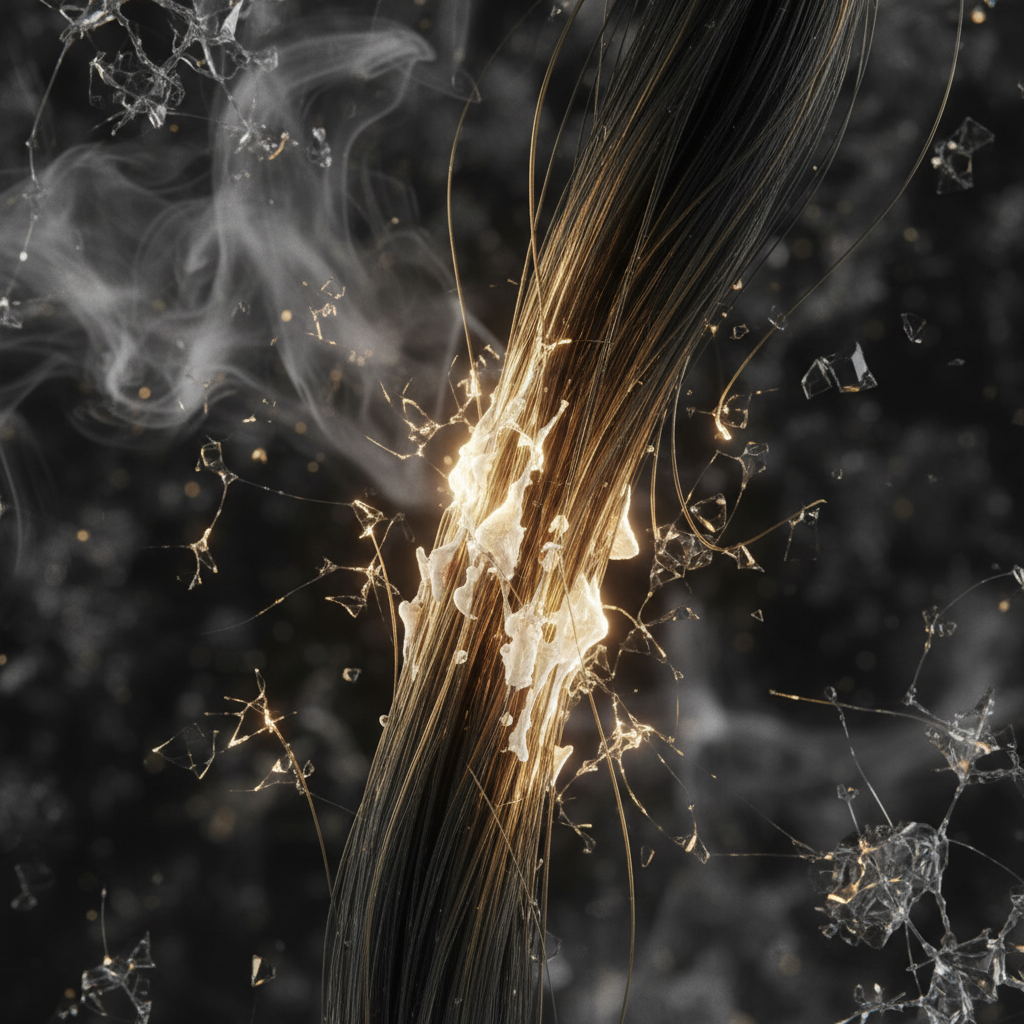
- Cuticle stripping and lipid loss: The outermost layer of the hair is coated in the 18-methyleicosanoic acid (18-MEA) lipid layer, which repels water and imparts natural shine. Temperatures above 140 degrees Celsius strip this delicate lipid shield. Without 18-MEA, the hair becomes hydrophilic, absorbing ambient humidity, swelling unevenly, and tangling easily.
- Cuticle cracking and flaring: As water flash-boils out of the fibre, the overlapping shingles of the cuticle blister, crack, and lift. This leaves the inner cortex exposed to environmental oxidants and mechanical friction.
- Cortex denaturation and moisture loss: The cortex contains high concentrations of cysteine, an amino acid that forms strong disulphide bonds. Excessive heat oxidises cysteine into cysteic acid, breaking the chemical scaffolding that gives hair its bounce and resistance to snapping.
- Pigment oxidation: Natural melanin granules inside the cortex oxidise under prolonged thermal stress, causing colour fading, brassiness, or unwanted bleaching in natural and colour-treated hair alike.
Signs your hair is heat damaged
Recognising the signs of thermal distress helps you choose the correct corrective routine before severe breakage occurs:
- Altered curl or wave pattern: Naturally curly or wavy hair fails to spring back after washing, looking limp, stringy, or unevenly straight in over-styled sections.
- Loss of elasticity: When wet, a healthy hair strand can stretch roughly 30 percent of its length and return to resting state. Heat-damaged hair snaps immediately upon light stretching.
- Rough, raspy texture: Sliding your fingers upward along a single hair strand feels bumpy, dry, and coarse due to raised cuticle edges.
- Chronic tangling and knotting: Because the protective lipid layer is gone, neighbouring hair fibres interlock and catch, leading to stubborn friction knots.
- Excessive breakage: You notice short, blunt-ended hair fragments on your clothing, bathroom counter, or brush. Unlike shedded hair, these broken pieces lack a white follicular bulb at the root.
| Hair State | Cuticle Condition | Elasticity & Stretch | Porosity | Primary Solution |
|---|---|---|---|---|
| Healthy Hair | Intact, flat shingles coated in natural 18-MEA lipids | Stretches up to 30% when wet and springs back | Low to medium; absorbs water evenly | Routine cleansing and light surface conditioning |
| Mild Heat Stress | Minor lifting of cuticle edges, dull surface | Normal to slightly reduced elasticity | Moderate; absorbs moisture quickly, dries fast | Heat protectants, weekly lipid-rich hair masks |
| Moderate Damage | Significant cuticle flaring, partial cortical exposure | Weak; stretches slightly before snapping | High; swells rapidly, prone to severe frizz | Hydrolysed protein treatments, bond-building complexes |
| Severe Heat Damage | Cuticles fractured, bubble hair voids, split ends | Zero elasticity; snaps under minimal tension | Extreme; sponge-like absorption, fragile structure | Regular trims, complete thermal styling cessation |
Step-by-step strategy for managing heat damaged hair
To revive compromised hair, you need a structured regimen that balances moisture, strength, and mechanical protection:
1. Perform an aggressive thermal detox
Put away flat irons, curling wands, and high-heat drying tools for a minimum of 4 to 8 weeks. If you must use a hairdryer, keep it on the cool or medium setting, hold the nozzle at least 15 centimetres away from your scalp, and keep the airflow moving continuously down the hair shaft.
2. Alternate protein and lipid conditioning
Damaged fibres require both tensile reinforcement and lubrication. Once a week, apply a targeted reconstructor containing hydrolysed wheat protein, keratin, or silk amino acids to temporarily fortify the cortex. Follow this with a deep conditioning mask containing fatty alcohols (such as cetyl or stearyl alcohol), shea butter, or argan oil to replenish the missing lipid barrier and seal the cuticle down.
3. Lower the washing pH
Damaged hair has an elevated isoelectric point and carries a strong negative surface charge. Use shampoos and conditioners formulated within an acidic pH range of 4.5 to 5.5. Acidic products contract the hair shaft, encouraging lifted cuticle scales to lie flat, which locks in moisture and boosts light reflection.
4. Apply leave-in film formers
After washing, coat damp strands with a leave-in serum or cream containing dimethicone, amodimethicone, or polyquaternium polymers. Cationic silicones like amodimethicone selectively target damaged areas, forming an invisible, breathable sheath that prevents friction and reduces comb-induced breakage.
5. Schedule regular micro-trims
Book a salon appointment every 6 to 8 weeks to trim away split ends. If split ends are left unaddressed, the longitudinal fracture travels upward along the cortex, destroying healthy hair further up the shaft.
When the cause may be something else
It is vital to distinguish between thermal breakage and genuine hair loss. If you observe excessive hair coming out from the scalp with a tiny white bulb attached to the root, you are experiencing follicular shedding (telogen effluvium) or patterned hair thinning (androgenetic alopecia), not heat damage.
Similarly, chemical over-processing from bleaching, permanent waving, or chemical relaxers mimics thermal damage by stripping the cuticle and oxidising disulphide bonds. Hard water mineral build-up (such as calcium and magnesium deposits) can also cause hair to feel dry, brittle, and unmanageable, leading people to mistake mineral coating for heat damage.
When to seek professional advice
Consult a qualified trichologist or dermatologist if you notice scalp tenderness, redness, or thinning patches at the crown or parting. If your hair is breaking off in large clumps despite eliminating heat tools, a professional can analyse your fibres under polarised light microscopy to rule out underlying structural shaft disorders, such as trichorrhexis nodosa or monilethrix.
The Watermans approach to hair resilience
Supporting hair through mechanical and thermal wear requires maintaining optimal scalp conditions alongside resilient fibre care. Watermans focuses on providing high-performance, sulphate-free haircare designed to cleanse gently without stripping essential surface moisture. Formulations enriched with biotin, rosemary, hydrolysed lupin protein, caffeine, and argan oil help keep the scalp balanced while coating stressed hair fibres in fortifying nutrients. By keeping the scalp nourished and reducing friction-induced breakage, you create the best environment for resilient, healthier-looking hair.
Frequently asked questions about How to Fix Heat Damaged Hair
Can heat damaged hair naturally repair itself over time?
No. Because hair fibres are dead biological material without living cells or blood supply, hair cannot self-repair. Any improvement in appearance comes from cosmetic coatings, protein treatments, or cutting away damaged sections as healthy new hair emerges from the follicle.
How to fix heat damaged hair without cutting it?
While you cannot repair split ends without a trim, you can manage how to fix heat damaged hair cosmetically by using leave-in conditioners with cationic polymers, weekly hydrolysed protein treatments, acidic rinses (pH 4.5 to 5.5), and eliminating high-heat styling to prevent structural snapping.
How long does it take to nurse heat damaged hair back to health?
Cosmetic improvements in softness, shine, and manageability appear immediately after targeted conditioning treatments. However, completely replacing heat damaged sections requires growing new hair from the root, which takes 6 to 18 months depending on your hair length and growth rate.
Does olaplex or bond building reverse thermal damage?
Bond-building technologies temporarily create synthetic cross-links across damaged protein structures in the cortex, improving tensile strength and elasticity. However, these effects are temporary and wash out over time; they do not physically reverse structural protein melting or mend split ends permanently.
At what temperature does hair heat damage actually occur?
Structural protein degradation begins around 155 to 160 degrees Celsius, where alpha-keratin denatures. If the hair contains moisture, damage can occur at much lower temperatures, as trapped water instantly vaporises into steam, blistering the cuticle and causing bubble hair deformity.
Moving forward with heat damaged hair
Mastering how to fix heat damaged hair comes down to practical science: accept the limits of non-living fibre, halt the thermal practices that caused the structural breakdown, and invest in intelligent cosmetic management. By integrating hydrolysed proteins, cuticle-smoothing emollients, and routine micro-trims, you can protect your vulnerable hair strands from snapping while fresh, undamaged hair grows in from the roots. Focus on gentle handling, keep temperatures sensible, and give your hair the care it needs to regain its natural bounce and shine.
Sources and references
- American Academy of Dermatology. "Hair Styling Without Damage." AAD Public Health Resources.
- Robbins, C. R. (2012). Chemical and Physical Behavior of Human Hair (5th ed.). Springer-Verlag.
- Lee, Y., Kim, Y. D., Hyun, H. J., Pi, L. Q., Jin, X., & Lee, W. S. (2011). "Hair shaft damage from heat and drying time of hair dryer." Annals of Dermatology, 23(4), 455-460.
- Marsh, J. M., Davis, M. G., Flagler, M. J., et al. (2015). "Preserving hair integrity: molecular mechanisms of thermal damage." Journal of Cosmetic Science, 66(4), 231-244.
- Christian, P., Winsey, N., Whatmough, M., & Spearing, K. (2011). "Volumetric measurement of thermal damage to human hair." International Journal of Cosmetic Science, 33(5), 461-468.
Find these ingredients in Watermans products
- Shea Butter: you will find this ingredient in our Curly Hair Conditioner.