Hair Thinning vs Hair Shedding: Causes, Differences, and Solutions
11 min read ·
Confused about hair thinning vs hair shedding? Learn the biological differences, triggers, diagnostic signs, and proven methods to support healthy hair density.
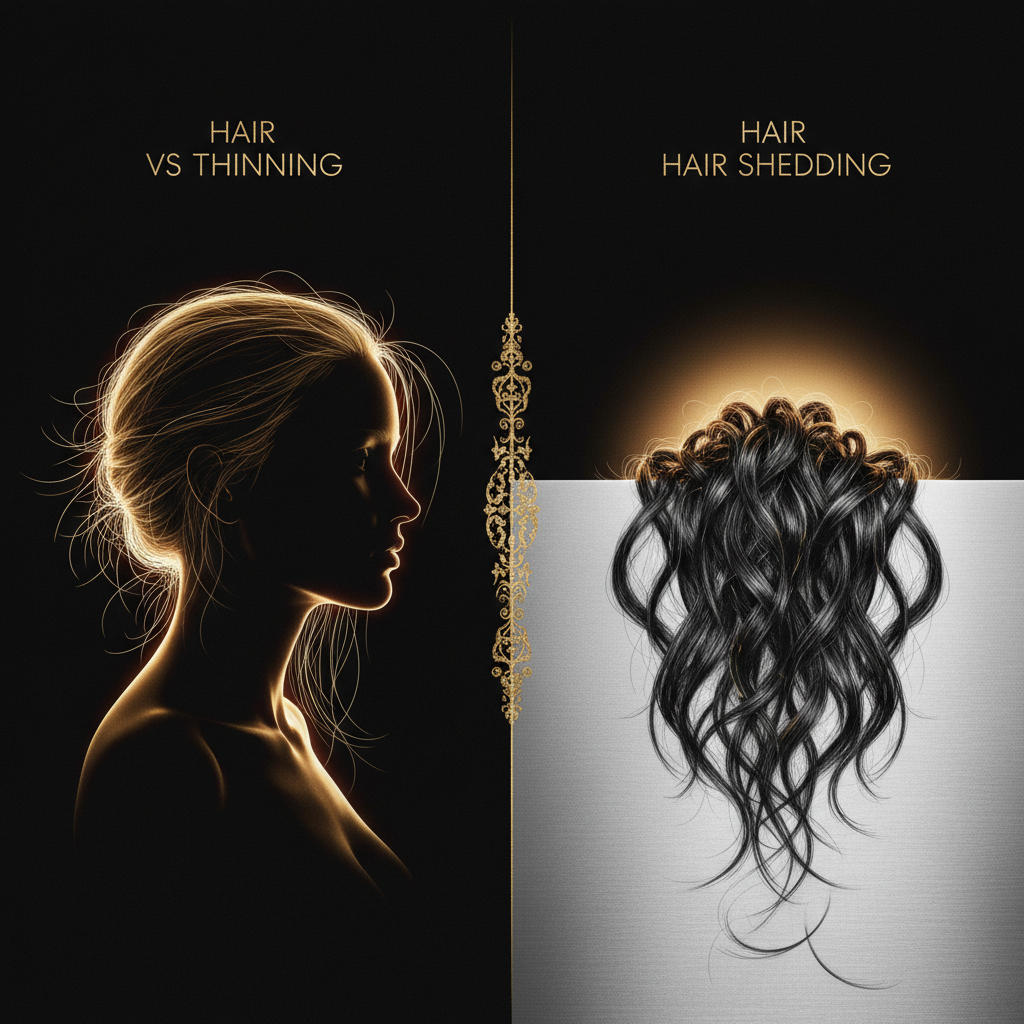
Quick answer: Understanding Hair Thinning vs Hair Shedding comes down to distinguishing follicle miniaturisation from cycle synchronisation. Hair shedding (telogen effluvium) involves whole strands falling out from the root in higher volumes than normal, often triggered by acute physiological stress. Hair thinning (androgenetic alopecia) is a progressive reduction in the diameter and density of individual hair fibres, causing the scalp to become visible without necessarily seeing heaps of loose strands. The main limitation is that both conditions can happen simultaneously, requiring careful clinical assessment to separate them.
Key takeaways
- Normal physiological shedding accounts for roughly 50 to 100 hairs daily as part of the natural hair growth cycle.
- Hair shedding refers to telogen effluvium, where an abrupt physiological shift shocks follicles into releasing their fibres en masse.
- Hair thinning refers to follicle miniaturisation, where hairs grow back progressively finer, shorter, and less pigmented over successive cycles.
- Shed hairs display a white keratin bulb at the proximal root tip, whereas broken hairs snap mid-shaft without a bulb.
- Shedding is usually temporary and self-correcting within six to nine months, whereas progressive thinning requires early, targeted intervention to preserve follicle calibre.
Hair Thinning vs Hair Shedding: what the evidence shows
Dermatologists and trichologists treat Hair Thinning vs Hair Shedding as two distinct biological phenomena governed by entirely different cellular pathways. Conflating them leads to inappropriate management, unhelpful anxiety, and delayed treatment.
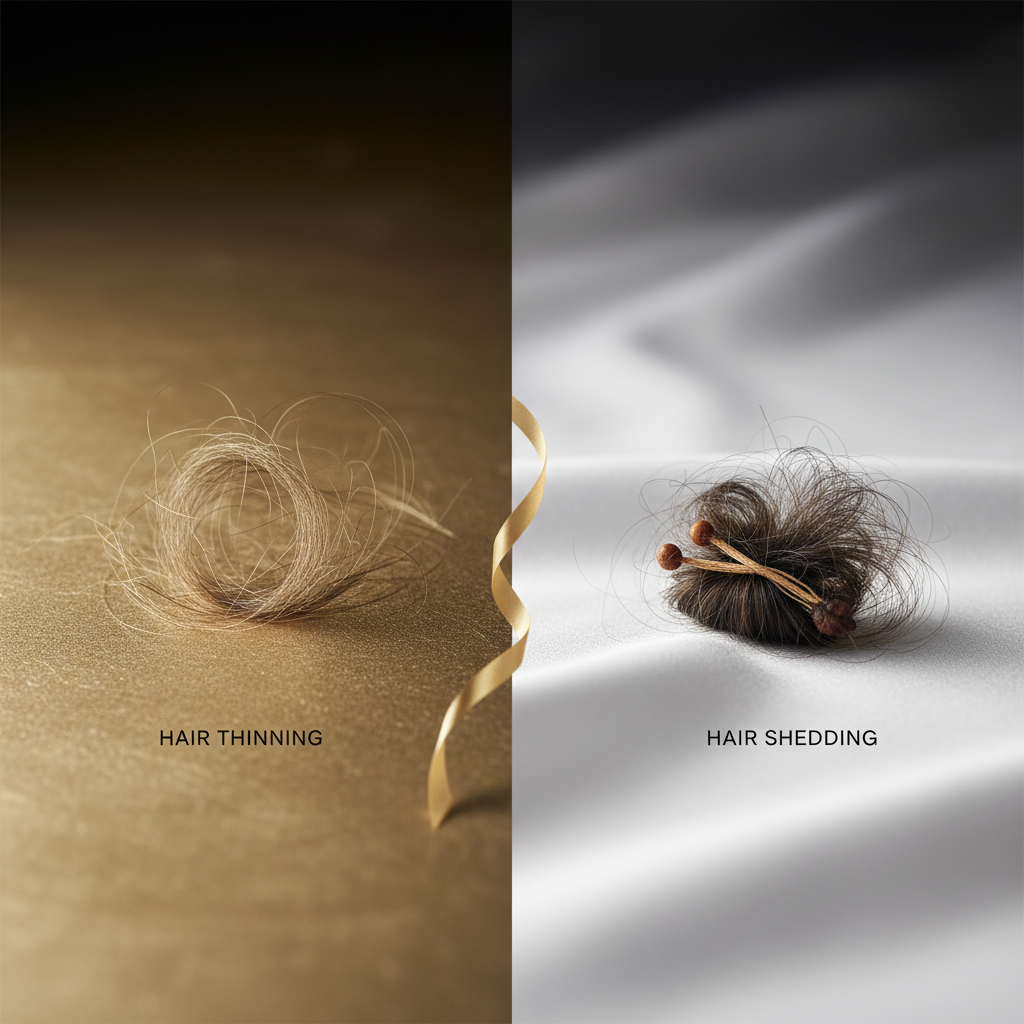
The average human scalp houses approximately 100,000 hair follicles. In a healthy scalp, roughly 85 to 90 percent of these follicles reside in anagen (the active growth phase, lasting two to seven years). Around 1 to 2 percent occupy catagen (the brief regression phase lasting two to three weeks), and 10 to 15 percent rest in telogen (the resting phase lasting two to four months). Exogen marks the final sub-phase where the club hair naturally detaches. Normal exogen yields 50 to 100 shed hairs per day.
Hair shedding becomes a clinical concern when that percentage shifts. Known medically as telogen effluvium, up to 30 to 50 percent of anagen follicles prematurely enter catagen and telogen following a systemic shock. Two to four months later, those hairs shed together. The sheer volume of hair gathering on pillows, shower grates, and brushes can feel alarming, yet the follicle itself remains undamaged and fully capable of producing a normal-calibre fibre.
In contrast, hair thinning, most commonly seen as androgenetic alopecia (pattern hair loss), is not primarily an issue of shedding rate. It is an issue of miniaturisation. Driven genetically and mediated by dihydrotestosterone (DHT) binding to androgen receptors in susceptible follicles, the anagen phase progressively shortens. With each subsequent growth cycle, the dermal papilla shrinks, producing a hair fibre with a narrower diameter, reduced tensile strength, and lighter pigmentation until the follicle eventually becomes vellus or dormant.
| Clinical Feature | Hair Shedding (Telogen Effluvium) | Hair Thinning (Miniaturisation) | Hair Breakage (Fibre Fracture) |
|---|---|---|---|
| Primary Mechanism | Follicles prematurely shift into resting phase | Progressive reduction in follicle size via DHT | Mechanical or chemical structural failure |
| Onset Pattern | Sudden, acute (usually 2 to 4 months post-trigger) | Gradual, insidious over years | Variable, often following chemical or heat trauma |
| Visual Appearance | Full-length hairs with white bulb at the root | Shorter, finer fibres; widening parting; scalp shows | Short, jagged pieces; frayed ends; no root bulb |
| Daily Hair Fall | Often 150 to 400+ hairs per day | Usually normal (50 to 100 hairs per day) | Fragmented debris rather than rooted hairs |
| Scalp Distribution | Diffuse across the entire scalp | Patterned (crown, temples, frontal hairline, or midline) | Localised to heavily styled or compromised areas |
| Reversibility | Highly reversible once trigger resolves | Treatable to slow or stabilise, difficult to reverse | Corrected by trimming and modifying haircare habits |
The underlying mechanisms explained
To properly evaluate hair changes, you must understand what happens inside the follicular unit.
The mechanism of excessive shedding
In telogen effluvium, the biological clock of the hair cycle is disrupted. A physiological stressor, such as acute illness, high fever, rapid blood loss, major surgery, severe psychological trauma, crash dieting, or post-partum hormone withdrawal, causes pro-inflammatory cytokines or systemic neuroendocrine signals to arrest anagen prematurely. The follicles transition smoothly into catagen and then telogen. Because the telogen resting phase lasts roughly 100 days, you rarely see the fallout immediately. Instead, shedding begins 8 to 12 weeks after the triggering event. Once the shedding peaks, anagen restarts, provided nutritional stores (like serum ferritin, zinc, and vitamin D) are sufficient to sustain active cell division in the matrix.
The mechanism of progressive thinning
In androgenetic thinning, the hair cycle runs too fast, not too loose. Circulating testosterone is converted to dihydrotestosterone by the enzyme 5-alpha reductase (specifically type II in the follicle sheath). In genetically predisposed individuals, DHT binds to androgen receptors in the dermal papilla, downregulating growth factors such as vascular endothelial growth factor (VEGF) and upregulating transforming growth factor-beta (TGF-beta). This causes the dermal papilla extracellular matrix to shrink. A terminal hair, typically 60 to 80 micrometres in diameter, shrinks across successive cycles to a vellus-like hair under 30 micrometres. The hair appears thin because the total cross-sectional area of keratin across your scalp is reduced, even if you are not shedding an unusual number of strands per day.
What the evidence does not show
Popular myths blur the lines between shedding, thinning, and fibre damage. Clarifying what the science refutes saves both time and unnecessary distress:
- Frequent shampooing does not cause shedding: Washing your hair dislodges fibres that have already separated from the dermal papilla days or weeks earlier in the exogen phase. Washing simply cleanses the scalp and removes loose hairs that were already resting in the follicular canal.
- Wearing hats does not cause thinning: Traction alopecia can occur from severely tight headwear or hairstyles that pull on the roots, but standard hats do not strangle the blood supply or trigger follicle miniaturisation.
- Thinning is not caused by clogged sebum pores: While a clean, balanced scalp microbiome supports optimal follicle function, sebum build-up alone does not miniaturise hair follicles or mimic pattern baldness.
- Hair shedding is not permanent hair death: Many people panic that every shed hair represents a permanent loss. In uncomplicated telogen effluvium, the stem cell niche in the follicular bulge remains fully intact and primed to generate a new hair shaft.
Signs to look for: how to self-assess
Differentiating between shedding and thinning at home requires looking at distribution, fibre anatomy, and timeline.
Look closely at the hairs you find. Use a clear surface and good lighting. Does the strand measure your full hair length, terminating in a tiny, firm, white nodule? That nodule is the keratinised bulb of a telogen club hair. If you are finding dozens of these full-length club hairs throughout the day, you are dealing with shedding.
Examine your scalp density under consistent lighting. Has your ponytail circumference suddenly shrunk by a third over a matter of weeks? That points toward diffuse shedding. Conversely, has your central parting widened gradually over two to five years, or have your temples receded while the back of your head remains thick? That points toward progressive follicular thinning.
Check for breakage as well. If the hair you find is short, lacks a bulb, and shows split or frayed ends under close inspection, your issue is hair breakage along the cuticle and cortex, not shedding from the follicle.
What you can do to support healthy hair growth
Managing either concern starts with identifying the driving cause and supporting the scalp environment.
For hair shedding
- Identify the timeline: Look back two to four months prior to the start of the shedding. Pinpoint any illnesses, crash diets, medical treatments, or intense life events.
- Review nutritional biomarkers: Request blood tests via your GP for full blood count, serum ferritin, vitamin D3, vitamin B12, and thyroid function (TSH, free T4). Iron deficiency without anaemia is a frequent silent perpetuator of prolonged telogen shedding.
- Avoid crash dieting: Follicular matrix cells possess the highest turnover rate in the human body. Severe caloric or protein restriction starves the hair matrix of amino acids required for keratin synthesis.
- Practice patience: Because anagen takes time to establish, noticeable reductions in shedding rarely occur sooner than three to six months after the underlying cause is resolved.
For hair thinning
- Consult a specialist early: Androgenetic changes respond best when follicles are caught early in the miniaturisation process, before the follicular ostium closes permanently.
- Support follicle nutrition and scalp circulation: A healthy scalp environment with optimal microcirculation provides the building blocks for developing hair fibres.
- Optimise daily topical haircare: Avoid heavy silicones and scalp-blocking build-up that weigh down fine strands. Focus on clean formulations that invigorate the scalp.
Supporting the scalp with Watermans
Cosmetic hair products cannot alter genetic androgen sensitivity, but they play a vital role in maintaining scalp vitality and protecting existing hair fibre diameter.
For those noticing hair thinning or diffuse shedding, Watermans Grow Me Shampoo and Condition Me Conditioner are formulated to cultivate an optimal scalp environment. Built around a synergistic complex featuring biotin, caffeine, rosemary extract, niacinamide, and argan oil, the formula energises the scalp, strengthens the feel of fine strands, and improves hair manageable thickness. By washing regularly with a clarifying, sulphate-free, nutrient-rich shampoo, you clear inflammatory sebum, soothe the follicular surface, and ensure that new anagen hairs emerge through a clean, refreshed scalp foundation.
When the cause may be something else
Hair changes do not always fit neatly into simple shedding or pattern thinning. Several other conditions mimic or exacerbate these presentations:
- Alopecia Areata: An autoimmune condition where T-lymphocytes cluster around the hair bulb, causing round, smooth, well-defined bald patches. Exclamation-point hairs are often visible at the margins.
- Traction Alopecia: Mechanical tension from tight ponytails, braids, or extensions damages the follicular wall over time, causing localised thinning and shedding along the frontal and temporal margins.
- Cicatricial (Scarring) Alopecia: Inflammatory conditions such as lichen planopilaris or frontal fibrosing alopecia destroy the hair follicle stem cells and replace them with fibrous tissue. These require urgent medical attention to halt permanent loss.
- Chronic Scalp Conditions: Uncontrolled seborrhoeic dermatitis or scalp psoriasis creates localised inflammation and oxidative stress, precipitating telogen shedding and weakening newly emerging fibres.
When to get professional advice
You should arrange an evaluation with a trichologist or dermatologist if you encounter any of the following:
- Shedding that persists at high volume for more than six months without improvement (chronic telogen effluvium).
- Sudden, patchy, coin-sized areas of total hair loss.
- Scalp symptoms including burning, stinging, intense itching, tenderness, redness, or visible scarring.
- Marked thinning accompanied by irregular menstrual periods, severe adult acne, or unusual facial hair growth (which can indicate polycystic ovary syndrome or endocrine imbalances).
- Rapid hairline recession in post-menopausal women.
A qualified professional will perform a trichoscopy (dermoscopic examination of the scalp), evaluate hair diameter diversity, check for peripilar signs, and perform a standardised pull test to provide an accurate clinical diagnosis.
Frequently asked questions about Hair Thinning vs Hair Shedding
Can hair shedding turn into permanent hair thinning?
No, pure telogen effluvium does not transform into androgenetic thinning. However, an episode of severe shedding can unmask underlying, genetic hair thinning that was previously progressing unnoticed. Once the shed hairs fall, the miniaturised follicles struggle to grow back with their former diameter.
What is the most reliable way to tell Hair Thinning vs Hair Shedding apart?
Examine the pattern and the fallen fibres. In Hair Thinning vs Hair Shedding, shedding produces loose, full-length hairs with small white bulbs, spread diffusely across the entire scalp. Thinning primarily shows up as a widening parting line or exposed crown where hairs grow back visibly finer, without large quantities of hair falling out at once.
How long does an episode of telogen shedding usually last?
Acute telogen effluvium typically lasts between three and six months. Once the underlying trigger is removed or resolved, the shedding gradually subsides, and hairs transition back into anagen growth over the following six to twelve months.
Can low iron cause hair shedding, hair thinning, or both?
Depleted iron stores, specifically measured through serum ferritin, primarily cause telogen shedding. Hair matrix cells require iron for ribonucleotide reductase activity during cell division. Without adequate ferritin, follicles struggle to maintain anagen, leading to diffuse shedding and fine, lacklustre regrowth.
Does a widened hair parting mean I am thinning or shedding?
A gradually widening parting line over several months or years is the classic hallmark of female pattern hair thinning (androgenetic alopecia). Diffuse shedding reduces overall density across the scalp simultaneously, whereas a widening midline parting reveals localised follicular miniaturisation.
Navigating Hair Thinning vs Hair Shedding with confidence
Distinguishing between Hair Thinning vs Hair Shedding is the first step toward choosing the right path forward. Hair shedding is almost always a temporary, reactive event driven by a disruption to your natural biological rhythms. In contrast, hair thinning represents a structural, gradual shift in the calibre of your hair follicles. By assessing your symptoms accurately, checking your nutritional and medical biomarkers, and adopting a dedicated scalp-care routine, you can approach your hair health with clarity and confidence.
Sources and references
- British Association of Dermatologists. Telogen Effluvium: Clinical Guidance. (bad.org.uk)
- National Institute for Health and Care Excellence (NICE). Alopecia androgenetica: Scenario management. (cks.nice.org.uk)
- American Academy of Dermatology Association. Hair loss: Who gets and causes. (aad.org.uk)
- Malkud, S. (2015). Telogen Effluvium: A Review. Journal of Clinical and Diagnostic Research, 9(9): WE01-WE03.
- Sinclair, R. (1998). Male pattern androgenetic alopecia. BMJ, 317(7162): 865-869.
- Asghar, F. Et al. (2020). Telogen Effluvium: A Comprehensive Review. Cureus, 12(5): e8320.
Find these ingredients in Watermans products
- Zinc: you will find this ingredient in our Hair Vitamins.
- Niacinamide: you will find this ingredient in our Hair Mask.