Hair Shaft Breakage vs Follicular Loss: How to Tell the Difference
9 min read ·
Learn the differences between Hair Shaft Breakage vs Follicular Loss, including how to spot the root bulb, inspect hair lengths, and treat damaged strands.
Quick answer: Understanding Hair Shaft Breakage vs Follicular Loss comes down to finding where the hair separates. Breakage occurs when external mechanical, chemical, or thermal trauma fractures the non-living fibre along the shaft, leaving the follicle intact in the scalp. Follicular loss occurs when an entire strand sheds from within the root, often visible with a tiny white keratin bulb at the end. While breakage can be corrected with gentle haircare and conditioning, follicular loss may involve systemic, genetic, or biological factors requiring clinical evaluation.
Key takeaways
- Breakage is physical or structural damage along the hair shaft; the hair root remains rooted in your scalp.
- Follicular shedding occurs at the scalp level and typically presents as a full-length strand featuring a visible white bulb.
- Broken hairs are usually uneven, shorter than your overall hair length, and lack a root end.
- While cosmetic treatments and protein conditioners dramatically reduce breakage, they do not resolve genuine follicular alopecias.
- Experiencing excessive root-level shedding (over 100 to 150 hairs daily) warrants investigation by a GP or trichologist.
Hair Shaft Breakage vs Follicular Loss: what the evidence shows
When evaluating thinning hair, distinguishing between Hair Shaft Breakage vs Follicular Loss is the single most critical diagnostic step. The hair fibre is an intricate biological structure consisting of three layers: the protective outer cuticle, the load-bearing cortex rich in keratinised intermediate filaments, and the central medulla.
When you experience hair shaft breakage, the internal disulphide cross-links within the cortex become compromised. This structural weakness is almost entirely driven by external stressors such as high-heat styling (temperatures exceeding 180°C denature keratin), alkaline chemical processing (such as bleach with a pH above 9.0), or harsh friction from rough towels and tight hairbands. Because the fracture takes place midway along the fibre, your scalp follicle remains healthy, active, and unaffected.
In contrast, follicular loss is an internal, biological event occurring beneath the surface of the scalp. In healthy humans, approximately 85 to 90 percent of scalp follicles reside in the anagen (growth) phase, while roughly 10 percent occupy the telogen (resting) phase. Normal physiological shedding involves losing roughly 50 to 100 telogen hairs per day as new anagen fibres push them out.
However, when medical, hormonal, or systemic stressors trigger conditions such as telogen effluvium or androgenetic alopecia, follicles prematurely cycle into the resting or miniaturisation phases. In these instances, the hair strand falls out entirely from the dermal papilla. Conflating these two distinct phenomena leads to inappropriate treatments, such as trying to halt hormonal thinning with deep-conditioning masks, or treating heat-damaged split ends with oral medications.
The diagnostic signs: how to tell them apart
A simple examination of fallen strands under bright light can quickly clarify whether you are dealing with structural fracturing or shedding from the root.
Look for the root bulb
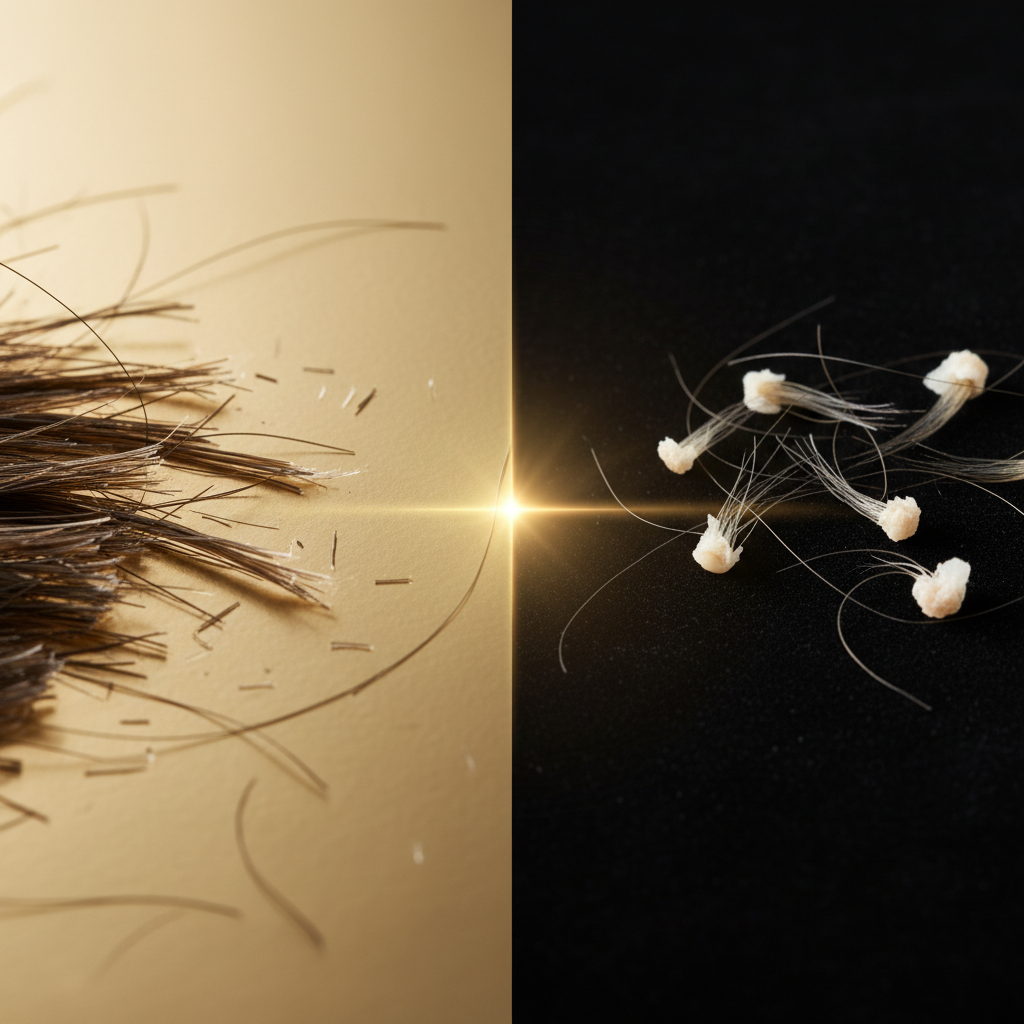
Pick up a fallen strand and inspect both ends against a dark background or under a magnifying glass. If one end features a small, soft, whitish or translucent node, this is the telogen root bulb. Its presence confirms follicular loss. If both ends are blunt, frayed, split, or tapered without a bulb, the hair has snapped along the shaft due to breakage.
Check the strand length
Compare the length of the fallen pieces to your current haircut. If you discover hundreds of tiny, jagged, 2 to 5 centimetre fragments on your bathroom counter, clothes, or pillowcase, you are observing hair shaft breakage. If the fallen strands match the full length of your hair, the fibre has detached from the follicle.
Inspect the scalp surface
Stand under direct lighting and examine your scalp. Follicular loss often presents as overall diffuse thinning, a widening central part, or receding temples, with an otherwise smooth scalp surface. Breakage, particularly when caused by heat tools or chemical over-processing, often creates an uneven halo of short, flyaway hairs, rough frizzy patches, and split ends along the perimeter.
| Diagnostic Feature | Hair Shaft Breakage | Follicular Loss |
|---|---|---|
| Point of separation | Along the fibre (cortex fracture) | Inside the scalp (dermal papilla) |
| Visible root bulb | Absent (both ends look fractured) | Present (small white/translucent bulb) |
| Strand length | Variable, short, jagged fragments | Full length of existing hair |
| Scalp density | Follicles remain fully populated | Diffuse thinning, widening part, or patches |
| Primary causes | Heat, bleach, friction, brushing | Genetics, hormones, illness, nutritional deficits |
| Effective solution | Conditioning, bond repair, gentler styling | Scalp care, clinical therapies, dietary review |
What the evidence does not show
There is no scientific evidence that hair breakage causes follicular hair loss. A snapping hair fibre does not weaken, pull on, or damage the underlying follicle unless extreme physical tension is applied continuously (known as traction alopecia).
Similarly, cosmetic products such as deep conditioners, keratin treatments, and smoothing serums do not penetrate the scalp to treat follicular alopecias. While topical cosmetics excel at reducing friction, sealing the cuticle layer, and preventing further breakage, they cannot reverse genetic miniaturisation or arrest systemic telogen effluvium. Clear expectations prevent frustration: address shaft issues with structural care and root issues with biological support.
Mechanical and biological mechanisms explained
The strength of the hair shaft relies on two critical chemical bonds: temporary hydrogen bonds and permanent disulphide bonds. When you wash your hair, water temporarily breaks the hydrogen bonds, swelling the fibre and increasing elasticity while reducing tensile strength. Brushing wet hair roughly exerts pulling forces that easily exceed the yield point of the wet cortex, leading to structural fractures. Furthermore, bleaching agents oxidise cystine into cysteic acid, stripping up to 30 percent of the shaft's native strength and making it brittle.
Follicular shedding, by comparison, is governed by neuroendocrine and cellular signalling pathways. In conditions like telogen effluvium, an acute trigger such as high fever, severe psychological stress, rapid weight loss, or childbirth shocks up to 30 percent or more of anagen hairs into the catagen (transitional) phase. Approximately two to three months later, these hairs enter the telogen phase and shed en masse.
In androgenetic alopecia, follicular loss is mediated by dihydrotestosterone (DHT) binding to androgen receptors within genetically susceptible follicles, shortening the anagen cycle and shrinking the dermal papilla until the hair turns into fine, vellus fuzz.
What you can do to address each condition
Pinpointing your primary issue allows you to tailor your routine for maximum benefit.
Interventions for hair shaft breakage
- Lower your styling temperatures: Keep heat tools below 175°C and always apply a silicone- or polymer-based thermal protectant beforehand.
- Minimise wet mechanical friction: Hair is most fragile when wet. Swap rough cotton bath towels for a gentle microfibre towel or cotton T-shirt, and detangle exclusively using a wide-tooth comb from ends to roots.
- Use bond-builders and protein conditioners: Hydrolysed wheat protein, keratin, and cationic conditioning agents help fill microscopic voids in a damaged cuticle, restoring flexibility and preventing snaps.
- Limit chemical overlaps: Ensure bleaches, relaxers, and permanent dyes are applied strictly to new growth rather than overlapping previously processed lengths.
Interventions for follicular loss
- Review nutritional foundations: Consult a doctor to check serum ferritin (iron stores), vitamin D, zinc, and thyroid hormones (TSH, free T4). Correcting low iron stores (ideally keeping ferritin above 50 ug/L for optimal hair cycling) can help support normal follicular function.
- Reduce scalp tension: Avoid high, tight ponytails, weaves, or extensions that strain the follicle base.
- Support the scalp environment: Keep the scalp clean, clear of sebum build-up, and calm. Cosmetic stimulating formulations featuring caffeine and biotin can help enhance the appearance of fullness and condition the scalp surface.
Supportive care from Watermans
For those navigating both fragile strands and reduced density, an integrated topical regimen can help create the best possible cosmetic environment. Watermans Grow Me Shampoo and Conditioner are formulated with ingredients such as biotin, caffeine, rosemary extract, niacinamide, and hydrolysed lupin protein.
While cosmetic formulations do not cure medical alopecias, these carefully balanced ingredients fortify the hair cuticle to visibly reduce breakage during washing while revitalising the scalp to leave hair looking thicker, denser, and stronger.
When to seek professional advice
If your hair shedding exceeds 100 to 150 full-length strands per day for longer than two consecutive months, book an appointment with your GP, a dermatologist, or a qualified trichologist. Seek immediate professional assessment if you notice:
- Sudden patchy, circular bald spots (characteristic of alopecia areata).
- Burning, itching, flaking, or pain across the scalp accompanying the loss.
- Signs of scarring, such as shiny, poreless scalp skin.
- Significant thinning accompanied by fatigue, irregular menstrual cycles, or sudden weight fluctuations.
Frequently asked questions about Hair Shaft Breakage vs Follicular Loss
How can I tell Hair Shaft Breakage vs Follicular Loss apart at home?
The most reliable test is inspecting the fallen hair ends. Follicular loss yields a full-length hair with a small, visible, whitish bulb at the root end. Breakage yields shorter, uneven fragments with blunt, fractured, or split ends and no root bulb.
Can severe breakage make your hair look thin all over?
Yes. Although the scalp follicles remain dense and intact, excessive breakage throughout the mid-lengths and ends strips away perimeter volume, making your hair look thin, wispy, and uneven.
Does brushing cause breakage or follicular shedding?
Brushing primarily causes breakage if you drag bristles through dry knots or fragile wet hair. However, normal brushing also dislodges loose telogen hairs that have already detached from the follicle and were merely resting within the hair canopy.
Can you experience both breakage and follicular loss simultaneously?
Yes. Many people experience both simultaneously. For instance, you might experience postpartum telogen effluvium while also having heat-damaged, brittle ends from frequent styling tools. Addressing both requires gentle handling along the lengths and nutritional or clinical support for the scalp.
Will broken hair grow back from the root?
Yes. Because breakage only fractures the external fibre, the underlying follicle is undamaged. It continues its normal biological growth cycle, producing new hair at the average rate of 1 to 1.25 centimetres per month.
Managing Hair Shaft Breakage vs Follicular Loss effectively
Successfully navigating Hair Shaft Breakage vs Follicular Loss requires honest identification of where your hair is separating. By checking fallen strands for the tell-tale white bulb, measuring fragment lengths, and evaluating your styling habits, you can immediately determine whether your hair demands gentler physical care or clinical, biological evaluation. Tailor your routine to the specific mechanism at play, protect your cuticle from preventable trauma, and consult a qualified medical professional whenever unexplained follicular shedding persists.
Sources and references
- British Association of Dermatologists. Telogen Effluvium: Patient Information Leaflet. 2021.
- Robbins, C. R. Chemical and Physical Behavior of Human Hair. 5th ed. Springer, 2012.
- Sinclair, R. D. "Healthy hair: what is it?" Journal of Investigative Dermatology Symposium Proceedings, 2007.
- National Institute for Health and Care Excellence (NICE). Alopecia androgenetica: Clinical Knowledge Summaries. 2022.
- Trueb, R. M. "Shampoos: Ingredients, benefits and adverse effects." Journal of the European Academy of Dermatology and Venereology, 2001.
Find these ingredients in Watermans products
- Zinc: you will find this ingredient in our Hair Vitamins.
- Niacinamide: you will find this ingredient in our Hair Mask.