Diffuse Thinning: Understanding Widespread Hair Density Loss
9 min read ·
Diffuse Thinning causes widespread hair density loss across the entire scalp. Discover the clinical causes, evidence-based treatments, and how to tell shedding from breakage.

Quick answer: Diffuse Thinning describes a widespread, generalised reduction in hair density across the entire scalp rather than in concentrated patches or a receding hairline. It occurs when large numbers of follicles simultaneously enter a resting phase or undergo progressive miniaturisation. While Diffuse Thinning affects both men and women, pinpointing the exact driver requires careful clinical evaluation because multiple triggers, including acute telogen effluvium, nutritional deficiencies, and diffuse androgenetic alopecia, present with nearly identical visual symptoms.
Key takeaways
- Diffuse Thinning involves generalised density reduction across the scalp rather than focal bald patches or localized recession.
- The two most common clinical drivers are telogen effluvium (rapid shedding) and diffuse unpatterned alopecia (gradual miniaturisation).
- Triggers range from physiological shock, severe illness, and thyroid disorders to ferritin deficiency and hormonal shifts.
- Hair shedding differs fundamentally from hair breakage: shedding releases club hairs from the root, whereas breakage involves structural fracture along the shaft.
- Recovery timelines depend on the root cause; acute shedding often resolves within 6 to 9 months once the trigger is corrected, while genetic thinning requires ongoing management.
Diffuse Thinning: what the evidence shows
Clinical dermatology classifies Diffuse Thinning as an overall decrease in hair density where the scalp becomes visible through existing strands across multiple zones. Research published by the British Association of Dermatologists and the American Academy of Dermatology demonstrates that widespread thinning reflects systemic disruptions to normal follicular cycling.

Under normal circumstances, approximately 85 to 90 percent of scalp follicles reside in the anagen (growth) phase, lasting anywhere from 2 to 7 years. Roughly 10 to 15 percent rest in the telogen phase for around 100 days before shedding. When an internal stressor alters this equilibrium, up to 30 to 50 percent of active follicles can abruptly transition into telogen. Two to three months later, those hairs shed en masse, producing noticeable Diffuse Thinning.
Evidence indicates that diffuse loss divides into two primary biological categories:
- Telogen Effluvium (TE): A reactive, non-scarring condition characterised by abrupt, excessive shedding of normal telogen club hairs. It is typically triggered by a specific physiological or emotional event.
- Diffuse Androgenetic Alopecia (DAGA) or Diffuse Unpatterned Alopecia (DUPA): A progressive miniaturisation of hair follicles driven by genetic sensitivity to dihydrotestosterone (DHT). While classic pattern loss recedes at the temples or crown, diffuse variants thin uniformly across the vertex or the entire scalp.
What the evidence does not show
Controlled medical research does not support the idea that everyday external hair habits cause true diffuse loss:
- Frequent shampooing does not cause Diffuse Thinning. Washing simply dislodges hairs that have already detached from the dermal papilla weeks earlier. Avoiding the shower does not save the hair; it merely gathers shed strands on the scalp until the next wash.
- Hard water and chlorine do not induce systemic thinning. While mineral buildup can leave hair brittle, dry, and prone to mechanical breakage, it does not cause follicles across the scalp to abort their growth phase. Breakage is a cosmetic fibre issue, not follicular shedding.
- Topical cosmetic shampoos do not cure genetic thinning or systemic deficiencies. Shampoos and scalp drops can optimise the scalp environment, reduce surface inflammation, and make strands look and feel thicker. However, cosmetic formulas cannot alter underlying ferritin levels, correct thyroid disease, or alter inherited androgen sensitivity.
Mechanisms: how diffuse loss develops
The biological mechanism depends on whether the thinning stems from cycle synchronisation or follicular miniaturisation.
Premature catagen transition
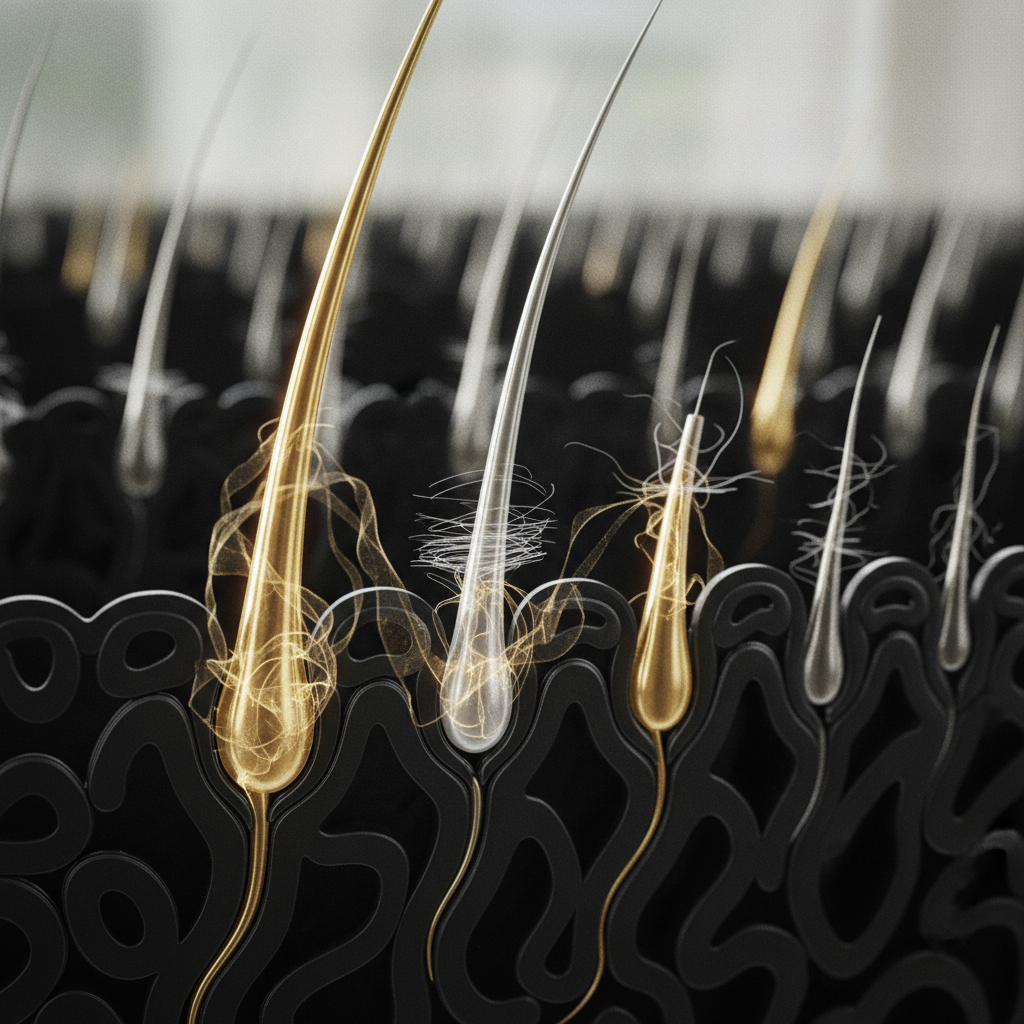
In acute telogen effluvium, an acute physiological insult (such as high fever, surgery, crash dieting, or childbirth) triggers a spike in pro-inflammatory cytokines and neuroendocrine hormones. These signalling molecules prompt growing anagen follicles to terminate early and transition into catagen, the brief regression phase. The hair bulb detaches from its vascular supply, forms a keratinised club root, and moves into telogen. Because the telogen resting phase lasts roughly 2 to 4 months, the visible shedding surge appears weeks after the original trigger has passed.
Follicular miniaturisation
In diffuse androgenetic presentations, the enzyme 5-alpha reductase converts circulating testosterone into dihydrotestosterone (DHT) within the scalp tissue. In genetically susceptible follicles, DHT binds to androgen receptors, shortening the anagen phase and elongating the telogen phase over successive cycles. Each new hair fibre grows thinner, shorter, and less pigmented. Over several years, widespread miniaturisation reduces total hair mass across the head without leaving an outright bald spot.
Signs to look for: identifying the pattern
Recognising how hair departs the scalp provides immediate diagnostic clues.
- Widening part lines: The central or side parting appears visibly broader, exposing more pale scalp under direct light.
- Reduced ponytail circumference: Many women notice that hair ties wrap three or four times instead of two, indicating a substantial loss of global volume.
- Excessive daily shedding: Losing more than 100 to 150 hairs daily across brushes, pillows, and shower drains over a sustained period of more than 4 weeks.
- Presence of white bulbs: Shed strands exhibit a small, white, bulbous tip (a telogen club hair), confirming that the hair shed from the root rather than snapping along the shaft.
- Absence of distinct focal patches: Unlike alopecia areata, which leaves smooth, coin-sized bare circles, diffuse presentations display a uniform reduction in density with hair still present across the area.
Comparing Diffuse Thinning presentations
Understanding the differences between common causes helps set realistic expectations for recovery:
| Feature | Acute Telogen Effluvium | Chronic Telogen Effluvium | Diffuse Androgenetic Alopecia | Mechanical Breakage |
|---|---|---|---|---|
| Onset | Sudden (2 to 3 months post-trigger) | Fluctuating, lasts over 6 months | Slow, gradual over years | Variable, follows heat or chemical use |
| Primary Root Cause | Systemic shock, illness, rapid weight loss | Persistent deficiency, thyroid, stress | Genetic sensitivity to DHT | Structural cuticle and cortex damage |
| Follicle Status | Healthy, temporary resting state | Healthy, cycling prematurely | Miniaturising follicles | Intact follicle; broken shaft |
| Shedding Characteristic | Club hairs with white bulbs | Club hairs with white bulbs | Short, fine, miniaturised hairs | Short hair fragments with no bulb |
| Typical Outlook | High spontaneous recovery (6 to 9 months) | Resolves once trigger is treated | Progressive without active management | Resolves with gentle handling and trims |
What you can do: evidence-based steps
Addressing widespread density reduction requires a two-step approach: investigating internal health markers while supporting hair fibre integrity externally.
1. Request comprehensive blood panels
Before investing in supplements, visit a GP or trichologist to test key systemic markers. Common panels include:
- Serum Ferritin: Iron stores should ideally register above 50 to 70 ug/L for optimal hair cycling; lower levels frequently prolong shedding.
- Thyroid Function (TSH, Free T3, Free T4): Both hypo- and hyperthyroidism disrupt follicular metabolic activity.
- Vitamin D3 and B12: Deficiencies correlate with impaired anagen development.
- Full Blood Count (FBC): Screens for underlying systemic inflammation or anaemia.
2. Balance nutritional intake
Hair is non-essential tissue; when calories or macronutrients drop, the body diverts protein and micronutrients away from follicle synthesis to preserve vital organs. Aim for balanced dietary protein (1.2 to 1.5 grams per kilogram of body weight if medically suitable), complex carbohydrates, and essential fatty acids.
3. Handle fragile strands gently
When density drops, surviving hairs must be protected from mechanical breakage, which exaggerates the visual loss:
- Use wide-tooth combs or flexible detangling brushes starting at the ends.
- Keep heat styling tools under 180 degrees Celsius and apply heat protection.
- Avoid tight updos, high ponytails, or extensions that place traction on already vulnerable follicles.
4. Maintain a healthy scalp environment
A clean, flake-free scalp provides the best foundation for emerging hairs. Excess sebum, malassezia yeast buildup, and mild perifollicular inflammation can compromise follicle health. Regular washing with balanced cleansers (pH 5.0 to 5.5) supports skin barrier function.
Premium topical support: Watermans
While internal triggers must always be addressed with medical guidance, high-performance topical care plays a valuable role in keeping existing hair feeling full and resilient.
Watermans Grow Me Shampoo and Condition Me Conditioner are formulated to optimise the scalp environment and strengthen fragile fibres. Formulated with biotin, rosemary extract, caffeine, niacinamide, argan oil, and allantoin, these products nurture the scalp surface, improve moisture retention, and reduce mechanical breakage. For individuals dealing with diffuse shedding, keeping the remaining lengths robust and the scalp cleansed helps hair look noticeably fuller and healthier while internal cycles reset.
When the cause may be something else
Diffuse thinning can occasionally mask more complex dermatological conditions. If shedding is accompanied by scalp itching, burning, flaking, or pain (trichodynia), consider these possibilities:
- Early Cicatricial (Scarring) Alopecia: Conditions like Frontal Fibrosing Alopecia or Lichen Planopilaris sometimes begin with subtle diffuse shedding before follicle destruction becomes obvious.
- Diffuse Alopecia Areata: An uncommon autoimmune variant where T-cells attack follicles across the scalp rather than creating defined patches.
- Severe Mechanical Breakage: Over-processed, bleached, or heat-damaged hair can snap close to the scalp across large sections. A trichologist can check the ends under a dermatoscope: broken hairs have jagged, frayed tips without the characteristic white bulb of a shed root.
Frequently asked questions about Diffuse Thinning
Can Diffuse Thinning reverse on its own?
Yes, when caused by acute telogen effluvium, Diffuse Thinning frequently resolves without clinical intervention once the inciting trigger (such as severe fever, surgery, or temporary stress) is removed. Follicles naturally return to anagen within 3 to 6 months, though full aesthetic density may take 12 to 18 months to grow down the length of the hair.
How do I tell if my diffuse loss is genetic or telogen effluvium?
Telogen effluvium begins abruptly, with massive shedding of full-length club hairs from all over the head. Diffuse genetic thinning progresses gradually over years, producing progressively thinner, shorter hairs rather than sudden handfuls in the drain. A trichologist uses a dermatoscope to check for hair diameter diversity (miniaturisation), which confirms androgenetic thinning.
Does stress alone cause Diffuse Thinning?
Severe physiological or psychological stress can trigger telogen effluvium. High cortisol levels and systemic stress neuropeptides cause growing follicles to enter the resting catagen phase prematurely. The shedding typically appears 8 to 12 weeks after the stressful episode occurs.
What blood tests should I ask my doctor for?
Ask for a full blood count (FBC), serum ferritin, total iron-binding capacity, thyroid stimulating hormone (TSH), free T4, vitamin D3, vitamin B12, and folate. If symptoms include irregular periods or acne, hormonal panels (total and free testosterone, DHEA-S) are also helpful.
Will cutting my hair make it grow back thicker?
Cutting your hair does not alter follicle count, growth rate, or fibre diameter. However, a shorter haircut removes weighted, straggly ends and gives the illusion of greater density, making diffuse thinning far less visible while new growth emerges.
The path to restoring density
Navigating Diffuse Thinning requires patience and diagnostic clarity. Because hair follicles operate on prolonged biological clocks, changes initiated today take months to manifest visibly at the surface. Identifying whether your shedding is an acute response to a biological event or a slow genetic shift is the foundation of effective care. By combining medical evaluation with gentle handling and scalp-nourishing routines, you can support your follicles through their natural recovery cycle and maintain optimal hair density over time.
Sources and references
- British Association of Dermatologists. "Telogen Effluvium: An Information Leaflet." Updated 2021.
- American Academy of Dermatology Association. "Hair loss: Diagnosis and treatment." 2023.
- Asghar, F., et al. "Telogen Effluvium: A Review of the Etiology, Pathophysiology, and Management." Clinical, Cosmetic and Investigational Dermatology, 2020.
- Malkud, S. "Telogen Effluvium: A Review." Journal of Clinical and Diagnostic Research, 2015.
- National Institute for Health and Care Excellence (NICE). "Alopecia androgenetica - clinical summary." 2022.