Demdex: Follicular Mites, Scalp Health, and Hair Shedding
9 min read ·
Learn the facts about demdex mites on the scalp, their real role in hair shedding, how overgrowth happens, and clinical steps to restore balanced follicles.

Quick answer: Searches for demdex almost always refer to Demodex, a microscopic genus of follicular mites that live naturally on human skin and within hair follicles. These organisms feed on sebum and dead skin cells, usually causing no symptoms at all. However, an overproliferation of demdex mites can trigger inflammatory scalp conditions, redness, flaking, and secondary hair shedding. While they rarely cause permanent baldness on their own, high mite densities disrupt follicle health and warrant medical evaluation.
Key takeaways
- The term demdex is the most common search misspelling for Demodex, microscopic mites that inhabit human pilosebaceous units.
- Two main species live on humans: Demodex folliculorum (found primarily in hair follicles) and Demodex brevis (found deeper in sebaceous glands).
- Almost all adult humans host these mites as part of the normal cutaneous microbiome without experiencing any adverse symptoms.
- Clinical issues arise when mite populations surge, leading to conditions like demodicosis, blepharitis, or scalp inflammation.
- Mites do not bite hair strands off or cause scarring alopecia, but the inflammation caused by an overpopulation can trigger telogen effluvium (hair shedding).
- Targeted dermatological treatments include topical acaricides such as ivermectin, permethrin, or regulated tea tree oil formulations.
Demdex: what the evidence shows
Microscopic analysis reveals that demdex mites are obligate human ectoparasites adapted to survive inside the sebum-rich environment of our pores. Demodex folliculorum measures roughly 0.3 to 0.4 mm in length and clusters within the upper follicular infundibulum. In contrast, Demodex brevis is slightly shorter, around 0.15 to 0.2 mm, preferring the deeper sebaceous and meibomian glands.

Under normal physiological conditions, these organisms function as commensals. They consume cellular debris and excess lipids, keeping bacterial colonization in check. Epidemiological studies published in dermatology journals indicate that colonization approaches 100 percent in adults over the age of 70, as cumulative exposure and increased sebum production create an optimal habitat.
Trouble begins when host immunity falters or the epidermal barrier breaks down. When mite density exceeds 5 mites per square centimetre (or more than 3 per follicle), dermatologists classify the state as demodicosis. At this density, the sheer physical presence of the mites, along with the bacteria they release upon death (Bacillus oleronius), triggers a host immune response characterized by erythema, follicular plugging, intense itching, and scaling around the hair root.
What the evidence does not show
There is no credible scientific evidence showing that demdex mites are the primary cause of pattern baldness (androgenetic alopecia). While internet forums often claim that mites "eat the hair root" and cause irreversible baldness, clinical dermatology does not support this mechanism. Androgenetic alopecia is driven by genetic sensitivity to dihydrotestosterone (DHT) causing progressive follicular miniaturisation, not by arachnid predation.
Furthermore, evidence does not show that vigorous physical scrubbing or scalding water will eradicate the mites. Because they reside deep within the hair follicle canal, superficial abrasion only damages the surrounding skin barrier, exacerbating inflammation while leaving the mites unharmed. Complete sterilization of the scalp is neither achievable nor medically desirable, as these organisms are a standard component of healthy human skin flora.
Biological mechanism: how mites affect the scalp
Understanding the life cycle of the mite clarifies how overgrowths cause clinical symptoms. The organism progresses through five distinct stages: egg, larva, protonymph, deutonymph, and adult. The entire life cycle spans approximately 14 to 18 days inside the follicle.
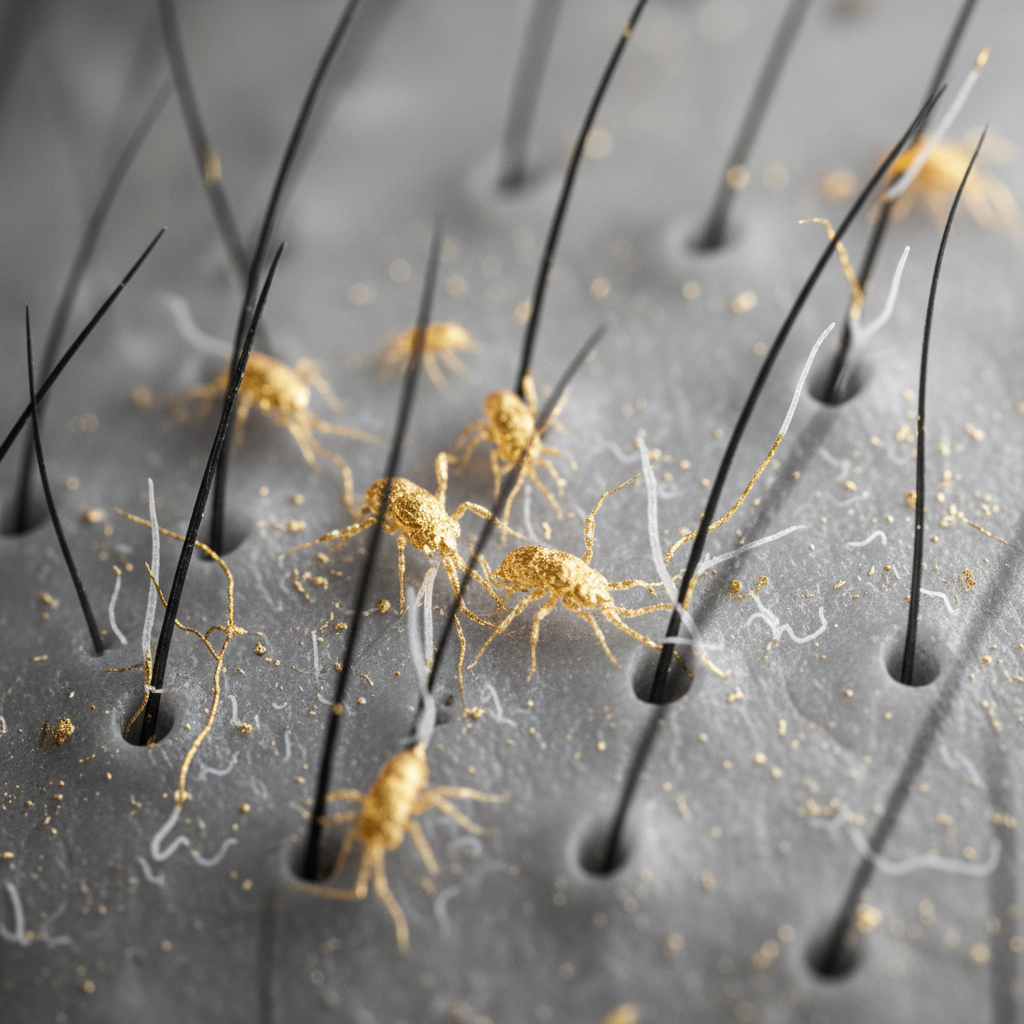
Because these mites lack an internal excretory orifice, they accumulate digestive waste throughout their lifespan. When an individual mite dies inside the follicle, its body disintegrates, releasing all accumulated waste proteins, cellular toxins, and symbiotic bacteria directly into the surrounding tissue.
In small numbers, the body clears this debris without noticeable reaction. In high numbers, this continuous release of foreign antigens causes significant perifollicular inflammation. The surrounding tissue swells, the stratum corneum thickens (hyperkeratosis), and the follicle struggles to complete its normal hair growth cycle. The resulting irritation can push active anagen (growth phase) follicles prematurely into the telogen (resting phase), leading to diffuse hair shedding.
| Factor | Commensal Demodex Presence | Pathological Demodicosis |
|---|---|---|
| Mite Density | Fewer than 5 mites per cm² | Exceeds 5 mites per cm² (or >3 per follicle) |
| Scalp Sensation | Asymptomatic (no sensation) | Itching, formication (crawling feeling), burning |
| Visible Signs | Clear scalp, normal sebum flow | Erythema, follicular scale, cylindrical dandruff |
| Hair Fibre Impact | None; hair cycles normally | Increased shedding due to perifollicular inflammation |
| Treatment Required | None; maintain normal hygiene | Topical acaricides (e.g., ivermectin) prescribed by a doctor |
Signs of high mite density on the scalp
An overgrowth of demdex mites presents with specific clinical signs that distinguish it from standard dandruff or eczema. A dermatologist or trichologist typically checks for the following indicators:
- Cylindrical dandruff: Also known as "collarettes", these are small, clear-to-waxy sheaths that wrap tightly around the base of the hair shaft at the scalp surface.
- Formication: A distinctive crawling or tickling sensation on the scalp, particularly noticeable at night when the mites emerge from the follicles to mate across the skin surface.
- Persistent itching and redness: Follicular erythema that fails to resolve with standard anti-dandruff zinc pyrithione or ketoconazole shampoos.
- Diffuse hair shedding: An increase in daily hair fall without clear patchy bald spots, caused by inflammatory stress on the follicle base.
- Secondary facial symptoms: Concomitant signs of ocular blepharitis (crusting on eyelashes) or papulopustular rosacea across the cheeks and forehead.
When the cause may be something else
Scalp irritation, flaking, and shedding stem from dozens of common dermatological conditions that mimic mite proliferation. Before assuming an overgrowth is present, clinicians rule out alternate explanations:
- Seborrhoeic dermatitis: Driven primarily by an overgrowth of Malassezia yeast interacting with sebum, producing greasy, yellowish flakes rather than cylindrical collars.
- Scalp psoriasis: An autoimmune condition causing rapid skin cell turnover, marked by thick, silvery plaques with well-defined borders.
- Telogen effluvium: Acute shedding triggered by systemic stressors such as high fever, nutritional deficiencies (e.g., ferritin or vitamin D), hormonal shifts, or surgery.
- Contact dermatitis: An allergic or irritant response to ingredients in hair dyes, fragrances, or styling products, causing acute burning and redness.
What you can do: clinical management and scalp care
If diagnostic testing confirms symptomatic demodicosis, management focuses on reducing the population density back to normal commensal levels rather than complete eradication.
Medical treatments
Dermatologists prescribe targeted anti-parasitic agents. Topical ivermectin (1% cream) and permethrin (5% cream) are widely used and supported by peer-reviewed clinical trials. In severe or recalcitrant presentations, a short course of oral ivermectin or oral metronidazole may be prescribed under medical supervision.
Over-the-counter and botanical options
Formulations containing purified tea tree oil (specifically its active component, terpinen-4-ol) have demonstrated acaricidal efficacy in laboratory and clinical settings. Undiluted tea tree oil is highly irritating and can trigger contact dermatitis; always use properly formulated cosmetic cleansers designed for scalp or eyelid hygiene that keep the concentration within safe, tested parameters (typically 1 to 5 percent).
Hygiene and lifestyle measures
Wash pillowcases and bed linens regularly at temperatures of 60°C or higher to eradicate shed mites. Avoid excessively heavy, occlusive scalp oils (such as mineral oil or pure coconut oil) if you are prone to flare-ups, as excessive lipid layers can create an uncontrolled feeding environment for the population.
Supporting the scalp environment with Watermans
When managing scalp recovery after addressing high mite density, maintaining a clean, balanced follicular environment is paramount. Products that eliminate excess surface sebum without stripping the skin barrier help keep the scalp hospitable for healthy hair retention.
Watermans Grow Me Shampoo is formulated with caffeine, biotin, argan oil, and rosemary extract to cleanse accumulated debris, support optimal scalp vitality, and promote stronger-feeling hair. Pairing proper clinical guidance with targeted, non-greasy cosmetic support ensures the scalp remains balanced, reducing the likelihood of inflammatory shedding and fibre breakage.
When to get professional advice
You should consult a general practitioner, dermatologist, or registered trichologist whenever scalp symptoms fail to respond to standard hygiene within two to four weeks.
Seek rapid evaluation if you notice pustules, severe scalp pain, rapid circular patches of hair loss, or irritation spreading to your eyelids and eyes. A clinician can perform a standardized skin surface biopsy (SSSB) using cyanoacrylate adhesive or pluck a few hairs for direct microscopic examination to quantify the mite density accurately before prescribing potent medical acaricides.
Frequently asked questions about demdex
What is the difference between demdex and normal dandruff?
Normal dandruff is primarily driven by the Malassezia yeast metabolising sebum into irritating oleic acid, resulting in loose, visible white or yellow flakes. Demdex issues stem from microscopic mites residing inside the pore, typically creating tight cylindrical collarettes around individual hair shafts, accompanied by night-time itching and localized follicle redness.
Can demdex mites cause permanent baldness?
No, the mites do not destroy the hair bulb or cause scarring alopecia. However, high densities provoke chronic perifollicular inflammation, which can disrupt the hair cycle and trigger telogen effluvium. Once the mite population is controlled and the inflammation subsides, affected follicles generally resume normal hair production.
How do doctors test for demdex overgrowth?
Clinicians most commonly use a standardized skin surface biopsy (SSSB), applying a drop of cyanoacrylate adhesive to a microscope slide and pressing it against the skin for one minute. Alternatively, they pluck several hairs and examine the root sheaths under a light microscope to count the number of mites per unit area.
Can you catch demdex mites from other people?
Yes, direct physical contact or sharing contaminated towels, pillows, and brushes can transfer mites. However, because almost every adult already carries a baseline population of these commensal organisms, transmission rarely causes symptoms unless the recipient's immune defences or skin barrier are compromised.
Closing thoughts on demdex
Understanding that demdex mites are a normal component of the human skin ecosystem shifts the focus from anxiety to practical management. You do not need to eliminate every organism to maintain a calm, healthy scalp; you only need to support your skin's natural defences and prevent population surges. By maintaining sensible scalp hygiene, avoiding heavy pore-clogging residues, and seeking timely dermatological treatment when persistent flaking or irritation appears, you can easily maintain follicle health and preserve strong hair growth.
Sources and references
- British Association of Dermatologists. Guidelines for the management of rosacea and related demodicosis disorders. 2021.
- Forton, F. M. N. "Papulopustular rosacea, skin immunity and Demodex: pityriasis folliculorum as a missing link." Journal of the European Academy of Dermatology and Venereology, 2012. DOI: 10.1111/j.1468-3083.2011.04312.x.
- Rather, P. A., & Hassan, I. "Human Demodex Mite: The Versatile Mite of Dermatological Importance." Indian Journal of Dermatology, 2014. DOI: 10.4103/0019-5154.125193.
- Lacey, N., et al. "Bacillus oleronius as a trigger of inflammation in demodicosis and rosacea." British Journal of Dermatology, 2007. DOI: 10.1111/j.1365-2133.2007.08056.x.
- National Health Service (NHS). "Blepharitis and dry eyes associated with Demodex mites." NHS Health A to Z, 2023.
Find these ingredients in Watermans products
- Zinc: you will find this ingredient in our Hair Vitamins.
- Oleic Acid: you will find this ingredient in our Camellia & Black Castor Hair & Body Oil.