Cicatricial Alopecia Causes: Understanding Scarring Hair Loss
8 min read ·
Explore the biological mechanisms and Cicatricial Alopecia Causes, covering stem cell destruction, immune pathways, genetics, and clinical signs.
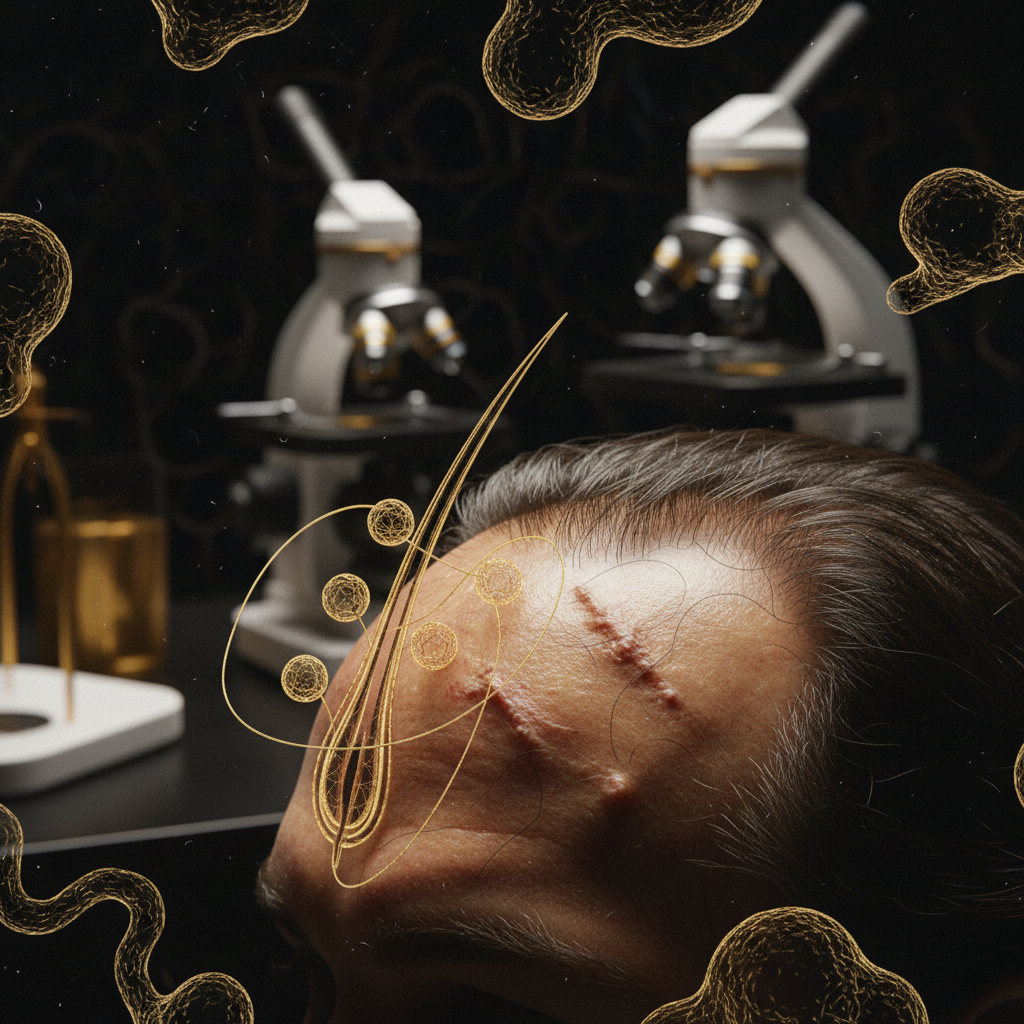
Quick answer: Investigating Cicatricial Alopecia Causes reveals that this group of rare disorders stems from targeted inflammation that permanently destroys follicular stem cells in the hair follicle bulge. Unlike non-scarring shedding, primary causes involve immune dysregulation, genetic susceptibility, neutrophil or lymphocyte infiltration, and lipid metabolism errors. Secondary causes include physical trauma, burns, and severe infections. The main limitation is that lost follicles cannot regenerate once replaced by fibrous scar tissue, making rapid medical diagnosis crucial to arrest progression before permanent hair loss occurs.
Key takeaways
- Cicatricial (scarring) alopecia occurs when inflammatory cells permanently destroy epithelial stem cells located in the follicular bulge.
- Primary forms are driven by intrinsic inflammation classified by the dominant immune cell: lymphocytic, neutrophilic, or mixed.
- Secondary forms result from external tissue destruction, including burns, radiation, severe fungal infections, or surgical trauma.
- Common primary subtypes include lichen planopilaris, frontal fibrosing alopecia, and central centrifugal cicatricial alopecia.
- Cosmetic products, hard water, and everyday grooming do not cause primary scarring alopecia, though harsh chemical relaxers or tight traction can accelerate specific variants.
- Treatment aims solely at halting active inflammation, because hair follicles replaced by fibrous tissue cannot regrow.
Cicatricial Alopecia Causes: what the evidence shows
Research into Cicatricial Alopecia Causes demonstrates that the underlying trigger is an inflammatory attack on the hair follicle's immune privilege and regenerative core. Under healthy conditions, the follicular bulge, situated near the insertion of the arrector pili muscle, houses multipotent epithelial stem cells responsible for cycling the hair fibre through anagen, catagen, and telogen phases.

In primary cicatricial alopecia, an abnormal immune cascade targets this region. Dermatological studies published in peer-reviewed journals, such as the British Journal of Dermatology, show that this inflammatory response compromises the follicle's immune privilege. The body no longer recognises the upper follicle as protected tissue. Depending on the exact condition, distinct immune pathways drive this destruction:
- Lymphocytic inflammation: Driven primarily by T-lymphocytes attacking the upper follicle. Conditions include lichen planopilaris (LPP), frontal fibrosing alopecia (FFA), and discoid lupus erythematosus (DLE).
- Neutrophilic inflammation: Driven by neutrophils, frequently leading to pustules, crusting, and follicular destruction. Conditions include folliculitis decalvans and dissecting cellulitis of the scalp.
- Mixed inflammation: Involves both lymphocytes and neutrophils, seen in conditions such as folliculitis keloidalis.
In every primary pathway, once inflammation destroys the stem cells in the bulge and the sebaceous gland disappears, the body repairs the site with collagenous, fibrous scar tissue. The follicular ostium (the pore) closes permanently.
Follicular Stem Cell Attack
 │
 ▼
Loss of Immune Privilege & Sebaceous Glands
 │
 ▼
Fibrous Tissue Replacement (Scarring)
 │
 ▼
Permanent Loss of Follicular Ostium
Genetic and hormonal factors
Evidence highlights significant genetic links in conditions such as Central Centrifugal Cicatricial Alopecia (CCCA). Research has identified mutations in the PADI3 gene (peptidyl arginine deiminase 3), which alters protein modification essential for hair shaft formation, predisposing individuals to follicular inflammation.
Similarly, Frontal Fibrosing Alopecia, which predominantly affects post-menopausal women, strongly implicates hormonal shifts alongside genetic susceptibility. HLA antigen associations (specifically HLA-B*07:02) have been identified in genomic studies, confirming that an individual's genetic baseline plays a decisive role in whether these inflammatory pathways trigger.
Secondary causes of cicatricial alopecia
Secondary cicatricial alopecia does not originate as an autonomous attack on the follicle. Instead, the follicle is collateral damage from broader cutaneous trauma. Documented secondary causes include:
- Thermal or chemical burns destroying the full dermal depth.
- High-dose ionising radiation therapy.
- Deep, invasive cutaneous malignancies (such as squamous cell carcinoma or basal cell carcinoma).
- Severe, untreated infectious processes, such as kerion (a severe inflammatory tinea capitis) or cutaneous tuberculosis.
Primary vs secondary cicatricial alopecia causes
To clarify how different presentations develop, dermatologists distinguish between conditions that start inside the follicle and those caused by broader skin trauma.
| Feature | Primary Cicatricial Alopecia | Secondary Cicatricial Alopecia |
|---|---|---|
| Primary site of origin | Hair follicle epithelium and bulge stem cells | Non-follicular dermis, epidermis, or external insult |
| Leading drivers | Autoimmune dysregulation, PADI3 mutations, peroxisome dysfunction | Thermal burns, mechanical trauma, radiation, severe deep infections |
| Key histological subtypes | Lymphocytic, neutrophilic, or mixed inflammatory cell infiltrate | Granulation tissue, non-specific dermal fibrosis across tissue layers |
| Early clinical presentation | Perifollicular erythema, follicular hyperkeratosis, pustules | Visible burn, open ulcer, surgical scar, or prior infected lesion |
| Scalp pore appearance | Gradual loss of follicular ostia within active patches | Broad, uniform sheet of scar tissue across the entire damaged area |
| Primary treatment approach | Immunomodulators, oral tetracyclines, topical corticosteroids | Wound care, surgical reconstruction, treating underlying pathogen |
What the evidence does not show
There is no scientific evidence that general haircare products, ordinary scalp dryness, or standard dietary deficiencies cause primary cicatricial alopecia. Stylists and clients often worry that switching shampoos, washing hair in hard water, or experiencing routine emotional stress triggers these devastating conditions.
Cosmetic products do not penetrate to the dermal depth of the follicular bulge, nor do they provoke the complex T-cell mediated destruction seen in lichen planopilaris. While harsh chemical relaxers, tight braiding, and hot combs can aggravate inflammation in people genetically predisposed to CCCA, physical hair styling alone does not cause the condition in individuals without underlying susceptibility. Furthermore, standard nutritional deficits, such as low ferritin or vitamin D levels, cause diffuse telogen effluvium (shedding), not scarring follicular destruction.
Early signs of scarring hair loss
Distinguishing between non-scarring shedding and cicatricial alopecia early is critical, as prompt intervention can save surviving follicles. Watch for these clinical signs:
- Loss of follicular openings: The scalp surface looks smooth, shiny, and porcelain-like, with no visible pores where hair once emerged.
- Perifollicular erythema: Redness or violet discolouration concentrated precisely around the base of individual hair shafts.
- Follicular hyperkeratosis: Small collars of rough, scale-like keratin (casts) hugging the hair shaft as it exits the scalp.
- Active scalp sensations: Intense burning, tenderness, tingling, or itching that does not improve with standard anti-dandruff shampoos.
- Tufting (pili multigemini appearance): Multiple hair fibres emerging from a single compromised, inflamed opening, resembling the bristles of a toothbrush (classic in folliculitis decalvans).
When to seek medical advice
If you or a client exhibit any signs of inflammation paired with thinning or smooth patches, seek urgent consultation with a qualified dermatologist. Cicatricial alopecia is a medical emergency for the hair. General hair treatments, deep conditioning masks, and salon therapies cannot halt cellular inflammation.
A dermatologist will perform a physical trichoscopy examination and, in almost all cases, a 4 mm punch biopsy. The biopsy is essential: it captures tissue from the active margin of the hair loss, allowing a dermatopathologist to stain the tissue, identify whether the infiltrate is lymphocytic or neutrophilic, and establish the exact diagnosis. Treatments often involve prescription-strength topical or intralesional corticosteroids, oral hydroxychloroquine, doxycycline, or immunosuppressive therapies.
Supporting the scalp alongside medical care
While prescription medication is necessary to manage active disease, maintaining a calm, hygienic scalp environment supports overall comfort.
Watermans formulations, including botanical scalp serums and gentle shampoos, focus on cleansing residue and conditioning the scalp surface. Using mild, non-stripping cleansers helps wash away surface debris, excess sebum, and flaky build-up without mechanical trauma. Keep in mind that topical cosmetic products cannot reverse or treat primary scarring alopecia; they should be viewed strictly as supportive cosmetic care for surrounding non-scarred hair and general scalp cleanliness under your doctor's supervision.
Frequently asked questions about Cicatricial Alopecia Causes
What is the most common primary cause of scarring hair loss?
The most frequent causes belong to the lymphocytic group, notably Lichen Planopilaris (LPP) and Frontal Fibrosing Alopecia (FFA). In these conditions, an immune-mediated attack targets the follicular bulge stem cells, leading to gradual follicular destruction and irreversible fibrosis.
Can tight hairstyles trigger Cicatricial Alopecia Causes?
Hairstyles do not act as the sole trigger, but chronic traction and harsh chemical processing can contribute to Central Centrifugal Cicatricial Alopecia (CCCA) in individuals carrying a genetic vulnerability, such as variations in the PADI3 gene.
Does hard water cause scarring alopecia?
No. Hard water leaves mineral deposits on the hair fibre, causing hair to feel dry, brittle, and prone to mechanical breakage. It does not cause internal follicular inflammation, does not attack the bulge stem cells, and cannot produce scarring alopecia.
Can hair grow back once cicatricial alopecia destroys the follicle?
No. Once inflammation destroys the follicular stem cells and the pore closes with fibrous scar tissue, that specific follicle cannot regenerate natural hair fibres. This is why immediate medical treatment is necessary to protect the surrounding, surviving follicles.
How does an infection lead to secondary cicatricial alopecia?
Severe, deep-seated infections such as an untreated fungal kerion or chronic bacterial abscesses cause significant tissue necrosis. The intense inflammatory reaction destroys the entire dermal architecture, including healthy follicles, replacing them with a non-follicular scar.
Summary of cicatricial alopecia origins
Understanding Cicatricial Alopecia Causes separates benign shedding from destructive inflammatory disorders. Whether driven by lymphocytic infiltration in conditions like frontal fibrosing alopecia, neutrophilic action in folliculitis decalvans, or secondary physical injury, the central problem remains the destruction of stem cells in the hair follicle bulge. Cosmetic treatments cannot replace lost follicles once fibrosis occurs. Early clinical evaluation, accurate scalp biopsy, and targeted dermatological therapy remain the only proven methods to suppress inflammation and safeguard remaining hair.
Sources and references
- British Association of Dermatologists. Lichen Planopilaris Guidelines. 2020.
- National Institute for Health and Care Excellence (NICE). Alopecia: Management and Diagnosis. Clinical Knowledge Summaries, 2022.
- Harries, M. J., et al. "Management of primary cicatricial alopecias: a practical guide." British Journal of Dermatology, 2018.
- Malki, L., et al. "Variant PADI3 in Central Centrifugal Cicatricial Alopecia." New England Journal of Medicine, 2019.
- Filbrandt, R., et al. "Primary Cicatricial Alopecia: Diagnosis and Treatment." American Family Physician, 2013.
Find these ingredients in Watermans products
- Vitamin D: you will find this ingredient in our Hair Vitamins.