Chronic Telogen Effluvium: What the Evidence Shows
8 min read ·
Chronic Telogen Effluvium causes prolonged diffuse hair shedding lasting over six months. Learn about its mechanisms, diagnosis, and evidence-based management.

Quick answer: Chronic Telogen Effluvium is a primary scalp condition characterised by diffuse, excessive hair shedding across the entire scalp that persists for more than six months. Most commonly seen in otherwise healthy women aged 30 to 60, Chronic Telogen Effluvium fluctuates with cyclical bouts of heavy shedding and periods of relative calm. While it rarely results in complete baldness, its fluctuating course often makes identifying single triggers difficult and requires dedicated clinical evaluation to separate from patterned hair loss.
Key takeaways
- Chronic Telogen Effluvium involves diffuse shedding lasting longer than six months, distinguishing it from acute episodes.
- The condition predominantly affects women in their thirties, forties, and fifties with no obvious single systemic trigger.
- Total baldness does not occur because follicles continuously re-enter the growth cycle, though overall ponytail thickness often reduces significantly.
- Clinical distinction from early female pattern hair loss requires careful trichoscopy, as both conditions can present with perceived thinning.
- Management focuses on identifying underlying nutritional, hormonal, or metabolic cofactors while supporting the follicular environment.
Chronic Telogen Effluvium: what the evidence shows
First delineated by dermatologist Dr David Whiting in 1996, Chronic Telogen Effluvium (CTE) represents a distinct clinical entity rather than simply an acute shedding episode that failed to resolve. While acute telogen effluvium typically follows a clear physiological shock (such as high fever, severe illness, rapid weight loss, or childbirth) and resolves within three to six months, CTE follows an insidious, prolonged path.

Patients experience excessive, unremitting hair loss that can persist for years, frequently cycling between periods of severe daily loss and phases of moderate stabilisation. The hair shedding is generalised across the scalp rather than concentrated at the crown or hairline. A healthy scalp typically holds roughly 85 to 90 percent of follicles in the anagen (growing) phase and 10 to 15 percent in the telogen (resting) phase, shedding between 50 and 100 hairs per day. In CTE, a persistently higher percentage of follicles prematurely transition into the resting state, resulting in daily shed counts that frequently exceed 200 to 300 hairs.
Importantly, evidence indicates that follicles do not miniaturise or undergo permanent destruction in uncomplicated CTE. Instead, the hair cycle shortens. The anagen phase briefens, triggering follicles to move rapidly into catagen (regression) and telogen (shedding), producing repeated cycles of rapid growth and loss.
What the evidence does not show
Controlled research has not found a single, universal cause for Chronic Telogen Effluvium. Many individuals undergo extensive blood testing that returns entirely normal clinical markers.
Furthermore, evidence does not show that CTE leads to permanent, irreversible alopecia. Unlike scarring alopecias or advanced androgenetic alopecia, follicular openings remain viable and active. You will not see shiny, smooth areas of complete scalp bareness.
Finally, the evidence does not support using harsh topical stimulants without supervision, nor does it show that excessive shampooing increases shedding. Washing simply dislodges hairs that separated from the dermal papilla weeks prior; avoiding hygiene does not preserve anchored hair and may inflame the scalp.
The mechanism: shortening of the hair cycle
To understand CTE, one must examine the follicle's internal biological clock. Every hair follicle cycles independently through three main phases:
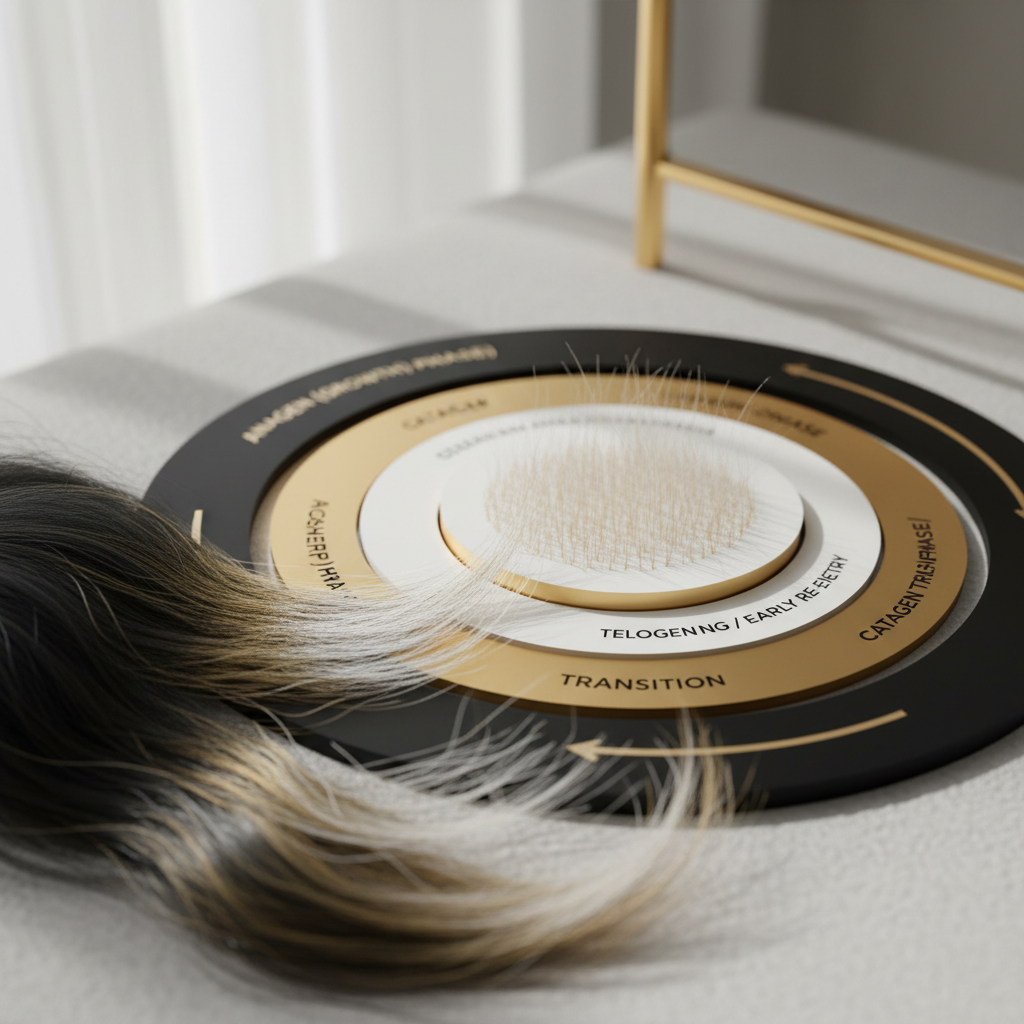
- Anagen: The active metabolic phase, normally lasting 2 to 7 years.
- Catagen: A brief involution phase lasting 2 to 3 weeks where the lower follicle regresses.
- Telogen: The resting phase lasting 2 to 4 months, culminating in exogen (shedding) as a new hair bud emerges underneath.
In Chronic Telogen Effluvium, the regular clock mechanism becomes dysregulated. The primary disturbance is an idiopathic shortening of the anagen duration. Because follicles spend less time in active growth, they enter telogen much sooner than expected.
Once in telogen, the hair fibre remains anchored until the end of the resting phase. This means the clinical shedding observed today reflects an altered signal received by the follicle two to four months earlier. Because anagen cycles reset rapidly, individuals often notice lots of short, newly emerging hairs along the frontal hairline alongside persistent shedding. These short hairs are often mistaken for breakage, but they represent a fresh wave of normal-calibre re-growth.
Signs to look for: CTE versus other conditions
Identifying CTE requires looking at specific clinical presentations across the hair shaft and scalp:
- Bitemporal thinning: Many patients notice diffuse reduction over the temples, but the frontal hairline itself remains stable and does not recede.
- Normal hair calibre: Shed hairs retain their full, thick diameter. They display the classic, unpigmented keratin bulb at the root (club hair).
- Trichodynia: Between 20 and 30 percent of patients report scalp tenderness, burning, or tingling alongside shedding episodes.
- Fluctuating shed counts: Hair counts rise and fall spontaneously over weeks or months, producing severe psychological distress.
The table below contrasts how Chronic Telogen Effluvium compares with Acute Telogen Effluvium and Female Pattern Hair Loss (Androgenetic Alopecia).
| Feature | Acute Telogen Effluvium | Chronic Telogen Effluvium | Female Pattern Hair Loss |
|---|---|---|---|
| Duration | Under 6 months | Over 6 months (often years) | Progressive, indefinite |
| Onset | Sudden, noticeable | Gradual, insidious | Slow, barely noticeable daily shedding |
| Identifiable trigger | Usually clear (illness, surgery, birth) | Rarely identifiable | Genetic / hormonal sensitivity |
| Pattern of loss | Diffuse across entire scalp | Diffuse across entire scalp | Crown and vertex thinning, preserved fringe |
| Follicle miniaturisation | Absent | Absent | Present (variable hair diameters) |
| Prognosis | Complete spontaneous recovery | Prolonged, fluctuating course | Progressive without treatment |
When the cause may be something else
Because diffuse hair loss presents similarly across multiple aetiologies, a clinician must rule out underlying medical issues before settling on an idiopathic diagnosis. Important confounders include:
- Thyroid dysfunction: Both hyperthyroidism and hypothyroidism disrupt follicle metabolism and cause ongoing shedding.
- Ferritin depletion: Stored iron deficiency (even without overt anaemia) impairs protein synthesis within the hair matrix. A serum ferritin below 30 to 50 micrograms per litre can aggravate shedding.
- Autoimmune disorders: Conditions such as systemic lupus erythematosus can present with non-scarring diffuse shedding.
- Drug reactions: Ongoing use of beta-blockers, anticoagulants, retinoids, or antidepressants can induce drug-associated telogen shedding.
What you can do to support the scalp
While primary CTE has no instant pharmaceutical cure, supporting follicular vitality and eliminating cofactors forms the cornerstone of effective management:
- Screen blood levels: Work with your doctor to check complete blood count, ferritin, vitamin D, vitamin B12, zinc, and thyroid-stimulating hormone (TSH). Correcting even modest nutritional deficits helps establish optimal growth conditions.
- Maintain scalp barrier health: Use gentle, sulphate-conscious cleansers to avoid follicular inflammation. An inflamed scalp can upregulate catagen signalling pathways.
- Minimise mechanical tension: Avoid tight ponytails, heavy extensions, and aggressive brush strokes that add traction stress to already loosely anchored telogen hairs.
- Track shed cycles objectively: Counting every shed hair daily creates anxiety that worsens stress pathways. Instead, monitor general density or take monthly standardised scalp photographs.
Cosmetic support and routine care: Watermans
Supporting hair density during prolonged shedding cycles involves both cosmetic care and scalp support. Watermans develops hair and scalp formulations designed to optimise the appearance of thinning, low-density hair.
Using ingredients like biotin, rosemary, caffeine, and niacinamide, Watermans Grow Me Shampoo and Condition Me Conditioner help moisturise the scalp skin, reduce mechanical breakage along fragile lengths, and give hair a visibly thicker, fuller look. While cosmetic cleansers do not cure medical conditions like Chronic Telogen Effluvium, maintaining clean follicles and strong, conditioned hair shafts ensures that newly emerging hairs reach their potential without snapping.
When to seek professional advice
You should book an appointment with a GP or a registered trichologist (or dermatologist) if your hair shedding lasts longer than three months without improvement.
Seek immediate clinical attention if you observe:
- Patchy, circular bald spots (which may indicate alopecia areata).
- Visible scarring, scaling, crusting, or pustules around follicular openings.
- Extreme scalp pain, swelling, or systemic symptoms like sudden joint aches and unexplained weight loss.
A professional will perform a pull test, trichoscopy, and blood work to give you an accurate diagnosis.
Frequently asked questions about Chronic Telogen Effluvium
Will Chronic Telogen Effluvium make me completely bald?
No. Chronic Telogen Effluvium does not cause complete baldness. Because follicles continuously generate new hairs after ejecting telogen clubs, overall hair production continues. Patients experience decreased volume and a thinner ponytail, but the scalp maintains widespread follicular coverage.
How long does Chronic Telogen Effluvium usually last?
The condition can persist for two to seven years, and sometimes longer. It typically follows a fluctuating path where shedding peaks, settles, and rises again. Many individuals experience spontaneous resolution over time once follicular cycles stabilise.
Can blood tests diagnose Chronic Telogen Effluvium?
Blood tests do not diagnose the condition directly, but they rule out other secondary triggers. A doctor will check ferritin, full blood count, zinc, vitamin D, and thyroid panels. If all results return normal and shedding persists past six months diffusely, a diagnosis of CTE is considered.
Does washing your hair more frequently make CTE worse?
No. Washing your hair loosens fibres that have already detached from the follicular base weeks ago. Restricting hair washes simply allows shed hairs to accumulate, creating an alarming clump of lost hair during your next shower without preserving any real volume.
Summary
Navigating Chronic Telogen Effluvium requires patience, clinical clarity, and a realistic understanding of the hair growth cycle. Because the condition involves an intrinsic shortening of the anagen phase rather than follicular destruction, the capacity for ongoing hair growth remains intact. Ruling out nutritional or endocrine triggers through medical testing provides the clearest baseline for care. By nurturing the scalp environment, minimising physical damage to delicate lengths, and avoiding unnecessary distress over daily shedding fluctuations, you give your follicles the best foundation for sustained recovery.
Sources and references
- Whiting, D. A. (1996). Chronic telogen effluvium: increased scalp hair shedding in middle-aged women. Journal of the American Academy of Dermatology, 35(6), 899-906.
- British Association of Dermatologists. (2021). Telogen Effluvium: Clinical Guidelines and Patient Information.
- National Institute for Health and Care Excellence (NICE). (2022). Alopecia: Diagnosis and Clinical Assessment.
- Malkud, S. (2015). Telogen Effluvium: A Review. Journal of Clinical and Diagnostic Research, 9(9), WE01-WE03.
- Sinclair, R. (1999). Chronic telogen effluvium: a study of 5 patients over 7 years. Journal of the American Academy of Dermatology, 41(2), 206-208.
Find these ingredients in Watermans products
- Zinc: you will find this ingredient in our Hair Vitamins.
- Niacinamide: you will find this ingredient in our Hair Mask.