Caffeine Shampoo for Hair Loss: What the Clinical Evidence Actually Shows
9 min read ·
Explore the science of Caffeine Shampoo for Hair Loss: how it penetrates follicles, fights DHT suppression, and what real evidence says about thinning hair.
Quick answer: Using a Caffeine Shampoo for Hair Loss helps deliver topical caffeine directly to the scalp and hair follicles, where laboratory research suggests it counteracts the suppressive effects of dihydrotestosterone (DHT) and stimulates cellular metabolism. While clinical studies show caffeine can support an optimal scalp environment and reduce excessive shedding, it is not a standalone cure for clinical pattern baldness. Shampoos rinse off, so caffeine serves primarily as an effective cosmetic support alongside a broader hair care regimen rather than a guaranteed medical treatment.
Key takeaways
- Topical caffeine penetrates the hair follicle pathway within two minutes of contact and remains detectable for up to 48 hours.
- In vitro studies show caffeine can counteract testosterone-induced follicle suppression by inhibiting the phosphodiesterase enzyme and boosting intracellular cAMP.
- A caffeine wash cannot replace medical interventions for severe androgenetic alopecia, but it provides valuable cosmetic support for thinning hair.
- Breakage along the hair shaft is often mistaken for follicle loss; caffeine targets the scalp and follicle, not snapped ends.
- Consistency matters: hair growth cycles take three to six months, so any visible reduction in daily shedding requires sustained use.
Caffeine Shampoo for Hair Loss: what the evidence shows
Research into topical caffeine began in earnest in the early 2000s, focusing on how the central nervous system stimulant interacts with isolated human hair follicles. A landmark 2007 laboratory study published in the International Journal of Dermatology demonstrated that caffeine concentrations between 0.001% and 0.005% stimulated the growth of human hair follicles cultivated in vitro. Crucially, when researchers exposed follicles to testosterone, growth slowed significantly. Adding caffeine counteracted this suppression, leading to longer hair shafts and an extended anagen (growth) phase.

Further clinical trials have evaluated topical caffeine in real-world settings. A 2017 randomised, open-label trial published in Skin Pharmacology and Physiology compared a 0.2% topical caffeine solution against a standard 5% minoxidil solution in men with androgenetic alopecia. Over six months, the caffeine group demonstrated a 10.59% improvement in anagen hair proportion compared to 11.68% in the minoxidil group, concluding that the topical caffeine formulation was non-inferior in managing hair shedding.
Follicular penetration studies from Charité University Hospital in Berlin confirmed that caffeine passes easily through the stratum corneum. When applied via a rinse-off shampoo, caffeine travels down the hair follicle infundibulum within two minutes. Even after rinsing with warm water, follicular depots retain measurable traces of caffeine for up to 48 hours, making regular washing an effective delivery route.
What the evidence does not show
It is vital to separate laboratory success from realistic consumer outcomes. A caffeine shampoo cannot revive completely dormant or scarred follicles. Once a follicle has miniaturised beyond a certain point, no topical wash can reverse the biological atrophy on its own.
Furthermore, cosmetics regulations in the UK and EU correctly classify shampoos as cosmetic washes rather than prescription pharmaceuticals. A caffeine shampoo does not alter your body's systemic hormone production. It acts locally on the scalp tissue.
Stylists and clinic practitioners also encounter clients who conflate hair breakage with genuine follicular shedding:
- Hair shedding (telogen effluvium): The hair bulb releases from the dermal papilla inside the scalp, usually leaving a tiny white bulb on the end of the fallen strand.
- Hair breakage: The structural cortex of the hair fibre snaps along the shaft due to heat, bleaching, or friction.
A caffeine wash supports the follicle and scalp; it does not glue fractured hair fibres back together.
| Metric | Topical Caffeine Shampoo | 5% Topical Minoxidil | Oral Finasteride |
|---|---|---|---|
| Classification | Cosmetic wash | Over-the-counter medicine | Prescription medicine |
| Primary action | Follicular stimulation, phosphodiesterase inhibition | Potassium channel opener, vasodilation | Systemic type II 5-alpha reductase inhibitor |
| Contact time | 2 to 5 minutes before rinsing | Leave-on (several hours) | Ingested daily tablet |
| Common side effects | Mild scalp dryness or tingling | Scalp irritation, hypertrichosis | Hormonal and sexual side effects |
| Target user | Daily maintenance, early thinning, hair shedding | Clinically diagnosed androgenetic alopecia | Male androgenetic alopecia |
How caffeine works on the scalp
To understand how caffeine works, you need to understand dihydrotestosterone (DHT). In genetically susceptible hair follicles, DHT binds to androgen receptors in the dermal papilla. This triggers a cascade of chemical signals that shortens the anagen (growth) phase and lengthens the telogen (resting) phase. Over successive cycles, the follicle shrinks, producing thinner, shorter, barely visible vellus hairs.
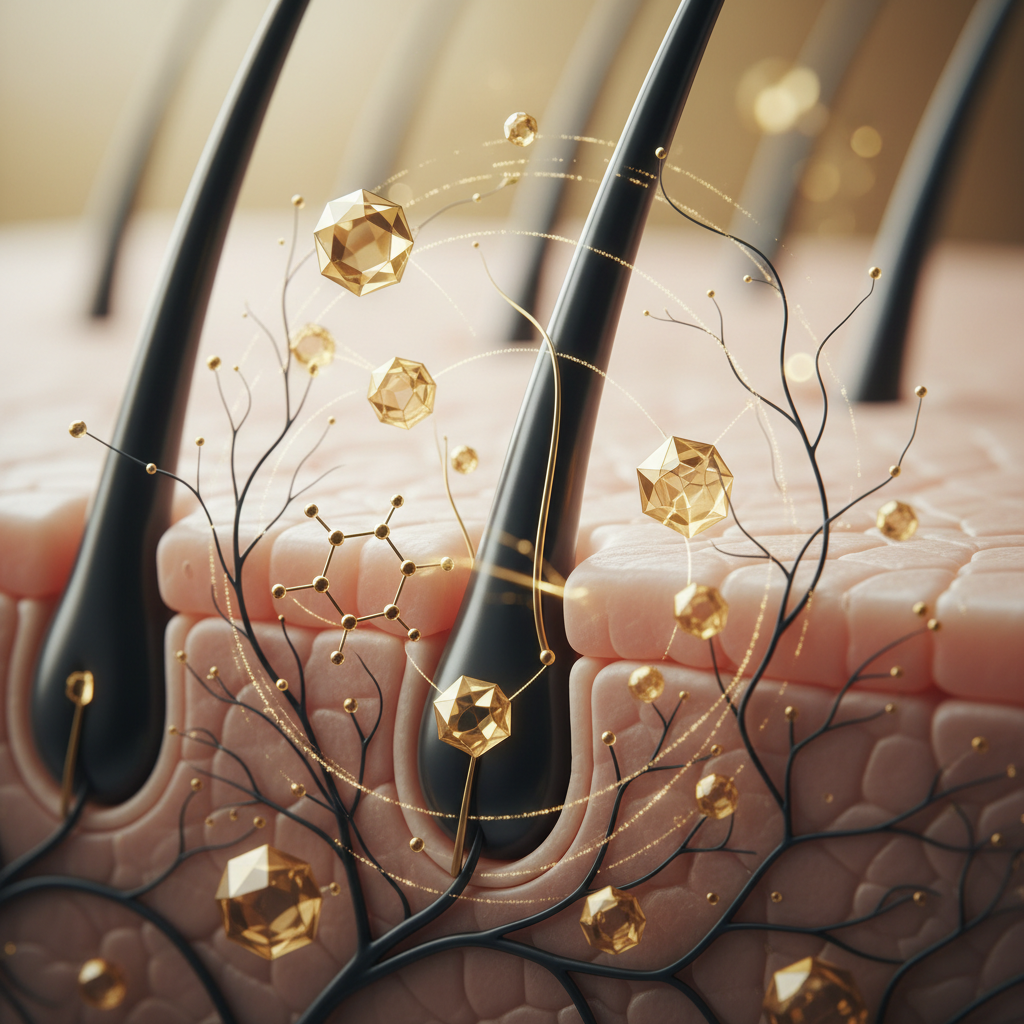
Topical caffeine works primarily by inhibiting the enzyme phosphodiesterase. By blocking this enzyme, caffeine increases the levels of cyclic adenosine monophosphate (cAMP) inside the follicular cells. Elevated cAMP promotes cell proliferation, stimulates cellular metabolism, and encourages follicular keratinocyte production.
Caffeine also promotes local microcirculation. Better blood flow around the dermal papilla ensures that essential nutrients, trace minerals, and oxygen reach the hair root during the active growth phase. Because caffeine is a small, amphiphilic molecule, it readily crosses biological barriers, allowing it to penetrate through the follicle sheath rapidly.
Signs of hair thinning versus temporary shedding
Recognising what type of hair loss you have dictates whether a caffeine wash will produce noticeable results.
Look for these distinct patterns:
- Androgenetic alopecia (pattern thinning): Gradual widening of the central parting in women, or recession at the temples and crown in men. The total shed count may look normal, but the new hairs growing back are visibly finer.
- Telogen effluvium: Sudden, diffuse shedding across the entire scalp, often losing 150 to 300 hairs per day. This frequently occurs two to three months after a physiological shock, severe illness, crash diet, or high fever.
- Traction alopecia: Thinning concentrated along the hairline or behind the ears, caused by tight ponytails, braids, or extensions physically pulling the root out of the dermis.
- Mechanical breakage: Uneven lengths and frayed ends without a white bulb at the root.
Topical caffeine offers the greatest cosmetic value for general thinning, sluggish growth rates, and telogen shedding, where the follicle remains viable and open to metabolic stimulation.
Maximising the benefits of a caffeine wash
Getting the most out of a caffeine-infused shampoo requires proper technique. Simply splashing it across your crown and rinsing immediately will not give the active compounds enough time to reach the follicle reservoir.
- Leave it on the scalp for at least two minutes: Research shows that follicular penetration begins within two minutes. Lather thoroughly and let the suds sit on your scalp while you wash the rest of your body.
- Focus on the scalp, not the ends: Shampoo is designed for the skin of your scalp. Massage with the pads of your fingers, using gentle circular motions to loosen sebum and stimulate blood circulation.
- Wash consistently: Because caffeine clearance occurs over 24 to 48 hours, using your caffeine wash four to five times weekly ensures a continuous supply of active compounds in the hair follicles.
- Follow with follicle-friendly conditioning: Apply conditioner primarily to mid-lengths and ends to avoid weighing down roots, ensuring hair fibres remain moisturised against breakage.
When the cause requires medical advice
While caffeine shampoo serves as an accessible first step for hair maintenance, certain presentations require immediate evaluation by a trichologist, dermatologist, or GP.
Consult a medical professional if you observe:
- Sudden, patchy bald spots that are round, smooth, and completely bare (classic indicators of alopecia areata, an autoimmune condition).
- Persistent scalp burning, severe scaling, pain, redness, or pustules, which can point to scarring alopecias like lichen planopilaris or scalp infections.
- Extreme hair fall accompanied by unintended weight loss, chronic fatigue, cold intolerance, or irregular menstrual cycles, which often signals thyroid disorders, ferritin deficiency, or polycystic ovary syndrome (PCOS).
Cosmetic products cannot resolve underlying endocrine failures or autoimmune responses. Diagnostic blood tests, including full blood count, serum ferritin, vitamin D, and thyroid panels, are vital when sudden shedding strikes.
Watermans: focused scalp and follicle support
For individuals seeking a reliable daily routine, Watermans developed the Grow Me Shampoo. Formulated in the UK, it blends premium caffeine with biotin, rosemary extract, niacinamide, argan oil, and lupin protein. This targeted combination provides a comprehensive scalp cleanse, clearing sebum build-up while flooding the follicular infundibulum with essential botanical stimulants.
Because Watermans formulations prioritise scalp balance without using harsh sulphates, they foster an ideal micro-environment for natural growth. Paired with the Watermans Condition Me conditioner, this system targets hair health from two fronts: invigorating the scalp at the root while strengthening the hair shaft against the daily mechanical breakage that robs hair of density.
Making Caffeine Shampoo for Hair Loss part of your routine
Adopting a Caffeine Shampoo for Hair Loss gives your daily routine a practical, science-backed tool to energise thinning hair. Laboratory and early clinical evidence confirm that caffeine easily reaches hair follicles, counteracts DHT-driven growth inhibition, and supports cellular energy.
However, managing hair density requires patience. Follicles operate on biological schedules that cannot be rushed in a few days. Commit to using your caffeine shampoo consistently for at least three to six months, combine it with a balanced diet rich in iron and protein, and consult a doctor if your hair shedding appears sudden or patchy.
Frequently asked questions about Caffeine Shampoo for Hair Loss
Does Caffeine Shampoo for Hair Loss really work?
Yes, within realistic cosmetic expectations. Clinical research shows topical caffeine penetrates follicles within two minutes, stimulating metabolic activity and counteracting testosterone-induced growth suppression. While a Caffeine Shampoo for Hair Loss will not cure genetic baldness, it consistently helps reduce excessive shedding and improves overall hair density over three to six months of regular use.
How long should I leave caffeine shampoo on my scalp?
You should leave caffeine shampoo on your scalp for at least two minutes before rinsing. Studies measuring follicular absorption demonstrate that caffeine requires approximately 120 seconds of direct cutaneous contact to travel down the hair shaft and absorb into the follicular infundibulum. Leaving it on for up to five minutes is acceptable if your scalp is not sensitive.
Can drinking coffee give the same hair benefits as caffeine shampoo?
No, drinking coffee does not produce the same follicular effects. To deliver an effective concentration of caffeine to your hair roots via your bloodstream, you would need to drink roughly 50 to 60 cups of coffee daily. Such high systemic doses are dangerous to the human heart and nervous system. Topical application delivers the compound directly to the follicle without systemic toxicity.
Can women use caffeine shampoo safely?
Yes, women can safely use caffeine shampoo. Although laboratory studies often evaluate caffeine against testosterone suppression, the underlying mechanism, boosting cellular energy (cAMP) and improving microcirculation, benefits both male and female follicles. It is particularly popular among women experiencing telogen effluvium, post-partum shedding, or menopausal thinning.
Does caffeine shampoo cause hair shedding when you first start?
A mild, temporary increase in shedding can occur during the first few weeks of using an energising shampoo. By stimulating follicular metabolism, caffeine may encourage telogen (resting) hairs that were already detached to drop out slightly earlier, clearing the way for new anagen (growth) fibres. If severe shedding continues past six weeks, speak with a doctor.
Sources and references
- Fischer, T. W., Hipler, U. C., & Elsner, P. (2007). Effect of caffeine and testosterone on the proliferation of human hair follicles in vitro. International Journal of Dermatology, 46(1), 27-35.
- Dhurat, R., Chitallia, J., May, T. W., Jayaraaman, A. M., Rufaut, N., Neufang, G., & Sharma, A. (2017). An open-label randomized multicenter study assessing the noninferiority of a caffeine-based topical liquid 0.2% versus minoxidil 5% solution in male androgenetic alopecia. Skin Pharmacology and Physiology, 30(6), 298-305.
- Otberg, N., Teichmann, A., Rasuljev, U., Sinkgraven, R., Sterry, W., & Lademann, J. (2007). Follicular penetration of topically applied caffeine via a shampoo formulation. Skin Pharmacology and Physiology, 20(4), 195-198.
- British Association of Dermatologists. (2020). Telogen Effluvium: Clinical Guidelines and Management.
- National Institute for Health and Care Excellence (NICE). (2022). Alopecia androgenetica: Clinical Knowledge Summary.
Find these ingredients in Watermans products
- Vitamin D: you will find this ingredient in our Hair Vitamins.
- Niacinamide: you will find this ingredient in our Hair Mask.